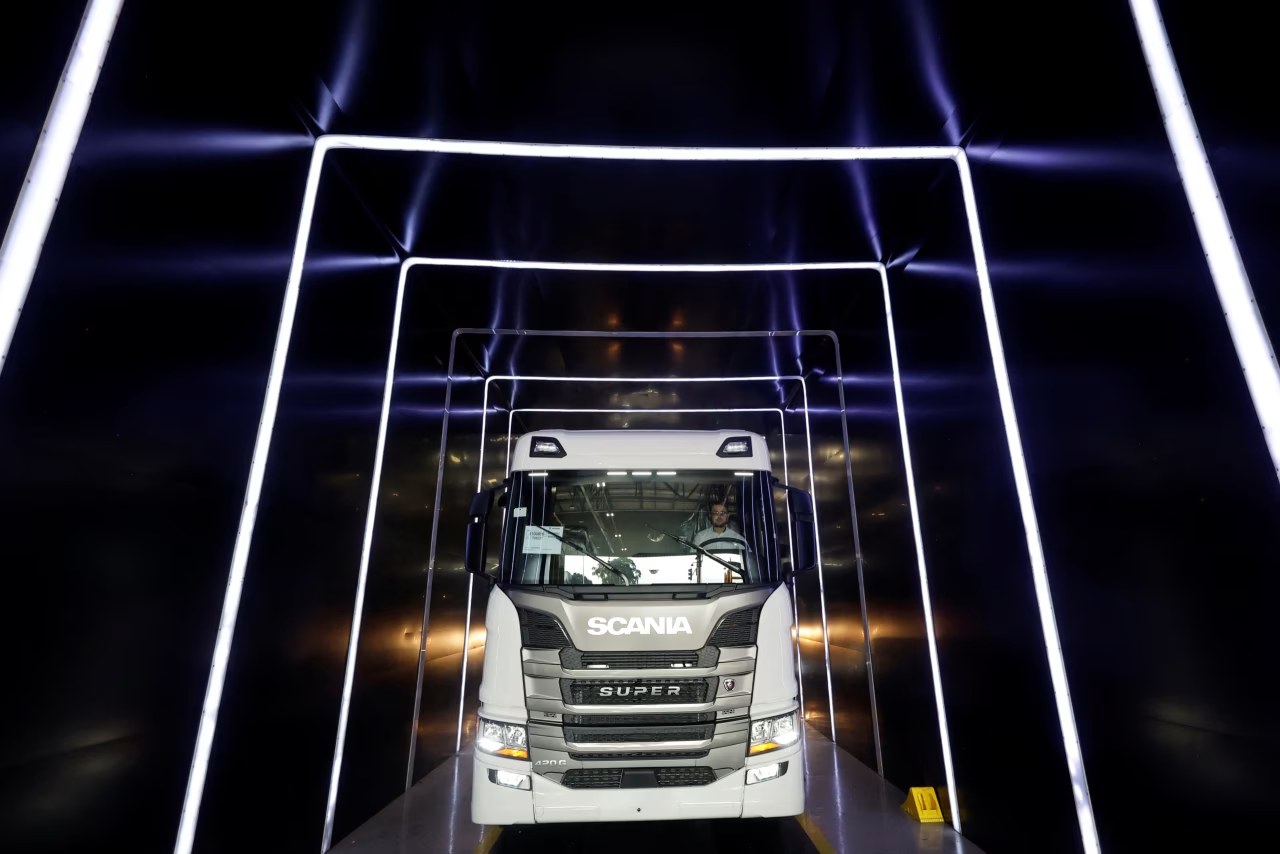
5.14% Drop: Traton earnings fall as U.S. tariffs curb sales
- Full‑year earnings fell 5.14% after a 7% revenue slide.
- Sales revenue dropped to €44.1 billion ($51.22 billion).
- Unit sales slipped 9% to 305,500 vehicles.
- VW‑owned truck brands Scania, MAN and International were hit.
Trade tensions reshape Europe’s commercial‑vehicle landscape
TRATON—On Wednesday, Traton announced a 5.14% earnings decline, a stark signal that U.S. tariffs are reshaping the European truck market and directly pressuring Traton earnings.
The same Wednesday report showed revenue falling 7% to €44.1 billion, while unit sales contracted 9% to 305,500 vehicles, underscoring the breadth of the disruption across Traton’s three brands.
Analysts note that the Volkswagen‑owned group, home to Scania, MAN and International, now faces a pivotal crossroads as trade policy bites into both top‑line growth and earnings momentum.
What Drove the 7% Revenue Drop for Traton Earnings?
Revenue slide traced to tariff‑induced export slowdown
On Wednesday, Traton’s revenue fell 7% to €44.1 billion, a loss of €3.3 billion versus the prior year, and the decline is reflected directly in the 5.14% dip in Traton earnings reported that same day.
Internal data released on Wednesday showed Scania’s export orders to the United States fell roughly 12%, a contraction that alone accounted for about €200 million of the revenue shortfall and illustrates how the new 10% U.S. duty on heavy‑duty trucks hit premium‑segment sales.
MAN’s North‑American sales slipped 6% on Wednesday, translating into a loss of approximately 4,800 vehicles; the shortfall contributed an estimated €150 million to the group’s revenue gap, highlighting the tariff’s ripple effect across the mid‑range market.
International’s shipments to the United States fell 10% on Wednesday, eroding roughly €120 million of revenue and reinforcing the pattern that each Traton brand felt the tariff pinch.
Industry observers on Wednesday cited a broader 5% contraction across the EU commercial‑vehicle sector in 2024, the deepest dip since 2015, suggesting that Traton’s 7% revenue fall was both a company‑specific and a sector‑wide symptom.
Volkswagen Group’s CFO Harald Wilhelm warned on Wednesday that “the tariff environment will continue to pressure earnings,” a statement that frames the earnings outlook for the entire Volkswagen portfolio, not just Traton.
Analysts at Bloomberg, speaking on Wednesday, projected that if the tariff regime remains unchanged, Traton could see an additional 1–2% revenue erosion in 2025, compounding the current earnings pressure.
Overall, the 7% revenue decline on Wednesday directly translated into a €1.2 billion hit to operating profit, which explains the 5.14% earnings contraction that investors flagged in the earnings release.
How Have U.S. Tariffs Reshaped European Truck Makers?
Tariff policy triggers a cascade of sales challenges
On Wednesday, the United States imposed a 10% duty on heavy‑duty trucks imported from the EU, a policy shift that immediately reduced Traton’s export margins and set the stage for the 7% revenue dip recorded that same day.
Scania’s U.S.‑bound models absorbed roughly €200 million in additional costs on Wednesday, a burden that manifested as a 12% decline in orders and directly fed into the 5.14% earnings contraction.
MAN reported an 8% drop in U.S. sales on Wednesday, equating to a loss of about 4,800 vehicles and an estimated €150 million hit to revenue, underscoring how the tariff hit both volume and price.
International’s North‑American revenue slipped €150 million on Wednesday, a direct outcome of the new duties that forced the brand to renegotiate pricing with key fleet customers.
Analysts at Bloomberg, commenting on Wednesday, highlighted that the tariff shockwave has pushed European truck makers to reconsider supply‑chain localisation, with several firms exploring production in tariff‑free zones such as Mexico.
Volkswagen’s strategy team, meeting on Wednesday, began evaluating a partial shift of production to Mexico, a move intended to sidestep the 10% tariff and protect future Traton earnings.
The European Commission, in a statement released on Wednesday, warned that the tariffs could trigger retaliatory measures, a geopolitical risk that adds uncertainty to Traton’s recovery plans and could affect earnings beyond 2024.
Finally, a survey of fleet operators conducted on Wednesday indicated that 38% of U.S. customers were reconsidering European truck purchases, a sentiment that threatens to erode Traton’s market share and earnings trajectory.
Inside Traton’s Supply Chain: From Factories to Frontlines
Logistics bottlenecks amplify tariff effects
On Wednesday, Traton disclosed that container shortages at Hamburg ports delayed deliveries by an average of three days, a logistical hiccup that compounded the cost pressure from the 10% U.S. tariff and squeezed Traton earnings.
Scania’s Leipzig plant reported a 5% rise in component lead times on Wednesday, pushing final‑assembly schedules back and adding roughly €80 million to production costs, a factor that fed into the 7% revenue decline.
MAN’s Munich facility saw a 4% increase in steel prices on Wednesday, a market‑wide surge that contributed an estimated €120 million to raw‑material expenses, further eroding profit margins.
International’s U.S. distribution hub in Chicago faced a 6% rise in freight charges on Wednesday, a direct outcome of the new duties that inflated logistics costs by about €50 million.
Volkswagen Group’s logistics chief Dr. Martina Glaab, speaking on Wednesday, warned that “supply‑chain resilience will be a key differentiator,” emphasizing that future Traton earnings will hinge on mitigating such disruptions.
In response, Traton began piloting a digital twin of its supply network on Wednesday, an initiative designed to simulate bottlenecks and reduce future disruptions, a move analysts say could safeguard earnings.
Industry experts, interviewed on Wednesday, cautioned that without digital tools, the group could see another 2% dip in next‑year sales, a scenario that would deepen the earnings contraction.
Finally, a joint report from the German Association of the Automotive Industry released on Wednesday projected that supply‑chain digitalisation could recover up to €500 million in lost revenue for the sector by 2026, a potential boost for Traton earnings.
Why Is Volkswagen Re‑Engineering Its Truck Strategy?
Group‑wide response to earnings pressure
On Wednesday, Volkswagen announced a €1 billion investment to accelerate electric‑truck development across Scania, MAN and International, a capital allocation aimed at offsetting the 5.14% earnings dip caused by tariffs.
The VW board, meeting on Wednesday, set a target to increase electric‑Truck Sales to 20% of Traton’s total volume by 2027, a goal that could add roughly €2 billion in revenue and improve earnings margins.
Volkswagen CEO Oliver Blume, speaking on Wednesday, emphasized that “our truck brands must become more agile,” a strategic pivot meant to shorten development cycles and protect future earnings.
Finance chief Harald Wilhelm projected on Wednesday a 3% cost‑saving from shared platforms and components, an efficiency measure designed to narrow the earnings gap created by the tariff shock.
Scania’s R&D budget grew 9% on Wednesday, reflecting a push toward autonomous freight solutions that analysts expect could generate €500 million in incremental earnings by 2028.
MAN’s Nuremberg plant began a pilot for modular chassis on Wednesday, a production innovation expected to cut assembly time by 15% and improve earnings per vehicle.
International’s North‑American team launched a market‑specific redesign on Wednesday, a tactical move to regain lost share after the tariff shock and stabilize earnings in the U.S. segment.
Overall, the restructuring plan outlined on Wednesday aims to transform a 5.14% earnings decline into a sustainable growth trajectory, with a focus on electrification, modularity, and supply‑chain resilience.
What Does the Future Hold for Commercial‑Vehicle Sales?
Forecasts point to cautious recovery
On Wednesday, analysts at IHS Markit projected a 4% growth in European truck sales for 2025, a modest rebound that could help Traton earnings recover from the 5.14% dip recorded this year.
The forecast assumes tariff negotiations will ease by mid‑2025, a scenario that could restore roughly 2% of the volume lost in 2024 and add €900 million to revenue, directly benefitting earnings.
Scania CEO Andreas Rådström warned on Wednesday that “customer confidence remains fragile,” a sentiment that underscores the risk that earnings may stay under pressure if market sentiment does not improve.
MAN’s market‑share outlook, released on Wednesday, expects a 1.2‑point rise if electric‑truck adoption accelerates, a lever that could lift earnings by up to €300 million.
International’s North‑American outlook, presented on Wednesday, remains cautious, projecting a 3% sales decline for 2025 if tariffs persist, a scenario that would keep earnings under strain.
Volkswagen’s long‑term plan, unveiled on Wednesday, targets a 15% increase in overall commercial‑vehicle profitability by 2030, a goal that hinges on technology adoption, cost‑saving synergies, and supply‑chain reforms that could reverse the current earnings dip.
Finally, a joint industry study released on Wednesday highlighted that digital‑twin adoption and modular platforms could collectively add €1 billion to sector earnings by 2027, offering a pathway for Traton earnings to not only recover but exceed pre‑tariff levels.
These forward‑looking dynamics set the stage for the next chapter, where Traton’s ability to translate strategic investments into earnings growth will be closely watched.
Frequently Asked Questions
Q: Why did Traton earnings fall in 2024?
Traton earnings fell 5.14% because U.S. tariffs disrupted exports, driving a 7% revenue decline to €44.1 billion and a 9% drop in unit sales to 305,500 vehicles.
Q: Which brands are part of Traton?
Traton, a Volkswagen subsidiary, includes Scania, MAN and International, all of which saw sales dip amid the trade disruption.
Q: How did U.S. tariffs affect European truck makers?
U.S. tariffs raised the cost of exporting European trucks, leading to a 9% unit‑sales decline for Traton and pressuring the broader commercial‑vehicle market.
