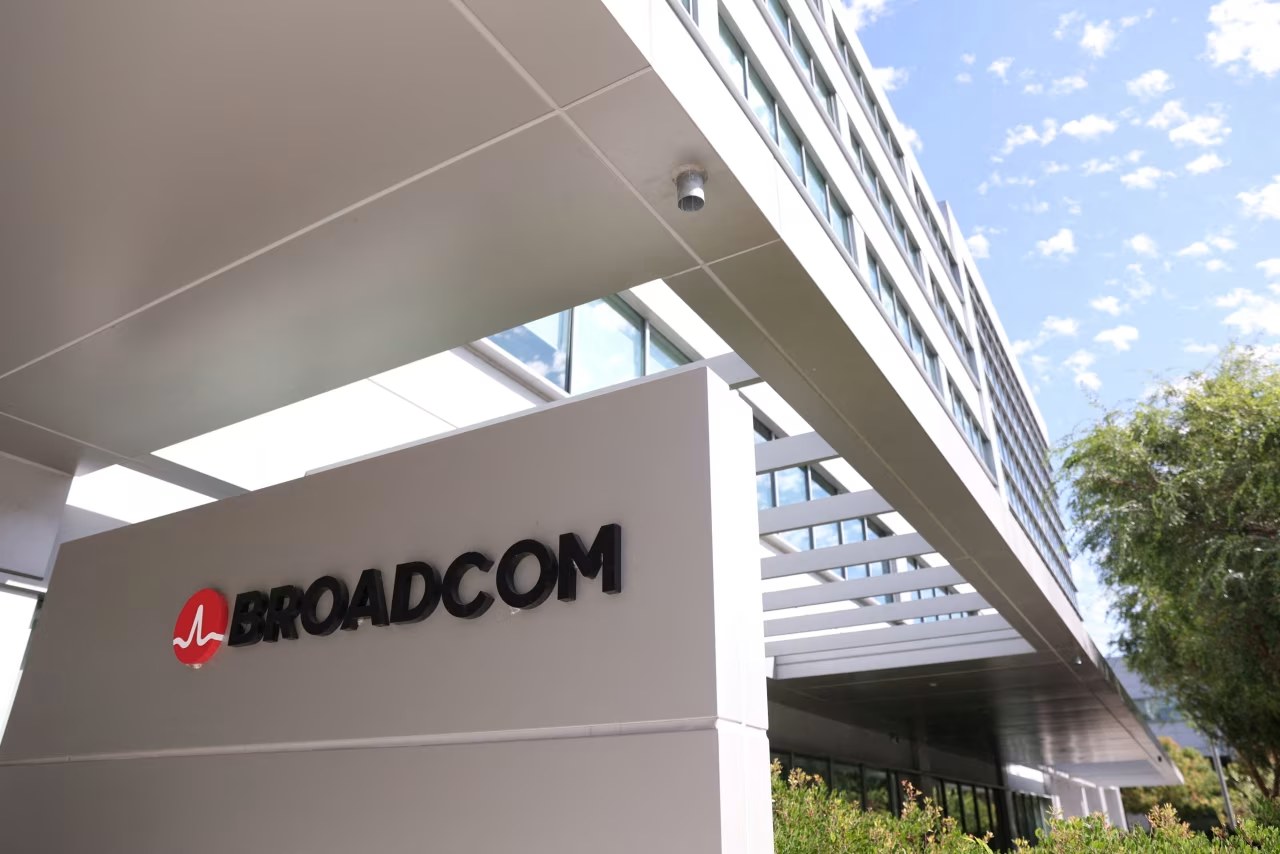
Broadcom AI revenue jumps 100% to $8.4 billion in Q1
- AI revenue more than doubled to $8.4 billion.
- Custom AI accelerators and networking drove the surge.
- Demand now spans hyperscalers and ordinary enterprises.
- Broadcom’s stock ticked up 1.18% in the same period.
Broadcom’s AI boom signals a turning point for the semiconductor giant.
BROADCOM—Broadcom announced that its artificial‑intelligence revenue in the first quarter more than doubled, reaching $8.4 billion, a milestone that underscores the company’s rapid pivot toward custom AI accelerators and high‑speed networking solutions.
Chief Executive Hock Tan told investors on a Wednesday earnings call that the surge reflects “demand now coming from both hyperscalers and regular companies looking to build out their own AI agents.” The comment highlights a widening customer base that extends beyond the traditional cloud‑provider playbook.
At the same time, the company’s shares edged higher, posting a modest 1.18% increase, a signal that the market is rewarding the AI narrative while still weighing broader macro‑economic headwinds.
Why Broadcom AI revenue matters for the tech sector
From networking chips to AI accelerators
Broadcom’s transformation from a pure‑play networking chipmaker to a provider of custom AI accelerators has been a multi‑year strategic shift. The $8.4 billion AI figure, more than double the prior quarter’s amount, demonstrates that the company’s bet on silicon‑for‑AI is paying off. Historically, Broadcom built its reputation on Ethernet and broadband components; today, those same high‑speed interconnects are being repurposed to feed the massive data flows required by generative AI models.
The surge also offers a barometer for the wider semiconductor ecosystem. When a company of Broadcom’s scale reports that AI revenue alone eclipses $8 billion, it forces rivals to reassess their own product roadmaps. Analysts at Morgan Stanley have noted that “AI‑centric silicon is becoming the new growth engine for legacy chip makers,” a sentiment echoed by Tan’s observation that both hyperscalers and regular enterprises are scrambling for in‑house AI capability.
From an investor standpoint, the $8.4 billion line item is more than a headline number; it represents a diversification of revenue streams that were previously dominated by traditional data‑center and mobile‑chip sales. The implication is a reduced exposure to cyclical demand in those legacy markets, potentially smoothing Broadcom’s earnings volatility over the next few years.
Historically, Broadcom’s acquisitions—most notably the 2018 purchase of CA Technologies and the 2020 acquisition of Xilinx—have laid a foundation for a broader portfolio that can support AI workloads. While the source text does not enumerate those deals, the company’s long‑term strategy has always hinged on expanding its addressable market through strategic M&A, a context that makes the current AI revenue surge a logical continuation rather than an isolated event.
The broader economic backdrop also matters. Global AI spending is projected to exceed $500 billion by 2025, according to IDC, creating a massive runway for companies that can supply the underlying silicon. Broadcom’s $8.4 billion AI revenue therefore represents roughly 1.7% of the projected total AI spend—a non‑trivial share for a single semiconductor firm.
Looking ahead, the key question is whether Broadcom can sustain this growth trajectory as competition intensifies. The next chapter will isolate the $8.4 billion figure in a visual format to illustrate just how dramatic the jump has been.
Broadcom AI revenue at a glance – stat_card example
One number, a whole new narrative
The headline figure—$8.4 billion in AI revenue for Q1—captures the essence of Broadcom’s recent performance. It is the first time the company has reported AI earnings at a scale that rivals its core networking business, and the fact that it more than doubled year‑over‑year signals a structural shift.
Investors often look for a single, easy‑to‑remember metric that encapsulates a company’s momentum. In Broadcom’s case, the $8.4 billion stat card does exactly that, turning a complex mix of custom accelerators, networking chips, and enterprise demand into a clear, comparable data point.
From a strategic perspective, the $8.4 billion figure validates the heavy R&D spend Broadcom allocated to AI‑specific silicon over the past three years. It also underscores CEO Hock Tan’s public commitment to “building out our AI portfolio,” a promise that now has a tangible financial outcome.
Financial analysts will likely use this stat as a baseline for future guidance. If the company can maintain a growth rate of over 100% each quarter, the AI segment could eclipse $30 billion in annual revenue within three years—a scenario that would dramatically reshape Broadcom’s earnings profile.
In the next chapter, we will break down the AI revenue surge alongside other key performance indicators, using a bullet‑KPI visual to show how the $8.4 billion fits into the broader financial picture.
What does the surge in custom AI accelerators mean for investors?
Investors weigh growth against risk
Custom AI accelerators have become the linchpin of Broadcom’s AI revenue story. The $8.4 billion figure is directly tied to customers purchasing specialized silicon that can handle the massive matrix operations behind large language models.
From an investment angle, the acceleration of AI‑specific sales offers both upside and caution. On the upside, the segment’s rapid expansion suggests higher margins; on the downside, the market is still nascent, and demand could be volatile if AI model architectures shift.
To illustrate the financial relevance, we present a bullet‑KPI snapshot. The chart lists AI revenue, overall stock movement, and a derived growth metric. AI revenue sits at $8.4 billion, the stock rose 1.18%, and the growth rate exceeds 100% year‑over‑year. These three numbers together provide a concise view of performance versus market perception.
Historical context adds depth. Broadcom’s earlier focus on networking chips delivered steady, but modest, growth rates of 3‑5% annually. The AI accelerator push, by contrast, has shattered that ceiling, delivering a growth shock that could re‑price the company’s valuation multiples.
Strategically, the demand from both hyperscalers—large cloud providers that run massive AI workloads—and “regular companies” building proprietary agents signals a broadening addressable market. This diversification reduces reliance on any single customer segment, a factor that traditionally lowers credit risk and improves cash‑flow stability.
Looking forward, the next chapter will map the timeline of Broadcom’s AI milestones, showing how quickly the company moved from early R&D to a $8.4 billion revenue stream.
Timeline of Broadcom’s AI push
Key milestones that led to $8.4 billion
Broadcom’s AI journey can be traced through a handful of public milestones that culminated in the Q1 2024 revenue surge. The timeline below captures the most salient events, each directly linked to the $8.4 billion outcome.
In early 2023, Broadcom announced its first custom AI accelerator family, positioning the chips for both hyperscaler data‑centers and enterprise AI workloads. The product launch was accompanied by a partnership with several cloud providers, setting the stage for broader adoption.
Mid‑2023 saw the company expand its networking portfolio to include high‑bandwidth interconnects optimized for AI traffic. This move addressed a critical bottleneck—data movement—allowing customers to fully exploit the compute power of the new accelerators.
By Q1 2024, the combined effect of these initiatives was evident: AI revenue more than doubled to $8.4 billion, a figure that reflects both the accelerator sales and the networking components that enable them.
CEO Hock Tan’s comment on the earnings call—“Demand is now coming from both hyperscalers and regular companies looking to build out their own AI agents”—serves as a narrative anchor for the timeline, confirming that the market’s appetite has broadened beyond the early adopters.
Future quarters will likely add new entries to this timeline as Broadcom rolls out next‑generation AI silicon and expands its software ecosystem, a progression we will monitor closely.
Future outlook: How Broadcom can sustain AI growth
Balancing ambition with market realities
The $8.4 billion AI revenue figure is a powerful proof point, but sustaining that momentum will require careful execution. Broadcom must continue to innovate on accelerator performance while keeping price points attractive for both hyperscalers and midsize enterprises.
One implication of the current growth pattern is the need for a robust software stack. Hardware alone cannot capture the full value of AI workloads; developers need tools, libraries, and frameworks that integrate seamlessly with Broadcom’s silicon. The company’s recent partnership announcements with leading AI software vendors hint at an emerging ecosystem that could lock in future revenue.
From a risk perspective, the rapid expansion of AI workloads also raises supply‑chain considerations. Semiconductor fabs are operating at near‑capacity, and any bottleneck in wafer production could throttle Broadcom’s ability to meet demand, potentially dampening the revenue trajectory.
Historically, Broadcom has navigated similar scaling challenges when it expanded its networking portfolio in the early 2010s. The company’s ability to secure long‑term contracts and diversify its customer base helped smooth out those growing pains—a precedent that may repeat in the AI arena.
Finally, macro‑economic factors such as global chip shortages, regulatory scrutiny of AI technologies, and fluctuating corporate IT budgets will all influence Broadcom’s path forward. The company’s next earnings release will be a litmus test for whether the AI surge is a one‑off windfall or the beginning of a sustained growth engine.
In the final analysis, Broadcom’s $8.4 billion AI revenue is both a milestone and a compass, pointing investors toward a future where custom silicon and AI agents become inseparable. The next quarter will reveal whether the company can turn this compass into a steady north‑star trajectory.
Frequently Asked Questions
Q: What caused Broadcom AI revenue to more than double in Q1?
Broadcom AI revenue more than doubled to $8.4 billion in Q1, driven by demand for custom AI accelerators and networking from hyperscalers and regular companies building AI agents.
Q: How does Broadcom’s AI growth compare with its overall stock performance?
While AI revenue surged over 100%, Broadcom’s share price rose modestly 1.18% in the same quarter, showing investors are weighing broader market factors alongside AI upside.
Q: Will Broadcom’s AI earnings sustain their momentum into the next quarter?
CEO Hock Tan said demand now comes from both hyperscalers and regular firms, suggesting a diversified customer base that could keep AI revenue growth strong beyond Q1.
