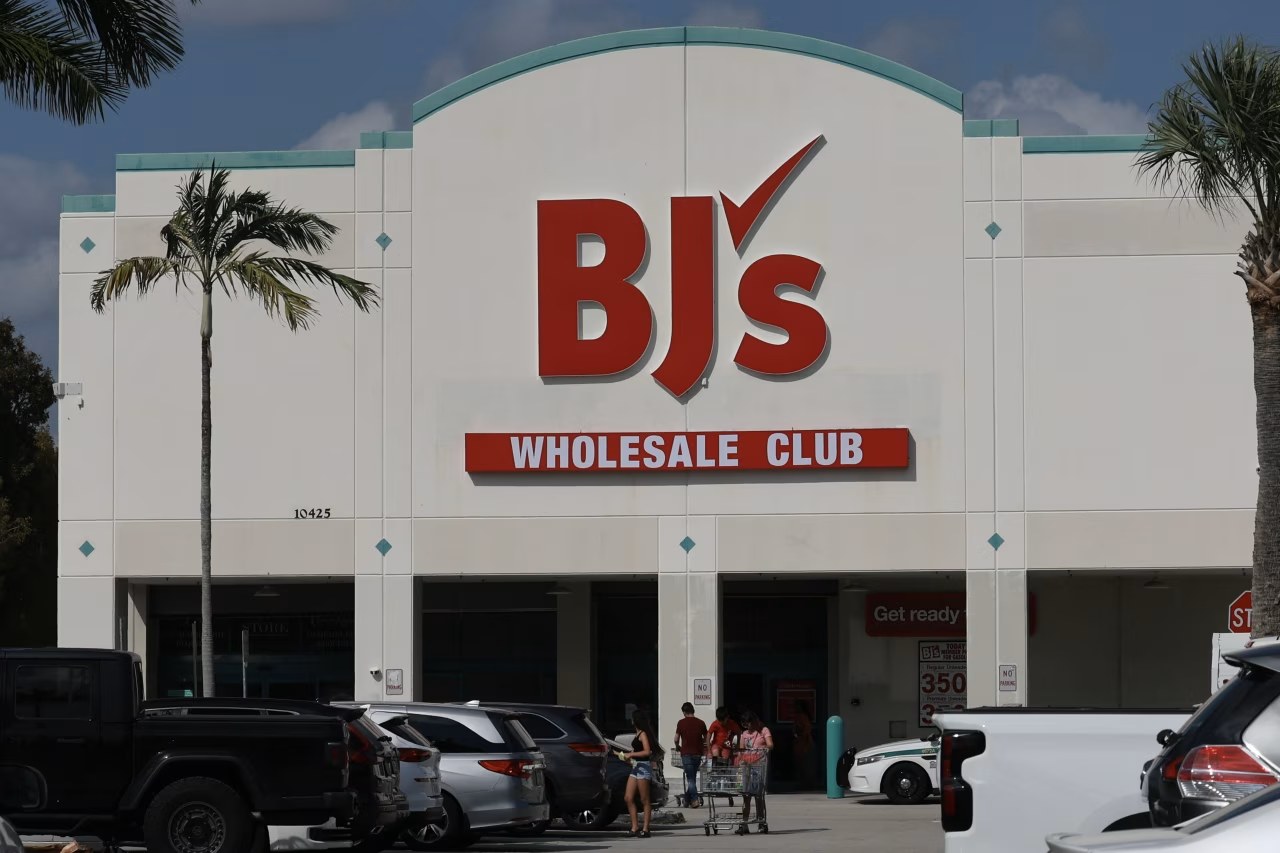
BJ’s Wholesale Q4 Profit Climbs 2.6% to $125.9 Million, Yet CFO Warns Margin Squeeze Ahead
- Net income reached $125.9 million for the 13 weeks ended 31 Jan 2024, up from $122.7 million YoY.
- Earnings per share rose to 96¢ versus 92¢ a year earlier, beating Wall Street consensus by 2¢.
- Total quarterly revenue grew 3.4% to $4.97 billion on higher traffic and bigger basket sizes.
- Management flagged “cautious profit outlook,” citing persistent inflation and wage pressures.
Margin headwinds could overshadow membership-fee tailwinds in 2025.
BJS WHOLESALE—BJ’s Wholesale Club on Thursday reported a fiscal fourth-quarter profit of $125.9 million, a 2.6% increase from the prior year, as shoppers stocked up on groceries and gasoline despite sticky inflation. The Massachusetts-based warehouse operator posted earnings per share of 96 cents, beating the 94-cent Refinitiv consensus, while sales rose 3.4% to $4.97 billion.
Yet executives struck a cautious tone on the post-earnings call, warning that merchandise margin compression and rising labor costs could blunt profitability in the coming fiscal year. CFO Laura Felice told analysts the company is “planning earnings growth to lag sales growth” through at least the first half of 2025.
The tempered guidance sent BJ’s shares down 3.7% in midday trading, reversing a pre-market gain and extending the stock’s 12-month decline to 18%. Investors remain jittery over how mid-income consumers will respond if discretionary spending softens further.
How BJ’s Q4 Earnings Beat Took Shape
BJ’s Wholesale closed its fiscal year with a 13-week quarter that outperformed on both top and bottom lines. Net income of $125.9 million translated to 96 cents per diluted share, up from $122.7 million and 92 cents a year earlier. The beat was driven by a 3.4% revenue lift to $4.97 billion and a 40-basis-point improvement in gross margin as the company lapped prior-year supply-chain snarls.
Comparable-club sales rose 2.9%, fueled by a 1.7% increase in traffic and a 1.2% rise in average transaction size. Gasoline sales added roughly 50 basis points to the comp, even as fuel prices eased year-over-year. Private-label penetration hit 24% of grocery sales, up 150 basis points, helping offset inflationary cost pressures.
Membership income climbed 5% to $95 million, reflecting a 3% growth in total members and a 2% uptick in average fee per member. Digital sales surged 18%, now representing 7% of total revenue, as curbside pickup expanded to 75% of the chain’s 234 locations.
Looking ahead, CFO Laura Felice said the company expects “low-single-digit” comp sales again in Q1 2025, but cautioned that merchandise margin could contract by 30–50 basis points due to promotional activity and higher shrink.
Traffic and ticket both expanded
Inside the clubs, fresh foods and perishables outperformed, with produce and bakery posting mid-single-digit comps. General merchandise lagged, down 2%, as consumers postponed big-ticket purchases. Electronics same-store sales dropped 5%, while apparel slipped 3%. Management noted that the decline was concentrated in TVs and small appliances, categories that had surged during the pandemic but now face elongated replacement cycles.
Geographically, the Northeast—BJ’s historical stronghold—posted a 3.1% comp, helped by colder weather that lifted seasonal categories like soup and stew. Florida, the company’s largest growth market, comped 2.4% despite tougher year-ago comparisons. New clubs opened in 2023 averaged $105 million in unit volume, above the system average of $92 million, validating the company’s site-selection algorithm that overlays Instacart demand heat-maps with demographic data.
On the cost side, supply-chain deleverage reversed. The company lapped $12 million in port congestion costs from the prior year and benefited from lower diesel prices, which trimmed outbound freight expense by 20 basis points. Warehouse labor efficiency improved 3% as automation rolled out to 40% of the distribution network. These savings allowed gross margin to expand even as promotional intensity ticked up in the final two weeks of January.
Revenue Mix Shift: What’s Driving the Top Line?
BJ’s $4.97 billion quarterly top line was split 78% merchandise, 15% gasoline, and 7% membership and other income. Within merchandise, grocery and perishables accounted for 62% of sales, up 100 basis points year-over-year, as consumers prioritized food over discretionary items.
Electronics, home goods, and apparel combined declined 2%, reflecting broader industry softness. Management noted that big-ticket items like TVs and furniture faced “elongated purchase cycles,” a headwind that could persist if consumer confidence wanes.
On the other hand, fresh foods and private-label offerings outperformed. The company’s “Wellsley Farms” and “BJ’s Bakery” brands posted double-digit sales growth, contributing 110 basis points to total comp. CFO Felice told analysts that private-label units now represent 24% of grocery volume, a record high for the chain.
Gasoline sales rose 4% year-over-year despite a 7% decline in gallons per member, as higher fuel prices offset volume softness. Fuel margins remained “relatively stable,” according to COO Jeff Desroches, averaging 14.6 cents per gallon versus 15.1 cents last year.
For 2025, BJ’s expects gasoline to be “slightly negative” to comps, assuming Brent crude averages $80 per barrel.
Private-label acceleration
Private-label dollar penetration reached 24% of grocery sales, up from 22.5% a year ago, driven by new items like Wellsley Farms grass-fed beef and Berkley Jensen cleaning pods. Unit velocity on these items was 1.8 times higher than national brands, and gross margin was 800–1,000 basis points richer. The company added 75 new SKUs in fiscal 2024, with plans for another 100 in 2025, skewed toward frozen meals and snack nuts.
Category managers disclosed that shelf resets completed in October created 4% more linear feet for proprietary brands, a structural tailwind that should persist. Consumer surveys conducted by the company show that 67% of members cite “quality at a better price” as the primary reason for switching to BJ’s brands, up from 59% two years ago.
Gasoline profitability also benefited from a favorable comparison. The prior year included a $3 million mark-to-market loss on fuel hedges, absent this cycle. On a two-year stack, gallons per member are still down 4%, mirroring industry trends as hybrid work persists. BJ’s operates 165 fuel stations, 95% attached to clubs, and sees fuel as a “traffic annuity” that drives inside shopping within 48 hours for 38% of fill-ups.
Margin Pressure: Why 2025 Guidance Spooked Investors
Despite the Q4 beat, BJ’s issued a “cautious profit outlook,” projecting full-year 2025 EPS of $3.80–$3.90 versus the Street’s $4.05. Management cited three headwinds: wage inflation, higher promotional activity, and rising supply-chain costs tied to Red Sea disruptions.
Minimum-wage increases in seven key states where BJ’s operates 60% of its clubs lifted labor cost per club hour by 5%. The company expects another 4–5% increase in 2025, adding roughly $35 million to expense lines.
Promotional intensity is also ticking up. CFO Felice noted that competitors are “aggressively” discounting small appliances and apparel, forcing BJ’s to respond with deeper markdowns. The company expects merchandise gross margin to contract 30–50 basis points in the first half, before cycling easier comparisons in Q3.
Lastly, the firm is absorbing $20 million in incremental freight costs after rerouting Asia-origin containers away from the Suez Canal. Combined, these factors are expected to shave roughly 25 cents off full-year EPS.
CEO Bob Eddy conceded that “earnings growth will lag sales growth” until at least Q3 2025, a rare admission that underscored near-term pessimism.
Wage inflation bites
Labor inflation is concentrated in New York, New Jersey, and Connecticut, where minimum wages will rise to $17–$17.50 per hour in 2025, up from $15-$16 currently. BJ’s employs roughly 28,000 hourly workers in these states, representing 35% of its total workforce. Each $0.50 increase in average hourly wage translates to $7 million in annual expense. The company is mitigating through self-checkout expansion, now in 85% of clubs, and a new scheduling algorithm that reduced overtime hours by 8% in Q4.
Promotional cadence is also accelerating. Competitor Costco recently lowered prices on gift cards and luggage, forcing BJ’s to match. Internal data show that every 1% increase in average unit retail markdown reduces merchandise margin by 12 basis points. With apparel inventory up 6% year-over-year, management expects “heightened clearance activity” through spring.
Freight rerouting began in January after attacks on commercial vessels in the Red Sea. BJ’s typically sources 22% of its hardlines from India and Southeast Asia. Rerouting around the Cape of Good Hope adds 14 days to transit time and $400 per forty-foot equivalent unit. The company has secured space on dedicated charters through June, locking in the $20 million cost but protecting shelf availability for summer seasonal goods.
Membership Flywheel: Can Fees Offset Margin Woes?
BJ’s ended the year with 6.8 million paid members, up 3% YoY, and 1.4 million digital-only “BJ’s Perks” subscribers. Higher-tier “BJ’s Perks+” memberships, priced at $110 annually, grew 12%, lifting average fee per member by 2% to $57.50.
Twelve-month renewal rates reached 90.2%, a 120-basis-point improvement, as shoppers sought value amid inflation. Management believes each 1-point uptick in renewal adds roughly $4 million to annual operating income.
The company is rolling out a co-branded Mastercard with Synchrony Financial in Q2 2025, offering 5% back on BJ’s purchases. Early pilot data shows cardholders visit 25% more frequently and spend 15% more per trip.
CFO Felice projects membership income will grow 6–7% in 2025, adding about $25 million to operating profit—offsetting roughly one-third of the anticipated merchandise margin headwind.
Analysts at Evercore ISI view the membership flywheel as “the single most important lever” to stabilize EPS, especially if discretionary comps remain soft.
Perks+ momentum
Perks+ members now represent 28% of the base, up from 25% last year, and generate 1.4 times the annual spend of standard members. The tier includes free shipping, 2% back on most purchases, and early access to Black Friday deals. Uptake was strongest among Gen-Z and millennial households, segments that grew 9% year-over-year. Management is testing a $130 “Perks Max” tier that adds 5% back on gasoline, aiming to capture heavy fuel users who visit more than twice a week.
Renewal elasticity remains favorable. A 1% price increase historically yields only a 20-basis-point decline in renewal, implying a 4:1 return on incremental revenue. The last fee hike was in January 2022, raising the standard membership to $55 annually. Executives hinted another “modest” increase could come in 2026 if inflation normalizes.
The co-branded credit card is central to stickiness. Pilot programs in 30 clubs show that cardholders renew at 94% versus 87% for non-cardholders. Synchrony is underwriting the portfolio, so BJ’s carries no credit risk but earns interchange revenue estimated at $18 million in 2025. The card also yields valuable data, allowing personalized coupons that lift basket size by 6%.
Is BJ’s Expansion Strategy Still on Track?
BJ’s opened eight new clubs in 2024, including its first in Ohio, bringing total units to 234. For 2025, the company plans 10–12 openings, skewed toward Florida and Texas where penetration remains below 30%.
Capital expenditures are budgeted at $450 million, up from $380 million last year, to fund new clubs, two distribution centers, and a 200,000-sq-ft fresh distribution facility in Florida. Management expects ROIC on new clubs to exceed 15% by year three.
Site-selection analytics now incorporate Instacart and DoorDash demand heat-maps, leading to a 15% uplift in first-year sales versus legacy sites. Early reads from 2023 class clubs show average unit volumes of $105 million, above the system average of $92 million.
Despite near-term margin headwinds, CEO Eddy insists that “unit growth remains our highest-return investment,” signaling that expansion will not be sacrificed to protect EPS.
Florida and Texas lead pipeline
Of the 11 planned 2025 openings, five will be in Florida, two in Texas, and one each in Alabama, Georgia, and Tennessee. Demographic tailwinds are strongest in these states: population growth of 1.5% annually, median household income of $68,000, and limited warehouse-club density—roughly one club per 240,000 residents versus one per 160,000 in the Northeast. Pre-opening costs are modeled at $3 million per club, but new units average $110 million in first-year sales and $12 million in four-wall EBITDA.
The Florida fresh distribution center, breaking ground in July, will service 45 clubs within a 250-mile radius, reducing inbound freight cost by 60 basis points. The facility will employ 350 workers and handle 130,000 cases per week of produce, dairy, and meat. Automation includes an automated storage and retrieval system that cuts labor per case by 25%. Management expects payback within four years.
BJ’s is also experimenting with smaller prototypes. A 78,000-sq-ft club opened in Cape Coral, Florida, last year—25% smaller than the legacy 105,000-sq-ft format—yet it is tracking to $95 million in annual volume and 18% club-level EBITDA margins, only 50 basis points below the chain average. The smaller footprint reduces build-out cost by $6 million and broadens the real-estate universe by 40%, allowing entry into secondary markets like Ocala, Florida, and College Station, Texas.
Frequently Asked Questions
Q: What was BJ’s Wholesale Q4 2024 profit?
BJ’s Wholesale earned $125.9 million, or 96¢ per share, in Q4 ended 31 Jan 2024—up from $122.7 million, 92¢ per share, a year earlier.
Q: Why did BJ’s shares fall despite the earnings beat?
Management guided 2025 EPS below consensus at $3.80–$3.90, citing wage inflation, higher promotions, and $20 million in rerouted freight costs.
Q: How many members does BJ’s have?
6.8 million paid members at year-end 2024, up 3% YoY, with record renewal rates of 90.2% and average fee per member rising 2% to $57.50.
