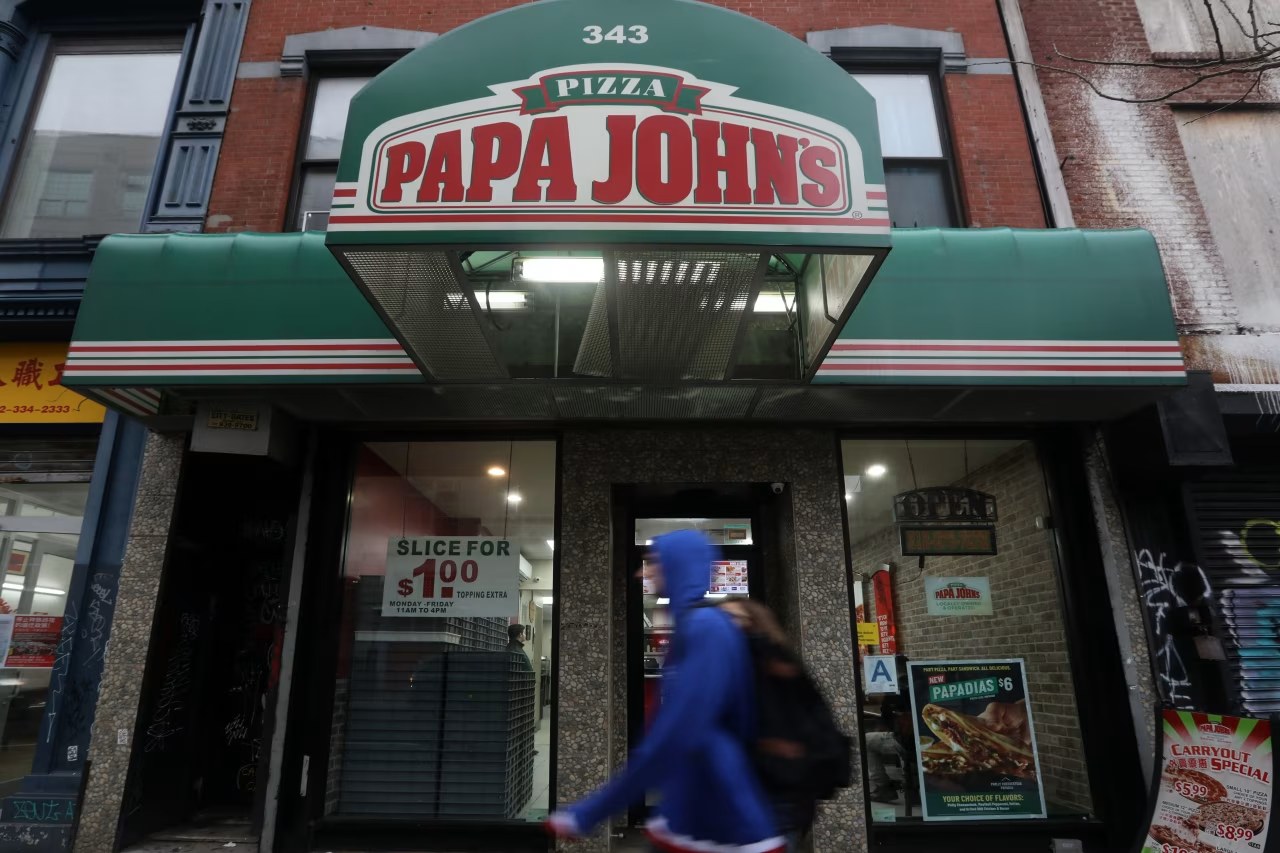
Papa John’s to Shutter 300 Stores by 2027 in $100M Turnaround Push
- Papa John’s will close 300 U.S. stores—about 6% of its domestic footprint—by 2027, with most shutdowns slated for 2025.
- The pizza chain is simultaneously slashing menu items and cutting corporate headcount to save an estimated $100 million annually.
- Franchisees, who own 98% of the chain’s 5,050 domestic restaurants, bear the brunt of the closures.
- Same-store sales have fallen for three straight years, intensifying pressure on operators already grappling with higher cheese and labor costs.
The fourth-largest U.S. pizza brand is betting fewer, more profitable kitchens will protect market share from Domino’s and fast-casual rivals.
PAPA JOHN’S—Louisville, Ky.—Papa John’s International told investors Tuesday it will shutter 300 underperforming U.S. restaurants and shrink its menu by up to 20% as the embattled pizza chain races to reverse a three-year slide in customer traffic and franchisee profitability.
The closures, disclosed during the company’s first-quarter earnings call, represent the largest single cull in the brand’s 40-year history and will unfold mainly in 2025, according to people briefed on the plan. Roughly 98% of the targeted units are franchise-owned, meaning individual operators—not the corporation—will absorb the real-estate write-offs and employee severance.
Chief executive Todd Penegor framed the retrenchment as a necessary reset after domestic same-store sales declined 2.1% last year and EBITDA margins compressed to 7.8%, the lowest level since 2017. “We are rightsizing the system to protect long-term brand health,” Penegor told analysts, adding that savings from smaller menus and leaner corporate payroll would top $100 million annually once fully implemented.
A Shrinking Empire: 300 Stores on the Chopping Block
Papa John’s ended 2024 with 5,050 restaurants in the United States, down from a peak of 5,400 in 2019. The planned closure of 300 additional units—roughly 6% of the domestic network—will bring the footprint to its smallest since 2015, according to company filings reviewed by The Wall Street Journal.
Executives told franchisees that selection criteria included five consecutive quarters of negative cash flow, average unit volumes below $700,000 and proximity to higher-performing sister stores that could absorb demand. The bulk of the targeted restaurants are located in small Midwestern and Southeastern markets where delivery radius economics no longer pencil out, one franchisee said on condition of anonymity because the discussions are confidential.
Franchise agreements give Papa John’s the right to deny renewal when a 10-year term expires, meaning operators whose leases end in 2025 or 2026 are most vulnerable. Industry consultants estimate the closures could eliminate 4,000 part-time driver and in-store jobs, though Papa John’s has not released an official head-count impact.
Implication: Fewer locations could boost per-unit sales, but also cede territory to Domino’s, which has added 312 U.S. stores since 2021.
Restaurant analyst Mark Kalinowski notes that Papa John’s domestic unit count has now contracted in four of the past five years, eroding the scale advantages that once underpinned national advertising clout. “Every closed store chips away at media efficiency,” Kalinowski said, pointing out that the chain’s ad fund contributions are tied to a percentage of gross sales spread across fewer outlets.
Menu Slim-Down: Ditching 20% of SKUs to Cut Complexity
Alongside store closures, Papa John’s will eliminate roughly one in five menu items by the end of 2025, executives confirmed. The axed products—mostly limited-time offers and niche desserts—account for less than 5% of total sales but require 30% of training resources, according to internal metrics.
Chief operating officer Amanda Furbee told franchisees that simplifying recipes could shave 12 seconds off average ticket times and reduce food-waste allowances by $2,400 per store annually. “Complexity kills execution,” Furbee said on the April call, citing a 2024 internal audit that found out-of-stock rates on specialty items exceeded 8% during peak hours.
The chain has already piloted a condensed menu in 400 restaurants across Tennessee and Kentucky, where store-level gross margins improved 180 basis points within two quarters. If scaled system-wide, Bernstein analyst Sara Senatore estimates the menu cull could add 15 cents to earnings per share by 2026.
Expert lens: Menu rationalization is a textbook turnaround lever, but risks alienating variety-seeking diners who have defected to fast-casual pizza concepts.
Technomic principal David Henkes notes that Blaze Pizza and MOD Pizza collectively added 95 new menu items last year, betting on customization while Papa John’s moves the other direction. “The pendulum is swinging toward simplicity, but you can’t cut so deep that you become irrelevant,” Henkes warned.
Corporate Belt-Tightening: 200 Headquarters Jobs at Risk
Papa John’s corporate workforce, which totaled 1,050 employees at year-end, will be trimmed by roughly 20%, according to people familiar with the plan. The reductions span marketing, supply-chain analytics and field operations, and will generate about $25 million in annualized savings, CFO Ravi Thanawala told analysts.
The company has already instituted a hiring freeze and eliminated non-essential travel. Executives are also vacating the Atlanta support office, consolidating remaining staff at the Louisville headquarters and smaller hubs in Texas and Colorado. Severance packages will average 12 weeks of pay plus outplacement services, one human-resources manager said.
Franchisees welcome the overhead reduction after years of shouldering higher royalty-adjacent fees. “We need corporate lean, not layered,” said David Ostenson, who owns 32 stores in Wisconsin. Still, some worry that deeper cuts could impede technology rollouts like AI-driven dispatch and next-gen ovens slated for late 2025.
Consequence: Streamlined overhead may boost EBITDA margins, but could slow innovation in a category where Domino’s spends $200M a year on technology.
Morningstar analyst Sean Dunlop cautions that aggressive cost cuts risk undermining service capabilities that differentiate Papa John’s from smaller rivals. “You can’t shrink your way to greatness,” Dunlop said, pointing to 2018 staff reductions that preceded customer-satisfaction declines.
Can Fewer Locations Reverse 3 Years of Sales Declines?
Papa John’s system-wide domestic same-store sales fell 2.1% in 2024, marking the third consecutive annual decline, according to regulatory filings. The trend contrasts sharply with Domino’s, which posted 3.9% growth last year, and Papa John’s own 2016–2019 streak of 12 straight quarters of positive comps.
Management blames the slump on inflation-weary consumers trading down to frozen pizza and aggressive discounting by Domino’s $7.99 mix-and-match deal. Internal surveys show Papa John’s average ticket of $22.40 is $1.85 higher than Domino’s, a gap that widened after the company reduced third-party delivery promotions.
The turnaround plan targets a 200-basis-point improvement in comparable sales by 2027, driven by fewer but better-located stores, streamlined menus and a renewed value platform. Early signs are mixed: comps edged up 0.4% in Q1 2025, the first quarterly gain since 2021, but traffic remained negative, implying growth came from higher prices.
Forward outlook: Wall Street projects flat 2025 comps; success hinges on franchisees’ willingness to reinvest remodel savings rather than bank them.
Consumer Edge data shows Papa John’s share of U.S. pizza delivery declined to 10.9% last year from 12.6% in 2020. “Closing stores can stabilize metrics, but regaining share requires product news and value,” said executive vice president Melissa Albright.
The Road Ahead: Can Papa John’s Out-Pizza Its Rivals?
Even after shuttering 300 stores, Papa John’s will remain the fourth-largest U.S. pizza chain by sales, trailing Domino’s, Pizza Hut and Little Caesars. The retrenchment buys time but does not address core menu perception gaps, according to a March 2025 survey by Datassential that ranked Papa John’s crust innovation seventh out of nine major chains.
Management’s next gambit involves a national advertising campaign tied to the NFL season, a tactic that historically spikes delivery orders 15–20%. The company also plans to roll out a crispy-thin crust and bring back the cult-favorite “Papa’s Perfect Pan” in select markets. Franchisees must commit $35,000 per store for new ovens to execute the platform, raising the stakes for cash-strapped operators.
Debt markets are watching. Papa John’s leverage ratio stands at 4.7× EBITDA—above the 3.5× covenant in its credit facility—meaning any misstep could trigger higher interest costs or restricted capex approvals. “They’re walking a tightrope,” said S&P analyst Robert Schulz, noting that Moody’s placed the company’s B1 rating on review for downgrade in April.
Bottom line: Fewer stores and simpler menus may steady the ship, but sustainable growth requires regaining customer relevance in a $46 billion U.S. pizza market that rewards speed, value and constant novelty.
If turnaround metrics hit guidance, analysts model 2026 earnings per share of $2.30, nearly double the $1.24 expected for 2025. Miss those targets, and the brand risks becoming a perennial number four—smaller, but not stronger.
Frequently Asked Questions
Q: How many Papa John’s stores are closing?
Papa John’s plans to close 300 U.S. stores by the end of 2027, with the majority shutting their doors in 2025. The closures represent roughly 6% of the chain’s 5,050 domestic restaurants.
Q: Why is Papa John’s closing restaurants?
The closures are part of a broader turnaround plan aimed at boosting profitability after three consecutive years of same-store sales declines and rising franchisee bankruptcies.
Q: Will franchisees be compensated for closures?
Papa John’s has not disclosed financial terms, but franchise agreements typically allow the company to decline renewal at no cost, leaving owners to absorb losses.
