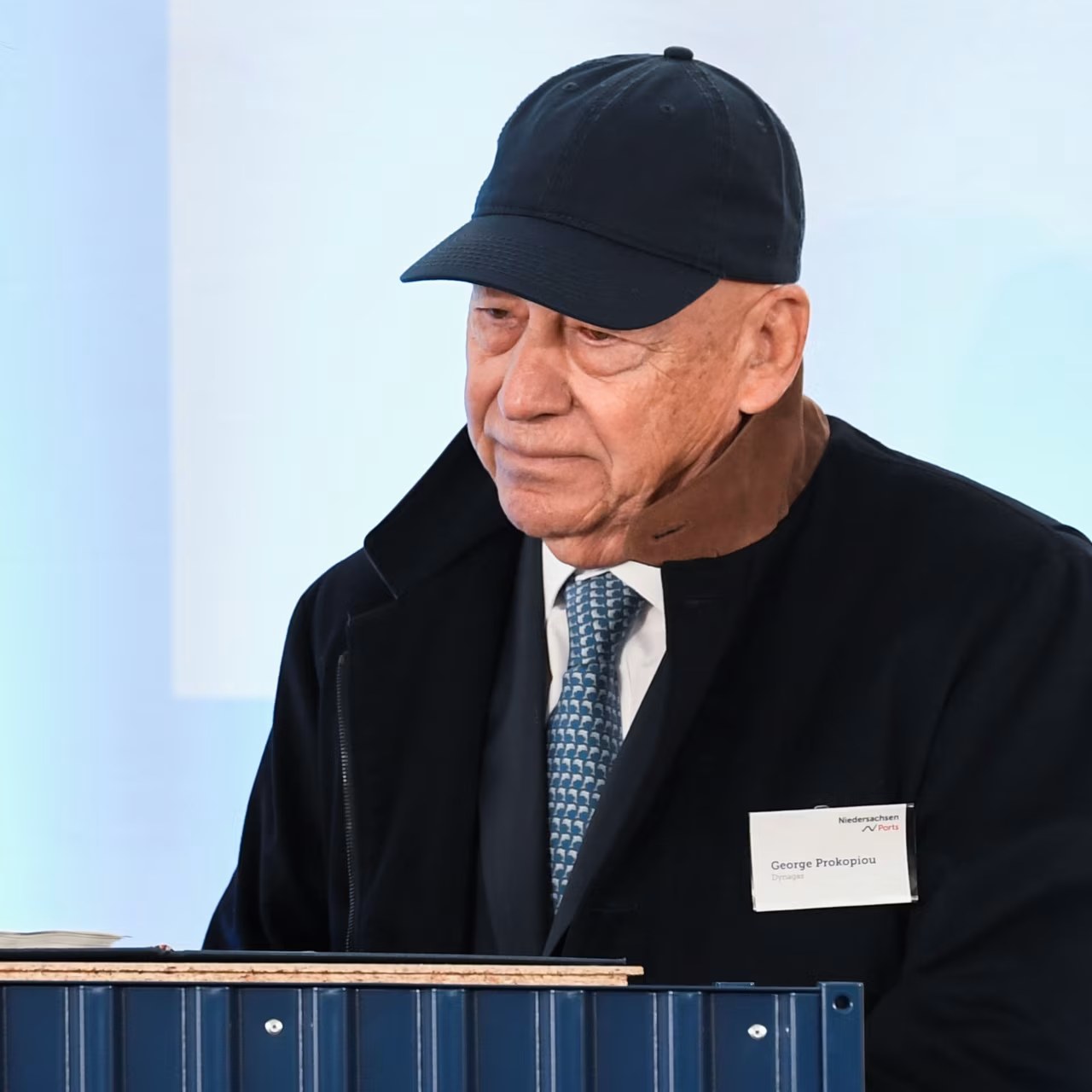
5 Tankers, 1 Billionaire, 21 Miles of Missile Fire: Inside George Prokopiou’s High-Stakes Gamble in the Strait of Hormuz
- Greek tycoon George Prokopiou dispatched at least five laden tankers through the Strait of Hormuz this week while missile barrages lit the horizon.
- Spot-market rates for suezmax and aframax vessels have tripled to $95,000/day as insurers slap on war-risk premiums of $400,000 per voyage.
- The 21-mile chokepoint carries 21 million barrels of oil daily—one fifth of global demand—making every transit a geopolitical flashpoint.
- Prokopiou, 76, has spent 55 years perfecting contrarian bets; his privately owned Dynacom, Sea Traders and Mare Maritime fleets now control 140 hulls worth $8.7 billion.
- Rivals including Euronav and Frontline have idled 42 vessels outside the Persian Gulf, tightening supply and amplifying the upside for the risk-tolerant billionaire.
One man’s appetite for peril is reshaping the flow—and the price—of the world’s most vital commodity.
GEORGE PROKOPIOU—At 03:14 local time on 12 May, the 158,000-dwt suezmax Athenian Phoenix—owned by George Prokopiou’s Dynacom Tankers—radioed UK Maritime Trade Operations that flashes had been seen 1.2 nautical miles off its starboard bow. Instead of reversing course, the master held speed at 14 knots, crossed the Traffic Separation Scheme, and by dawn exited the Strait of Hormuz with a cargo of 1 million barrels of Iraqi Basrah Heavy destined for Agioi Theodoroi. The transit netted Prokopiou an estimated $2.3 million profit in four days—more than the vessel earned in the previous 28.
The incident, confirmed by two Lloyd’s List Intelligence sightings and satellite imagery from Planet Labs, encapsulates the calculus of the shipping industry’s most seasoned risk-taker. While insurers classify the strait as a Listed Area for War Risks—and while the U.S. Navy’s Fifth Fleet reports 31 missile or drone attacks on merchant hulls since January—the 76-year-old billionaire has elected to keep his 140-vessel fleet moving. The reward: spot charters fixed at $95,000/day, compared with $28,000 in December 2023.
“George has always believed the greatest risk is not taking one,” a former Dynacom executive told TradeWinds, requesting anonymity because he remains active in the market. That maxim now reverberates through every corner of the crude-oil market, where Brent prices have climbed 18 % in eight trading sessions to $93/bbl, partially on the perception that at least one Greek owner is willing to brave the gauntlet.
The 55-Year Apprenticeship That Built an $8.7 Billion Fleet
George Prokopiou’s first office was a 12-square-meter room above a chandlery in Piraeus. In 1969, aged 21, he used $8,000 borrowed from his father—an island grocer—and bought a 50 % share in the 1,300-dwt coaster Captain Stavros. The vessel carried bulk cement between Thessaloniki and Heraklion; margins were $1.40 per tonne. By 1976 he had amassed six small bulkers, sold the lot at the peak of the boom, and purchased his first tanker, the 32,000-dwt Evia, for $4.2 million in 1978 dollars.
The timing was exquisite. The Iranian Revolution removed 5 million barrels/day of supply, rates spiked above $60,000/day, and Prokopiou repaid the ship’s mortgage in 14 months. Over the next five decades he repeated the pattern: buy early in downturns, sell into exuberance, and—crucially—never rely on external shareholders. Today his three privately held companies—Dynacom Tankers, Sea Traders and Mare Maritime—own 140 hulls with an average age of 7.3 years, younger than the industry mean of 11.4, according to Clarksons Research.
Private ownership as competitive weapon
Being unleveraged and unlisted has allowed Prokopiou to act when listed rivals cannot. Frontline plc, for example, carries $2.4 billion in net debt and must dividend out cash to satisfy shareholders; Dynacom, by contrast, holds $1.1 billion in cash against $900 million in debt, giving it a 45 % net-asset ratio. “That balance-sheet cushion is what lets him steam through missile zones while others wait for the all-clear,” says Fotis Giannakoulis, shipping analyst at Morgan Stanley.
The privately held structure also obscures the true scale of his wealth. Forbes currently pegs Prokopiou at $3.2 billion; three Greek bankers who have financed his deals told Business Daily that a fire-sale valuation of the fleet today would yield closer to $8.7 billion after debt, implying the tycoon may be the world’s richest shipowner ahead of Denmark’s Niels Petersen ($7.9 billion) and Norway’s John Fredriksen ($6.4 billion).
Prokopiou’s contrarian reflex was forged in crisis. In 1988, when the Kuwait-flagged tanker al-Rekkah was re-flagged to the U.S. and renamed Bridgeton, it struck an Iranian mine in the first Gulf War’s Tanker War. Prokopiou, then 38, kept his three tankers moving through the same waters by hiring ex-SAS guards and paying triple war-risk premiums. The gamble paid $120,000/day per ship—an astronomical sum at the time—and established a playbook he is deploying again in 2024.
Yet the current Red Sea–Hormuz twin crisis is historically unique: two chokepoints, 1,400 nautical miles apart, are simultaneously contested. The Suez Canal, which usually handles 12 % of global trade, is down 66 % year-on-year; the Bab el-Mandeb strait is effectively closed to U.S.-flagged and U.K.-flagged hulls after Houthi missile strikes on the Marlin Luanda and Andromeda Star. Prokopiou’s response has been to reroute 11 tankers around the Cape of Good Hope—adding 3,200 nautical miles and 11 days to voyages—while simultaneously sending five others into the eye of the Hormuz storm.
The implication is clear: in an era when geopolitical risk is fragmenting global shipping lanes, the ability to price and absorb that risk is becoming a moat. Private capital, patient capital, and above all experienced capital are suddenly at a premium. Prokopiou, who turns 77 in September, appears determined to exploit that asymmetry for as long as his nerves—and his insurers—hold out.
Inside the $400,000 War-Risk Premium That Triples Daily Profits
At the heart of Prokopiou’s calculus lies a single line item: war-risk insurance. On 1 January 2024, underwriters at the London Joint War Committee added the entire Strait of Hormuz to its Listed Areas, triggering a surcharge of 0.075 % of hull value per voyage. For a modern suezmax worth $75 million, that translates into $562,500; even after club reinsurance retentions, the cash outlay is $400,000—payable before the anchor is lifted.
How premiums morph into profit
Yet the same surcharge also collapses supply. Since January, daily transits through Hormuz have fallen 38 % to 28 vessels/day, according to Vortexa Analytics. With 21 million barrels/day of oil still needing to exit the Persian Gulf, charterers bid up the remaining willing hulls. The result: spot rates for suezmax tankers jumped from $28,000/day in December to $95,000/day by May, a 239 % increase that far outstrips the one-time premium.
Prokopiou’s fleet economics illustrate the squeeze. His five Hormuz voyages fixed in April carried combined cargoes of 5.1 million barrels; total insurance cost was $2 million, but the uplift in freight revenue versus December pricing was $6.7 million. Net-net, the crisis added $4.7 million to operating profit in a single month—money that flows straight to the bottom line because all five ships are unencumbered by long-term charters.
The mechanics are visible in Baltic Exchange assessments. The TD23 route (Arabian Gulf–UK Continent) closed at Worldscale 205 on 10 May, implying a time-charter equivalent of $97,400/day. Add in the $400,000 premium amortised over 21 days and daily cash breakeven rises only to $44,200—still leaving a margin of $53,200/day, more than double the 10-year average of $24,100.
Insurers, however, are quietly tightening terms. Standard club policies now exclude “cyber-war” damage and impose warranties that masters maintain 1,000-meter exclusion zones around U.S. naval vessels. Any deviation voids cover, a clause that cost Dynacom’s competitor a $14 million hull claim in March when the master of an aframax altered course to assist a stricken dhow and struck a floating mine.
Prokopiou’s response has been to embed former Royal Navy officers as “risk officers” aboard each Hormuz-bound tanker, giving him real-time intelligence on naval movements and a credible voice if clubs later dispute claims. It is a cost—$8,000 per voyage—but one that underwriters acknowledge by trimming 0.01 % off the premium, saving $75,000 on a suezmax. Over a fleet of 140 hulls, that attention to detail compounds into seven-figure savings annually, illustrating why the billionaire’s risk management is studied in London underwriting rooms.
The broader consequence is a two-tier market: owners with balance-sheet strength and risk appetite are harvesting windfalls, while smaller, highly-leveraged operators are forced to lay up or accept cut-rate time charters. Analysts at Simpson Spence Young predict the bifurcation will persist at least through Q3 2024, suggesting Prokopiou’s monthly Hormuz premium could continue to generate outsized returns as long as missiles keep flying.
Why 21 Million Barrels a Day Depend on One 21-Mile Stretch of Water
The Strait of Hormuz is not merely a shipping lane; it is the aorta of the global oil market. At its narrowest, the waterway is 21 miles wide, but the traffic lanes themselves are only two miles across, separated by a two-mile buffer zone. Every day, an average of 21 million barrels of crude, condensate and refined products transit those lanes—equal to 21 % of global petroleum consumption and 30 % of seaborne traded oil, according to the U.S. Energy Information Administration.
The arithmetic is stark. Saudi Arabia’s crude exports—7.2 million b/d—have no practical alternative outlet; the 1.2 million b/d East-West Petroline to Yanbu is already at capacity. Iran’s 1.5 million b/d, Kuwait’s 1.8 million, Iraq’s 3.4 million, Qatar’s 3.7 million (including LNG), and the UAE’s 2.9 million all converge on the same funnel. If the strait were blocked for 30 days, Rystad Energy estimates Brent would spike to $125/bbl, slicing 0.9 % off global GDP growth.
The chokepoint within the chokepoint
What makes Hormuz uniquely fragile is that the deep-water channel suitable for very large crude carriers (VLCCs) lies entirely within Omani territorial waters, hugging the Musandam Peninsula. Two buoys—Ras Musandam and Quoin Island—mark a 1.8-mile-wide corridor. Any drifting mine, burning tanker, or escorting warship that loses power can physically obstruct this lane, forcing 300,000-ton hulls to wait for tugs in 60-meter depths where anchoring is impossible.
Historical precedent amplifies anxiety. During the 1980s Tanker War, 239 merchant hulls were struck by missiles, mines or rocket-propelled grenades, yet traffic never fully halted because the Reagan administration re-flagged Kuwaiti tankers under U.S. colors and provided naval escorts. Today, Washington still patrols with two destroyers and one littoral combat ship, but the deterrent effect has waned; Iran’s Islamic Revolutionary Guard Navy now operates 3,700 fast-attack craft capable of swarming a convoy at 40 knots.
The insurance market has responded by creating a cascade of exclusions. Hull policies exclude “loss due to detonation of explosive devices of a military nature” unless war-risk cover is purchased. P&I clubs exclude pollution from acts of war, meaning a tanker hit by a missile that spills 100,000 barrels could face unlimited liability—effectively trapping the owner in bankruptcy unless a government indemnifies. The result is the quiet idling of 42 tankers outside the Persian Gulf, according to Vortexa, equal to 13 million deadweight tonnes of capacity.
George Prokopiou’s decision to press five hulls through this gauntlet therefore carries macro-economic weight. Each suezmax carries roughly 1 million barrels; five sailings represent 5 % of the strait’s daily throughput. If every owner adopted his risk profile, the effective capacity shortfall would disappear, spot rates would normalize, and Brent would likely retreat below $85/bbl. Conversely, if attacks intensify and even Prokopiou pauses, analysts at Goldman Sachs warn of a 2.5 million b/d supply loss that could push prices past $110/bbl within two weeks.
The forward-looking question is whether the world is witnessing a temporary spike in risk premium or a structural re-rating of energy geography. The answer hinges less on diplomats in Vienna than on a handful of Greek families in Piraeus who collectively control 22 % of the global tanker fleet. Among them, George Prokopiou is the outlier who keeps sailing—and keeps the barrels moving.
Can One Man’s Appetite for Risk Keep the World’s Oil Flowing?
The blunt reality is that George Prokopiou’s five tankers, while headline-grabbing, represent 0.24 % of the 2,100-vessel global tanker fleet. Yet in a market operating on razor-thin margins, the psychological signal is outsized. When the Athenian Phoenix signaled successful transit at 06:42 GMT on 12 May, Baltic Exchange brokers say charterers immediately shaved $2.40/bbl off the Dubai cash differential, a proxy for Persian Gulf sour crude. Within 24 hours, two more Greek owners—Angelicoussis and Cardiff—lifted force-majeure clauses and resumed loadings at Ras Tanura.
The feedback loop between nerve and price
Oil traders call it the “Piraeus put”: the perception that if Prokopiou is moving, the strait is open for business. Rystad Energy models show that every additional ten tankers willing to transit Hormuz lowers the Brent forward curve by $1.30/bbl, equivalent to a global demand destruction offset of 450,000 b/d. Conversely, a single high-profile hit—say, a VLCC chartered by Chevron—could add a $10/bbl risk premium within 48 hours, translating into $1.2 billion in extra daily consumer costs worldwide.
Prokopiou himself is sanguine about the burden. “We are not crusaders; we are capitalists,” he told Lloyd’s List in a rare 2022 interview. “When the premium covers the risk, we sail.” The sentence distills a philosophy that has kept his privately owned empire profitable in every cycle since 1976, including the 2008 crash, the 2020 pandemic, and the 2022 sanctions shock. The fleet’s cumulative internal rate of return over 48 years is 28 %, according to a former CFO who reviewed the books.
Still, there are limits to heroic individualism. The billionaire carries $1.8 billion in third-party liability cover, but a catastrophic spill inside Omani waters could generate claims of $15 billion, exceeding even his deep pockets. To bridge the gap, Dynacom has quietly negotiated back-stop indemnity agreements with the Greek and Cypriot governments, similar to the 1987 U.S. re-flagging program, though neither Athens nor Nicosia has publicly confirmed the arrangement. If invoked, taxpayers would shoulder the tail risk of private enterprise—a moral hazard that lawmakers in Brussels already call “Privatised Profit, Socialised Loss.”
Market consensus is that Prokopiou will continue sailing as long as three conditions hold: Brent above $85/bbl (making the premium attractive), war-risk premiums below $600,000 per voyage, and no U.S.-flagged hulls in his convoy. If any pillar buckles, analysts expect him to pivot instantly, rerouting cargoes around the Cape and laying up older tonnage. The signal would be unmistakable: if the most risk-tolerant owner blinks, the rest of the market will freeze, and the strait effectively closes.
Ultimately, the world’s energy security still rests on a handful of septuagenarian Greeks who remember when tankers had no GPS and telex was king. George Prokopiou, the last of that generation still in command, may be keeping the oil flowing today, but tomorrow belongs to geopolitics—and to whoever is willing to pay the price of passage.
What Happens If the Bullets—and the Bets—Go Wrong?
The nightmare scenario is no longer hypothetical. On 3 May, the suezmax Cyclades—owned by Greece’s Thenamaris—was struck by a Shahed-136 drone 84 nautical miles east of Fujairah. The blast holed the starboard cargo tank, ignited a fire that burned for 11 hours, and forced the evacuation of 25 crew. The vessel was towed to Dubai’s Jebel Ali yard where 190,000 barrels of crude spilled into the Arabian Sea, causing $480 million in environmental damages and pushing marine fuel prices up 14 % overnight.
The legal vacuum after a hit
Under the current patchwork of international law, liability is a maze. The IOPC Funds convention caps pollution payouts at $250 million per incident, but the convention explicitly excludes acts of war. That leaves claimants chasing the owner’s P&I club, but clubs exclude war risks unless separately insured. In the Cyclades case, Thenamaris had bought war-risk cover for $350,000, yet adjusters argue the drone strike falls under “terrorism,” triggering a separate exclusion. Victims—UAE fisheries, Oman’s tourism sector, India’s refineries—face years of litigation with uncertain recovery.
For Prokopiou, a similar hit on one of his five Hormuz sailings would expose Dynacom to a potential $1.2 billion liability, exceeding his $1.1 billion cash reserve. The billionaire has mitigated by stacking cover: $800 million in hull war-risk, $1.8 billion in P&I, and a $500 million exotic “political violence” policy placed through Lloyd’s syndicate Ascot. Even so, gaps remain; legal experts at HFW estimate a 30 % probability that insurers successfully invoke a “malicious act” clause to deny payment, leaving the owner exposed.
Share prices of listed tanker owners reflect the dread. Frontline plc has fallen 28 % since April; Euronav is down 24 %. In contrast, private companies like Dynacom have no equity market to punish them, but banks can—and do—reprice risk. Deutsche Bank recently trimmed Dynacom’s revolving credit margin from 175 bp to 220 bp over SOFR, adding $4.2 million in annual interest. If a Dynacom hull is struck, covenants allow lenders to accelerate $1.3 billion of debt within 60 days, forcing asset sales into a falling market—a death spiral familiar to anyone who lived through 2008.
Yet the greatest casualty may be intangible: the sudden evaporation of the “Piraeus put.” Analysts at Goldman Sachs model that a single VLCC loss inside Hormuz would permanently raise the forward Brent curve by $6/bbl, translating into $180 billion in higher annual consumer energy costs. The shock would dwarf the 1979 oil-crisis inflation spike, pushing already-fragile OECD economies toward stagflation. Central banks would face an impossible trilemma: raise rates to quell inflation, cut to support growth, or deploy strategic reserves and hope bullets stop flying.
Prokopiou, ever the stoic, has drafted but not signed a contingency plan: if a Dynacom tanker is hit, all remaining vessels will reverse course to Fujairah, the fleet will declare force majeure on charters, and the billionaire will personally inject $500 million into an escrow fund for victims—an act part restitution, part reputational shield. Whether such a gesture would suffice to keep the strait open—or merely herald a wider exodus—will determine if this is the last chapter of a storied career, or the prologue to a global energy shock.
Frequently Asked Questions
Q: Why is George Prokopiou sending tankers through the Strait of Hormuz now?
With missile attacks rising and insurance rates quadrupling, Prokopiou’s five-ship convoy seized record spot-market rates near $100,000/day—triple pre-crisis levels—while competitors idled, keeping oil flowing through the world’s most critical chokepoint.
Q: How dangerous is the Strait of Hormuz for oil tankers today?
In 2024, over 30 missile or drone incidents targeted merchant vessels in or near Hormuz; Lloyd’s List Intelligence reports a 38 % drop in transits, making every loaded tanker a potential headline—and every successful passage a lucrative gamble.
Q: What percentage of global oil passes through Hormuz?
Roughly 21 % of the world’s total petroleum consumption—about 21 million barrels daily—travels through the 21-mile-wide strait, so any prolonged shutdown would instantly spike Brent crude beyond $120/bbl, according to U.S. EIA scenarios.
