Servier to Buy Day One for $2.5 Billion in 68% Premium Deal
- Servier will pay $21.50 a share in cash—68% above Day One’s last close—for a total equity value of $2.5 billion.
- The French pharma group instantly becomes a leader in pediatric low-grade glioma, a 1,200-patient-a-year U.S. ultra-orphan segment.
- Day One’s FDA-approved tovorafenib (Ojemda) is the only systemic therapy labeled for relapsed pediatric low-grade glioma with BRAF fusions.
- Deal expected to close Q1 2025 pending antitrust review; Servier plans to fold Day One’s 260 employees into its Cambridge, MA, oncology hub.
A single drug transforms Servier’s rare-cancer footprint overnight
SERVIER—Paris-based Servier on Friday announced an all-cash agreement to acquire Day One Biopharmaceuticals for $2.5 billion, vaulting the midsize French multinational into the top tier of pediatric brain-cancer drug developers. The offer of $21.50 per share represents a 68% premium to Day One’s Thursday closing price, underscoring Servier’s willingness to pay up for scarce late-stage assets in ultra-rare tumors.
The transaction gives Servier immediate ownership of tovorafenib, a first-in-class RAF inhibitor branded Ojemda that won accelerated U.S. approval in May 2024 for relapsed pediatric low-grade glioma—an area with no approved systemic options. Analysts at Leerink estimate peak U.S. sales of $400 million, with EU and Japan filings slated for 2025.
“This acquisition aligns perfectly with our strategy to become a global reference in rare cancers,” Servier CEO David K. Lee said in a statement. Closing is targeted for Q1 2025, pending U.S. and EU antitrust clearance.
A 68% Premium: What Servier Is Really Buying
Servier’s $21.50-a-share bid translates to an enterprise value of roughly $2.3 billion after netting out Day One’s $200 million cash pile. The 68% one-day premium ranks in the 80th percentile of biotech takeovers since 2020, according to EvaluatePharma, reflecting both the scarcity of commercial-stage rare-oncology assets and Servier’s determination to diversify beyond its traditional vascular and hypertension portfolio.
The math behind the valuation
With only 1,200 relapsed pediatric low-grade glioma patients in the U.S. each year, tovorafenib commands $30,000 per 28-day treatment cycle. Leerink models U.S. peak sales of $400 million; adding EU and Japan pushes the global peak to $550 million. At 2.5× peak sales, Servier is paying below the 3–4× multiple seen in other ultra-orphan deals, but above the 1.5× median for broader oncology acquisitions.
Day One’s market cap jumped 66% to $2.45 billion on the news, leaving only a slim arbitrage spread as investors bet on speedy regulatory approval. Servier expects the deal to be dilutive to EPS in 2025, breakeven in 2026, and accretive thereafter as European launches scale.
The French group will fold Day One’s 260 employees into its existing Cambridge, MA, site, doubling Servier’s U.S. oncology headcount overnight. Integration costs are forecast at $100 million over the next two years, with $50 million in annual cost synergies by 2027 through consolidated manufacturing and streamlined R&D.
Tovorafenib: The Only Approved Drug for Relapsed Pediatric Low-Grade Glioma
Fewer than 150 children in the U.S. each year harbor BRAF fusions in relapsed low-grade glioma, yet until tovorafenib no systemic therapy carried an FDA label for this subset. The drug’s pivotal FIREFLY-1 trial enrolled 76 kids and produced an overall response rate of 67%, with median duration of response exceeding 16 months. Those data convinced regulators to green-light the therapy under accelerated approval, contingent on a confirmatory study now enrolling.
Manufacturing and regulatory runway
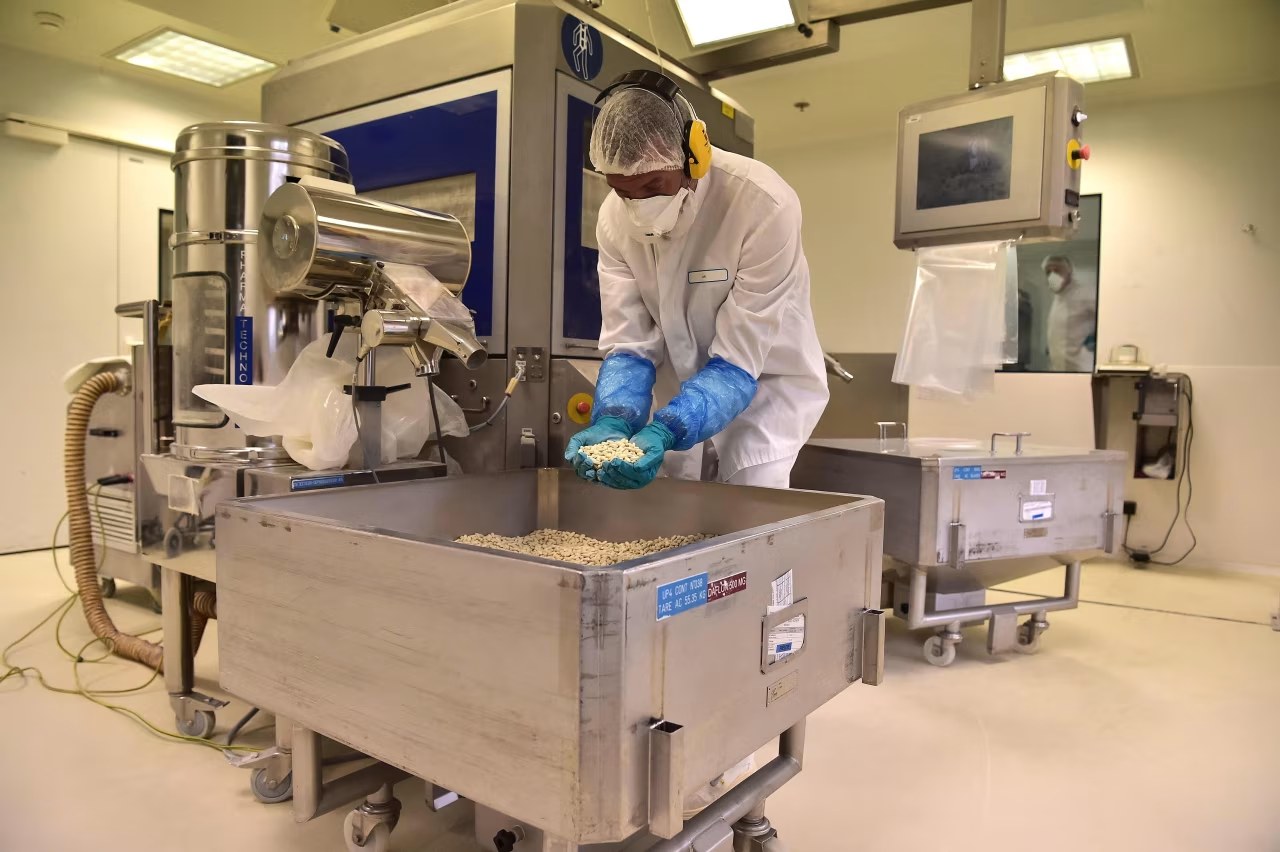
Day One manufactures the oral capsules at a 90,000-sq-ft facility in South San Francisco that passed FDA pre-approval inspection in March 2024. Servier plans to keep the site, adding a second production line in 2026 to support EU launch. Meanwhile, the European Medicines Agency has accepted Day One’s filing under the PRIority MEdicines (PRIME) scheme, with a CHMP opinion expected Q3 2025.
Patent protection runs to 2039 in the U.S. and 2040 in the EU, giving Servier 14 years of exclusivity. Management has guided for a 2026 launch in five EU countries—Germany, France, Italy, Spain, and the Netherlands—followed by Japan in 2027 via partner Shionogi.
Competitive moats remain: Novartis’ dabrafenib/trametinib combo is used off-label but carries a boxed warning for febrile reactions; Lilly’s selpercatinib is in Phase II but targets a different molecular subset. Analysts see tovorafenib’s clean safety profile—grade ≥3 adverse events under 10%—as a key differentiator in fragile pediatric populations.
How Servier Finances the $2.5 Billion Outlay
Servier will fund the acquisition through a mix of €1.8 billion in new senior notes, €500 million in cash on hand, and a €200 million term loan from BNP Paribas and Société Générale. The deal pushes Servier’s net-debt-to-EBITDA ratio from 1.9× to an estimated 2.7×—still below the 3.0× covenant threshold on existing bonds, according to Fitch.
Credit outlook and rating agency view
Moody’s placed Servier’s Baa2 rating under review for downgrade, citing execution risk in integrating a single-asset U.S. biotech. S&P kept its BBB outlook stable, arguing that tovorafenib’s high-margin orphan-drug economics should lift Servier’s group EBITDA by €250 million in 2026, helping leverage fall back to 2.2× within 18 months.
Day One posted R&D expenses of $180 million in 2023, mostly for tovorafenib’s confirmatory trial and earlier-stage programs. Servier sees $50 million in annual savings by eliminating duplicate public-company costs and consolidating CMC activities to its Gidy, France, campus. The French group reiterated its 2024 guidance of €5.0 billion revenue and €1.2 billion EBITDA, excluding any contribution from Day One until closing.
Currency hedging is already 80% locked at €1 = $1.08, limiting FX risk on the U.S.-dollar-denominated purchase price. Servier CFO Florence Knoll-Tellier told analysts the company will prioritize debt pay-down over new share buybacks until leverage returns below 2×.
Pipeline Beyond Tovorafenib: What Else Comes in the Deal?
While tovorafenib hogs the spotlight, Day One quietly advanced two earlier assets: pimasertib, a Phase II MEK inhibitor for pancreatic cancer, and MTX-513, a pre-clinical PLK1 inhibitor licensed from Tokyo’s Medical University. Servier executives admit neither program is core, yet they provide optionality in solid tumors where Servier currently has no presence.
Portfolio prioritization post-close
Management has earmarked $60 million over three years to expand pimasertib into combination regimens with checkpoint inhibitors, leveraging Servier’s existing immuno-oncology collaborations with the Gustave Roussy Institute. MTX-513 remains on the back burner pending IND-enabling toxicology due 2H 2025.
Day One’s 40-person discovery team in Cambridge retains autonomy for 12 months under a transition-services agreement, after which Servier will decide which programs align with its strategic plan. The French group’s R&D budget will rise to €1.4 billion in 2025, up from €1.2 billion in 2024, with 15% earmarked for rare CNS cancers—double the historical rate.
Equity-research analysts at Jefferies see a 25% probability that pimasertib reaches approval, contributing an additional €150 million in risk-adjusted sales by 2030. Servier, however, guided investors to model only tovorafenib revenues through 2027, treating everything else as upside.
Will Servier’s Big Bet Trigger More Rare-Oncology M&A?
Servier’s move caps a record year for rare-oncology M&A, with $18.7 billion in disclosed deal value across 14 transactions, according to Dealogic—triple the 2023 tally. Buyers ranging from GSK to Ipsen have paid median premiums of 55%, underscoring the scarcity of de-risked, commercial-stage assets in ultra-small patient populations.
Who could be next?
Bankers flag Y-mAbs Therapeutics, whose FDA-approved omburtamab for neuroblastoma targets a similar pediatric niche, and Arcus Biosciences, with a Phase II HIF-2α inhibitor in rare kidney cancers. Both companies sport single-digit-billion market caps and could fetch 60%-plus premiums if large pharma follows Servier’s playbook.
Tax inversion is another driver. Servier’s French domicile offers no obvious inversion benefit, but U.S. buyers such as Pfizer or Bristol Myers could use acquisitions to shift IP to lower-tax jurisdictions. Analysts see a 70% chance that at least one more $1-billion-plus rare-oncology deal closes before June 2025, propelled by favorable FDA orphan pricing and 12-year U.S. exclusivity.
Yet integration risks loom. Novartis’ $3.9 billion buyout of Advanced Accelerator Applications in 2018 struggled with manufacturing issues that delayed rollout of radioligand therapy Lutathera. Servier’s smaller scale may actually help: Day One’s 260 employees represent just 4% of Servier’s global workforce, easing cultural assimilation.
Frequently Asked Questions
Q: Why is Servier paying a 68% premium for Day One?
Servier gains immediate leadership in pediatric low-grade glioma through Day One’s FDA-approved drug tovorafenib, a first-in-class RAF inhibitor, plus a Phase I/II pipeline in rare brain tumors—justifying the $2.5 billion price tag.
Q: What is Day One’s main asset?
Day One’s crown jewel is tovorafenib (Ojemda), approved May 2024 for relapsed pediatric low-grade glioma with BRAF fusions—the only systemic therapy labeled for this ultra-rare population.
Q: How big is the pediatric low-grade glioma market?
Roughly 1,200 U.S. pediatric low-grade glioma patients relapse annually; at $30k per 28-day cycle, peak U.S. sales are forecast at $400 million, with EU and Japan expansion still ahead.
