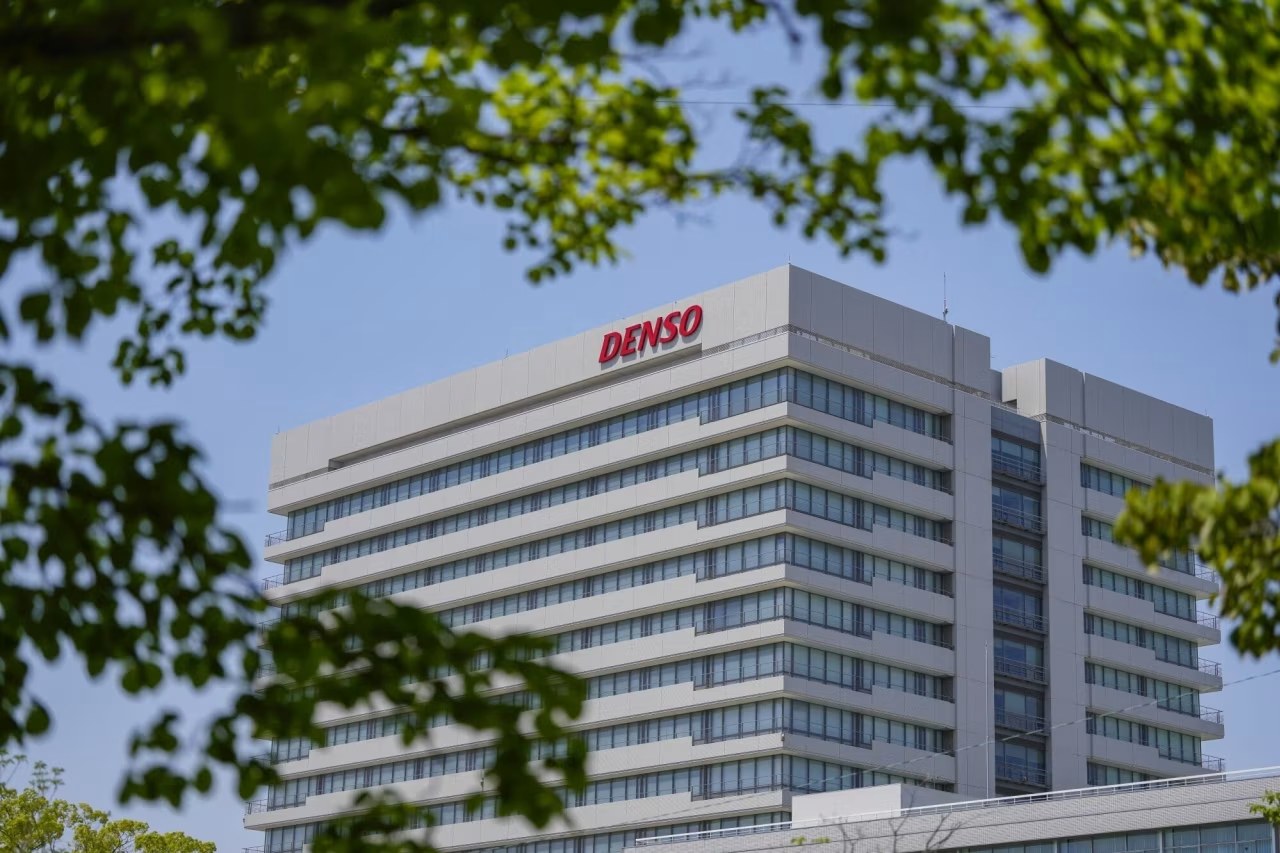
Denso’s $5-billion-plus takeover bid for Rohm would create Japan’s largest auto-chip powerhouse
- Toyota-affiliated supplier Denso confirmed it has proposed to acquire Kyoto-based Rohm, valuing the chip maker near ¥700 B ($5.2 B)
- Rohm disclosed the approach Friday; talks center on securing silicon-carbide capacity for EV inverters
- Deal would tighten Toyota’s grip on critical semiconductors as global auto-chip shortages still bite
- Combined entity would rival Infineon and STMicroelectronics in automotive power-device market share
Japan’s biggest auto-parts maker wants to own the chips that run tomorrow’s cars
SEMICONDUCTORS—Denso, Toyota’s largest supplier with $48 billion in annual sales, has made a formal takeover proposal to Rohm, the Kyoto-headquartered semiconductor firm that quietly powers everything from Ford’s Mustang Mach-E inverters to Toyota’s Lexus RZ steer-by-wire systems.
The approach, confirmed by both companies late Friday, signals a dramatic escalation in Japan’s race to secure domestic chip supply for electric and self-driving vehicles. Rohm’s market capitalization hovered near ¥670 billion ($5 billion) before the news leaked; analysts say Denso is prepared to pay a 20-30 % premium, implying an enterprise value north of $6 billion.
A successful deal would mark the largest Japanese semiconductor acquisition since Renesas bought Intersil for $3.2 billion in 2017 and would give Toyota, which owns 24 % of Denso, direct influence over a fab network that ships more than 100 million power chips a year.
From Carburetors to Carbide: Denso’s $40-billion pivot inside Toyota’s orbit
Denso began life in 1949 as a Toyota spin-off making spark plugs. Today it ranks as the world’s second-largest auto-parts supplier behind Bosch, with 132 plants in 35 countries and consolidated sales of ¥6.4 trillion ($48 billion) in FY 2023. Yet margins are thinning: operating profit fell to 6.1 % last year, down from 9.2 % in 2018, as price-cutting by EV startups and rising raw-material costs bite.
The chip gap that keeps Denso awake
Despite building engine-control units since the 1970s, Denso still buys 85 % of its power semiconductors on the open market. That dependency exploded into crisis in 2021 when Toyota cut global output by 14 %—about 500,000 vehicles—because Renesas and Rohm fabs couldn’t deliver microcontrollers and IGBTs fast enough. Denso’s president Shinnosuke Hayashi told investors in May 2023 that securing in-house wafer supply is now “mission-critical” if Toyota wants to sell 3.5 million EVs by 2030.
Rohm fits that need precisely. The 66-year-old company invented high-speed silicon carbide MOSFETs in 2010 and now controls 14 % of the global SiC wafer market, according to Fuji Keizai. Its 12-inch fab in Miyazaki—opened in 2022—runs at 90 % utilization supplying Toyota’s bZ4X, Subaru’s Solterra, and Ford’s F-150 Lightning. Analysts at Goldman Sachs estimate Denso could save ¥120 billion annually by internalizing Rohm wafers while shielding Toyota from the cyclical spot market where SiC prices have swung 40 % in two years.
The strategic logic is already visible in capital expenditure: Denso earmarked ¥650 billion for capex over 2022-24, the highest three-year spend in its history, yet admits “external chip procurement risk remains unresolved.” Buying Rohm would flip that equation overnight and give Denso control of fabs in Japan, Malaysia, and China capable of 2.4 million wafer starts a month.
Rohm’s Quiet Silicon-Carbide Empire: 100 million chips a year behind the scenes
Rohm is hardly a household name, yet its chips manage battery packs in 1 of every 10 EVs sold globally last year. Founded in 1958 as a resistor maker, the company pivoted early to compound semiconductors, betting $2.3 billion over two decades on silicon-carbide R&D when larger rivals still favored silicon IGBTs. That bet paid off: Rohm’s FY 2023 revenue hit ¥448 billion ($3.4 billion), up 18 % year-on-year, while operating margin reached 19 %—double Denso’s.
Inside the Miyazazi 12-inch fab that Denso craves
The crown jewel is Rohm’s 18-hectare campus in Miyazaki prefecture, opened in September 2022. The facility runs 24,000 wafer starts per month on 200 mm SiC substrates, the largest such line outside of Wolfspeed’s New York fab. Each wafer yields roughly 550 MOSFET dies, enough for 90 inverter modules, translating into 1.3 million EVs annually at Toyota’s current mix. Rohm plans to double capacity to 48 k wspm by 2025, investing an additional ¥170 billion, but has been constrained by cash flow after net debt rose to ¥132 billion.
Customer concentration is both a strength and a risk. Toyota and Honda together account for 38 % of Rohm’s automotive revenue, while Ford, Geely, and Hyundai make up another 29 %. A takeover by Denso would deepen that dependence but also guarantee multi-year offtake contracts, eliminating the boom-bust cycle that saw Rohm idle lines for 11 weeks in 2020 when the pandemic froze car output.
Equity markets have rewarded Rohm’s SiC story: its Tokyo-listed shares traded at 28× forward earnings before the Denso approach, a 40 % premium to the TOPIX. Analysts at Morgan Stanley value Rohm’s power-device business at 2.5× sales, or ¥550 billion—roughly 80 % of the firm’s total enterprise value—underscoring how critical the Miyazaki fab has become.
What a $6-billion deal would mean for Japan’s EV supply chain
Japan controls only 9 % of the global automotive semiconductor market, down from 18 % in 2010, as Toshiba, Renesas, and Sony ceded share to European and U.S. rivals. A Denso-Rohm combination would create a domestic champion with combined auto-chip revenue of ¥1.1 trillion ($8.3 billion), leap-frogging Infineon’s $6.9 billion and second only to NXP’s $9.5 billion.
Integration timeline: 18 months to fused fabs
Denso would likely fold Rohm into a new “Power Device Company” reporting directly to CTO Yoshifumi Kato, people familiar with the plan said. Synergy calculations assume 30 % cost savings on external wafer purchases, 15 % faster development cycles for next-generation 800-volt inverters, and combined R&D of $1.8 billion annually, rivaling Tesla’s entire engineering budget.
The Ministry of Economy, Trade and Industry (METI) is quietly cheering the move. Japan’s auto output fell below 7 million vehicles in 2023 for the first time since 1961, and METI fears that without domestic chip security, Toyota and Honda could be forced into costly last-minute sourcing like European carmakers during the 2021 shortage. A merged Denso-Rohm would qualify for METI’s ¥120 billion subsidy pot for advanced power semiconductors, shaving another ¥40 billion off the effective purchase price.
Union opposition is minimal: Rohm’s 23,000-strong workforce includes only 600 unionized staff at its Kyoto headquarters, compared with 151,000 Denso employees worldwide. Analysts expect Denso to offer Rohm engineers stock-based retention packages worth ¥1.5 billion to keep key talent from defecting to TSMC’s upcoming Kumamoto fab, which is poaching Japanese engineers with 30 % salary premiums.
Could regulators in Tokyo, Washington, or Beijing block the takeover?
Japan’s antitrust authority, the JFTC, has never blocked a horizontal merger between automotive suppliers, but precedent is shifting. In 2022 the agency forced Nidec to divest two plants after buying Mitsubishi Motors’ starter-motor unit, citing 55 % domestic share. A Denso-Rohm deal would create a 34 % share of Japan’s SiC MOSFET market—below the JFTC’s 50 % red flag yet well above the 25 % that triggers extended review.
Washington’s national-security lens on Kyoto fabs
U.S. regulators are less concerned about market share than about technology leakage. Rohm’s Miyazaki fab is licensed to produce 90-nanometer SiC devices that the U.S. Commerce Department labels as “emerging and foundational.” Under October 2023 export-control rules, any foreign takeover must pass a Committee on Foreign Investment in the United States (CFIUS) review if the target owns “critical facility supporting U.S. automotive production.” Rohm’s 2022 supply contract for 120,000 Ford F-150 Lightning inverters meets that threshold, so Denso will need a mitigation agreement pledging to keep U.S. customer data firewalled—mirroring the structure Nissan adopted in 2020.
Beijing’s stance is murkier. Rohm generates 18 % of revenue from Chinese EV makers including BYD and Li Auto, and China’s State Administration for Market Regulation (SAMR) has already slowed similar deals—most recently Intel’s $5.4 billion Tower acquisition—for more than 18 months. People close to Denso say the company is prepared to offer a “hold-separate” remedy for Rohm’s Dalian assembly plant, employing 2,000 workers, to win SAMR clearance within 12 months.
What happens next: three possible timelines for 2025
Bankers at Mizuho and JPMorgan, advising Denso, have penciled in a three-stage timeline. Under the most bullish scenario, a friendly tender offer launches in October 2024 at ¥4,500 per share—35 % above Rohm’s undisturbed close of ¥3,330—funded 40 % by Denso cash, 40 % by a Toyota subordinated loan, and 20 % by a METI subsidy. Closing would occur in March 2025, enabling combined guidance for FY 2026 of ¥9 trillion revenue and 11 % operating margin.
Alternative paths: hostile bid or partial stake
If Rohm’s founding Sato family (holder of 18 % of shares) resists, Denso could pivot to a two-step approach: acquire 20 % via a third-party allotment at ¥3,800, then launch a hostile tender next summer. Analysts assign a 30 % probability to this route, citing the family’s historical aversion to external ownership since Rohm’s 1980 IPO.
A third scenario—preferred by activist hedge fund ValueAct, which owns 2 % of Rohm—sees Denso settling for a 51 % majority, leaving Rohm listed to preserve access to equity markets for fab expansion. That structure would reduce upfront cash demand to $3.5 billion but could forfeit tax synergies worth ¥18 billion annually, according to Nomura.
Whatever the path, Toyota’s endorsement is pivotal. Chairman Akio Toyoda reiterated in June that “stable semiconductor procurement is existential for our 2030 EV target.” With Toyota’s 24 % Denso stake and board nominations, Denso is unlikely to proceed without explicit Toyota backing, making a sweetheart deal for Rohm shareholders the most probable outcome by early 2025.
Frequently Asked Questions
Q: Why is Denso bidding for Rohm?
Denso wants secure access to Rohm’s silicon-carbide chips critical for next-gen EV inverters and self-driving ECUs, reducing Toyota’s supply-chain risk.
Q: How big is Rohm in automotive chips?
Rohm commands 14 % of the global silicon-carbide wafer market, supplies Toyota, Honda, and Ford, and booked ¥448 B revenue in FY 2023.
Q: What happens if the deal closes?
A takeover would fold Rohm into Denso’s $48 B parts empire, create Japan’s first vertically-integrated EV chip-to-system supplier, and intensify global chip M&A.
