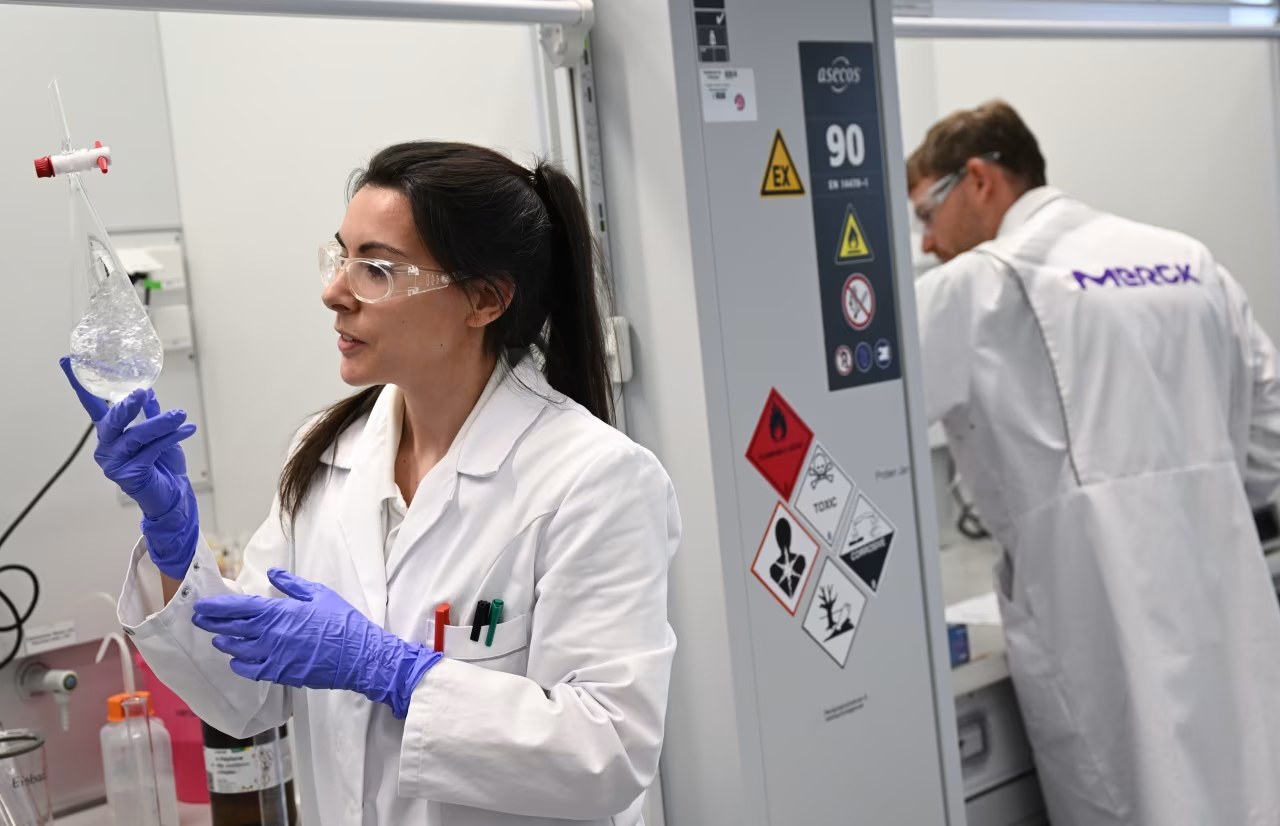
Merck KGaA braces for currency headwinds that could erase up to €200 million from 2024 earnings
- Flat sales projected for 2024 after 2023 revenue of €21.2 billion
- Adjusted EBITDA seen declining from 2023’s €4.4 billion base
- U.S. dollar weakness and emerging-market swings flagged as ‘considerable’ drag
- CEO transition looms as Belen Garijo prepares to exit after three-year tenure
The Darmstadt-based group becomes the latest European exporter to warn that foreign-exchange swings will overwhelm volume growth next year.
MERCK KGAA—Merck KGaA, the 356-year-old German science and technology conglomerate, closed the book on the Belen Garijo era with a sobering message for investors: currency headwinds will dominate its 2024 profit trajectory. In its final quarterly release under the outgoing chief executive, the company guided for flat sales and lower adjusted earnings, citing “considerable foreign-exchange headwinds” that threaten to shave hundreds of basis points from margins.
The warning lands as the euro has strengthened roughly 7 % against the dollar since September, while volatility across Latin American and Asian currencies intensifies. For Merck—whose life-science tools, bioprocessing resins, and semiconductor materials are priced predominately in dollars—the translation bite is immediate. Every 1-cent move in the EUR/USD pair alters annual EBITDA by about €25 million, according to internal sensitivity tables disclosed last year.
With 60 % of revenue denominated in or linked to the greenback, management now sees adjusted EBITDA slipping from 2023’s €4.4 billion benchmark, even after stripping out one-time factors. Shares in Frankfurt fell as much as 2.8 % intraday before paring losses to close 1.94 % lower at €155.40, the lowest level since October 2023.
The 2024 Outlook: Flat Sales, Shrinking Margins
Merck KGaA’s guidance matrix for 2024 is stark: group sales “at best flat” and adjusted EBITDA expected to decline. The company generated €21.2 billion in net sales for 2023, a 3.8 % currency-adjusted increase, but reported growth slid to 0.9 % after translating currencies at average 2023 rates. Management now projects nominal revenue will hover between €20.8 billion and €21.4 billion, implying 0 % to –2 % organic growth before portfolio tweaks.
Currency headwinds emerge as the single biggest swing factor
Finance head Marcus Kuhnert told analysts on the 2023 earnings call that the basket of relevant currencies—dollar, yuan, won, peso, and real—has moved 4.3 % against the euro since the third quarter. A sustained level would translate into a €180–200 million EBITDA headwind, enough to push the margin down by roughly 90 basis points. The company hedges only 35 % of transactional exposure, leaving the remainder to flow through the P&L.
Flat sales guidance masks divergent segment trajectories. Life Science, which supplies lab equipment and bioprocessing consumables to drug makers, faces destocking by large U.S. clients that will linger into mid-2024. Healthcare, anchored by multiple-sclerosis drug Mavenclad and fertility treatments, is penciling in low-single-digit growth on volume gains in Europe. Electronics, the smallest division at €3.6 billion, is expected to rebound as semiconductor customers restock after a brutal 2023 downturn.
The net effect: earnings quality deteriorates. Adjusted earnings per share are forecast at €6.40–€6.90 versus €7.22 in 2023, a decline of 4–11 %. Investors have little room for upside surprises unless the dollar weakens materially or destocking ends sooner than the company’s July timeline.
How Currency Headwinds Rip Through the P&L
Merck KGaA’s currency headwinds are neither new nor trivial. In 2022 a 12 % dollar surge added €330 million to EBITDA; the 2023 reversal is erasing similar value. The mechanism is twofold: translation of dollar-denominated earnings into a stronger euro, and the erosion of pricing competitiveness in emerging markets where contracts are dollar-linked but costs are local.
Transactional vs translational: the double hit
Transactional exposure arises when Merck invoices in dollars but incurs costs in euros—about 45 % of group profit. Translational exposure hits when subsidiaries’ dollar earnings are converted at weaker average rates. Combined, these forces subtracted 4.1 % from 2023 group EBITDA, management calculates, even though volumes grew 2.7 %.
The company’s hedge book covers only short-term cash flows. Roughly €1.1 billion in forward contracts and options roll off within 12 months, leaving the balance sheet exposed beyond that horizon. Kuhnert said extending cover to 24 months would cost 0.4 % of notional, a premium finance committee deems uneconomical given the difficulty of forecasting customer order patterns post-COVID.
Peers face similar pain. BASF cited a €600 million currency drag in 2023; Bayer expects €250 million this year. Yet Merck’s exposure is amplified by its high-margin life-science consumables, where EBITDA margins top 28 %. A 1 % FX move therefore translates into €44 million profit swing—four times the impact at the more diversified Bayer.
Investors have started to price a structural discount. Merck’s enterprise value trades at 8.9 × 2024E EBITDA versus a 10-year median of 11.2 ×, according to Berenberg. Unless the euro weakens below $1.02, analysts say multiple expansion is unlikely.
Life Science: The Destocking Drag That Refuses to Fade
Merck KGaA’s life-science division, the profit engine that delivered double-digit growth during the pandemic, is now the epicentre of its currency headwinds. Revenue slid 5.4 % in 2023 to €9.7 billion, entirely due to U.S. biopharma customers working off excess inventory of filtration membranes and single-use bioreactor bags.
Customer inventory days jumped from 90 to 140
CEO Garijo told analysts that large CDMOs such as Catalent and Lonza over-ordered in 2021 fearing supply-chain snarls. By late 2023 their warehouses held 140 days of Merck consumables versus a historic 90-day norm. Management initially predicted destocking would end by March 2024; that timeline has now slipped to July, implying a €300 million revenue shortfall in the first half.
The division’s EBITDA margin contracted 220 basis points to 28.1 %, magnified by currency headwinds. Dollar-denominated bioprocessing resin contracts, priced at $12,000 per litre, are now worth 7 % fewer euros, while fixed European overhead remains unchanged. Operating leverage flips negative: every 1 % volume decline translates into 1.4 % profit drop.
Competitors feel similar pain. Danaher’s Cytiva unit posted a 7 % core sales decline in 2023; Sartorius warned of a 9 % slide. Yet Merck’s exposure is larger because 70 % of its life-science sales are tied to large molecules, where order patterns are lumpier. The company is cutting 350 temporary workers at its Darmstadt and Danvers, Massachusetts sites, reducing variable costs by €25 million.
Longer-term, management bets on gene-therapy CDMO demand. A €130 million expansion of Carlsbad, California viral-vector plant comes online in 2025, potentially adding €400 million revenue at 35 % margins. Until then, currency headwinds and destocking remain the dominant narrative.
Healthcare and Electronics: Can They Offset the FX Pain?
While currency headwinds batter life science, Merck KGaA’s healthcare division offers a partial cushion. Mavenclad, the oral multiple-sclerosis therapy, grew 12 % to €1.4 billion in 2023, driven by U.S. launches and European label expansions. Fertility treatments such as Gonal-f added 5 % on volume, helped by China’s post-COVID rebound.
Pricing power in euros, but half the sales are dollar-linked
Healthcare generates 45 % of its revenue in dollars through U.S. wholesalers. Despite list-price increases of 4 %, net pricing after rebates fell 1 % when converted into euros. The division’s EBITDA margin still improved 40 basis points to 24.7 % because promotional spending was cut ahead of patent cliffs for Mavenclad in 2026.
Electronics, the smallest segment, is the swing factor. After a 14 % revenue crash in 2023 on semiconductor destocking, management guides for 6–9 % rebound in 2024, aided by AI-driven demand for high-purity process chemicals. A new €60 million plant in Hsinchu, Taiwan, will supply 3-nm fabs, locking in dollar-denominated contracts at 30 % margins. Yet even this revival cannot fully offset group-level currency headwinds; electronics accounts for only 17 % of total sales.
Combined, healthcare and electronics are expected to add €250 million incremental EBITDA in 2024, but currency will claw back €200 million, leaving net growth near zero.
CEO Transition: What Comes After Garijo?
Belen Garijo’s exit, announced in December 2023, adds strategic uncertainty atop currency headwinds. The 63-year-old Spaniard orchestrated the 2021 acquisition of Exelead for €780 million and tripled Mavenclad sales, but investors criticized her for over-optimistic life-science guidance in 2022.
Internal candidates lead the succession race
Supervisory-board chairman Wolfgang Büchele said three internal and two external candidates are under review. Front-runners include healthcare head Peter Guenter, life-science president Matthias Heinzel, and CFO Kuhnert. A decision is expected before the April 24 AGM; Garijo will remain available for consultations until September to ensure continuity.
Investors hope the successor will accelerate portfolio pruning. Merck holds 22 % of cosmetics supplier Symrise, worth €3.1 billion, and minority stakes in five German real-estate funds. Divesting non-core assets could raise €2 billion and offset currency headwinds through buybacks, though management has ruled out a special dividend in 2024.
Investor Takeaway: Is the Valuation Gap a Currency-Induced Trap?
Merck KGaA now trades at 8.9 × 2024E EBITDA, a 20 % discount to its 10-year median and below German chemical peers BASF (10.2 ×) and Covestro (9.7 ×). Analysts argue the currency headwinds are transitory, yet the market assigns a structural penalty.
Free-cash-flow yield rises to 6.4 %, highest since 2016
Management guided for €2.2–2.5 billion free cash flow in 2024, implying a 6.4 % yield at current enterprise value. Debt metrics remain comfortable: net debt/EBITDA is 2.1 × versus a covenant ceiling of 3.5 ×. Yet buybacks are unlikely while litigation over legacy pharmaceuticals lingers in the U.S.
Upside triggers include a euro retreat below $1.02, faster life-science restocking, or a surprise sale of the Symrise stake. Downside risks extend from a stronger euro to renewed semiconductor weakness. Until the new CEO unveils a strategic reset, the currency headwinds narrative is set to dominate Merck KGaA’s story in 2024.
Frequently Asked Questions
Q: How much will currency headwinds reduce Merck KGaA’s 2024 earnings?
Management expects ‘considerable’ foreign-exchange drag, implying a mid-single-digit percentage hit to adjusted EBITDA, which totaled €4.4 billion in 2023. Every 1-cent drop in the U.S. dollar versus the euro trims roughly €25 million from annual EBITDA.
Q: Is Merck KGaA the same as U.S.-based Merck & Co.?
No. Merck KGaA, headquartered in Darmstadt, Germany, is a separate 356-year-old science and technology conglomerate focused on life-science tools, healthcare, and electronics. U.S. Merck & Co. (MSD) operates independently outside North America.
Q: Who will replace Belen Garijo as CEO?
The supervisory board has not yet named a successor. An internal and external search is underway; a new leader is expected before the 2024 annual general meeting in April 2024.
