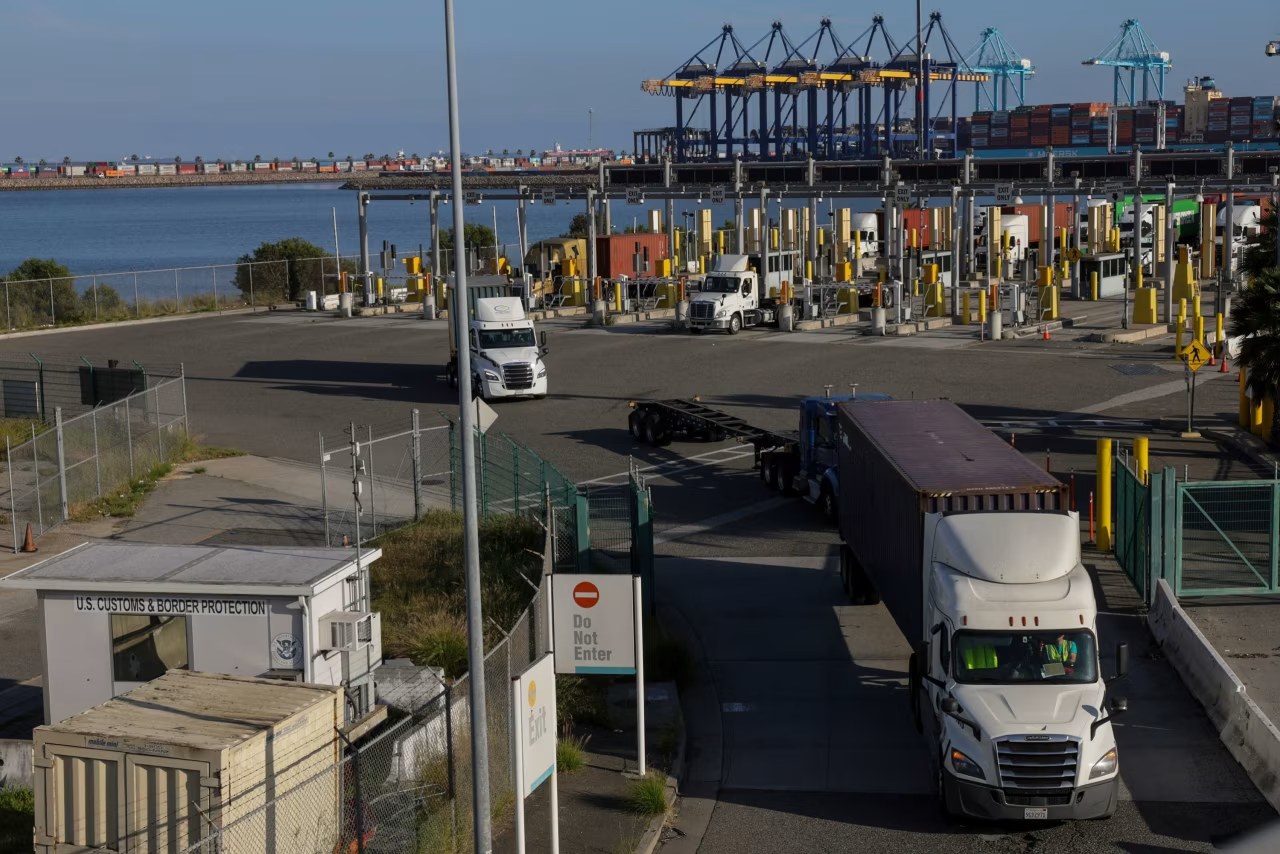
Iran War Oil Shock Sends Diesel Up $1 Since January, Slicing 5% Off Trucker Pay
- Diesel has jumped more than $1 per gallon since January as Middle East conflict disrupts supply chains.
- Independent trucker Heather Griffith loses roughly 5% of her earnings on each 500-mile haul.
- U.S. forces massed 8,000 miles away are preparing for wider war, tightening global oil flows.
- Analysts warn the Iran war oil shock could push gasoline past $4 nationally by July 4.
America’s 3.5 million truckers and 260 million motorists face the biggest fuel-price jolt since 2008.
IRAN WAR OIL SHOCK—Heather Griffith keeps a simple spiral notebook in the cab of her Kenworth. On page after page, the 42-year-old independent trucker writes down the price she pays for diesel each night she leaves the Los Angeles rail yard bound for California Polytechnic State University. Since January, those numbers have marched steadily higher—up more than a dollar a gallon—erasing about 5% of her take-home pay on the 500-mile round trip she runs six nights a week hauling modular dorm rooms.
Griffith is not alone. From Long Beach to Newark, truckers, farmers, and commuters are absorbing the first shock waves of what analysts call an Iran war oil shock, a supply crunch triggered by escalating U.S. military operations 8,000 miles away in the Persian Gulf. Oil markets have already priced in the risk of a wider conflict, lifting the national average for diesel to $4.61 a gallon, the highest March level on record, according to AAA data released Monday.
The ripple effects are moving fast. Diesel is the lifeblood of the U.S. freight system; when its price spikes, groceries, construction materials, and Amazon packages all get more expensive. Economists at JPMorgan now estimate that every sustained 10-cent rise in diesel adds roughly $15 billion in annual logistics costs across the economy. With a dollar-plus increase since New Year’s, the Iran war oil shock is on track to siphon more than $150 billion out of consumer wallets before the holiday shopping season unless diplomacy or additional supply intervenes.
The $1 Diesel Surge: How Fast Fuel Costs Are Eroding Truckers’ Margins
Heather Griffith’s notebook tells the story better than any spreadsheet. On January 2, she paid $4.02 per gallon at a TA Travel Center in Ontario, California. By March 15, the same pump displayed $5.09. The 27% jump translates to an extra $64 in fuel for every 500-mile haul, roughly the cost of groceries for her teenage daughter for a week.
Griffith owns her truck and books loads through the Spot market, meaning she bears 100% of the fuel risk. A typical round trip consumes 75 gallons. At today’s prices, she spends $382 on diesel before subtracting insurance, maintenance, and loan payments. Her net margin per run has fallen from $312 in January to $248, a 20% drop.
Owner-operators are quitting in record numbers
The Owner-Operator Independent Drivers Association (OOIDA) surveyed 1,300 members last week; 38% say they are considering parking their trucks if spot rates do not rise within 60 days. That exodus would remove an estimated 260,000 trucks from U.S. highways, tightening freight capacity and accelerating goods inflation. The Iran war oil shock is therefore not just a petroleum story—it is a labor-market story.
Historical context sharpens the stakes. During the 2008 oil spike, diesel peaked at $4.84 in July before collapsing with the financial crisis. Back then, crude hit $147 a barrel. Today Brent is only $92, yet diesel is already within pennies of its all-time high, reflecting the premium markets attach to geopolitical risk around the Strait of Hormuz, through which 21% of global oil transits.
Forward-looking signals are flashing red. The CME Ultra-Low-Sulfur Diesel futures curve shows backwardation through December 2025, indicating traders expect tight supply to persist. If the Iran war oil shock escalates and Washington imposes secondary sanctions on Iranian crude buyers such as China and India, analysts at Energy Aspects warn Brent could vault to $120, pushing retail diesel above $6 and gasoline toward $5 nationally.
Why the Iran War Oil Shock Could Push Gasoline Past $4 by July 4
Gasoline prices lag diesel by roughly six weeks because refiners prioritize the more lucrative truck and jet fuel markets. But the Iran war oil shock is now propagating down the barrel. On March 18, the national average for regular stood at $3.52, up 41 cents since January. Tom Kloza, global head of energy analysis at OPIS, told clients Tuesday that a glide path to $4 by Independence Day is ‘base-case unless OPEC+ announces a surprise 1 million barrel-a-day increase.’
Seasonal factors compound the risk. Refineries conduct maintenance between February and April, trimming U.S. gasoline output by about 600,000 barrels per day. Meanwhile, the Environmental Protection Agency’s summer-blend switch reduces vapor pressure specifications, effectively removing another 500,000 barrels per day of supply. Inventories measured by the Energy Information Administration are already 7% below the five-year average.
$4 gasoline has political consequences
The last time prices breached that threshold, in 2008, President George W. Bush’s approval rating slid to 25%. Today, with the 2024 election cycle underway, White House officials have discussed another Strategic Petroleum Reserve (SPR) release. Yet the SPR currently holds 347 million barrels, down from 621 million in 2020 after President Biden’s 180-million-barrel drawdown. Analysts calculate an additional 40-million-barrel sale would lower pump prices by only 15 cents a gallon for six months—insufficient to offset the Iran war oil shock.
State-level impacts vary. California drivers pay an average $4.97 today; Mississippi drivers $3.09. If crude spikes to $120, Goldman Sachs estimates 19 states would top $4, including Texas, Ohio, and Florida. The investment bank assigns a 35% probability to that scenario before September unless a cease-fire emerges in the Persian Gulf.
Consumer behavior is already shifting. Waze traffic data shows U.S. vehicle miles traveled fell 0.8% in February, the first year-over-year decline since 2021. A repeat of 2008-style demand destruction—where gasoline demand dropped 4%—would shave 0.3 percentage points off GDP growth, according to Oxford Economics, amplifying recession odds that markets price at 45% by Q1 2025.
Which Regions Face the Sharpest Pain From the Iran War Oil Shock?
The Iran war oil shock is not an equal-opportunity crisis. Diesel demand is highest in the Midwest farm belt and the Gulf Coast petrochemical corridor, while gasoline consumption peaks in the sprawling suburbs of the Southeast. Overlay those demand centers with pipeline access and refinery capacity, and a clear geography of pain emerges.
Texas refines 6.1 million barrels of oil per day, more than any state, but also consumes 1.2 million barrels of diesel monthly for drilling and fracking operations in the Permian Basin. When diesel rises above $4.50, break-even costs for shale producers jump by $6 per barrel, curbing output growth. The Energy Information Administration reported last week that Permian rig counts fell by five, the first decline this year.
California’s unique blend wall
California drivers pay the most because only a handful of refineries worldwide can produce the state’s bespoke CARB gasoline. The Iran war oil shock has lifted California’s average to $4.97, and analysts at Stillwater Associates warn $6 is possible if ExxonMobil’s Torrance refinery, currently offline for planned maintenance, stays down beyond April 10.
The Northeast faces a different squeeze. The region relies on imported diesel from Europe, but EU refineries are running at 86% capacity, down from 92% last year after strikes in France and maintenance in Rotterdam. Imports into New York Harbor now command a 25-cent-per-gallon premium over the Gulf Coast, the widest spread since 2013.
Mountain states have the least wiggle room. Wyoming, Montana, and Idaho lack pipeline connections to Gulf Coast refineries and depend on a single 40-year-old pipeline from Billings to Denver. When that line went down for 48 hours in February, Denver diesel shot up 37 cents. A prolonged Iran war oil shock could trigger intermittent shortages across the Rockies this summer, state regulators warn.
Could Relief Come From OPEC+, the SPR, or a Cease-Fire?
The fastest way to blunt the Iran war oil shock is diplomacy. Analysts at ClearView Energy Partners assign a 25% probability to a partial cease-fire in the Strait of Hormuz by June, which could shave $15 off Brent and 35 cents off diesel within a month. Yet neither Tehran nor Washington has signaled flexibility; Iran continues uranium enrichment at 60%, while the U.S. deployed a second carrier strike group to the Gulf last week.
OPEC+ holds the next lever. The 23-nation alliance meets June 2. Technically, it can increase output by 2 million barrels per day, but Saudi Arabia has warned it will not ‘fill gaps created by geopolitics’ unless consuming nations offer security guarantees against future price crashes. Analysts peg the odds of a unilateral Saudi hike at 30%.
The SPR is depleted
The U.S. Strategic Petroleum Reserve ends March at 347 million barrels, its lowest level since 1983. Energy Secretary Jennifer Granholm told Congress that refilling the reserve above 400 million barrels is a ‘national security priority,’ yet purchases scheduled for this summer have been deferred to avoid competing with private buyers during peak demand. A 30-million-barrel emergency sale, which the White House is reportedly considering, would lower pump prices by only 12 cents for three months, according to ClearView.
Domestic production is creeping higher. U.S. output reached 13.2 million barrels per day last week, up 300,000 from January, but frackers face $80-a-barrel breakevens in the Permian once diesel hits $5. The Iran war oil shock therefore risks choking off the very supply response that could tame prices.
Demand-side measures remain. The administration is reviving talks for a federal rebate tied to fuel efficiency, and California is fast-tracking its summer waiver to allow cheaper winter-blend gasoline early. Yet these tweaks offset only 5–7 cents a gallon, a marginal cushion against a $120 crude scenario that would send gasoline toward $5 nationally.
What History Tells Us About the Iran War Oil Shock’s Endgame
The last time markets faced a similar disruption was 1990, when Iraq’s invasion of Kuwait removed 4.3 million barrels per day from supply. Crdoubled to $41 within three months, lifting U.S. gasoline to $1.35, equivalent to $3.25 today. Once Operation Desert Shield secured Saudi cooperation and Washington tapped the SPR, prices retreated 40% within a year.
Today’s Iran war oil shock differs in scale and structure. The world consumes 102 million barrels per day, 30% more than in 1990, yet spare capacity has fallen from 10% to 3%. Back then, OECD nations held 115 days of import cover in strategic stocks; today the figure is 65 days. The margin for error is thinner, and the rebound potential higher.
Lessons from 2008
In 2008, a demand-driven spike sent Brent to $147. The global recession that followed destroyed 2 million barrels per day of consumption, proving that triple-digit prices sow the seeds of their own destruction. The Energy Department’s latest forecast shows a similar elasticity: a sustained $120 price would cut U.S. demand by 900,000 barrels per day within 18 months, enough to send crude back toward $90.
But the transition could be painful. During the 2008 episode, unemployment jumped from 5% to 10%, and consumer confidence plunged to an all-time low. If the Iran war oil shock propels gasoline past $4 nationally, the Federal Reserve estimates headline inflation would rise 0.7 percentage points, complicating the central bank’s plan to cut interest rates later this year.
Geopolitically, the 2015 Iran nuclear deal offers a roadmap. Under that accord, Tehran limited enrichment and regained the right to export 1 million barrels per day. A revived agreement, floated by Oman last month, could restore those barrels within six months and clip $20 off Brent. Yet domestic politics in both Washington and Tehran make 2024 negotiations unlikely before the U.S. election, leaving markets to price war risk well into next year.
Frequently Asked Questions
Q: How much have diesel prices risen since January?
Diesel has surged more than $1 per gallon since January as the Iran war oil shock tightens global supply and raises trucking costs.
Q: What share of a trucker’s earnings does fuel now consume?
The price spike consumes roughly 5% of independent trucker earnings per 500-mile haul, according to California driver Heather Griffith.
Q: Could gasoline hit $4 nationwide this summer?
Analysts warn the Iran war oil shock could push the national gasoline average past $4 by July 4 if Middle East barrels stay offline.
