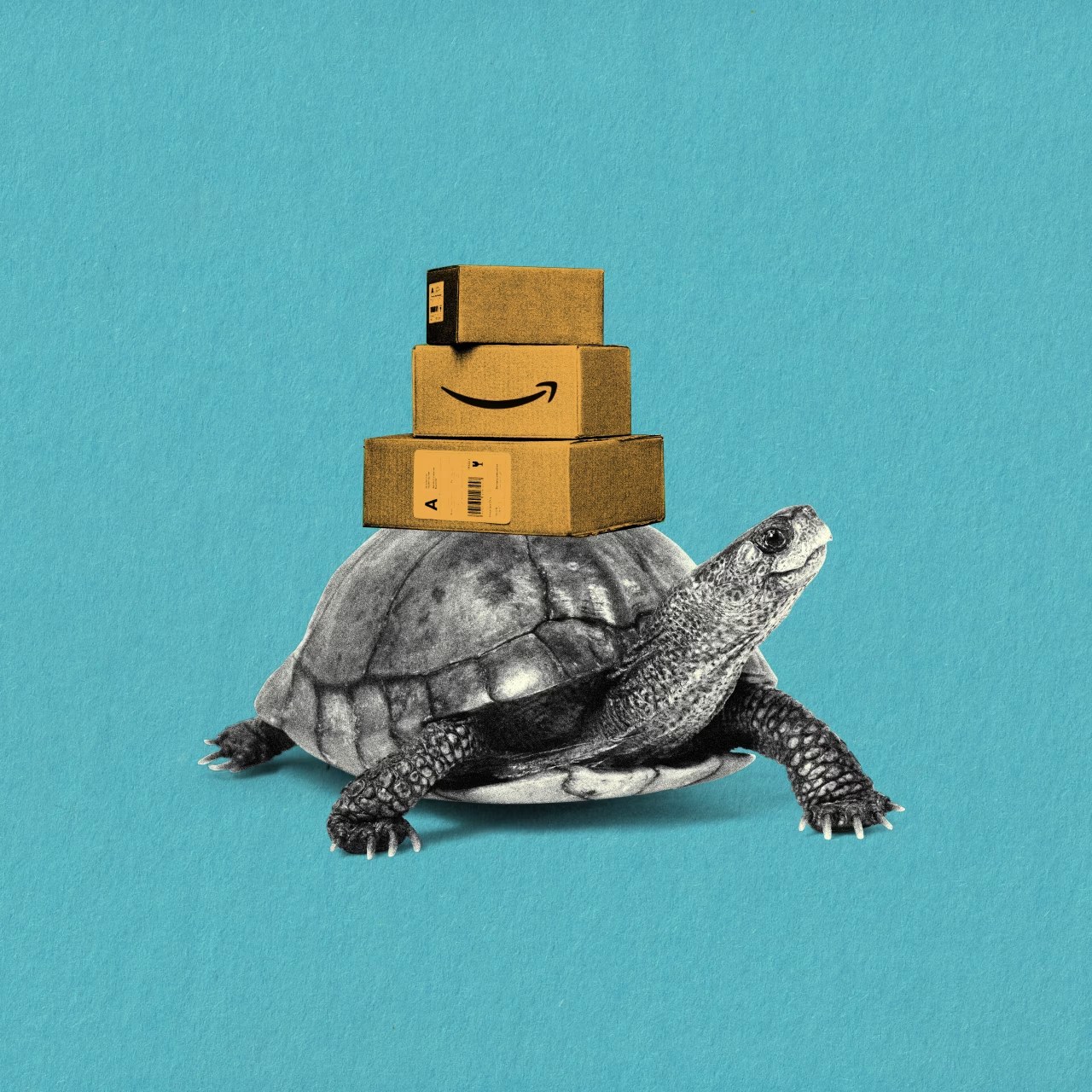
7% Discount on Delayed Shipping Marks End of Fast Free Shipping Era
- Amazon now offers a 7% discount for customers who choose later delivery dates.
- Gap provides up to five shipping options, including a free “no‑rush” choice that can take nine business days.
- The shift reflects growing retailer pressure to curb costly same‑day logistics.
- Consumers are being nudged toward slower, cheaper shipping without losing free‑shipping perks.
Retail logistics are at a crossroads
AMAZON—Remember that package you ordered last week? It should be arriving any day now, but the promise of lightning‑quick, free delivery is fading.
After years of priming shoppers to expect speedy deliveries, the ever‑growing e‑commerce economy is weaning us off them—and no one seems to mind.
The pioneer of same‑day delivery—Amazon—whose deliveries were so quick that the rest of the industry hustled to match them, now offers some customers a 7% discount if they select a later arrival date.
The Rise of Same‑Day Delivery and Its Discontents
From novelty to norm
When Amazon first rolled out same‑day delivery, it was hailed as a logistics marvel that reshaped consumer expectations. The service promised that a product ordered in the morning could be at the doorstep by evening, effectively erasing the distance between online click and physical receipt.
That promise spurred an industry‑wide sprint. Competitors scrambled to build fulfillment networks capable of matching Amazon’s speed, investing billions in warehouse automation, last‑mile couriers, and predictive inventory placement. The result was a market where “fast free shipping” became a baseline expectation rather than a premium.
Yet the model carries hidden costs. Rapid fulfillment demands dense warehousing near major metros, expensive air‑freight for last‑mile hops, and a workforce that must operate around the clock. Over time, those costs have begun to surface in corporate earnings reports and investor briefings, prompting a strategic reassessment.
Implications for retailers
Retailers now face a paradox: they must keep the promise of speed to retain customers while also protecting margins that are squeezed by the high price of ultra‑fast logistics. The tension is evident in the latest moves by Amazon and Gap, two companies that sit at opposite ends of the price spectrum but share a common response—offering incentives for slower shipping.
Industry analysts note that the shift is not merely a cost‑saving measure; it also reflects a broader recalibration of consumer expectations. Shoppers who once demanded instant gratification are beginning to weigh price, sustainability, and convenience more holistically. This evolution sets the stage for the next chapter, where discount incentives become a lever to guide shopper behavior.
As the logistics landscape continues to evolve, the question looms: will fast free shipping become a relic of a bygone era, or will new technologies revive its feasibility? The answer will shape the next wave of e‑commerce strategy.
Why Are Retailers Offering Discounts for Slower Shipping?
Amazon’s 7% discount as a case study
Amazon’s recent policy of granting a 7% discount to customers who opt for a later delivery window is a concrete illustration of the new calculus. The figure—7%—is not arbitrary; it reflects a margin that the company believes can be reclaimed by shifting orders away from the costly same‑day pipeline.
By nudging shoppers toward a slower timeline, Amazon reduces the need for premium air‑freight, short‑notice warehouse staffing, and the logistical gymnastics required to meet a same‑day promise. The discount also serves a behavioral function, subtly rewarding price‑sensitive shoppers without overtly charging for speed.
Economic rationale
From a financial perspective, the discount translates into a direct cost reduction. If a typical order is $100, a 7% discount saves the consumer $7 while potentially saving the retailer a larger amount per order in fulfillment expenses. Over millions of orders, the aggregate savings can be substantial, helping to offset the erosion of profit margins caused by free‑shipping expectations.
Retailers like Gap are employing a similar strategy, albeit with a different framing. Gap’s “no‑rush” shipping option, which can take up to nine business days, is typically the cheapest—often free—choice for shoppers. By positioning the slower option as the most economical, Gap aligns cost savings with consumer choice.
Implications for consumer behavior
The emerging pattern suggests that retailers are moving from a model where speed is the default to one where speed is a premium feature. Consumers who value cost savings will gravitate toward the discounted or free slower options, while those who cannot wait will continue to pay for expedited service.
In the next chapter, we will examine how Gap’s multi‑option strategy operationalizes this shift and what it means for the broader market.
How Gap’s ‘No Rush’ Option Redefines Value
Five delivery choices, one free favorite
Gap’s website now lists as many as five distinct shipping options, ranging from standard to express. The standout is the “no‑rush” choice, which can take up to nine business days and is usually the cheapest—or even free—alternative, depending on the basket size.
This tiered approach gives shoppers clear price signals. The slower option is positioned as the most economical, while faster tiers carry higher fees. By doing so, Gap leverages price elasticity: customers who are less time‑sensitive naturally select the free or low‑cost tier, reducing the retailer’s fulfillment burden.
Implications for logistics and margins
From a logistics standpoint, the ability to spread out deliveries over a longer window eases pressure on distribution centers and last‑mile carriers. It also allows for more efficient routing, batch processing, and potentially lower carbon emissions per package.
Financially, the free “no‑rush” option can improve gross margins on orders that would otherwise incur shipping costs. For Gap, the strategy also serves as a differentiator in a crowded apparel market, where free shipping is often a baseline expectation.
Expert context
Supply‑chain analysts note that offering a free, slower option can be a win‑win: it satisfies cost‑conscious consumers while granting retailers operational flexibility. The approach mirrors tactics used by grocery and home‑goods retailers, where delivery windows are used to balance capacity and cost.
Looking ahead, the next chapter will explore how these shifting incentives reshape overall consumer expectations and what that means for the future of fast free shipping.
What Does the Shift Mean for Consumer Expectations?
Changing the mental model
For years, the phrase “fast free shipping” has been a cornerstone of e‑commerce marketing. The recent moves by Amazon and Gap suggest that the mental model is evolving. Shoppers are now being asked to consider trade‑offs between cost and speed, a decision that was previously framed the other way around.
Psychologically, the introduction of a discount for delayed delivery reframes slower shipping as a benefit rather than a compromise. The 7% discount from Amazon, for example, turns a potential inconvenience into a tangible monetary gain, encouraging consumers to re‑evaluate the value of immediacy.
Timeline of key milestones
The shift can be traced through a series of public policy changes and product announcements. While exact dates are not disclosed in the source, the sequence of events includes Amazon’s discount rollout, Gap’s expansion to five shipping tiers, and the broader industry’s acknowledgment of rising fulfillment costs.
These milestones illustrate a broader industry trend: logistics providers are moving from a “speed‑first” paradigm to a “choice‑first” paradigm, where speed is one of several variables shoppers can manipulate.
Implications for the market
Retailers that adapt quickly may capture cost‑conscious shoppers, while those that cling to fast free shipping at all costs could see margin compression. For consumers, the net effect could be lower overall shipping spend, albeit with longer wait times for a subset of orders.
In the final chapter, we will look ahead to how these dynamics could reshape the e‑commerce landscape over the next decade.
Future Scenarios: From Fast Free Shipping to Choice‑Driven Logistics
Potential pathways
Looking forward, the e‑commerce sector could follow several trajectories. One scenario sees fast free shipping becoming a premium, pay‑for‑speed service, reserved for high‑value or time‑critical purchases. Another envisions a hybrid model where retailers routinely present a menu of shipping speeds, each tied to clear cost incentives.
In the hybrid model, the primary driver is consumer empowerment. Shoppers decide whether to pay for speed or accept a discount for a slower window, much like they choose between economy and business class on airlines. This could lead to a more efficient allocation of logistics capacity, reducing waste and potentially lowering carbon footprints.
Industry experts weigh in
Logistics futurists argue that advances in AI‑driven demand forecasting and autonomous delivery could eventually lower the cost of same‑day fulfillment, making fast free shipping viable again. However, they caution that such technologies will likely be adopted first by the largest players, widening the gap between premium and standard services.
Meanwhile, sustainability advocates point out that slower shipping can reduce emissions by allowing for more consolidated deliveries. If consumer preferences shift toward greener options, retailers may find additional justification for promoting “no‑rush” choices.
Strategic recommendations
For retailers, the immediate recommendation is to experiment with pricing incentives similar to Amazon’s 7% discount and Gap’s free “no‑rush” tier. Tracking uptake, cost savings, and customer satisfaction will provide data to refine the model.
For policymakers, encouraging transparency around shipping costs and environmental impact could help consumers make informed choices, further supporting a market where speed is a selectable attribute rather than an assumed default.
As the balance between speed, cost, and sustainability continues to evolve, the era of fast free shipping may give way to a more nuanced, choice‑driven logistics landscape.
Frequently Asked Questions
Q: Why are retailers moving away from fast free shipping?
Retailers are introducing slower, cheaper options and discounts like Amazon’s 7% off for later delivery to cut costs, manage capacity, and give shoppers more choice while still meeting demand for free shipping.
Q: How does Gap’s “no rush” shipping work?
Gap labels its cheapest delivery as “no rush,” allowing orders to arrive in up to nine business days and often providing the service for free, depending on the purchase value.
Q: What impact could the shift from fast free shipping have on consumers?
Consumers may see longer delivery windows but benefit from lower prices or discounts, while the logistics network could become less strained, potentially improving sustainability and reliability.
