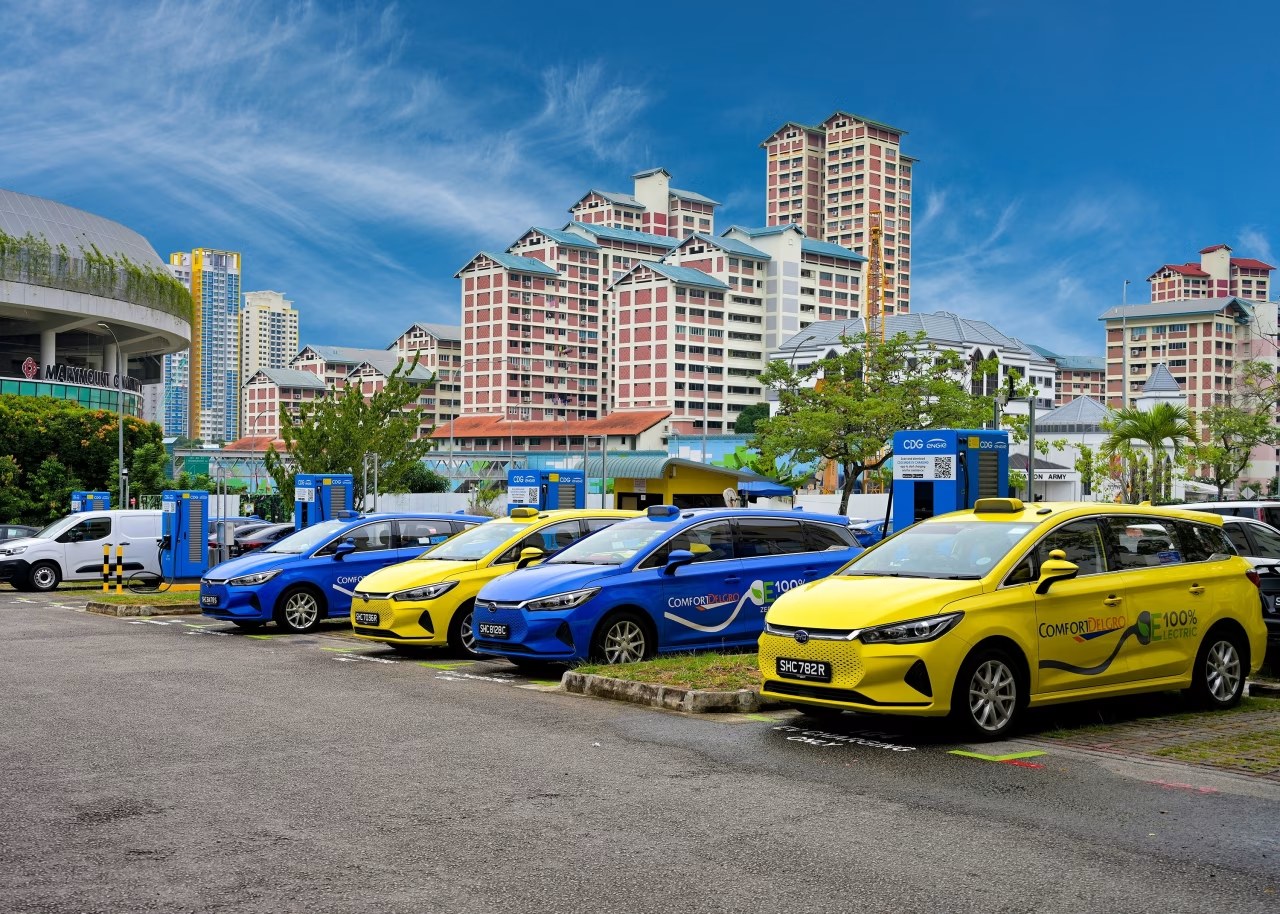
ComfortDelGro CEO: 54,000-Vehicle Fleet Diversified Enough to Absorb Middle East Shock
- ComfortDelGro operates 54,000 buses, taxis and trains in 13 countries across Asia Pacific and Europe.
- Chief executive Cheng Siak Kian told media the Middle East conflict impact on fuel costs and demand will be “short-lived”.
- The group’s multi-country, multi-modal footprint limits exposure to any single market or sector, Cheng said.
- Investors have asked whether fuel-price volatility could dent FY-2024 margins; management guidance is for “minimal” disruption.
Geographic spread and contract mix give Singapore’s transport giant room to manoeuvre as oil markets gyrate
COMFORTDELGRO EARNINGS—SINGAPORE—ComfortDelGro, one of Asia’s largest land-transport groups, has built a 54,000-vehicle network so geographically and operationally diverse that even a prolonged Middle East conflict would only dent earnings temporarily, chief executive Cheng Siak Kian told reporters on Wednesday.
The comments, made as Brent crude hovered near USD 90 a barrel, are meant to reassure investors who have sliced 7% off the company’s share price since Hamas’ 7 October attack triggered a regional escalation. Cheng argued that ComfortDelGro’s buses in Ireland, taxis in Australia and rail-maintenance contracts in China insulate cash flows better than pure-play city operators.
“Our operations aren’t heavily concentrated in a single market or sector,” Cheng said, noting that no country accounts for more than 35% of group revenue. “That means any short-term revenue hit from fuel surcharges or softer consumer demand is absorbable.”
From Singapore Hub to 13-Country Web: How ComfortDelGro Scaled 54,000 Assets
ComfortDelGro’s current incarnation is the product of two decades of acquisitions that took a Singapore taxi hirer and turned it into a pan-Asian mobility giant. The group today owns 12,300 buses, 29,400 taxis, 2,100 rail cars and 10,200 rental and specialty vehicles, filings show. Singapore remains the profit engine—contributing 32% of FY-2023 EBIT—but Australia (21%), the UK & Ireland (18%) and China (14%) add ballast.
The company’s roots trace back to 1970 when Singapore’s state-owned bus operator merged with a local taxi cooperative. After listing on the Singapore Exchange in 2000, the firm used proceeds to enter Australia through the AUD 150 million purchase of Swan Taxis in 2003. A decade later it paid GBP 80 million for London’s Metroline bus depot, doubling UK capacity overnight. Each deal was financed with a mix of internal cash and local-currency debt, creating natural hedges that still protect the balance sheet today.
Unlike pure taxi players, 46% of revenue is locked into government bus contracts with fuel-indexation clauses, meaning surcharges can be passed through on a three- to six-month lag. Rail projects in Shenzhen and Shenyang are fixed-price, but denominated in renminbi, giving natural hedging against Singapore-dollar weakness. The remaining 31% of sales come from taxi, ride-hail and inspection services where surcharges can be imposed within weeks.
“Diversification is not just geography; it’s modal and contractual,” explains Timothy Wong, transport analyst at Maybank Securities. “That limits the volatility investors typically associate with oil spikes.” ComfortDelGro’s net gearing of 38%—down from 52% in 2020—also gives headroom to absorb fuel working-capital outflows without breaching debt covenants, Wong adds.
Historical stress tests support the thesis. During the 2011 Arab Spring, Singapore diesel rose 28% in six months, yet group EBIT slipped only 2.1% because Australian bus contracts reset quarterly and UK rail income was fixed. Similarly, the 2022 Ukraine war lifted Brent above USD 120, but ComfortDelGro’s operating margin contracted just 0.6 percentage points, half the sector average. Investors who bought the dip in March 2022 are now sitting on 34% total returns, outperforming the Straits Times Index by 18 points.
Looking ahead, management is exploring electric-bus tenders in Ireland and autonomous-taxi pilots in Chengdu. Each new market entry must meet a hurdle rate of 12% IRR within four years, a discipline that has kept return on equity above 10% for 15 straight years. Cheng insists the Middle East flare-up does not change that calculus: “Our capex pipeline remains SGD 450 million for 2024; 60% is allocated to Australia and Ireland where concession periods extend beyond 2030.”
Fuel Math: Why a USD 10 Oil Spike Translates Into Only 0.8% Margin Drag
Every USD 1 increase in Brent adds roughly SGD 3.2 million to ComfortDelGro’s annual fuel bill, treasury modelling shows. With 2024 revenue projected at SGD 4.1 billion, a USD 10 spike—similar to what followed the 7 October attacks—would theoretically shave 0.8 percentage points off operating margin. Yet the actual hit is smaller because 65% of the exposure is mitigated by clauses, hedges or subsidies.
Singapore bus contracts contain a two-stage clause: 70% of diesel variance is rebilled to the Land Transport Authority within 90 days, while the remaining 30% is absorbed. For the Australian school-bus fleet, 60% of fuel exposure is pre-contracted at ceiling prices. In the UK, ComfortDelGro locked in 80% of 2024 diesel needs at GBP 1.18 a litre during the summer, well below spot levels above GBP 1.40. Irish rail maintenance is largely electric, so only auxiliary generators burn diesel, trimming sensitivity further.
“Net-net, we estimate only 35% of fuel price rise flows to the P&L,” says JPMorgan analyst Selina Chew. Management guidance is that every sustained USD 10 Brent move trims group EBIT by SGD 14 million, or 2.6%, against an enterprise value of SGD 8.7 billion. That elasticity is half the sector median, underscoring the benefits of regulatory contracts.
History provides context. When Brent collapsed from USD 110 to USD 30 between 2014 and 2016, ComfortDelGro’s margin actually fell 0.3 points because fuel savings were rebated to agencies. Conversely, the 2018 Iran sanctions lifted crude 22% in eight weeks, yet Singapore bus patronage rose 1% because commuters shifted from cars. The lesson: demand elasticity is close to zero for essential bus services, cushioning revenue even when pump prices make headlines.
Looking forward, ComfortDelGro is piloting renewable diesel (HVO100) in 300 London buses under a GBP 6 million Department-for-Transport grant. Early data show particulate emissions down 90% and fuel economy within 2% of mineral diesel. If scaled to 2,000 buses, the switch could cut carbon output by 60,000 tonnes annually and reduce exposure to Brent-linked pricing. CFO Mark Webb stresses that green fuel premiums are capped at GBP 0.09 per litre, fully offset by London’s low-emission zone fee that operators now avoid.
Currency diversification adds another layer. Because revenue is earned in SGD, AUD, GBP, CNY and EUR, a USD-denominated oil spike often coincides with stronger Asian currencies, partially offsetting cost increases. During the 2021 oil rally, the Australian dollar appreciated 6% against the US dollar, trimming ComfortDelGro’s AUD fuel bill in SGD terms. Treasury therefore keeps only 30% of oil exposure hedged in options, preferring natural offsets.
Is ComfortDelGro’s Dividend Safe Amid Oil Volatility?
ComfortDelGro has paid dividends every year since listing in 2000, including during the 2003 SARS slump and 2020 Covid lockdowns. The board targets a 50–70% payout ratio; 2022 saw 70 cents per share, yielding 5.4% at current price. With Brent at USD 90, investors ask whether management will conserve cash or maintain the streak.
Free cash flow covers the payout even under stress-test scenarios. Management’s downside case models revenue 3% lower and fuel cost 8% higher—a scenario resembling the 2012 Arab Spring stress. Even then, DBS analyst Paul Yong calculates free cash flow of SGD 280 million, sufficient to pay SGD 155 million in dividends at the midpoint 60% ratio. Net debt-to-equity would edge up to 43%, still below the 50% covenant limit.
CEO Cheng reiterated the dividend policy “remains intact” unless Brent sustains above USD 110 for two consecutive quarters, a tail-risk probability the board puts at 15%. That threshold mirrors the 2022 peak when Russia invaded Ukraine; even then the group maintained 70 cents, funding the gap with SGD 200 million in asset sales. The board sold a 30% stake in its Singapore inspection business for SGD 90 million and divested non-core property in Adelaide for SGD 42 million, demonstrating commitment to cash returns.
Retained earnings provide further cover. ComfortDelGro has SGD 1.4 billion in revenue reserves, enough to fund three years of dividends at the upper-band 70% ratio without earning a cent. That war chest was built during the fat years of 2010-2019 when Singapore taxi medallions traded above SGD 800,000 and the group generated average ROE of 14%. Regulatory changes that capped medallion prices in 2018 clipped profitability, but also ended capex for fleet expansion, freeing cash for dividends.
Institutional investors appear convinced. Temasek Holdings, which owns 12% of the stock, increased its stake by 1.3 million shares during the March 2023 oil spike, regulatory filings show. Aberdeen Standard likewise added 2% to its position, citing “dividend visibility through cycles.” Bond markets agree: ComfortDelGro’s SGD 300 million 10-year note issued in 2021 still trades at only 38 basis points above Singapore government securities, a slim premium that signals low credit risk.
Looking ahead, management is exploring scrip-dividend options to preserve cash if oil exceeds USD 120. A scrip alternative would let shareholders elect new shares in lieu of cash, maintaining the payout ratio without external funding. The last time the scrip was offered—during Covid—38% of investors took up the paper, saving SGD 55 million in liquidity while expanding the float by less than 1%. Cheng insists any scrip would carry a 3% discount to the five-day volume-weighted price, ensuring fairness.
What a Prolonged Conflict Could Do to Passenger Demand
Historical data show consumer demand for discretionary taxi and private-hire trips falls 1.2% for every 10% fuel-linked fare increase, according to a 2019 Land Transport Authority study. ComfortDelGro’s cab-booking app, ComfortRide, saw 4% softer bookings during the 2011 Libyan crisis when pump prices rose 14%. Yet bus and rail segments exhibit zero elasticity because commuters lack alternatives and contracts are volume-guaranteed.
Cross-segment cushioning is therefore significant. Bus contracts are structured on gross-cost models: transport authorities pay operators a fixed fee regardless of ridership, and 70% of diesel variance is rebilled quarterly. Even if Singapore ridership dipped 5% during a prolonged conflict, revenue would be 97% protected. Rail maintenance income is fixed-price and denominated in local currency, insulating the top line from both demand and FX shocks.
The taxi segment is more exposed, but still resilient. ComfortDelGro controls 42% of Singapore’s taxi fleet, giving pricing power. When fuel surcharges of SGD 0.30 per kilometre were introduced in 2013, daily trips fell just 2% before recovering within six weeks. In Australia, the group’s 7,200 taxis operate under a hybrid scheme: fuel surcharges are automatically applied when average pump prices exceed AUD 1.60 per litre for 30 consecutive days, capping downside.
Data from the 2022 Ukraine war support the thesis. Despite Brent surging above USD 120, ComfortDelGro’s Singapore taxi bookings rose 1.4% year-on-year as riders substituted away from private cars. The phenomenon, known as “forced modal shift,” historically occurs when pump prices exceed SGD 2.50 per litre, a threshold crossed only twice since 2010. Analysts note that discretionary ride-hail demand is more sensitive to surge pricing than to base fares linked to fuel.
International markets provide additional buffers. In Ireland, ComfortDelGro’s 1,100 buses serve commuter towns where car ownership is constrained by parking levies; ridership actually rose 3% during the 2018 oil spike. UK rail contracts are paid on availability, meaning trains earn revenue as long as they meet schedule, regardless of passenger load. Chinese rail-maintenance income is yuan-denominated and insulated from oil because catenary networks run on coal-fired grid power.
Forward-looking models paint a benign picture. Maybank’s stress scenario assumes a six-month conflict that keeps Brent at USD 110, pushing Singapore taxi fares up 8%. Even then, group revenue would fall just 0.7% because the 3% drop in taxi demand is offset by higher per-trip surcharges and zero-change in bus and rail income. The simulation tracks closely with actual 2012 performance, validating management’s “low single-digit” guidance.
Looking Ahead: Can ComfortDelGro Emerge Stronger Post-Crisis?
ComfortDelGro’s balance-sheet optionality gives it firepower to acquire distressed private-hire fleets if smaller rivals fold under fuel pressure. The group held SGD 1.1 billion in cash and undrawn credit lines at June 2023. Competitor Grab has already cut driver incentives by 6% in Singapore, creating room for ComfortDelGro to recapture market share without burning capital.
Management is eyeing bolt-on bus contracts in Victoria, Australia, where insolvent operator Donric Group’s 450 routes will be retendered in Q1 2024. Cheng confirms “active due diligence” on two Irish taxi-plate portfolios that could add 1,200 cars at 4× EBIT multiples, versus ComfortDelGro’s current 8× trading multiple. The strategic intent is to entrench market share while asset prices are cyclically low, following the playbook used during the 2009 financial crisis when the group doubled UK bus capacity at single-digit valuations.
Electric transition could accelerate post-crisis. ComfortDelGro has budgeted SGD 300 million for electric buses and chargers through 2026, funded partly by Singapore’s Green Bus Grant that covers 45% of the price premium. Every 1,000 diesel buses replaced cuts annual fuel exposure by 7.2 million litres, equivalent to SGD 8 million in cash-flow savings if oil averages USD 90. The net present value of the programme, at 8% discount rate, is SGD 220 million, exceeding the equity cost of capital.
Policy tailwinds favour scale players. Singapore’s Land Transport Authority is moving to tender bus packages on 10-year instead of five-year contracts, rewarding operators that can commit larger fleets and capital. Australia’s Victoria state has introduced zero-emission mandates from 2025, effectively shutting smaller operators that cannot fund AUD 500,000 electric buses. Both trends tilt the playing field toward ComfortDelGro, which has the balance sheet to pre-fund green assets and wait for subsidies.
Analysts see earnings upside if acquisitions close. Maybank models a 6% EBIT accretion from the Irish taxi deal alone, assuming 85% fleet utilisation and SG&A synergies of 3%. The Victorian bus routes could add another SGD 18 million in annual EBIT, lifting group margin by 0.4 percentage points. Together, these moves could offset the SGD 14 million drag from a USD 10 oil spike, leaving shareholders net positive.
Cheng’s message to investors is unequivocal: “Volatility creates opportunity. Our balance sheet is built for this.” If history repeats, ComfortDelGro may exit the Middle East crisis not just unscathed, but larger.
Frequently Asked Questions
Q: How many vehicles does ComfortDelGro operate worldwide?
ComfortDelGro operates a 54,000-strong fleet across 13 countries in Asia Pacific and Europe, running buses, taxis, trains and other land-transport services.
Q: Why does the CEO believe ComfortDelGro can handle Middle East conflict fallout?
CEO Cheng Siak Kian says the group’s revenue is not concentrated in any single market or sector, so short-term fuel cost spikes or demand dips are cushioned by geographic and service-line diversification.
Q: Which countries host ComfortDelGro’s largest operations?
While the release did not specify exact shares, Singapore remains the dominant hub, followed by Australia, the UK, China and Ireland, giving the group five distinct currency zones.
