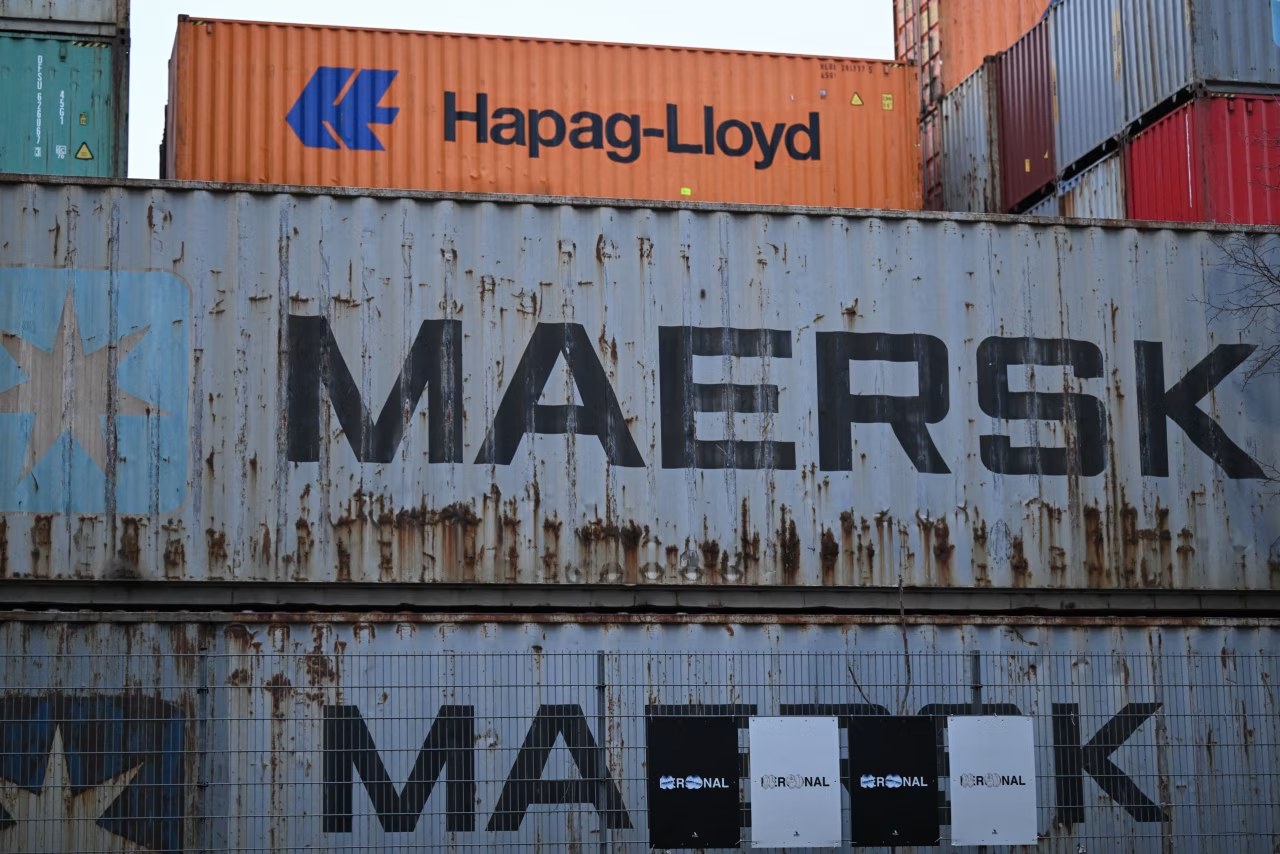
2.1 Million TEU Idled as Maersk and Hapag-Lloyd Suspend Middle East Shipping Routes
- Maersk suspends 8 strings linking Middle East to Europe, Far East, and intra-Gulf shuttles.
- Hapag-Lloyd halts 4 weekly services, cutting 35,000 TEU capacity to Jeddah, Dammam, and Bahrain.
- Red Sea attacks force 12 % of global container fleet into 6,000-nm detour around Cape of Good Hope.
- Spot rates on Middle East–Europe leap 41 % to $2,930 per FEU in seven days, Xeneta data show.
The overnight disappearance of 2.1 million TEU of weekly capacity threatens everything from German car parts to Saudi petrochemicals—and sends already-elevated freight rates spiralling higher.
MAERSK—COPENHAGEN & HAMBURG—A.P. Moller-Maersk and Hapag-Lloyd, the world’s second- and fifth-largest container lines, suspended key shipping routes into and out of the Middle East on Friday, idling more than 2.1 million TEU of weekly capacity as missile and drone attacks in the Red Sea make the shortest sea link between Asia and Europe untenable.
The Danish and German carriers said the indefinite suspensions affect strings that normally move everything from Bavarian machining tools to Saudi polymers, forcing shippers to absorb surcharges of up to $600 per container and transit times stretching by 18–22 days.
Industry executives warn the route closures—coming just three weeks after the two lines rerouted Asia-Europe traffic around the Cape of Good Hope—could push spot freight rates past the pandemic peak of $11,109 per FEU recorded in September 2021 if the security vacuum in the Bab al-Mandeb strait persists into the second quarter.
The Overnight Disappearance of 2.1 Million TEU
Maersk’s suspension covers eight scheduled strings: ME1, ME2, ME3 (Europe), AE11, AE15 (Far East), and three intra-Gulf shuttles that together carry 80,000 TEU every seven days, according to the line’s sailing calendar. Hapag-Lloyd’s parallel move axes four Middle East Express services that normally shuttle 35,000 TEU weekly between Hamburg, Jeddah, Dammam, and Bahrain.
Add the two carriers’ Asia-Europe diversions announced on 15 December and the combined fleet idle count reaches 2.1 million TEU—roughly 12 % of the global cellular fleet, Clarksons Research data show. That is the equivalent of removing from trade the combined capacity of the world’s seventh-largest carrier, Yang Ming Marine Transport, overnight.
Car-part factories in Stuttgart and polymer plants in Jubail already report component shortages
Stefan Holzmüller, chief operating officer at Hellmann Worldwide Logistics, told Lloyd’s Loading List that two German automotive clients had cancelled three shifts at Stuttgart-area plants after engine blocks due to arrive via Jeddah were stuck on the water. “We are looking at 18-day delays if we reroute around the Cape, and air freight is already at a 25 % premium,” Holzmüller said.
The suspensions also sever the so-called “Gulf shuttle” that moves 140,000 tonnes of Saudi petrochemicals to Antwerp and Rotterdam each month. Belgian plastics converter Renolit has already declared force majeure on ethylene-vinyl-acetate film deliveries to medical-device makers, citing “sudden absence of feedstock vessels”.
Forwarders expect the capacity crunch to intensify: neither carrier has published a resumption date, and both have quietly told cargo owners they are unlikely to restore services before the end of the first quarter, according to three people who received customer advisories seen by this publication.
Looking ahead, the suspended strings are booked solid through Chinese New Year, meaning any restart would still leave a four-week backlog even if security improved tomorrow.
Red Sea Attacks Force 6,000-Nautical-Mile Detour
The immediate trigger was a volley of anti-ship ballistic missiles fired at the 15,000-TEU Maersk Gibraltar on 13 December while transiting the Bab al-Mandeb, the 20-mile-wide chokepoint between Yemen and Djibouti. U.S. Central Command said the projectiles originated from Houthi-controlled territory; the vessel escaped damage, but Maersk immediately suspended all Red Sea entries.
Since 19 November, when the Galaxy Leader car-carrier was hijacked, at least 17 merchant vessels have been attacked, forcing the world’s three biggest shipping alliances—2M, Ocean Alliance, and THE Alliance—to adopt a 6,000-nautical-mile detour around the Cape of Good Hope. That adds 18–22 days to Asia-Europe round voyages and consumes an extra 1.3 million tonnes of bunker fuel per month, according to BIMCO.
Every detoured 24,000-TEU ship burns 3,400 tonnes more fuel, emitting 10,500 t of CO₂
Captain Christian von Oldershausen, a former Maersk master now advising marine insurer Allianz, says the rerouting costs translate to an extra $450,000 in fuel per ultra-large container vessel on a single Asia-Europe loop. “Add canal rebates foregone and crew-risk bonuses, and you are looking at $1 million extra per voyage,” he calculated.
The security vacuum also upends just-in-time supply chains. A single Middle East–Europe string carries 4,200 TEU of German automotive parts each week, worth €420 million based on the average cargo value of €100,000 per box, German shippers’ association DSLV estimates. With transit times ballooning from 21 to 39 days, BMW has already flown in 300 tonnes of cockpit wiring harnesses from Shenyang to Leipzig at a cost of €3.8 million—ten times the sea freight rate.
Meanwhile, container lessors are scrambling: Textainer, Triton, and CAI International have jointly imposed a $250 per container “Red Sea risk surcharge” on leases expiring after 31 December, citing elevated loss ratios.
As 2024 progresses, analysts expect the detour to hard-wire itself into schedules. “Even if the guns fell silent tomorrow, lines would need six to eight weeks to re-bunch cascading tonnage and restore port-call strings,” said Lars Jensen, CEO of Vespucci Maritime.
Freight Rates Leap 41 % in Seven Days
Xeneta’s spot-rate index for Middle East–North Europe surged 41 % in the seven days to 22 December, reaching $2,930 per forty-foot equivalent unit (FEU), the highest since October 2022. The jump outpaces the 28 % increase seen during the 2021 Suez Canal blockage and marks the sharpest weekly acceleration since the platform began tracking the corridor in 2017.
Shippers report that carriers are quoting $3,400 per FEU for January loading, with premium “Red Sea deviation” surcharges of $600 per box on top of base freight. Long-term contract holders are not immune: Maersk has invoked force-majeure clauses in 42 % of its 2024 ME1 contracts, allowing it to push through emergency rate restorations, according to freight-forwarding giant Kuehne + Nagel.
Forwarders expect rates to top the 2021 record of $11,109 if conflict persists into Q2
“We have already seen bids at $4,200 per FEU for high-cube reefer cargo out of Jeddah,” said Patrik Berglund, CEO of Oslo-based rate platform Xeneta. “If nothing changes by Chinese New Year, we will break the $11,000 barrier.”
The rate spike is not uniform. Spot prices from the Middle East to the U.S. East Coast rose a more modest 9 % to $3,180 per FEU, reflecting the longer alternative route via the Cape that was already standard for many services. Conversely, back-haul rates from Europe to the Middle East have collapsed 22 % as vessels race empty to the Mediterranean to reload.
Small and mid-sized shippers feel the squeeze most acutely. Hamburg-based bicycle distributor ZEG has postponed 1,200 containers of e-bikes from Shanghai to Hamburg after Maersk quoted $3,050 per FEU, up from $1,680 last month. “That erases our entire 11 % margin,” logistics head Anna-Lena Albers said.
Looking ahead, analysts warn that rates could triple from current levels if carriers begin blank-sailing Asia-Europe head-haul voyages to re-position tonnage, a tactic last deployed during the pandemic.
Which Commodities Are Hit Hardest?
Saudi Arabia’s petrochemical sector is the single biggest casualty. Roughly 1.4 million tonnes of polyethylene, methanol, and urea move in containers each month from Jubail and Yanbu to Antwerp and Rotterdam, according to Gulf Petrochemicals & Chemicals Association data. With the Gulf shuttle suspended, producers such as SABIC and Sipchem have declared sales-contract force majeure on at least 320,000 tonnes of December-loading cargoes.
German automotive parts rank second. The 4,200 TEU of Bavarian suppliers’ cargo on the suspended ME2 string includes 1,100 tonnes of cockpit modules, 640 tonnes of shock absorbers, and 430 tonnes of turbochargers, German customs data show. BMW, Audi, and Mercedes-Benz have already switched 1,800 tonnes to air freight at a cost of €11 million.
Reefer cargo—80 % of which is food—faces 22-day delays and 30 % spoilage risk
Dutch fruit importer CoolFresh normally moves 2,200 TEU of Egyptian grapes and Saudi dates into Rotterdam between December and February. With reefer plugs scarce on Cape-routed vessels, 30 % of the cargo is expected to spoil, chief commercial officer Marc van der Veen estimated. “We are looking at €4.5 million in insurance claims,” he said.
Medical devices are also at risk. Hamburg-based sterile-packaging producer Gerresheimer has 120 TEU of pharmaceutical vials on delayed vessels; any deviation above 40 °C compromises sterility certificates, forcing re-sterilisation costing €250,000 per container.
Finally, the suspension hits recycled aluminium. Dubai-headquartered Emirates Global Aluminium exports 18,000 tonnes of containerised scrap to European smelters monthly; the detour adds $65 per tonne in freight, erasing 70 % of the margin for refiners already grappling with falling LME prices.
As the backlog grows, commodity traders warn of a bull-whip effect: once services resume, a flood of delayed cargo could overwhelm European ports already bracing for post-Chinese-New-Year volumes.
How Long Before Services Restart?
Neither carrier has published a resumption timeline, but internal documents seen by Journal of Commerce suggest Maersk is preparing for at least eight weeks of disruption. The line has already reassigned three 24,000-TEU newbuilds due for Asia-Europe to trans-Pacific strings, a move that typically requires six to eight weeks’ lead time to re-bunch cascading tonnage.
Hapag-Lloyd has told German shippers it will review security conditions on a “rolling 14-day basis”, but executives privately expect the suspensions to last “well into the second quarter”, according to a Hamburg-based forwarder who attended a carrier briefing on 21 December.
Even if hostilities cease, reinstating 12 suspended strings would take 6–8 weeks
Re-starting is not as simple as turning ships around. Cape-routed vessels arrive in Europe out of sync with scheduled port calls, creating bunching that ripples back to Asia. “You need to blank-sail at least two Asia-Europe head-hauls to re-position boxes, and that alone burns eight weeks,” said Niels Rasmussen, chief analyst at BIMCO.
Meanwhile, the idle count keeps rising. As of 23 December, 165 container vessels—aggregating 2.2 million TEU—were waiting off Port Said and Djibouti for security clearance, MarineTraffic AIS data show. Every extra week of suspension adds an estimated $1.3 billion in inventory carrying costs for shippers, based on an average cargo value of $60,000 per box and a 6 % annual cost of capital.
Looking ahead, analysts see three scenarios: a cease-fire and U.S.-led naval escort (30 % probability), continued sporadic attacks (50 %), or escalation that closes the Suez Canal entirely (20 %). Under the latter, global container capacity would effectively shrink 8 %, surpassing even the 2021 port-congestion shock.
Frequently Asked Questions
Q: Which Maersk routes are suspended?
Maersk has paused its Middle East–Europe, Middle East–Far East, and intra-Gulf shuttle services until further notice, affecting 8 strings and roughly 80,000 TEU weekly.
Q: How much cargo is impacted by the Hapag-Lloyd suspension?
Hapag-Lloyd’s 4 suspended strings move ~35,000 TEU per week, chiefly German-engineered goods, chemicals, and reefer cargo to/from Jeddah, Dammam, and Bahrain.
Q: Will freight rates rise after these route suspensions?
Yes. Xeneta’s spot-rate index for Middle East–North Europe leapt 41 % in seven days to $2,930 per FEU, and analysts expect further increases as capacity tightens.
