2-Year Suez Closure: Iran Conflict Delays Hapag-Lloyd’s 2025 Canal Return
- Hapag-Lloyd CEO Rolf Habben Jansen confirms the carrier is pausing its 2025 Suez restart plan.
- The world’s fifth-largest liner last moved a containership through the canal in 2021.
- More than two years of Red Sea unrest have effectively closed the waterway to box services.
- Rerouting 2.5 M TEU monthly around the Cape adds 10–14 days and $1 m in fuel per round-voyage.
Global supply-chain relief now hinges on geopolitics, not logistics.
SUEZ CANAL—The Middle East conflict has derailed container shipping’s most direct path between Asia and Europe. On Monday, Rolf Habben Jansen, chief executive of German carrier Hapag-Lloyd, told analysts the company is shelving any near-term plan to send its 331-ship fleet back through the Suez Canal.
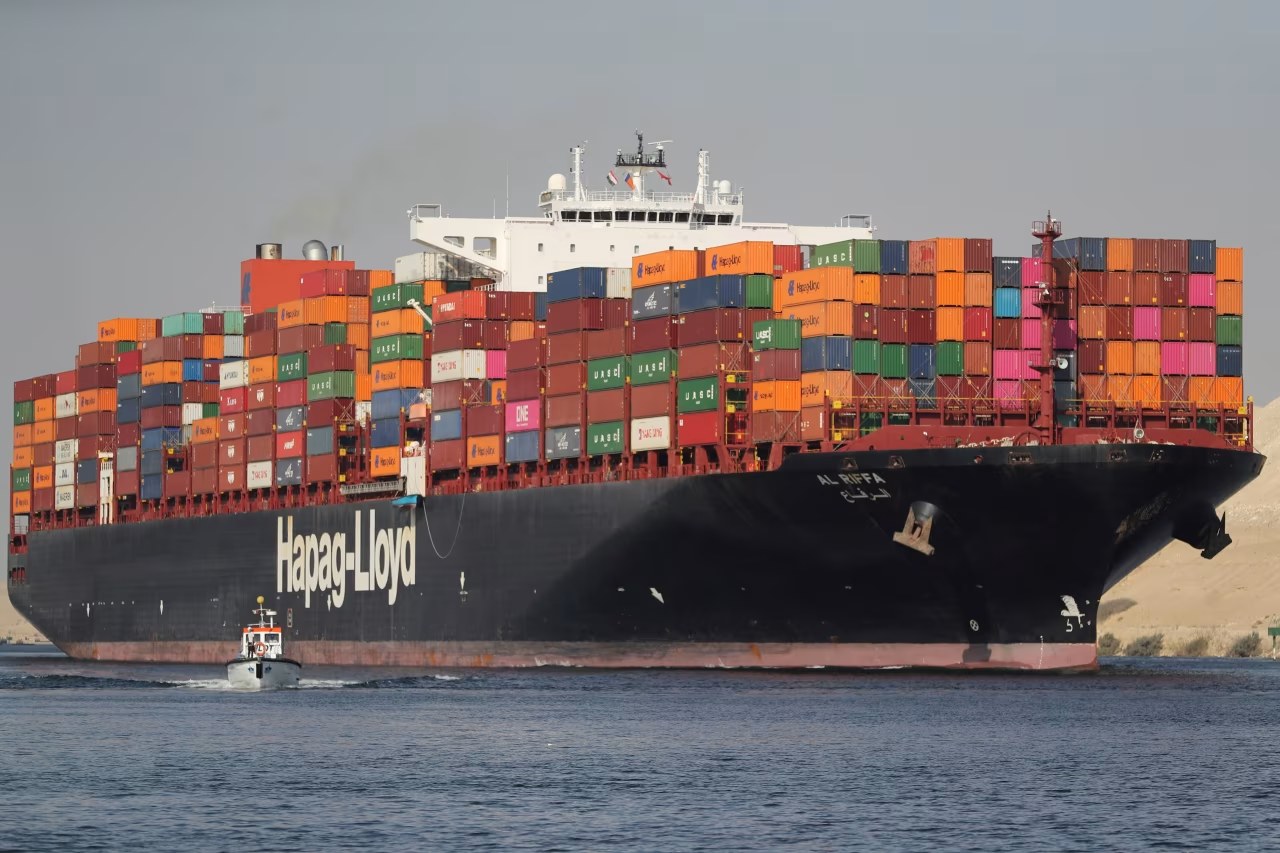
The announcement marks the second straight year the world’s fifth-largest liner operator has scrapped a comeback to the 120-mile Egyptian waterway that normally handles 12 percent of global trade. Hapag-Lloyd’s last Suez transit—photographed in 2021—now feels like a relic of pre-crisis normality.
With Iran-linked militias escalating attacks on merchant hulls, the carrier’s 2.5 million TEU monthly capacity will stay on the 4,000-nautical-mile detour around the Cape of Good Hope. Shippers face at least another year of $700-per-FEU bunker surcharges and transit times stretched by a fortnight.
The 2025 Restart That Never Was
Hapag-Lloyd began 2024 briefing charterers that a phased Suez reopening was pencilled for the second half of 2025. The plan assumed a U.S.-brokered de-escalation after Yemen’s Houthi rebels agreed to a fragile truce in January. Instead, April drone strikes on Israeli-linked tankers and July missile hits on three containerships convinced underwriters to keep Red Sea war-risk premiums at 1.2 percent of hull value—five times 2021 levels.
Jansen told reporters the carrier’s contingency board met on 12 August and voted unanimously to suspend all canal re-entry studies until at least Q2 2026. The Hamburg-based line has 151 vessels on Asia-North Europe and 78 on Asia-Mediterranean strings; none will file Suez transit permits this winter.
The reversal echoes 2023, when Hapag-Lloyd abandoned a similar restart after the 14,000-TEU Al-Muraykh was forced to turn back mid-canal when a nearby tanker caught fire. Since then, the average weekly container volume through Suez has fallen from 470,000 TEU to below 35,000, according to Suez Canal Authority data released 30 September.
Cost of the long haul
Every diverted 23,000-TEU ULCV burns roughly 210 tonnes of additional bunkers per day on the Cape route. At today’s Rotterdam VLSFO price of $582 per tonne, a single round-voyage bleeds $1.05 million in extra fuel, not counting canal toll savings of $735,000. Carriers pass the net $315,000 cost to shippers via emergency surcharges that have stayed on invoices for 26 consecutive months.
Forwarders surveyed by Container Trade Statistics in August report average Asia-North Europe spot rates at $4,870 per FEU—78 percent above the 2019 baseline, even though vessel capacity is 6 percent higher than pre-crisis. The paradox keeps global inflation forecasts sticky: the IMF estimates the Red Sea detour adds 0.3 percentage points to world consumer prices.
Who Still Dares to Transit?
While Hapag-Lloyd holds the line, smaller niche carriers have quietly resumed limited runs. Eastern Mediterranean operator MPC Container Ships said 14 September it will deploy three 2,800-TEU vessels on a Turkey-Egypt-Jeddah loop that transits Suez twice per 28-day rotation. The Danish stock-listed carrier secured war-risk cover at a flat $75,000 per voyage—cheaper than the extra bunkers on the Cape detour for ships under 4,000 TEU.
Yet the big three alliances remain absent. Ocean Alliance, THE Alliance and 2M have filed zero Asia-Europe Suez transit plans for November, according to port-calling schedules published on 27 September. Collectively the groupings control 82 percent of the trade, so their absence keeps canal receipts in free-fall.
Suez Canal Authority revenues for container vessels collapsed to $293 million in the first eight months of 2024, down from $3.9 billion in the same period of 2022—a 92 percent plunge that has forced Egypt to devalue the pound three times this year. Cairo now budgets canal income at just 0.7 percent of GDP, half the 2022 share.
Insurance as gatekeeper
London underwriters will not green-light mega-ships without naval escort, according to Neil Roberts, head of marine and aviation at the Lloyd’s Market Association. Only warships from Operation Prosperity Guardian—primarily U.S., U.K. and Greek frigates—offer credible cover, but escort slots are rationed to two convoys per week and priority is given to tankers and grain carriers under UN humanitarian clauses.
Container lines also fear crew repatriation risk. The International Transport Workers’ Federation recorded 2,400 seafarer resignations from Red Sea-bound vessels in August alone, the highest monthly figure since the 1980s Iran-Iraq tanker war.
The stalemate leaves Hapag-Lloyd and peers in limbo. Until insurers or navies change posture, the canal that once moved 19,000 ships a year will stay a ghost lane for boxships.
Is the Cape Route the New Normal?
Shipping veterans warn the industry is quietly institutionalising the Cape detour. Alphaliner data show 167 new Asia-Europe services launched since January 2023; 152 of them route exclusively around South Africa. Slot allocations have become so predictable that Maersk now publishes a 42-day Cape transit schedule—identical to the pre-crisis Suez timetable plus the two-week penalty.
Ports from Tangier to Colombo have retooled rotations. Salalah, once a Suez refuelling stop, lost 38 percent of its container calls in 2024; Cape Town, previously a niche cruise hub, handled 313 boxships in August, triple 2021 levels. Transnet, South Africa’s port operator, is fast-tracking a $1.2 billion dredging project to deepen berths for 24,000-TEU giants.
Hapag-Lloyd’s Jansen admits the Cape template could calcify. “Once customers redesign supply chains around 36-day lead times, reverting to 22 days becomes disruptive,” he told investors on 16 September. Retailers such as Inditex and IKEA have already shifted European distribution centres from Hamburg to Gdansk to sync with the longer maritime leg.
The environmental math is bleak. A single 18,000-TEU vessel rerouted via the Cape emits an extra 4,900 tonnes of CO₂ per round-voyage, according to IMO 2024 emissions factors. With 2.5 million TEU monthly on the detour, the sector adds 1.05 million tonnes of CO₂ each month—equal to the annual output of Lebanon.
Yet carriers face no carbon penalty; the EU Emissions Trading System covers only voyages terminating in Europe, and the extra distance is treated as “force majeure.” Environmental NGOs are lobbying Brussels to close the loophole in 2025, but liner lobby group World Shipping Council warns any new tax would simply be passed on to importers.
Geopolitics Over Logistics: What Has to Change?
Analysts agree only a durable Red Sea ceasefire—not lower insurance rates—will coax Hapag-Lloyd back. The carrier’s three pre-conditions, repeated by Jansen on 23 September, are: zero missile attacks on boxships for 60 consecutive days, removal of war-risk premiums by the London market, and written safe-passage guarantees from both Iran-backed Houthis and Western navies.
None look imminent. U.S. Central Command recorded 72 Houthi attacks on merchant vessels since January, including two on 26 September that targeted 14,000-TEU ships registered in Singapore and Liberia. Tehran’s support for the rebels—evidenced by confiscated missile guidance systems displayed at a Pentagon briefing on 5 October—keeps diplomatic talks stalled.
Even if guns fell silent tomorrow, insurers would demand a 30-day “quiet period” before downgrading premiums, pushing the earliest realistic Suez reopening into Q3 2025. Hapag-Lloyd has therefore written off any canal benefit in its 2025 budget, locking in $1.4 billion extra bunker cost across the fleet.
Customers are responding by “near-shoring.” EU import data for July show Chinese televisions and Vietnamese footwear down 18 percent year-on-year, while Turkish and Moroccan shipments of the same HS codes rose 24 percent. The reshuffle shortens supply chains to Europe via overland routes, bypassing both the Red Sea and the Cape.
For now, the canal that Ferdinand de Lesseps hailed as the “highway of empires” remains hostage to a regional proxy war. Until geopolitics shifts, Hapag-Lloyd’s 331 ships—and the wider container ecosystem—will keep Africa’s southern cape on the horizon.
Frequently Asked Questions
Q: Why is Hapag-Lloyd delaying its Suez Canal return?
CEO Rolf Habben Jansen cites intensified Iran-linked attacks on Red Sea shipping that make the 2025 restart plan too risky for the 5th-largest global carrier.
Q: How long has the Suez Canal been closed to most boxships?
Container services have avoided the canal for more than two years; Hapag-Lloyd alone last ran a containership through in 2021.
Q: What routes are carriers using instead of Suez?
Lines reroute 2.5 M TEU monthly via the Cape of Good Hope, adding 10–14 days and ~1 Mt CO₂ per round-voyage versus the Suez shortcut.
