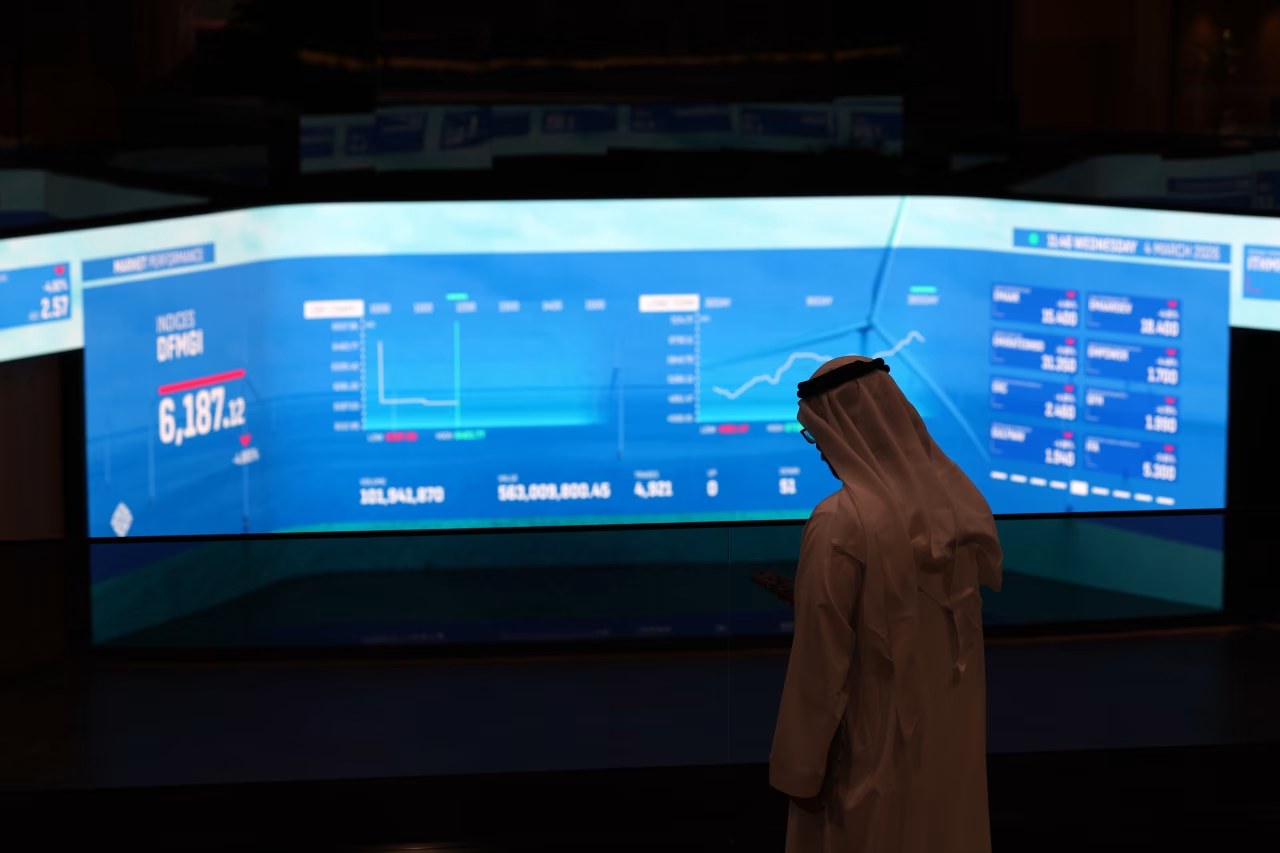
$42B Evaporates: Iran War Triggers Biggest Gulf Market Rout Since 1991
- Persian Gulf exchanges lose $42 billion in market cap in 21 trading days
- Dubai’s DFM General Index tumbles 19%, Saudi TASI drops 11%
- 31 tankers stranded off Fujairah; Brent spikes $7.4 to $92.8/bbl
- Tel Aviv TA-35 jumps 9% on defense-spending rotation
- 7,400 regional flights cancelled; insurers slap war-risk surcharges
After decades of cushioned volatility, investors are waking up to a new risk map
IRAN WAR—For two decades investors treated the Gulf as a bubble of calm. Oil rents and careful diplomacy insulated glitzy Dubai and ultra-modern Doha from the wars raging in Gaza, Lebanon and Syria. That immunity shattered overnight when Iranian missiles began hitting UAE airspace and Qatari LNG terminals, forcing markets to re-price geopolitical risk in real time.
Between April 2 and April 29 the six-member Gulf Cooperation Council (GCC) saw $42 billion in equity value erased—its steepest three-week slide since Iraq’s 1990 invasion of Kuwait—while benchmark Brent crude leapt $7.40 to $92.80 per barrel, according to Bloomberg data. The Tehran Stock Exchange All-Share Index, already down 34% year-to-date, fell another 15% in five sessions as the rial plunged past 650,000 per dollar on the parallel market.
The inversion is stark: while Dubai property bellwether Emaar sank 24% and Saudi petro-giant SABIC lost 13%, Tel Aviv’s TA-35 military-cyber cohort gained 9%, powered by Elbit Systems (+26%) and Rafael Advanced Defense Systems (+31%). Investors are rotating out of perceived Iranian firing-range assets and into companies set to benefit from a prolonged air-defense build-out.
— Flight Paths and Freight Rates: The $42B Selloff
Airspace closures and tanker detours are translating directly into equity markdowns
The first tremor came on April 3 when Emirates, flydubai and Qatar Airways simultaneously suspended flights to Tehran, Isfahan and Shiraz. Within 72 hours the UAE’s General Civil Aviation Authority had recorded 1,324 flight cancellations and 2,100 reroutings, shaving an estimated $540 million off airline sector market cap, according to S&P Global.
Meanwhile Lloyd’s Market Association added the Persian Gulf and Gulf of Oman to its Listed Areas for war risk, driving up daily tanker rates on the benchmark AG-China route from $2.35 per barrel on April 1 to $3.01 on April 24. Thirty-one laden crude carriers now sit idle off Fujairah, data from Vortexa show, tying up 18 million barrels of oil worth roughly $1.6 billion at current prices.
Equity investors responded with a region-wide risk-off. Saudi Arabia’s Tadawul All-Share retreated 11% in three weeks, vaporizing $27 billion. Dubai’s DFM General Index—heavily weighted toward tourism and logistics—plunged 19%, erasing $9 billion. Qatar’s QE Index fell 12%, slicing $5 billion off the bourse. Kuwait, Bahrain and Oman posted smaller but still sharp corrections, completing the $42 billion rout.
Analysts say the speed of the repricing is unprecedented. “We have not seen a synchronized GCC drawdown of this magnitude since the 1991 Gulf War,” said Mona Dajani, a London-based partner at law firm Pillsbury who advises sovereign funds. “The market is pricing in a scenario where air and sea corridors remain contested for months, not weeks.”
— Tel Aviv’s Surge: Defense Stocks Defy the Odds
Elbit, Rafael and cyber plays are attracting record foreign inflows
While Gulf bourses bled, Israel’s TA-35 logged its strongest three-week run since the 2020 Abraham Accords. The index rose 9%, led by defense contractors Elbit Systems (+26%) and Rafael Advanced Defense Systems (+31%). Cyber-security firms Check Point and CyberArk added 11% and 14% respectively, pushing sector valuation to an all-time high of $38 billion.
Foreign investors pumped $1.2 billion into Tel Aviv during the period, the largest weekly inflow since Bank of Israel records began in 2005. Analysts attribute the rotation to expectations that the government will raise military spending by at least 15% in 2025, translating into multi-year order backlogs for drone-interception systems, surveillance satellites and AI-enabled cyber defenses.
“The market is front-running a structural up-shift in Israeli defense budgets,” said Gilad Itzhak, head of research at IBI Capital in Tel Aviv. “Every 1 shekel increase in defense procurement adds roughly 0.4 shekel to Elbit’s annual EPS.” Elbit’s forward price-to-earnings multiple has expanded from 18× to 23× in a month, still below U.S. peers Raytheon and Northrop at 26×.
Insurance stocks also fared better than expected. Despite 312 rocket interceptions over Israeli cities, property insurers such as Harel and Clal posted single-digit losses as investors bet that government-backed war-damage pools will cap claims. The shekel, after an initial 2% dip, recovered to 3.62 per dollar, outperforming every regional currency except the Kuwaiti dinar.
— Oil: Why a $7.4 Spike May Be Just the Start
Strategic reserve releases are masking a tighter physical market
Brent crude’s $7.40 climb to $92.80 per barrel understates the physical tightness. While benchmark futures reflect a risk premium, on-the-ground cargo differentials tell a starker story: Saudi Arab Medium for Asia delivery now commands a $2.90 premium to Dubai, the widest since the 2019 Abqaiq attack.
Part of the surge is logistical. Tanker owners are demanding war-risk bonuses of $375,000 per voyage, equal to 94¢ per barrel on a two-million-barrel cargo. More importantly, Iran’s own exports—running at 1.6 million barrels per day in March—have fallen to an estimated 800,000 bpd in April as buyers in China and India defer cargoes fearing secondary sanctions or hull seizures.
Yet strategic stocks are cushioning headline prices. The U.S. sold 5.2 million barrels from its SPR in April, while Germany and Japan collectively released 3 million, blunting what analysts at Goldman Sachs estimate would otherwise be a $105-per-barrel print. Forward curves remain in steep backwardation, with December 2025 Brent at $86, signaling expectations of a supply deficit if hostilities persist into winter.
“Every month Iranian barrels stay offline, global inventories draw by 40–45 million barrels,” said Martijn Rats, chief commodities strategist at Morgan Stanley. “By August the OECD stock cover could fall below the IEA’s 90-day mandate, forcing prices above $100.”
— Flight Hiatus and Tourism: Dubai’s $2.2B Reversal
Dubai’s economy, built on aviation, hospitality and re-exports, is feeling the pain acutely. Emirates Group alone contributes 14% of Dubai’s GDP, but the carrier’s market value has fallen $5.4 billion since April 2. Combined with hotel cancellations—Jumeirah Group reports 38,000 room-nights scrapped—tourism revenue could drop $2.2 billion in Q2, equivalent to 2.1% of emirate GDP.
Hotel occupancy slips below 70% for the first time since COVID-19
STR Global data show Dubai hotel occupancy at 68% for the week ending April 27, down from 84% a year earlier. Average daily rates fell 18% to $285, reversing a post-pandemic pricing boom. Qatar is similarly affected: Doha’s Oryx hotel portfolio reported 22% cancellations, mostly from Asian tour operators rerouting Gulf stopovers to Istanbul and Baku.
Commercial real estate transactions in Dubai slid 31% month-on-month in April, according to Property Monitor, as Asian and Russian investors hit pause. Off-plan apartment sales—usually resilient—dropped 27%, dragging overall deal volume to its lowest since June 2020. Emaar Properties has responded by offering post-handover payment plans stretching to 2030, a move last seen during the 2008 financial crisis.
Still, policymakers retain firepower. Abu Dhabi injected $7 billion in stimulus during 2020–21 and retains a fiscal surplus forecast at 6.2% of GDP this year, giving the UAE scope for airline bailouts or tourism rebates if the conflict drags into summer peak season.
— What’s Next: Could a Cease-Fire Reverse the Selloff?
History suggests a diplomatic breakthrough could trigger a violent snap-back. After the 2020 Abraham Accords, Dubai’s DFM surged 16% in a fortnight; Saudi’s TASI added 12%. Fund managers are already positioning for a repeat. EPFR Global tracked $1.8 billion into Middle-East ETFs during the last week of April, the fastest pace since October 2022.
Analysts see 25% upside if Hormuz shipping normalizes
Citigroup’s base-case scenario values Gulf equities on a 12-month forward P/E of 15.2×, below the five-year average of 17.4×. Strategist Rahul Bajaj argues that if tanker insurance premiums revert to pre-escalation levels, combined GCC earnings could rise 9%, translating into a 25% index uplift. Conversely, a prolonged closure of the Strait of Hormuz could shave 3% off global GDP, according to Oxford Economics.
For now, options markets imply a 35% probability of Brent above $100 by September. That keeps sovereign balance sheets flush—Saudi’s breakeven oil price is $79—but leaves equity investors hostage to headlines. As one Dubai-based hedge-fund manager put it: “The risk premium won’t disappear until the last missile is dismantled, and markets know it.”
Until then, investors will keep watching Tehran’s nightly skies—and the ticker tapes that reflect them—for the next signal to buy or bail.
Frequently Asked Questions
Q: How much value have Gulf equity markets lost since the Iran War escalated?
Regional bourses have shed roughly $42 billion in combined market capitalization since cross-fire with Iran began, with Dubai’s DFM General Index down 19% and Saudi’s TASI off 11% in the first three weeks of direct conflict.
Q: Which regional stock market is actually gaining from the conflict?
Tel Aviv’s TA-35 index has rallied 9% as investors rotate into defense, cyber-security and counter-drone firms, betting that Israel’s military spending surge will translate into higher corporate earnings.
Q: How many commercial tankers are currently stranded?
Maritime insurers have added a war-risk surcharge to 31 laden crude and product tankers idling off Fujairah and Qatar, pushing freight rates on Middle-East to Asia routes up 28% in seven trading days.
