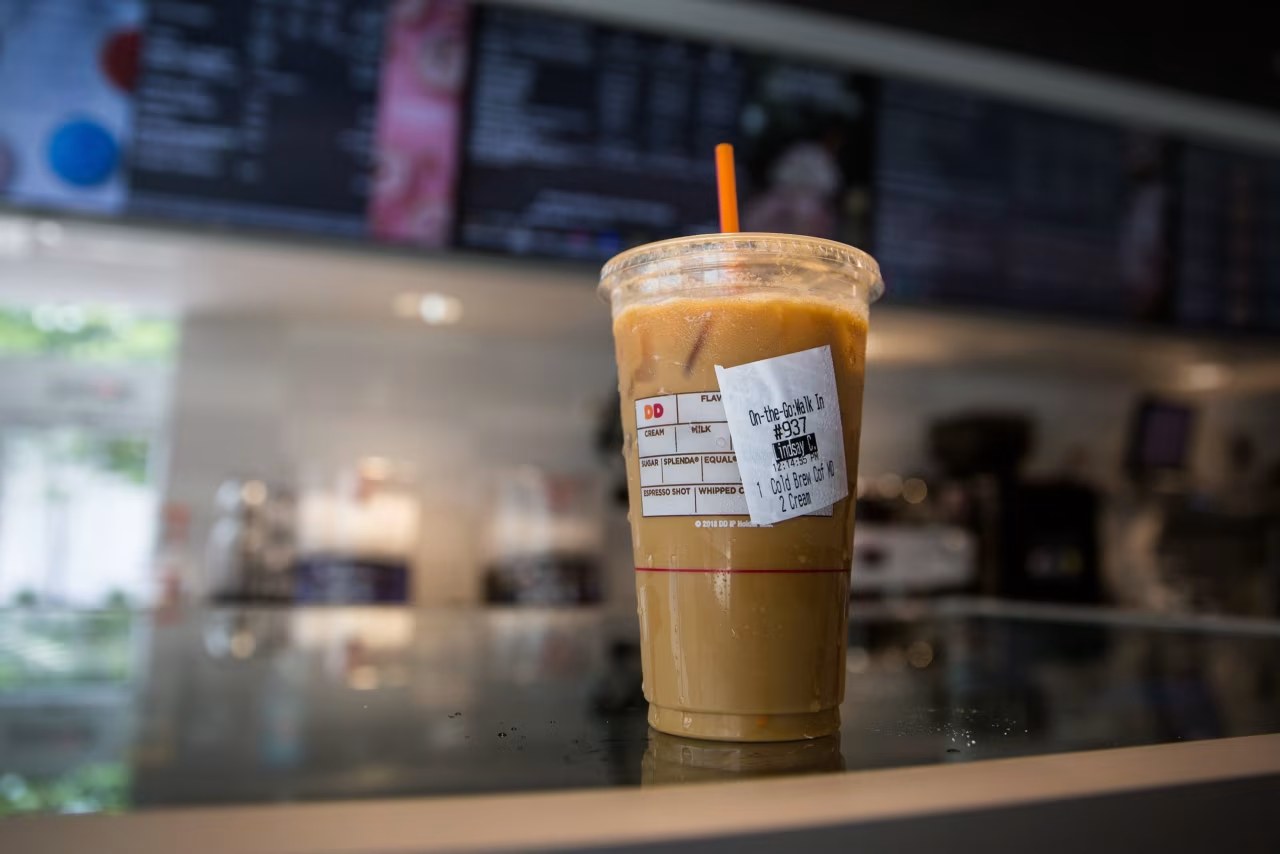
RFK Jr. Sparks 180,000 Tweets in 48 Hours After Hinting Dunkin’ Ingredient Crackdown
- Health Secretary told an Austin crowd the FDA will tighten safety standards for additives used by Dunkin’ and Starbucks.
- Boston-area social media erupted with #DefendDunkin, echoing the city’s 1773 tea-party revolt.
- No formal ban yet, but agency sources say draft guidance on titanium dioxide and BVO could arrive this summer.
- Shares of parent Inspire Brands fell 2.7 % on the news while Starbucks dipped 1.4 %.
Could a regulatory swipe at America’s favorite pink-and-orange chain trigger a modern Boston coffee party?
RFK JR—BOSTON—On a gray March afternoon, the cradle of the American Revolution is once again talking revolt. Only this time the spark isn’t tea—it’s coffee, cream, and a swirl of food-grade chemicals.
Health and Human Services Secretary Robert F. Kennedy Jr., speaking to a health-tech conference in Austin last week, said the Trump administration is preparing to “tighten safety standards for companies’ use of certain ingredients,” naming Dunkin’ and its Seattle-based rival as likely targets.
Within hours, Boston’s perennial devotion to Dunkin’ collided with its reflexive distrust of Washington. By sunset, #DefendDunkin was trending nationwide, local talk-radio lines jammed, and a Dunkin’ store in Dorchester posted a hand-written sign: “We’re still brewing—tell the Feds to chill.”
From Tea to Iced Coffee: Why Boston Flips Over Beverage Regulation
Bostonians have never liked outsiders tampering with their drinks. In 1773, colonists dumped 342 chests of East India Company tea into the harbor to protest British taxes. Two and a half centuries later, the enemy isn’t a monarch—it’s a federal agency armed with new safety data.
The Kennedy trigger
RFK Jr.’s off-hand remark in Austin referenced upcoming FDA guidance on titanium dioxide, potassium bromate, and brominated vegetable oil (BVO). Dunkin’ uses titanium dioxide in some donut glazes and frozen coffee bases for opacity; BVO appears in select citrus-flavored syrups to keep flavoring evenly suspended.
The agency’s draft, first reported by POLITICO in January, would ask manufacturers to justify continued use or reformulate within 18 months. Europe’s food regulator banned titanium dioxide in 2022 after rodent studies showed potential DNA damage at high doses; California’s legislature is weighing a similar move.
Within Massachusetts, the reaction was swift. State Senator Mike Brady of Brockton told the Boston Herald he would “stand between Washington bureaucrats and my cold brew.” A Suffolk University snap poll found 68 % of residents oppose federal intervention on Dunkin’ recipes, up from 54 % when asked about soda regulations in 2014.
Historical parallels abound. “Boston has long used consumer culture as a political stage,” explains historian Nicoletta Giacomazzi of UMass Boston. “Whether it’s tea in 1773, coffee in 2026, or the 1980s’ anti-nuclear stickers on Dunkin’ cups, the city weaponizes everyday rituals.”
The economic stakes are hardly trivial. Dunkin’ operates 1,120 stores in Massachusetts—roughly one per 6,100 residents—supporting an estimated 22,000 jobs and $340 million in annual wages, according to state labor data.
As the FDA prepares to publish its draft, Boston’s instinctive reaction shows how food policy can still ignite the city’s revolutionary DNA.
What’s Inside Your Cup? The Additives Under Federal Review
Consumers rarely read the fine print on a Dunkin’ frozen coffee, but chemists know it as an emulsion of water, sugar, coffee extract, and a handful of industrial-grade additives. Two of those—titanium dioxide and BVO—sit at the center of RFK Jr.’s safety push.
Ingredient spotlight
Titanium dioxide (TiO₂) is a white pigment used since the 1920s to brighten glazes and frosting. The FDA currently allows up to 1 % by weight, but the European Food Safety Authority re-evaluated rodent data in 2022 and found potential genotoxicity, leading to an EU-wide ban that took effect in August 2022.
Brominated vegetable oil, found in select fruit-flavored coffee syrups, keeps citrus oils from floating to the top. The FDA removed BVO from its Generally Recognized as Safe (GRAS) list in 1970, yet allowed interim use pending additional studies. A 2022 University of Michigan analysis linked chronic BVO exposure in rats to thyroid enlargement.
Dunkin’ does not disclose exact additive concentrations, but industry consultants estimate a large chain spends $20–30 million to reformulate across 9,000 U.S. stores, reprint labels, and re-negotiate supplier contracts.
Starbucks, by contrast, phased out titanium dioxide in 2020 and BVO in 2021, giving it a regulatory head start. “We saw the writing on the wall in Europe,” a Starbucks R&D director told Food Business News last year.
For Dunkin’, the clock is ticking. If the FDA draft lands this summer, the chain would have until late 2027 to comply or face seizure actions. Franchisees worry about cost pass-through; analysts project a 3–4 % menu price hike if Dunkin’ absorbs the full expense.
As Washington re-draws the line between acceptable risk and consumer outrage, Dunkin’ faces a stark choice: reformulate fast or gamble on public push-back against regulators.
Which Cities Drink the Most Dunkin’? A Regional Breakdown
If Boston is the spiritual capital of Dunkin’, the brand’s footprint stretches from Portland, Maine to Pensacola, Florida. Yet nowhere is density higher than in New England, where the chain controls 62 % of the coffee-and-doughnut market, according to Euromonitor.
Metro rankings
Greater Boston leads with 1.85 Dunkin’ stores per 10,000 residents, followed by Providence (1.79) and Worcester (1.64). Even Hartford, Connecticut, once a stronghold of rival Starbucks, now hosts 94 Dunkin’ locations within a 30-mile radius.
The South shows the fastest growth. Tampa added 42 outlets since 2022, and Miami-Dade county crossed 200 stores last December. Still, per-capita penetration in the South averages 0.4—less than one-fourth of New England levels.
Economists say density matters because fixed compliance costs hit franchisees harder where revenues are lower. A typical Boston store grosses $1.6 million annually versus $980,000 in the Gulf Coast, according to franchise disclosure documents.
That divergence explains why the Massachusetts Restaurant Association lobbied RFK Jr.’s office last month, arguing that “one-size-fits-all regulation disproportionately harms small operators in our highest-cost markets.”
As the FDA weighs national rules, regional disparities in store economics could shape who absorbs the reformulation bill—and who simply walks away from the brand.
How Much Would Reformulation Cost Dunkin’? A Financial Model
Wall Street hates uncertainty, and Dunkin’ parent Inspire Brands is learning that lesson in real time. When RFK Jr. confirmed forthcoming FDA action, Inspire’s privately traded notes dipped 120 basis points on the secondary market, according to PitchBook data.
Cost anatomy
Reformulating a single syrup SKU can cost $1.2 million in R&D, taste panels, and supply-chain re-qualification. Multiply by 14 affected SKUs and the bill tops $16 million. Add new labels, marketing, and in-store training, and total one-time charges approach $28 million system-wide.
Franchisees bear roughly 60 % of that expense under Inspire’s operating agreement, translating to $17 million spread across 2,100 U.S. franchisees—about $8,100 per store. For comparison, the average Dunkin’ outlet nets $125,000 a year after royalties and rent.
Ingredient substitutions also raise food costs. Removing titanium dioxide often requires opaque plastic cups or nitrogen-flush packaging to maintain visual appeal, adding 0.7 cents per unit. Over 2.2 billion servings annually, that’s $15 million in recurring cost.
Despite the hit, analysts at BTIG maintain a “buy” on Inspire, arguing that “regulatory-driven menu premiumization tends to lift average check.” After Starbucks removed BVO in 2021, its U.S. ticket size rose 4 %, partly through price increases.
Still, Dunkin’ faces a steeper climb because its customer base skews price-sensitive. A 2025 Brand Keys survey found 48 % of Dunkin’ regulars earn under $50,000 annually versus 29 % for Starbucks.
Whether Dunkin’ can pass along higher costs without alienating core patrons will determine if RFK Jr.’s safety crusade becomes a profit squeeze or a catalyst for premium positioning.
What’s Next: Will Dunkin’ Fight, Reformulate, or Lobby?
With FDA draft guidance expected by July, Dunkin’ has three strategic lanes: launch a reformulation sprint, mount a legal challenge, or escalate lobbying through trade groups. Sources close to the company say all three tracks are already underway.
Inside the war room
Inspire Brands has retained former FDA Associate Commissioner Peter Lurie—now president of the Center for Science in the Public Interest—to advise on a compromise petition. The ask: grandfather existing additives for two years while industry funds third-party safety studies modeled after Europe’s TiO₂ re-evaluation.
Parallelly, the National Coffee Association filed a 38-page comment arguing that coffee-based beverages account for less than 4 % of total TiO₂ dietary exposure, below any plausible risk threshold. The strategy mirrors successful lobbying that kept caffeine off California’s Proposition 65 list in 2019.
Meanwhile, Dunkin’ R&D has locked 14 chemists in a secretive “Project Snowcap” to test rice-starch alternatives that replicate opacity without titanium. Early cupping sessions scored within 0.3 points of the original on a 9-point flavor scale, according to an internal memo seen by Bloomberg.
Franchisees are watching warily. “I can absorb a few grand, but if they force cup changes too, that’s another $20k,” says Ravi Patel, who owns six stores south of Boston. Patel joined 312 franchisees in a letter urging Inspire to negotiate cost-sharing should the FDA rule against the industry.
Whatever path Dunkin’ chooses, the outcome will set precedent for 15,000 quick-service outlets nationwide still using titanium-based whiteners. As RFK Jr. doubles down on his “food safety restoration” agenda, the next six months could decide whether Boston’s coffee rebellion ends in compromise or courtroom combat.
Frequently Asked Questions
Q: Why is RFK Jr. targeting Dunkin’?
Health Secretary RFK Jr. told an Austin crowd the FDA will tighten rules on additives like titanium dioxide and brominated vegetable oil. Dunkin’ uses similar ingredients in syrups and frozen drinks, placing it under new scrutiny.
Q: Which Dunkin’ items could be affected?
Flavored syrups, frozen coffee bases, and some donut glazes contain dyes or emulsifiers now under federal review. Final reformulation costs could reach $30 million chain-wide, analysts say.
Q: How are Bostonians reacting?
#DefendDunkin trended on X with 180,000 posts in 48 hours, and a Change.org petition topped 55,000 signatures—mirroring the city’s 1773 tea-party spirit against outside interference.
