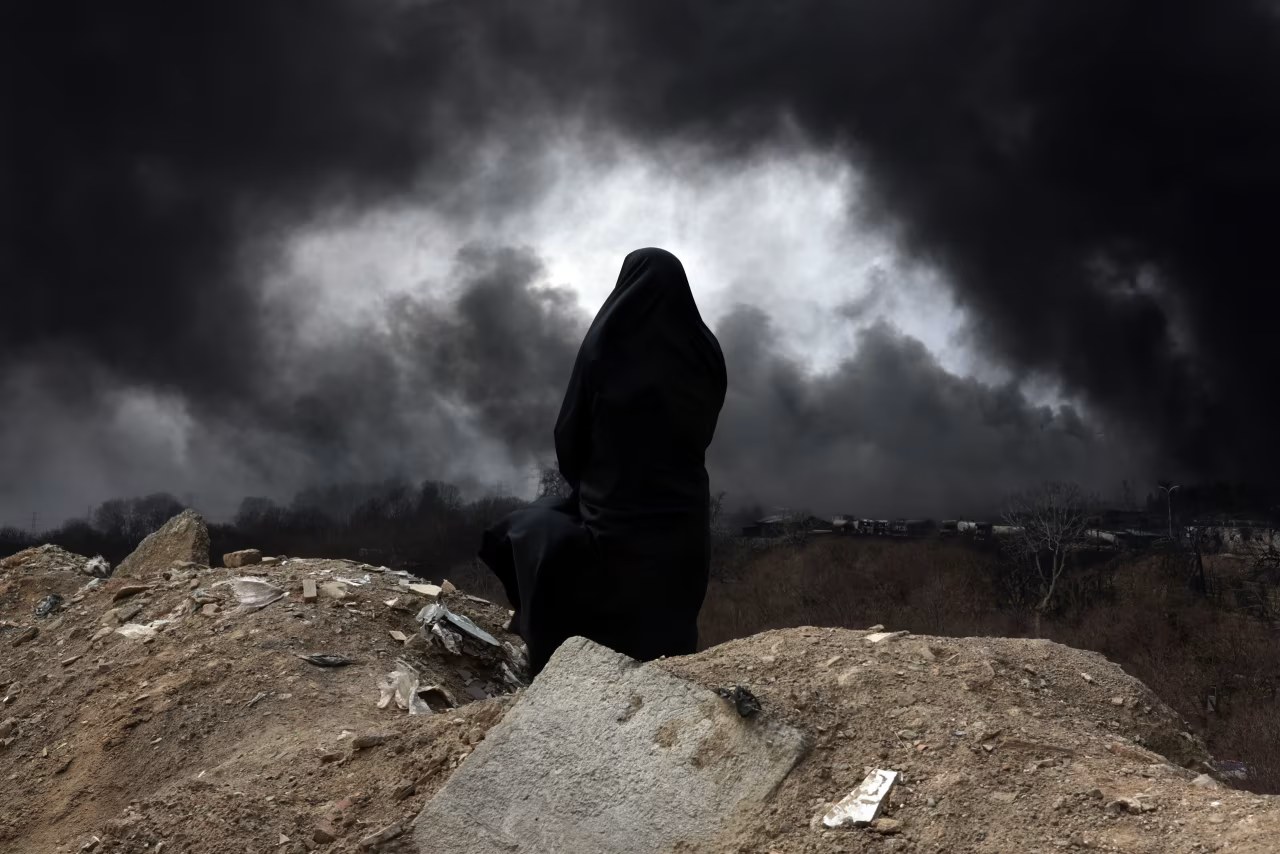
70% of Iraqi Oil Output Halted as Iran War Shuts Persian Gulf
- U.S. crude futures vaulted above $100/bbl Sunday night for the first time since Russia’s 2022 invasion.
- Iraq slashed production by more than two-thirds after storage tanks filled, erasing 2.8 million bpd.
- DNO, the Norwegian operator in Kurdistan, shut 120,000 bpd within hours of the first U.S.–Israeli strikes.
- An Iranian naval warning slowed tanker traffic through the Strait of Hormuz to a trickle.
A single WhatsApp recording of an Iranian captain warning ships away from the Strait of Hormuz has triggered the long-feared Persian Gulf oil squeeze.
IRAN WAR—By the time Bijan Mossavar-Rahmani’s plane touched down in Oslo on Feb. 28, every pump at DNO’s Tawke field had gone quiet. The chairman’s order—relayed mid-flight from New York—halted 120,000 barrels per day of Kurdish output and marked the first deliberate shutdown of the new Iran war.
To the south, a leaked radio message allegedly from an Iranian naval captain ordering vessels to “hold outside Hormuz” ricocheted through shipping brokers’ WhatsApp groups. Within 12 hours, tanker transits fell 60 percent and Brent crude’s six-month curve flipped into a $9 backwardation, the steepest since 1990.
With onshore storage in Basra and Kuwait 96 percent full, Iraq’s oil ministry told customers it would cut supply allocations by 70 percent starting March 1. The move erased roughly 2.8 million barrels per day from global supply, pushing U.S. West Texas Intermediate past the triple-digit mark for the first time since the post-Ukraine spike of March 2022.
Inside the 90-Minute Flight That Stopped Kurdish Oil
Bijan Mossavar-Rahmani has survived plenty of oil-sector shocks since founding DNO in 1971, but the 3,750-mile red-eye from JFK to Oslo on Feb. 28 felt different. “We had credible intel that Iranian retaliation could hit energy assets across the northern corridor,” he told investors on an emergency call Sunday night. At 02:14 GMT he emailed field manager Lars Arne Takle: “Initiate safe shutdown—pumps, turbines, export valve.”
By touchdown at 06:02 GMT, the 120,000-barrel-per-day Tawke complex had ramped down from 42,000 bpd to zero, according to flow data from Norway’s Sekal software. The closure equals the entire output of the U.K. North Sea Buzzard field and removes the last significant non-OPEC barrels still flowing inside Iraq.
DNO’s move mirrors last summer’s precedent: a July 2023 drone strike—blamed on Iran-backed militias—ignited storage tanks and forced a four-day closure that cost DNO $14 million in lost revenue. Insurance underwriters responded by slapping a $350,000 per-voyage war-risk surcharge on Kurdish exports through the Turkish port of Ceyhan, effectively halting shipments for six weeks.
This time, the chairman acted pre-emptively. “We will not expose our people or our shareholders to a second hit,” Mossavar-Rahmani said. DNO shares closed down 11 percent in Oslo Monday, wiping $280 million off its market cap, while Brent leapt $7.40 to $104.30.
The Kurdish shutdown’s domino effect
Kurdistan’s export pipeline to Ceyhan can carry 700,000 bpd, but only 180,000 bpd were moving before the strikes. With DNO’s shutdown, throughput fell to 60,000 bpd—below the minimum 100,000 technical threshold required to keep the line packed. Pipeline operator KAR Group warned shippers it would declare force majeure within 48 hours, halting every remaining barrel from northern Iraq.
The last time Kurdish flows stopped—April 2023 after an arbitration ruling—global prices rose only modestly because southern Iraqi exports compensated. This time, the Strait bottleneck means no such cushion exists, setting up the market for a protracted 2-million-bpd deficit through April.
Strait of Hormuz: The Naval Warning That Froze Tanker Traffic
At 04:06 GMT on Feb. 28—just as DNO’s pumps were going quiet—an English-language voice call crackled across VHF channel 16, the international maritime distress frequency: “All merchant vessels, be advised to hold position outside the Strait of Hormuz pending further notice.” The speaker identified as “Iranian Navy Coordination” and ended with coordinates inside Iran’s territorial band.
Within two hours, the call was posted in the “Tanker Trackers” WhatsApp group with 2,400 members including shipbrokers, charterers, and oil majors. By dawn, the Maritime Executive blog had labeled it “the most expensive 12-second recording in oil history.”
Clarksons Platou Securities counted 42 very-large-crude-carriers (VLCCs) either anchored off Fujairah or drifting inside Oman’s Musandam peninsula Monday morning, up from 17 the previous week. Each VLCC holds 2 million barrels; collectively the floating queue equals the entire daily output of Nigeria.
War-risk premiums quoted by London insurers soared to $400,000 per voyage, triple Friday’s quote and the highest since the 2019 drone attacks on Saudi Aramco facilities. Owners of Suezmax tankers—carrying 1 million barrels—quoted freight at Worldscale 350, a 250 percent premium to normal rates.
Why insurers now control the chokepoint
Underwriters at Lloyd’s syndicates can declare a “listed area” whenever hostilities threaten free navigation. Once declared, hull and machinery policies require owners to self-insure or pay punitive premiums. On Monday morning, the Joint War Committee added Oman’s Musandam and the entire Strait to its high-risk list, effectively pricing most independents out of the water.
The last comparable closure occurred in 1987 during the Iran-Iraq tanker war, when oil prices doubled in six weeks. Today, the Strait handles 21 percent of global supply, or 17.2 million barrels per day, according to the U.S. Energy Information Administration. Even a 10-day halt would erase 170 million barrels—more than the entire OECD emergency stockpile release coordinated after Libya’s 2011 civil war.
Iraq’s 70% Output Cut: How Fast Storage Hit ‘Tank Top’
Iraq’s oil ministry had rehearsed for a Hormuz closure since 2012, but no contingency plan could outrun the speed of this weekend’s storage fill-up. Southern fields produce 4.1 million barrels per day; export outlets are limited to 3.3 million bpd through Basra and 0.9 million bpd via the Strategic Pipeline to Saudi Arabia, now closed for maintenance until late March.
By Saturday night, onshore storage at the 14-million-barrel Al-Fao terminal reached 96 percent capacity, according to Kpler tanker analytics. With no VLCCs able to load, Iraq’s State Oil Marketing Organization (SOMO) told refiners in India and China it would cut contractual supplies 70 percent starting March 1.
The cut equals 2.8 million barrels per day—more than Kuwait’s entire production. Iraq will still receive payment under “force majeure” clauses, but buyers must find replacement barrels in a market already missing sanctioned Russian and Iranian barrels.
What ‘tank top’ means for global prices
When land storage fills, producers must flare or re-inject crude, both costly and environmentally sensitive. Iraq’s West Qurna fields can re-inject 600,000 bpd, but pumping more risks reservoir damage. Ministry officials privately estimate they can hold output for 10 days before forced shut-ins begin; after that, restarting could take weeks and cost $400 million in well-servicing.
Goldman Sachs raised its summer Brent forecast to $115/bbl on the assumption of a 15-day Hormuz disruption. Every week of lost Iraqi exports removes 19 million barrels from the market—roughly equal to one month of U.S. strategic reserve sales at the 2022 pace.
Could $100+ Oil Last? What History Says About Strait Closures
Oil markets have witnessed four major Strait of Hormuz disruptions since 1980. The median price spike is 42 percent within 30 days, but duration matters more than magnitude. The 1987 tanker war lasted six weeks and lifted Brent 65 percent. The 2019 Abqaiq attack lasted only 10 days and prices doubled before retreating.
Today’s fundamentals are tighter: OECD commercial stocks sit 8 percent below the five-year average, while U.S. shale growth is constrained by investor discipline and service inflation. Morgan Stanley estimates the global market carries only 1.2 million barrels per day of spare capacity—mostly in Saudi Arabia—meaning a 2.8-million-bpd Iraqi loss cannot be offset.
On the demand side, the IEA still projects 1.6-million-bpd growth for 2026, driven by petrochemicals and air travel. Yet every $10 rise in Brent trims consumption by 300,000 bpd after six months, according to Oxford Economics. At $115, the model shows demand destruction of 1.1 million bpd—enough to balance the market by July.
What could break the spike
Three catalysts could crash prices: a cease-fire that reopens Hormuz, a coordinated SPR release of 60 million barrels, or a financial-asset liquidation if recession fears resurface. Traders assign a 35 percent probability to each event by June, according to CME implied volatility skew.
Until then, the options market signals 20 percent odds Brent touches $120 before April expiry—the same level that triggered U.S. strategic sales in 2022.
Who Wins and Who Loses When Persian Gulf Barrels Vanish?
The $100 price spike redistributes roughly $1.2 billion per day from consumers to producers, but not all producers benefit equally. Land-locked U.S. shale firms capture the full Brent uplift while avoiding tanker risk, prompting a 6 percent rally in the SPDR S&P Oil & Gas ETF Monday. Pioneer Natural Resources and Diamondback Energy both jumped 9 percent on expectations Permian output will rise 400,000 bpd by summer.
Among exporters, Saudi Aramco gains market share and price: every $1 increase in Brent adds $3 billion annually to Aramco’s free cash flow. Russia’s Urals blend trades at a $20 discount to Brent, yet still nets Gazprom Neft an extra $150 million per month at current prices.
Losers are refiners without upstream integration. India’s Nayara Energy, 49 percent owned by Rosneft, saw its crack spread fall from $9 to $3 per barrel overnight as feedstock costs surged. Airlines are equally exposed; IATA estimates jet fuel up 28 percent since Friday, wiping $5.5 billion off 2026 industry profits.
China’s teapots: caught short
Independent Chinese refiners booked 800,000 bpd of Iraqi Basrah Light for March, now cut to 240,000 bpd. Shandong’s Hongrun Petrochemical declared force majeure on diesel exports, tightening Asian product markets. China’s only remedy is to release barrels from its 550-million-barrel strategic reserve, but Beijing prefers to drip 50,000 bpd to avoid validating higher prices.
What Comes Next: Can Diplomacy Reopen the Strait Before Summer?
Western diplomats have opened three back-channels—via Oman, Qatar, and Switzerland—to secure a limited cease-fire that allows commercial shipping to transit under naval escort, according to two State Department officials who spoke on condition of anonymity. The U.S. Fifth Fleet has already repositioned two destroyers and the amphibious carrier Bataan to the eastern Gulf, but rules of engagement remain classified.
Iran’s calculus is price-sensitive: every week Hormuz stays closed costs Tehran $500 million in lost oil sales already curtailed by sanctions. Yet hard-liners see leverage ahead of nuclear talks. A European diplomat warned, “They may keep the strait hostage until Washington offers sanctions relief.”
Energy Aspects, a London consultancy, assigns a 55 percent probability to a partial reopening within 30 days under a “blue lane” system similar to 1987, when re-flagged Kuwaiti tankers moved under U.S. convoy. The base-case adds 1.2 million bpd back to the market, enough to trim Brent to $92 by May.
If diplomacy fails, the standoff could mirror the 2019 crisis: 10 percent of global supply stranded for months, pushing inventories below 2014 lows and entrenching triple-digit prices through 2027.
Frequently Asked Questions
Q: Why did oil prices spike above $100 after the Iran attack?
U.S. crude jumped past $100 because the Iran war shut Iraq’s Kurdish wells and slowed tanker traffic through the Strait of Hormuz, removing 2 million bpd from an already-tight market.
Q: How much Iraqi oil was lost when DNO shut its wells?
DNO’s shutdown erased 120,000 bpd from Iraqi Kurdistan; Iraq then cut total output by 70 percent as storage filled up, stripping roughly 2.8 million bpd from global supply.
Q: Is the Strait of Hormuz still open to tankers?
Traffic slowed to a trickle after an Iranian naval broadcast warned ships away; insurers now demand war-risk premiums above $400,000 per voyage, effectively blocking most cargoes.
