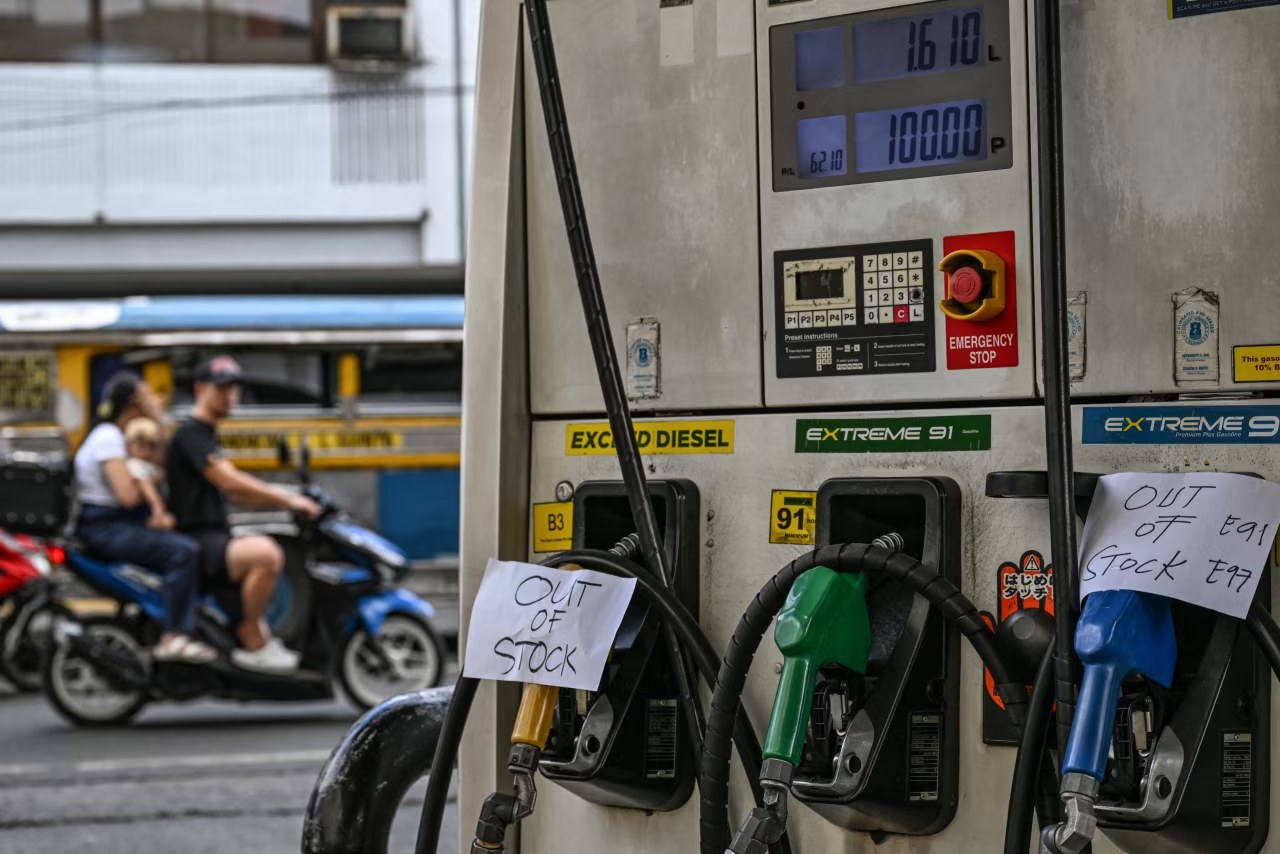
Oil leaps 27% to $115.77 as analysts warn supply drag may outlast Middle East conflict
- WTI crude closed at $115.77/bbl Monday, up 27% in a single session
- Brent touched $116.15/bbl, its first triple-digit print since September 2023
- Strait of Hormuz traffic has ‘effectively halted’, threatening 21 million bpd of flows
- Analysts fear lasting damage to pipelines and production facilities
A single strike on Iranian oil sites over the weekend has catapulted global crude benchmarks into triple-digit territory and raised the specter of a supply shock that could persist long after the guns fall silent.
STRAIT OF HORMUZ—By 03:55 GMT Monday, front-month West Texas Intermediate futures had jumped 27% to $115.77 a barrel, while Brent surged 25% to $116.15, according to data from Phillip Nova. The catalyst: reports that Iranian infrastructure had been hit, placing the world’s most critical chokepoint—the Strait of Hormuz—under a de-facto shipping embargo.
Priyanka Sachdeva, senior market analyst at Phillip Nova, told clients the disruption has the potential to “remain beyond the Middle East conflict’s duration,” because markets are beginning to price in the risk of permanent damage to energy installations across the region. Roughly one-fifth of seaborne crude passes through the 21-mile-wide channel, making any prolonged outage the equivalent of losing more than the entire output of the U.S. shale patch.
The Anatomy of a 27% Spike
The magnitude of Monday’s rally dwarfs any single-day move since Russia’s invasion of Ukraine in February 2022. Within six hours of the opening bell, WTI leapt from $91.12 to an intraday peak of $115.77, while Brent mirrored the frenzy, tagging $116.15 before settling at $115.83. Exchange data show a record 2.3 million contracts changed hands, eclipsing the previous volume high set during the 2020 price war between Saudi Arabia and Russia.
Asian refiners scramble for cover
Asian buyers—who rely on the Middle East for 72% of their crude imports—moved first. South Korea’s GS Caltex bought a 2-million-barrel cargo of U.S. Gulf Coast sour crude at a $9 premium to dated Brent, the widest differential since Hurricane Katrina in 2005, according to tender results seen by traders. Japan’s Eneos cancelled three very-large-crude-carrier cargoes that were scheduled to load in Kharg Island, Iran, next month, replacing them with West African grades at an extra $6.50 per barrel.
The forward curve underscored the panic. Brent’s prompt-month premium to the six-month contract—known as backwardation—widened to $8.70, a level last seen when Libyan output collapsed in 2011. Analysts at Standard Chartered note that such extreme backwardation typically signals traders expect physical shortages within weeks, not months.
Yet the rally also lit a fuse under broader risk assets. The S&P 500 energy sub-index jumped 11%, while airlines and consumer-discretionary shares sold off on fears of higher fuel bills. Sachdeva cautions that “oil’s sharp rise could trigger profit-taking in broader markets,” a pattern observed during the 1990 Gulf War when equities fell 15% in eight weeks even as crude doubled.
Strait of Hormuz: 21 Miles That Move 21 Million Barrels
The Strait of Hormuz is less than 21 miles wide at its narrowest point, yet it funnels 21 million barrels of crude, condensate and refined products daily—about 21% of global petroleum liquids consumption. When traffic stops, the shockwaves ripple from Shanghai refineries to Midwest gasoline pumps.
Insurance costs quadruple overnight
War-risk underwriters hiked premiums for vessels transiting the strait to 5% of hull value from 1.2% on Friday, according to London broker Howden. That adds roughly $2.5 million to the cost of a standard Suezmax voyage, brokers said. At least six tankers—carrying 10 million barrels—have already diverted around the Cape of Good Hope, adding 18 days and $1.20 per barrel to freight rates.
Tehran’s port authority confirmed that “normal operations continue,” but ship-tracking data from Vortexa show the seven-day moving average of crude and condensate exports has fallen to 480,000 bpd, the lowest since July 2020. Simultaneously, QatarEnergy declared force majeure on three spot LNG cargoes, telling buyers that loading schedules are “indeterminately delayed.”
The U.S. Navy’s Fifth Fleet, based in Bahrain, said it is “monitoring the situation,” but has not announced a coalition escort program akin to Operation Earnest Will in the 1980s. Without naval protection, analysts at Macquarie expect “insurance exclusions to broaden and crew recruitment to dry up,” effectively blockading the waterway even if geopolitical tensions ease.
Will Asian Buyers Face Years of Supply Scars?
Asia imports 14.5 million bpd of Middle Eastern crude, equal to 72% of its total crude purchases. China alone buys 3.5 million bpd through the strait, India 2.1 million and Japan 1.8 million. Any prolonged outage forces these nations to pay steep premiums for Atlantic-basin grades or tap strategic stocks.
China’s SPR release is smaller than headlines suggest
Beijing announced a 6.9-million-barrel auction from its strategic petroleum reserve (SPR) for late April, but traders say that barely covers two days of lost Hormuz flows. China’s commercial inventories, at 928 million barrels in March, are 11% below the five-year average, according to analytics firm Kpler. Refiners have already trimmed run rates by 350,000 bpd, the steepest cut since the 2022 Shanghai lockdowns.
India, the world’s third-largest importer, has cancelled three tenders for 90-day delivery crude, citing “force majeure conditions.” State-run Indian Oil Corp. is instead negotiating with U.S. exporters for Midland-grade WTI at an $8 premium to dated Brent, a record spread. Analysts at FGE warn that Indian refineries geared toward heavy Iranian and Iraqi grades cannot easily switch to light U.S. shale, raising the specter of lower diesel output ahead of monsoon planting season.
Japan and South Korea hold 530 million barrels combined in government and commercial storage—enough for 150 days of imports under IEA rules. Yet both countries lack the regasification capacity to offset lost LNG from Qatar, the world’s largest exporter. Tokyo Gas has already declared a “supply warning,” telling industrial customers to prepare for possible curtailments.
Can Producers Fill the Void?
Global spare capacity stands at 3.8 million bpd, according to the International Energy Agency, but 60% of that sits in Saudi Arabia and the UAE—countries that must also ship through Hormuz. If the chokepoint remains closed, only 1.5 million bpd of truly diversifiable spare capacity exists, mostly in the United States, Brazil and Canada.
U.S. shale needs 6–9 months to accelerate
Shale executives gathered in Houston last week told investors they can add 300,000 bpd by year-end, far short of the 3 million bpd shortfall. Frac-fleet utilization is already at 92%, and equipment makers such as Liberty Oilfield Services say new high-spec spreads won’t be delivered until Q1 2025. Pioneer Natural Resources, now part of ExxonMobil, reiterated that the Permian is “in harvest mode,” prioritizing shareholder returns over production growth.
Brazil’s Petrobras could lift pre-salt output by 200,000 bpd by December, but its tankers must traverse the Cape of Good Hope, adding 40 days to China voyages. Canada’s Trans Mountain Expansion pipeline, set to start in May, adds 590,000 bpd of egress, yet most barrels are locked into term contracts to U.S. refineries, leaving little for Asia.
Riyadh has 2.2 million bpd of official spare capacity, but energy minister Prince Abdulaziz bin Salman warned last month that “capacity is only useful if you can export.” Without Hormuz, Saudi Arabia must rely on the 5-million-bpd East-West Petroline to the Red Sea, which analysts at Rystad Energy say maxes out at 7 million bpd—still leaving 1.5 million bpd of exports stranded.
What History Teaches Us About Chokepoint Shocks
Since 1950, the world has witnessed 14 major chokepoint disruptions lasting more than seven days. The median price spike is 38% within one month, but supply scars can linger for years. When Iraqi forces invaded Kuwait in August 1990, Brent rose 46% in two weeks, yet it took four years—and a U.S. bombing campaign—to restore Kuwaiti output to pre-war levels.
The 2019 Abqaiq attack offers a blueprint
In September 2019, drone strikes on Saudi Arabia’s Abqaiq processing plant knocked out 5.7 million bpd, equal to 6% of global supply. Prices jumped 15% in a single session, but the kingdom brought capacity back online within 45 days. The difference today: no obvious technical quick-fix exists if Iranian, Saudi and UAE export terminals are simultaneously compromised.
During the 1980s Tanker War, reflagging Kuwaiti vessels and U.S. naval escorts allowed flows to resume, but only after 18 months of sporadic attacks. Lloyd’s of London estimates that modern reflagging and convoy operations could take six months to organize given current insurer reticence and crew shortages.
The 1973 Arab oil embargo lasted only five months, yet altered consumption patterns for a decade, spurring efficiency gains that capped demand growth at 0.8% annually through 1983. If today’s disruption extends beyond six months, analysts at BCA Research expect a similar demand destruction of 1.2 million bpd, mainly from EV adoption and work-from-home trends.
Investor Playbook: Santos, Woodside and the LNG Knock-On
While crude grabs headlines, liquefied natural gas is quietly shaping up as the bigger bottleneck. Qatar, which pumps 77 million tonnes per annum (mtpa) of LNG—equivalent to 10% of global supply—has suspended loading at Ras Laffan. Spot Asian LNG prices spiked 28% to $18.40 per million British thermal units, the highest since Europe’s energy crisis two years ago.
Macquarie picks Santos over Woodside
In a note to clients at 01:41 GMT, Macquarie analysts retained an outperform rating on Santos, noting the Adelaide-based producer has “low-cost Barossa gas and Darwin LNG tolling upside.” Santos shares rose 2.7% to A$7.66 in Sydney trade. The broker sees limited additional upside after Monday’s rally and trimmed its price target to A$8.40 from A$8.70, but still expects total shareholder returns of 12% including dividends.
Woodside, by contrast, was downgraded to neutral. The stock trades at 1.35× the broker’s long-term net-present-value estimate, a level last reached during the 2022 commodity super-cycle. At A$30.97, Woodside is pricing in Brent above $95 for the next three years, leaving little margin for project delays such as its $12 billion Trion development in Mexico.
North American LNG exporters are immediate beneficiaries. Cheniere Energy’s stock jumped 9% in after-hours trading, while Tellurian—whose Driftwood LNG project is under construction—rose 18%. European TTF gas futures surged 22%, reviving hedging interest from German utilities that had bet on a mild 2024 winter.
Yet the rally also invites demand destruction. Japan’s Ministry of Economy warned that any LNG price above $16/mmBtu triggers fuel-switching to coal, potentially adding 28 million tonnes of CO₂ emissions annually—equal to the climate gains from 1.2 million EVs.
Frequently Asked Questions
Q: Why did oil prices spike above $100?
Weekend strikes on Iranian infrastructure raised fears of lasting damage to pipelines and production, while the Strait of Hormuz effectively shut, cutting 20% of seaborne crude.
Q: How high did WTI and Brent futures climb?
Front-month WTI surged 27% to $115.77/bbl and Brent jumped 25% to $116.15/bbl, the steepest one-day rally since the 2022 Ukraine invasion.
Q: Could prices fall once the Strait reopens?
Macquarie says crude could unwind quickly, but spot LNG may lag because Qatar’s liquefaction trains need weeks to restart, keeping Asian buyers exposed longer.
