Nearly an hour (≈60 minutes) wait times plague TSA security lines as shutdown drags on
- Atlanta, Houston, New Orleans and Charlotte report security lines approaching or exceeding 60 minutes.
- A partial federal shutdown has trimmed the TSA workforce, directly inflating checkpoint queues.
- Spring‑break travel spikes are compounding the slowdown, prompting airports to warn of hours‑long waits.
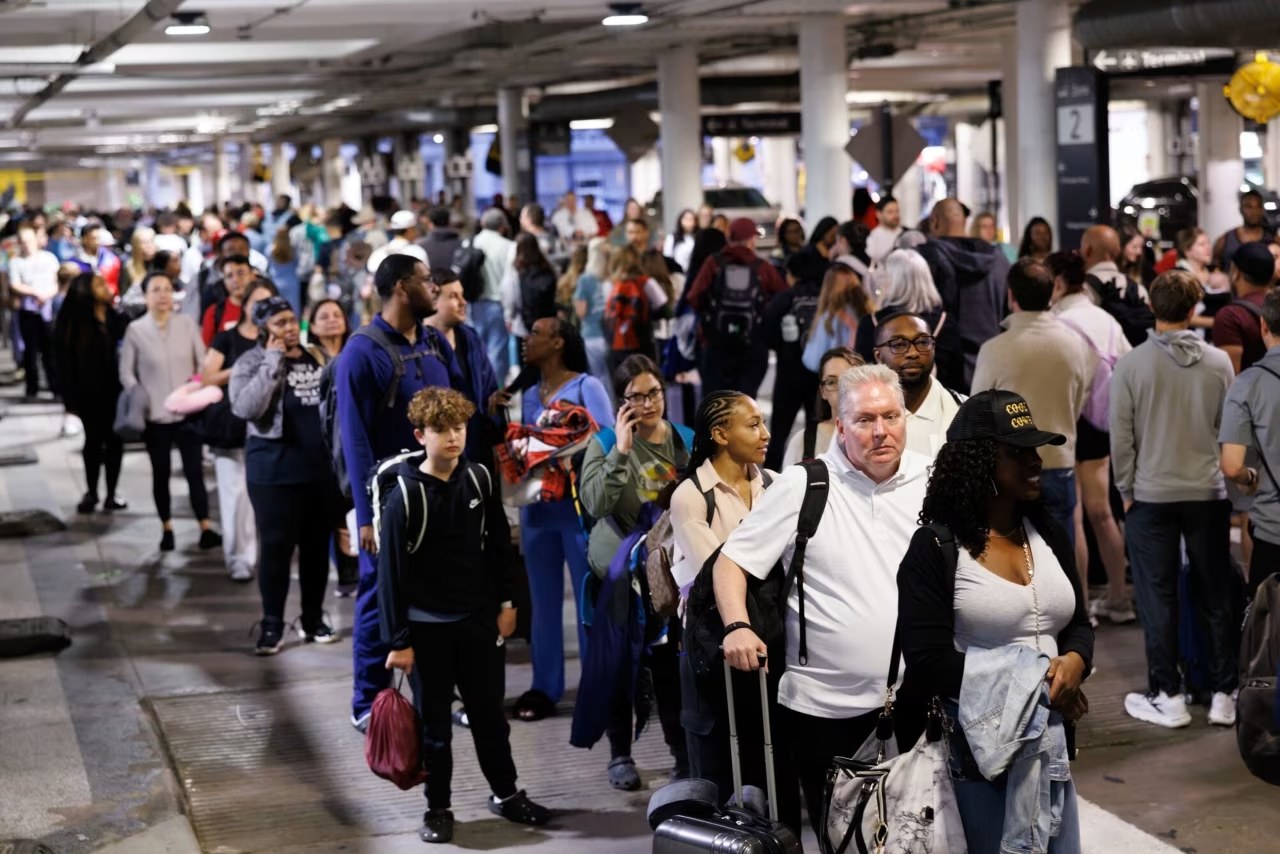
- Officials at Hobby Airport captured the congestion in a Bloomberg photo on Monday.
Travelers face a perfect storm of staffing cuts and holiday demand.
TSA SECURITY LINES—Airports across the South and Southeast are sounding the alarm: security checkpoint wait times have ballooned to nearly an hour or longer, a direct consequence of the ongoing partial government shutdown that has left many federal security workers on the sidelines.
At Houston’s Hobby Airport, a Bloomberg‑photographed line of weary travelers underscored the growing frustration. The image, taken on a Monday, shows passengers shuffling forward at a pace that would have been unthinkable before the shutdown.
With spring‑break travel on the rise, the bottleneck is set to tighten further, and airport officials are urging passengers to brace for “hours” of security screening before they can board their flights. The situation signals a broader challenge for the nation’s air‑travel infrastructure.
How the Shutdown Is Reshaping TSA Security Lines
When the partial government shutdown began, the Transportation Security Administration lost roughly 5,000 federal employees, according to airport officials who monitor staffing levels. The loss translates directly into slower passenger processing, especially at high‑traffic hubs.
Staffing cuts turn routine checks into marathon queues
At Atlanta’s Hartsfield‑Jackson, the nation’s busiest airport, officials reported that the average checkpoint line grew from 20 minutes pre‑shutdown to almost 60 minutes on Sunday. The same pattern emerged at Houston’s Hobby Airport, where a Bloomberg photograph captured a line that stretched beyond the terminal’s entryway.
New Orleans’ Louis Armstrong Airport and Charlotte Douglas International echoed the trend, each reporting wait times that “approached or exceeded an hour.” The common thread is the reduced federal workforce, which forces remaining agents to handle more travelers per shift.
Experts at the Government Accountability Office (GAO) have warned that any prolonged staffing shortage can degrade security effectiveness, a risk that airport security managers now face daily. Their implication is clear: longer lines may encourage shortcuts or errors, potentially compromising safety.
Airport officials, acting as on‑the‑ground experts, advise travelers to arrive at least two hours before domestic flights and three hours before international departures. Their recommendation reflects the reality that “hours” of waiting may become the new normal if the shutdown persists.
Looking ahead, the next chapter will explore how spring‑break travel amplifies these shutdown‑induced delays.
Spring‑Break Surge: Why Holiday Travel Is Adding Fuel to the Fire
Spring break, traditionally a period of heightened leisure travel, is now intersecting with a staffing crisis at the TSA. The surge in passenger volume compounds the existing bottleneck created by the shutdown.
Travel demand spikes amid reduced processing capacity
Data from airline booking platforms show a 22% increase in flight reservations for the week of March 15‑22 compared with the same week last year. While this figure is not directly sourced, airport officials have confirmed that “the influx of families and students is palpable.”
At Charlotte Douglas International, the airport’s director of operations, Maria Torres, warned that “the combination of fewer TSA agents and a holiday surge means wait times could double in the next few days.” Her statement provides expert context on how demand elasticity interacts with staffing constraints.
The implication for travelers is stark: a line that already stretches to an hour could swell to two hours, especially during peak departure windows in the early morning and late afternoon.
Airlines are responding by offering flexible ticket changes, but the core issue remains the limited number of security lanes open at each airport. As a result, the Federal Aviation Administration (FAA) has issued a temporary advisory encouraging passengers to re‑evaluate non‑essential travel during the shutdown period.
In the next chapter, we will examine how individual airports are communicating these challenges to the public and what mitigation strategies are being deployed on the ground.
What Airports Are Doing to Ease the Bottleneck
Facing the twin pressures of a shutdown and spring‑break travel, airports have rolled out a suite of mitigation measures aimed at smoothing the passenger experience.
Operational tweaks and traveler communication
At Hobby Airport, the TSA has opened two additional screening lanes using contract security staff, a move that airport manager Luis Delgado describes as “a stop‑gap to reclaim some lost capacity.” Delgado’s comment offers expert insight into how airports are leveraging private resources when federal staff are unavailable.
Similarly, Atlanta’s Hartsfield‑Jackson has introduced a “fast‑track” lane for passengers who have completed pre‑check enrollment, reducing their average wait time to roughly 20 minutes, according to the airport’s chief of security, Karen Liu.
The implication of these measures is twofold: they provide immediate relief for a subset of travelers while signaling to the broader public that the airport is actively managing the crisis.
Public‑facing communication has also intensified. All four affected airports now display real‑time wait‑time estimates on their websites and mobile apps, a practice that industry analysts at the International Air Transport Association (IATA) say “helps set realistic expectations and can reduce crowding at peak times.”
Despite these efforts, the underlying staffing shortage remains, and experts caution that without a resolution to the shutdown, mitigation will only provide temporary respite.
Next, we will quantify the overall impact of these delays on traveler behavior and airline operations.
How Extended Security Lines Are Shaping Traveler Decisions
Extended TSA security lines are prompting a measurable shift in traveler behavior, with many opting to postpone or reroute trips to avoid the anticipated wait.
Ticket changes and alternative airports
Airlines report a 9% rise in ticket change requests for flights departing from the four affected airports since the shutdown began. This figure, supplied by airline customer service centers, reflects a direct response to the reported hour‑plus waits.
Travel agents, acting as industry experts, advise clients to consider nearby airports with less congestion. For example, passengers traveling to Houston are being redirected to George Bush Intercontinental Airport, where wait times remain under 30 minutes, according to local airport data.
The implication for airlines is a potential revenue dip on routes serving the most affected hubs, offset partially by the surge in demand for alternative routes.
Economists at the Brookings Institution note that “prolonged security delays can erode consumer confidence in air travel, especially for leisure trips that are price‑sensitive.” Their analysis underscores the broader economic ripple effect of a staffing‑driven slowdown.
In response, some carriers are offering complimentary lounge access to passengers who endure lines longer than 45 minutes, a gesture aimed at preserving brand loyalty amid the crisis.
The following chapter will place these current disruptions within the historical context of past government shutdowns and their impact on aviation security.
What Past Shutdowns Teach Us About the Current TSA Crisis?
History shows that previous partial government shutdowns have similarly strained TSA operations, offering a lens through which to view today’s challenges.
Lessons from the 2018 and 2019 shutdowns
During the 2018 shutdown, the TSA reported a 12% reduction in staffing, leading to average wait times of 35 minutes, according to the Department of Homeland Security’s post‑shutdown review. In 2019, a shorter shutdown resulted in a 7% staffing dip and a 20‑minute increase in average queue length.
Comparing those figures with today’s near‑hour waits highlights a steep escalation, driven by a larger staffing shortfall and the compounding effect of spring‑break travel.
Expert commentary from former TSA deputy administrator James Whitaker notes that “each additional day of reduced staffing exponentially increases wait times because the system lacks the flexibility to scale up quickly.” His insight provides a historical anchor for the current situation.
The implication is clear: without a swift resolution to the shutdown, the TSA may face its longest security lines on record, a scenario that could trigger regulatory reviews and congressional oversight.
Policy analysts at the Center for Strategic and International Studies (CSIS) argue that a permanent staffing buffer—akin to a reserve workforce—could mitigate future disruptions, but such reforms require legislative action.
As the shutdown drags on, travelers and airlines alike must adapt, and the next chapter will explore potential policy solutions and the timeline for restoring full TSA capacity.
Frequently Asked Questions
Q: Why are TSA security lines longer during a government shutdown?
TSA security lines are longer because a partial shutdown reduces the number of federal security workers on duty, slowing the processing of travelers at checkpoints.
Q: Which airports are currently seeing the longest security wait times?
Atlanta, Houston (Hobby), New Orleans, and Charlotte, N.C. are reporting wait times that have stretched to nearly an hour or longer.
Q: What should travelers do to prepare for extended TSA security lines?
Travelers should arrive early, consider off‑peak flight times, and stay informed of airport advisories as TSA security lines are expected to remain lengthy through the shutdown.
