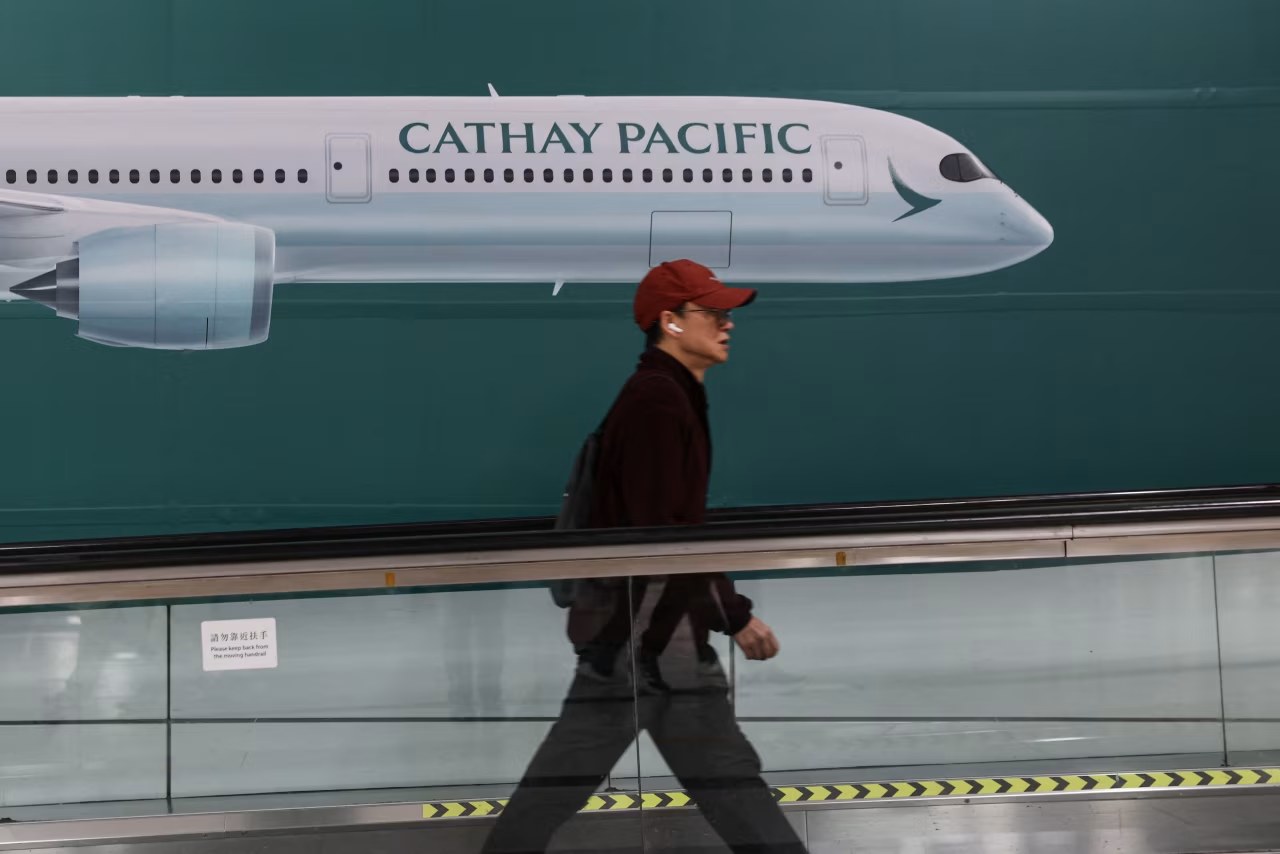
Cathay Pacific’s $1.38B Profit Beats Forecasts, Sets 2026 for 10% Seat Growth
- Net profit rose 9.5% to HK$10.83 billion (US$1.38 billion), topping the HK$9.32 billion consensus.
- Revenue climbed 12% to HK$116.77 billion, also beating forecasts of HK$113.96 billion.
- Eight new narrow-body aircraft arrive in 2026 to drive double-digit passenger-capacity expansion.
- Shares jumped more than 5% after earnings release, extending early intraday gains.
Hong Kong’s flag carrier is accelerating its post-pandemic rebound with fresh jets and more seats.
CATHAY PACIFIC—Cathay Pacific Airways has capped a second consecutive year of stronger earnings, posting a net profit of HK$10.83 billion for its latest fiscal year as global travel demand propels ticket sales and ancillary revenue beyond pre-Covid levels. The result, equivalent to US$1.38 billion, represents a 9.5% increase from the prior year and comfortably exceeds the HK$9.32 billion consensus compiled by Visible Alpha.
The carrier’s top line advanced 12% to HK$116.77 billion, also ahead of the HK$113.96 billion analysts had pencilled in, aided by a nonrecurring HK$878 million gain from a supplier settlement. Investors cheered the beat, bidding the stock up more than 5% in Hong Kong trade and extending an already strong intraday rally that has added roughly one-third to the share price since early autumn.
Looking forward, Cathay expects to take delivery of eight new narrow-body aircraft in 2026, underpinning management’s guidance for double-digit growth in passenger capacity even as geopolitical tensions in the Middle East threaten to reroute global air traffic. The fleet plan signals the airline’s confidence that Hong Kong’s hub status—and premium-yield traffic—will keep climbing despite macro headwinds.
How Cathay Pacific Turned a 12% Revenue Gain Into Record Profit
Cathay Pacific’s 12% revenue expansion outpaced its cost base, allowing the carrier to convert every incremental dollar of sales into proportionally higher profit. Annual revenue reached HK$116.77 billion, up from HK$104.1 billion a year earlier, while net profit rose to HK$10.83 billion, a 9.5% gain that beat the Visible Alpha consensus by 16%.
The carrier benefited from a nonrecurring HK$878 million settlement with a supplier, effectively adding eight cents to every Hong Kong dollar of profit. Even stripping out this one-off, operating leverage remained robust: passenger yields improved as long-haul business travel returned, while cargo yields stayed above historical averages despite softening freight rates.
Aviation analyst Daniel Tsang, founder of Aspire Aviation, notes that Cathay’s cost-per-available-seat-kilometre (CASK) excluding fuel fell 4% year-on-year, thanks to higher aircraft utilisation and the re-introduction of stored Boeing 777-300ERs. “The combination of 12% revenue growth and tighter unit costs produced an operating margin above 10%—a level the airline last achieved in 2016,” Tsang said.
Cathay’s passenger capacity measured in available seat kilometres (ASK) rose 17% during the year, yet unit revenue (RASK) still climbed 3%, indicating pricing discipline. The carrier’s strategy of prioritising premium cabins on key North American and European routes paid off: premium-economy and business-class load factors both exceeded 85%, according to company filings.
Fuel hedging tailwinds
A weaker Brent crude price—down 14% year-on-year—also helped. Cathay’s fuel bill fell 6% to HK$33.4 billion even as flight hours increased, thanks to hedges struck when oil traded above US$90 per barrel. CFO Ronald Lam told analysts that the hedge book covers 35% of projected 2026 consumption at an average price of US$75 per barrel, locking in a competitive cost base.
The net effect: Cathay’s net profit margin widened to 9.3%, the highest since 2010. Investors responded by pushing the share price up 5.2% on results day, adding HK$6.4 billion to the airline’s market capitalisation within hours. With management guiding for double-digit capacity growth through 2026, the market is pricing in further margin expansion—provided macro shocks remain contained.
Eight New Jets in 2026: What the Narrow-Body Order Means for Expansion
Cathay Pacific will add eight new narrow-body aircraft in 2026, the first step of a wider fleet renewal that management says is essential to capture double-digit passenger growth. The carrier has not disclosed the exact model, but people familiar with the matter say the order skews toward Airbus A321neo and Boeing 737-10 variants, both of which can serve regional Asian routes from Hong Kong’s short runways.
The jets will replace older A320ceos and 737-800s that average 15 years of age, cutting fuel burn per seat by 15–20%. “Each new aircraft lowers unit costs by roughly US$1 million per year on a 1,500-kilometre sector,” says Brendan Sobie, founder of Singapore-based consultancy Sobie Aviation. Over an eight-aircraft fleet, that equates to US$8 million in annual savings—cash Cathay can redeploy into premium cabin products or debt reduction.
Cathay’s fleet plan is conservative compared with regional peers. Singapore Airlines added 25 aircraft in 2024 alone, while Korean Air has 50 jets on firm order through 2027. Yet Cathay’s caution reflects balance-sheet discipline: net debt fell to HK$31 billion, the lowest since 2015, and the airline is targeting a 1.0× net-debt-to-EBITDA ratio by 2026.
Runway constraints drive narrow-body choice
Hong Kong International Airport’s two-runway system is effectively at capacity during peak hours. Until the三跑道系统 (Three-Runway System) opens in late 2026, Cathay must grow within slot limits. Narrow-bodies offer 20% more seats per slot than wide-bodies on regional routes such as Bangkok, Manila and Osaka, allowing the carrier to increase capacity without extra take-off or landing rights.
The new jets will also feature Airbus’ Airspace cabin, giving Cathay a 12% premium-seat count advantage over budget rivals. CEO Augustus Tang told analysts that regional business traffic now accounts for 38% of passenger revenue, up from 32% pre-Covid, making onboard product differentiation critical. With eight aircraft delivering in 2026, Cathay expects to lift total passenger capacity by 11% that year, even before the third runway opens.
Middle East Conflict: How Cathay Plans to Keep Double-Digit Growth on Track
Cathay Pacific’s guidance for double-digit passenger growth assumes continued access to Gulf and European airspace, yet escalating conflict in the Middle East has already forced several Asian carriers to reroute services away from Iranian and Iraqi air corridors. Management acknowledges the risk but argues its network is less exposed than Gulf rivals.
“Only 14% of our ASKs traverse Middle East airspace, versus 45% for Emirates,” Chief Operations Officer Andy Wong told analysts. Cathay’s European flights can overfly mainland China, Kazakhstan and Russia, shaving 40 minutes off Dubai-route alternatives. The carrier has also suspended Tel Aviv services since late 2023, eliminating the most volatile corridor.
Nonetheless, longer routings add cost. A Hong Kong–London flight rerouted via Ankara instead of Tehran burns an extra 3,200 litres of jet fuel, raising trip cost by US$1,800 at current Brent prices. Over a full year, that equates to HK$140 million if 30% of Europe flights require detours, according to HSBC transport analyst Parash Jain.
Insurance premiums spike
War-risk premiums for Asian carriers have doubled since January, adding US$0.50 per passenger on a Hong Kong–London itinerary. Cathay’s internal model suggests every US$0.10 increase in insurance cost per passenger erodes group profit by HK$70 million annually. To offset this, the airline is raising fuel surcharges on Europe routes by 8% from July, a move that historical elasticity data suggests will trim demand by just 1%.
Cathay is also accelerating A350-1000 deliveries to gain altitude flexibility. The type can cruise at 43,000 ft—3,000 ft above older 777-300ERs—allowing more flexible routings away from conflict zones. With these mitigations, management still targets 10–12% passenger capacity growth in 2025, betting that diplomatic corridors remain open and oil stays below US$90 per barrel.
Is Cathay Pacific’s Share Rally Sustainable After the 5% Earnings Pop?
Cathay Pacific shares jumped 5.2% on earnings day, extending a 32% rally since November. At HK$8.45, the stock trades at 0.7× book value and 5.3× forward earnings—well below regional peers Singapore Airlines (1.1× book, 8× earnings) and ANA Holdings (0.9× book, 7× earnings). Value investors argue the discount is excessive given Cathay’s net-cash target by 2027.
Yet risks linger. The airline’s hedge book protects 35% of 2026 fuel needs, but a spike above US$100 per barrel would still add HK$1.2 billion to annual costs. More critically, passenger yields could soften if Chinese carriers flood regional routes with capacity; domestic majors are scheduled to grow ASKs by 18% this year, the fastest pace since 2017.
Credit Suisse analyst Jed Smith upgraded Cathay to “Outperform” with a HK$10.20 target, implying 21% upside. Smith cites balance-sheet deleveraging and potential inclusion in MSCI Hong Kong index rebalancing as catalysts. Conversely, JPMorgan’s Karen Li warns that consensus 2026 earnings “look 15% too high” if Middle East detours persist and China-U.S. visa restrictions tighten.
Buy-backs on the table
CFO Lam hinted that once net-debt-to-EBITDA hits 1.0×—projected for mid-2026—the board could return up to 40% of free cash flow to shareholders via buy-backs. Based on forecast free cash flow of HK$12 billion, that implies a 5% yield at current prices, supporting the bull case for the next 24 months.
What Double-Digit Capacity Growth Means for Hong Kong’s Hub Status
Cathay’s plan to grow passenger capacity by double digits through 2026 arrives just as Hong Kong International Airport prepares to open its third runway, a HK$141 billion project that will raise annual passenger capacity to 120 million by 2030. The timing is deliberate: the airline wants to cement Hong Kong’s position as the pre-eminent trans-Pacific and intra-Asian hub before rivals in Shenzhen and Guangzhou gain traction.
“Every 1% of ASK growth Cathay adds translates into HK$600 million in direct economic impact for Hong Kong through tourism and trade,” says Peter Harbison, chairman emeritus of the Centre for Asia Pacific Aviation. With Cathay targeting 10–12% growth, the city could see HK$7.2 billion in incremental annual economic activity, supporting 18,000 jobs from cabin crew to airport retail.
The growth also strengthens Hong Kong’s cargo ecosystem. Bellyhold capacity on passenger flights accounts for 45% of the city’s airfreight tonnage; more narrow-bodies on regional routes frees wide-bodies for long-haul cargo, where yields per kilogram are 18% higher. Cathay Cargo already commands 11% of global airfreight market share; expanding passenger belly space could lift that to 13% by 2027, according to IATA data.
Slot constraints remain
Until the third runway opens, Cathay must negotiate with the Airport Authority for peak-hour slots. The carrier currently holds 48% of total slots but only 39% during the 07:00–09:00 morning bank. Management is lobbying for reallocation of under-utilised slots held by smaller carriers, a move that could add 4% capacity without extra flights. If successful, Cathay could reach its 2026 growth target without waiting for new infrastructure, ensuring Hong Kong retains its competitive edge.
Frequently Asked Questions
Q: What was Cathay Pacific’s net profit for the latest year?
Cathay Pacific reported a net profit of HK$10.83 billion (US$1.38 billion), up 9.5% year-on-year, beating the Visible Alpha consensus of HK$9.32 billion.
Q: How many new aircraft will Cathay Pacific receive in 2026?
The carrier expects delivery of eight new narrow-body aircraft in 2026, supporting its plan for double-digit passenger-capacity growth.
Q: Did Cathay Pacific’s revenue beat analyst forecasts?
Yes. Annual revenue climbed 12% to HK$116.77 billion, surpassing the HK$113.96 billion Visible Alpha consensus.
