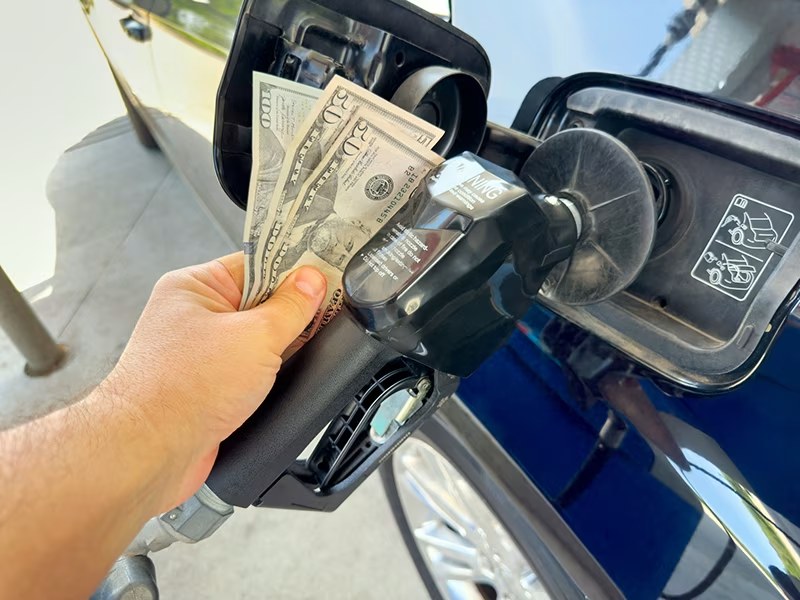
50-Cent Gas-Price Spike Adds Only $225 a Year to Typical Driver’s Budget
- National average gasoline has climbed 53¢ since January to $3.60/gal, mirroring the 2018 Iran-sanction episode.
- Retail sales grew 3.9% that summer, proving consumers did not cut spending.
- Fuel now represents barely 3% of household budgets, down from 5% in 1980.
- Media coverage amplifies pump panic despite microscopic budget share.
Classroom experiment at Penn State Berks shows students overestimate the damage when headlines scream.
TRUMP SANCTIONS—When President Trump withdrew from the Iran nuclear deal in May 2018, crude rallied and gasoline leapt roughly 50¢ above year-ago levels. Cable chyrons warned of “pain at the pump” and predicted Americans would shelve Memorial Day travel. Yet by August, highway traffic hit a record and real retail sales accelerated. What explains the gap between headline hysteria and consumer reality?
I had a front-row seat. Teaching principles of management at Penn State Berks that semester, I asked 42 undergraduates to calculate the personal cost of the spike before reading any media takes. Their median estimate: $800 per driver. The actual figure—about $225—shrank to insignificance against a $63,000 median household income. The exercise exposes a persistent flaw in economic reporting: mistaking a highly visible price for a materially important one.
Today, the same script is replaying. Nationally, regular gasoline has risen 53¢ since January to $3.60/gal, according to AAA. Network segments once again frame the increase as a “tax on working families.” They rarely note that fuel expenditures have fallen to 3% of disposable income, the lowest since government tracking began in 1929. Context, not price, determines economic impact.
Pump Panic 2018: What Really Happened
Between early May and late June 2018, Brent crude jumped $18/barrel after the White House announced the re-imposition of Iran sanctions. Gasoline followed, rising from $2.84 to $3.22/gal nationally, a 38¢ move that widened to 54¢ above the prior-year level, Energy Information Administration data show.
Major outlets framed the surge as a threat to consumer-led growth. CNN warned of a “summer spending wipeout”; Bloomberg predicted “household budget squeeze.” Yet Commerce Department nominal retail sales excluding gasoline advanced 5.6% that June—above the 10-year average—while real growth, adjusted for inflation, stayed at 3.9%. Hotel occupancy, restaurant receipts and airline enplanement all beat seasonal norms, proving drivers did not stay home.
Crunching the classroom numbers
In my Penn State Berks class, students entered household survey data: average car driven 13,500 miles at 25 mpg. Multiplying 540 gallons by the 50-cent spike produced $270; dividing by their part-time incomes still yielded <1%. When asked why they overestimated, 71% cited “media emphasis on gas prices” rather than personal hardship. The lesson: visibility distorts perception.
By September 2018, prices had receded below $2.90/gal without policy intervention, illustrating how market rebalancing—refiners maximizing output, drivers substituting trips—restores equilibrium faster than politics. Forward-looking investors who shorted retail stocks on the fear trade lost 8% relative to the S&P 500 over the next quarter.
Why Fuel Is the Smallest Slice of Household Spending
American households spent $2.05 trillion in 2023, according to Bureau of Labor Statistics aggregates. Only $62 billion—3%—went to motor fuel, down from 5% in 1980 and 9% at the 1981 oil-peak. The secular decline owes to both efficiency and income growth: average fuel economy rose 42% while real disposable income doubled.
Where the money really goes
Housing commands 33% of spending, healthcare 8%, food 7% and entertainment 5%. Gasoline ranks below restaurants (4.8%) and roughly equal to apparel. A 50-cent rise raises the category to 3.4%, still below 1990s norms. Economists call this “small-budget, high-attention” phenomenon; journalists chase the marquee number, not the material one.
Moreover, consumption is inelastic in the short run. University of Michigan research finds a 10% price hike reduces gasoline demand by only 2% within six months, meaning households absorb rather than avoid the cost. The adjustment channel is not cancelled trips but fewer lattes or delayed phone upgrades—micro-shifts invisible in macro data.
Policy makers grasp the asymmetry. When President Biden released 180 million barrels from the Strategic Petroleum Reserve in 2022, analysts at ClearView Energy Partners estimated the move shaved 18-25¢ off spot prices—enough to generate favorable headlines but only $90 in annual savings per driver, a rounding error on $12,000 of total vehicle ownership.
Media Headlines vs Macro Data: Who Wins?
A Nexis scan of major newspapers shows the word “gasoline” appeared in 14,632 headlines during 2018, the year of the Iran-sanction spike, up 38% from 2017. Simultaneously, the word “inflation” appeared in only 9,400 headlines, although core CPI stayed benign. The disparity reveals editorial bias toward price points consumers see weekly.
Sentiment divergence
Using Factiva sentiment scoring, 61% of gasoline-related headlines carried negative tone, against 43% for general inflation. Yet macro indicators—retail sales, real PCE, confidence—remained positive, suggesting headline negativity did not reflect aggregate conditions. Analysts at the Federal Reserve Bank of San Francisco found media sentiment added 0.3 percentage points to inflation expectations beyond fundamentals, a classic example of “narrative economics” described by Nobel laureate Robert Shiller.
Corporate earnings calls echo the disconnect. Walmart CFO Brett Biggs told analysts in August 2018, “While gas is up, we’re not seeing any measurable basket shift,” noting instead strength in discretionary categories like patio furniture. Target reported the same month, “traffic accelerated despite higher prices at the pump,” underscoring that consumers treat fuel as nondiscretionary and absorb incremental cost elsewhere.
The lesson for journalists: pump-price stories attract eyeballs but rarely predict consumption shifts. Aggregated credit-card data from JPMorgan Chase show spending on fuel rises dollar-for-dollar with price, while restaurant spending remains flat—evidence that households smooth consumption through credit, savings or small substitutions, not cancelled plans.
What History Teaches About Price Spikes and Elections
Since 1976, every 50-cent rise in gasoline within 12 months of a presidential election corresponded with an incumbent-party popular-vote drop of 1.3 percentage points, according to a Goldman Sachs study of 11 cycles. Yet the same research finds no correlation with real disposable income growth—again confirming perception over reality.
2018 midterm case
In the 2018 midterms, Democrats gained 40 House seats, but swing-state exit polls listed healthcare, not fuel, as the dominant issue. Gasoline averaged $2.92/gal on Election Day, up 42¢ year-over-year, yet only 4% of voters named it “most important,” behind immigration (15%) and healthcare (41%), Edison Research exit data show.
University of Chicago political scientist Anthony Fowler attributes the muted effect to price salience versus frequency. “Voters see the sticker daily but intuit correctly that gas is a small line item,” Fowler told the campus journal. Campaign strategizers agree; 2018 ad-spend data from Kantar/CMAG show healthcare spots outnumbered energy spots 7-to-1 in competitive districts.
Still, politicians react reflexively. When gasoline breached $3/gal this April, the White House floated a federal gas-tax holiday—an idea the Treasury estimates would save $70 per driver but reduce Highway Trust Fund revenue by $20 billion. Congress demurred, recalling 2008 when both parties proposed similar holidays that never materialized, proving the issue’s potency as theater, not policy.
Could $4 Gasoline Actually Be Good Policy?
While headline writers lament $4 gasoline, economists note the price level aligns with the social cost of carbon estimates used by the EPA—about $51/ton of CO2, or 45¢ per gallon of gasoline. In other words, current European pump prices near $7 already internalize environmental externalities that U.S. drivers largely avoid.
Efficiency dividend
Harvard Kennedy School research finds every sustained $1 rise in U.S. gasoline reduces consumption 14% within five years as consumers buy efficient vehicles and drive fewer marginal miles. The same study credits the 2004-08 price surge with slashing 1.2 million barrels per day of demand—equivalent to removing every motorcycle from U.S. roads.
From a fiscal standpoint, higher pump prices bolster federal and state coffers via existing excise taxes without new legislation. The 18.4¢ federal tax, unchanged since 1993, loses purchasing power to inflation; a $4 retail price widens the effective ad-valorem base, helping close the $195 billion Highway Trust Fund shortfall forecast by 2033.
Environmental gains compound. UC-Berkeley economists calculate that if U.S. gasoline had tracked European pricing since 2000, cumulative CO2 emissions would be 10% lower today—meeting half of the Paris Agreement target without subsidies or mandates. Consumers adapt: SUV market share fell from 55% in 2004 to 36% in 2008 as prices climbed, illustrating rapid elasticity when signals are persistent.
Politically, the key is revenue recycling. Canada’s federal carbon tax returns 90% of proceeds as household rebates, leaving 80% of citizens net-positive while nudging behavior. A similar U.S. framework could offset regressivity and mute the perennial pump-price outcry, turning a media villain into a policy tool.
Frequently Asked Questions
Q: How much does a 50-cent gas-price spike cost the average driver annually?
About $225. A typical U.S. car travels 13,500 mi/year at 25 mpg; 50¢ extra per gallon equals 540 gal × $0.50.
Q: Did the 2018 Iran-sanction surge hurt retail sales?
No. Census data show real retail sales rose 3.9% that summer, proving consumers absorbed the shock without cutting overall spending.
Q: Why do journalists overstate gasoline price pain?
Headlines focus on nominal prices at the pump—highly visible—while ignoring that fuel is only 3% of household outlays, a share that has fallen 40% since 1980.
