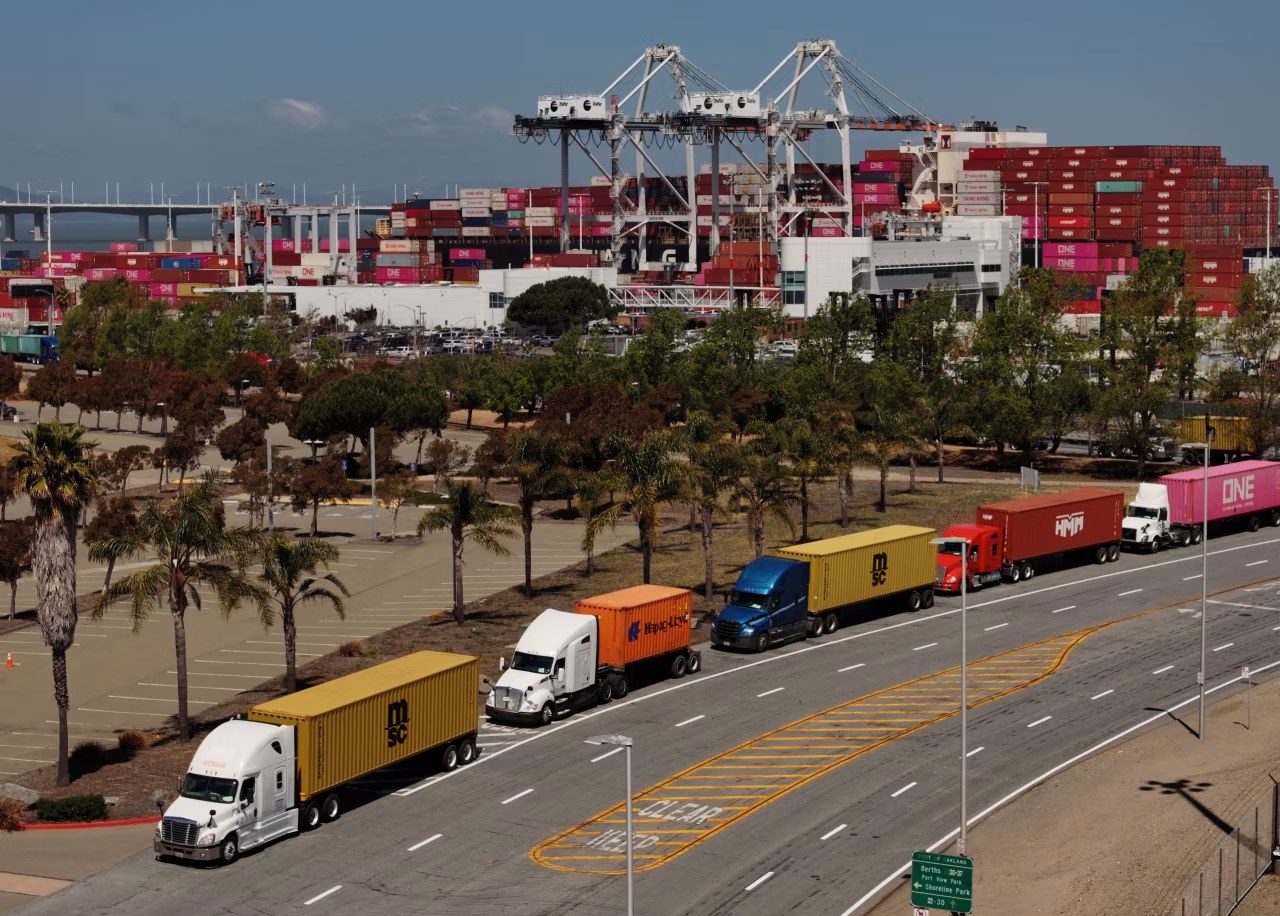
Oil Surges 4.8% to $91.98 as Persian Gulf Closures Rattle Auto & Transport
- Brent crude jumps $4.20 to $91.98 after three ships are hit near the Strait of Hormuz.
- IEA pledges record 400 million-barrel reserve release to blunt any supply shock.
- Rivian due to unveil R2 SUV tomorrow with first price likely above $45,000 target.
- Analysts warn another oil rally looms if strait does not reopen within days.
Energy and EV shocks collide: what higher fuel prices and a mass-market Rivian reveal about the road ahead.
STRAIT OF HORMUZ—Oil markets lurched into risk-premium mode on the latest flare-up in the Persian Gulf, pushing Brent crude to within a whisker of $92 a barrel and reviving inflationary ghosts for the auto and transport world. With roughly one-fifth of global seaborne oil flows normally transiting the Strait of Hormuz, the stand-off has already added more than 8% to crude benchmarks in two sessions.
Against that backdrop, electric-vehicle upstart Rivian Automotive is preparing to pull the covers off its R2 mid-size SUV — a model widely cast as the Irvine, Calif. company’s ticket to scale and a direct challenger to Tesla’s best-selling Model Y. Analysts caution the first version will almost certainly cost more than the $45,000 figure management has floated, complicating Rivian’s pitch to mainstream buyers.
The twin developments underscore a central tension for 2026: while legacy automakers and logistics firms grapple with higher diesel and jet-fuel bills, EV makers must prove they can hit mass-market price points before subsidy fatigue sets in.
Strait of Hormuz Disruptions Send Brent Past $91
Three commercial vessels were reportedly struck near the chokepoint early in the session, prompting a fresh bout of buying across petroleum futures. Brent crude for front-month delivery settled up 4.8% at $91.98, while West Texas Intermediate closed 4.6% higher at $87.25 — its loftiest finish since late 2022.
The International Energy Agency responded within hours, announcing it would release a record 400 million barrels of oil from member-country strategic reserves. Yet analysts stressed the move is a stop-gap, not a solution. “There is still a distinct lack of progress in terms of actual de-escalation, or in terms of transit through the Strait of Hormuz resuming in any meaningful manner,” Michael Brown, market analyst at Pepperstone, wrote in a client note.
Why 18 million barrels a day matters
The strait normally carries around 18 million barrels of crude and condensate daily, according to the U.S. Energy Information Administration. A prolonged closure would dwarf the 5 million barrels per day Russia exported by sea before sanctions. Shipping data show at least a dozen tankers idling near Fujairah, underscoring the immediate logistical headache.
Dennis Kissler, senior vice-president of trading at BOK Financial, told clients that unless tanker traffic resumes within “the next few days” another price leg higher is likely. The reserve release, he added, is “definitely not a big bullish factor, more of a relief near term.”
Forward curves already signal stress: Brent’s one-year spread flipped into a steep backwardation of $5.60 a barrel, a structure that rewards prompt delivery and often precedes inventory draws. Refiners from South Korea to the Netherlands have started testing alternative routes via the Cape of Good Hope, adding up to 20 days to voyage times and roughly $2.50 a barrel to freight.
IEA’s 400M-Barrel Tap: Record, But Is It Enough?
The 31-member IEA has only twice authorised collective stockpile draws of more than 60 million barrels: during the 1991 Gulf War and after Hurricane Katrina in 2005. Today’s pledge of 400 million barrels eclipses both events combined, yet analysts quickly pointed out logistical limits. Roughly 60% of those barrels sit in U.S. salt caverns along the Gulf Coast; moving them to Asian refiners could take 40–45 days, according to energy consultancy FGE.
Japan and South Korea together hold about 550 million barrels of public and private stocks, but legal hurdles require parliamentary approval for large releases. Germany’s 287 million-barrel reserve, held by the EBV, can discharge a maximum of 17 million barrels per month under current legislation. “The headline number is eye-catching, the delivery is incremental,” said Richard Bronze, head of data analytics at Energy Aspects.
Market psychology vs physical reality
Oil futures reacted more to the signal than to barrels on the water. Front-month Brent volume spiked to 1.4 million contracts, double the 20-day average, while open interest rose only 3%, suggesting short-covering rather than fresh longs. ETF flows show retail investors sold $210 million of crude exposure last week, the largest weekly outflow since June 2023, according to Bloomberg data.
Still, the release buys policy makers time. Every $10 increase in Brent adds roughly 25 cents to U.S. retail gasoline within six weeks, according to the Dallas Fed. With national pump prices already at $3.92 a gallon, the White House is eager to blunt any move toward $4.50, a level associated with a 0.3-percentage-point drag on consumer sentiment.
Rivian R2 Debut: Can It Undercut Tesla Model Y?
Rivian’s investor day tomorrow will mark the first public viewing of the R2, a five-seat electric crossover built on the company’s new midsize platform. Benchmark analyst Mickey Legg expects the launch variant — equipped with dual-motor all-wheel drive and a large battery pack — to retail above the $45,000 figure repeatedly cited by CEO RJ Scaringe. “A clearly articulated roadmap to a $45k single-motor entry over time” will be revealed, Legg wrote, but initial units will likely sticker closer to $48,500 before incentives.
That positions the R2 within $1,000 of Tesla’s Model Y Long Range, currently listed at $47,740 in the U.S. after recent price hikes. The Model Y remains the best-selling EV globally, moving 1.23 million units in 2025, according to Clean Technica. Rivian, by contrast, delivered 57,232 vehicles last year, all high-margin pickups and SUVs priced above $73,000.
Configuration simplicity as a strategy
Legg argues Rivian will limit early build combinations to “roughly 200 permutations,” versus the thousands typical for legacy OEMs, to accelerate quality and cut supplier complexity. The company has also pre-ordered single-source tooling for key stampings, a risk-management move that helped Tesla during its Model 3 ramp. Rivian shares slipped 1.5% in midday trading, trimming year-to-date gains to 12%.
Supply-chain executives note that Rivian’s Illinois plant has capacity for 150,000 units on a single shift; adding a second shift could lift output to 250,000 by 2027. Battery cells will initially come from Samsung SDI’s 2170 cylindrical format, the same used in Tesla’s Fremont-built Model Y. The R2 is expected to qualify for the full $7,500 federal EV tax credit under the 2026 requirements because Rivian sources more than 60% of battery components from North America.
Will Higher Oil Speed EV Adoption or Stall Logistics?
History shows a mixed picture. During the 2008 oil spike, U.S. EV registrations doubled from 56,000 to 115,000, but the absolute base was tiny. By contrast, the 2022 Brent surge above $100 barely moved the EV penetration needle because semiconductor shortages capped production. Today, inventories of both battery minerals and finished EVs are healthier: Benchmark Lithium estimates global lithium stocks stand at 11 weeks of demand, up from 6 weeks in 2022.
Yet logistics firms face an immediate cash-flow squeeze. A 10-cent rise in diesel translates into a $135 weekly cost increase per Class-8 truck, according to the American Trucking Associations. Large fleets such as Knight-Swift and J.B. Hunt typically pass through 90% of fuel via surcharges, but smaller carriers often lack pricing power. The Department of Transportation’s latest survey shows 62% of carriers with fewer than 100 trucks operate without fuel hedges.
Airlines caught in the middle
Jet-fuel prices in New York harbor have climbed 22% since the strait tensions began, outpacing Brent’s 17% gain due to kerosene-specific supply tightness. Delta Air Lines said on its last earnings call that every 5-cent increase in jet fuel adds $95 million in annual expense. With summer bookings already 4% ahead of 2023 levels, carriers are reluctant to raise fares aggressively for fear of dampening leisure demand.
Railroads have some insulation: diesel accounts for roughly 12% of operating costs at Union Pacific, versus 25–30% at truckers. Still, crude-by-rail could stage a comeback if the strait stays shut. Western Canadian rail loading terminals have 400,000 barrels per day of idle capacity, and producers at Hardisty are offering $7-a-barrel discounts to WTI, the widest since April 2023.
What Comes Next for Auto Stocks and Supply Chains?
Equity strategists at BNP Paribas raised their 2026 Brent assumption to $88 from $78 and cut EPS forecasts for global airlines by 9% while trimming North American railroads by 2%. Auto makers face a more nuanced hit: higher oil historically boosts EV consideration, but also lifts petrochemical feedstocks that filter into plastics and synthetic rubber. Morgan Stanley estimates every $10 rise in Brent adds $95 to the bill of materials for a mid-size EV, mostly via tire and interior trim inflation.
Rivian’s R2 reveal could therefore arrive at an opportune psychological moment, yet execution remains fragile. The company burned $3.1 billion in cash during 2025 and has $7.9 billion on hand, enough for roughly two years at current spend rates. Benchmark’s Legg maintains a “speculative buy” with a $15 price target, implying 28% upside from Wednesday’s close. Short interest stands at 18% of the free float, a level that often magnifies moves on news.
Policy tailwinds and headwinds
The EPA’s final tail-pipe rule due in March could require 56% of new U.S. light-vehicle sales to be zero-emission by 2032, up from 8.9% today. Meanwhile, the European Commission is weighing extending its 2035 combustion ban to heavy trucks under 26 tonnes, a move that would favor battery or hydrogen platforms. Conversely, a bipartisan bill introduced in the U.S. House last week proposes capping federal EV rebates at $55,000 MSRP, a threshold that would exclude most Rivian and Tesla configurations.
Supply-chain managers are dusting off 2022 playbooks: securing dual sourcing for semiconductors, pre-buying petrochemical resins, and indexing fuel surcharges to weekly rather than monthly benchmarks. The Auto Care Association reports that aftermarket suppliers have increased safety-stock targets from 28 to 42 days since the strait tensions began. For investors, the key variable remains duration: a two-week disruption is largely cosmetic, but a three-month closure would rival the 1973 oil embargo in magnitude.
Frequently Asked Questions
Q: Why did oil prices jump above $90?
Three commercial vessels were struck near the Strait of Hormuz, and Iran is disrupting transit. With 20% of global seaborne oil at risk, Brent surged 4.8% to $91.98, while WTI leapt 4.6% to $87.25.
Q: How much oil is the IEA releasing from reserves?
The International Energy Agency will unleash a record 400 million barrels from member emergency stockpiles to offset any supply shortfall if the strait stays closed.
Q: What is Rivian’s R2 and how does it compare to Tesla Model Y?
Rivian’s R2 is a mid-size electric SUV slated to debut tomorrow. Benchmark analyst Mickey Legg expects an initial dual-motor AWD version priced slightly above the oft-cited $45k target, positioning it as a direct Model Y competitor.
