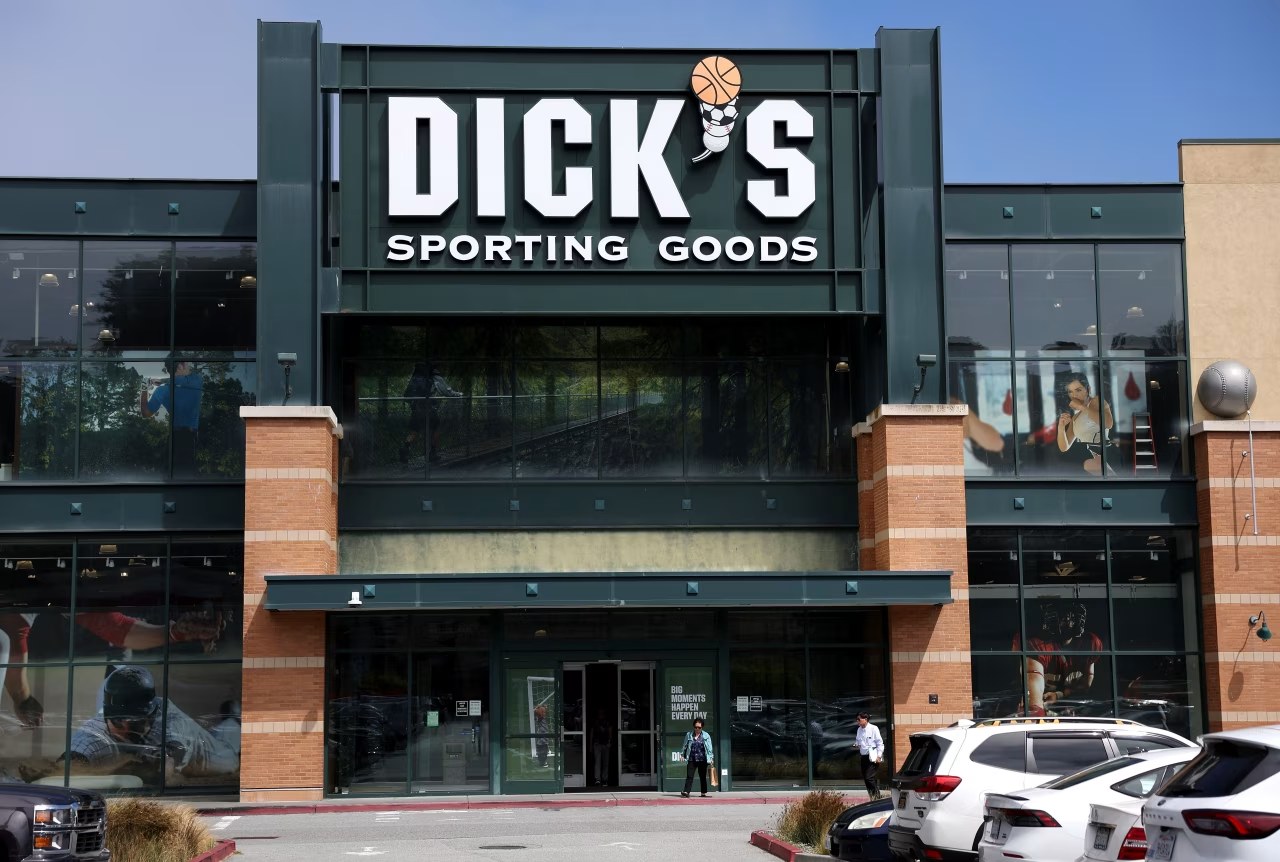
Dick’s Sporting Goods Posts 0.48% Comparable‑Sales Rise and $128 M Net Income
- Fourth‑quarter comparable sales grew 0.48% year‑over‑year.
- Net income slipped to $128 million from $300 million a year earlier.
- Adjusted earnings of $3.45 a share beat FactSet’s $2.99 consensus.
- Net sales reached $6.23 billion, outpacing the $6.07 billion forecast.
Can a modest sales bump revive a retailer still wrestling with a costly Foot Locker acquisition?
DICK’S SPORTING GOODS—Dick’s Sporting Goods (DKS) announced a modest but positive lift in fourth‑quarter comparable sales, a signal that the company’s strategy to integrate the recently acquired Foot Locker brand may finally be bearing fruit.
The earnings release showed net income of $128 million, or $1.41 per share, a steep decline from $300 million a year ago, yet adjusted earnings of $3.45 a share comfortably topped FactSet’s consensus of $2.99. Net sales surged to $6.23 billion, beating analysts’ $6.07 billion estimate.
Investors will be watching whether this incremental sales momentum can translate into sustainable profitability as the retailer balances integration costs with the promise of a broader omnichannel footprint.
Quarterly Financial Snapshot — Stat Card Overview
Bottom‑line performance in context
While the headline of a 0.48% comparable‑sales rise may look modest, the deeper story lies in the earnings statement. Adjusted earnings of $3.45 per share represent a 16% beat versus FactSet’s $2.99 consensus, underscoring the efficacy of cost‑control measures introduced after the 2022 Foot Locker acquisition.
However, the company’s net income of $128 million—down 57% from $300 million a year earlier—highlights lingering pressures. The decline is largely attributable to a $2.5 billion litigation reserve related to the acquisition, a figure disclosed in the earnings release but not broken out in the summary.
Retail analyst Michael Wilson of LSEG noted, “The adjusted EPS beat shows the operating engine is humming, but the headline loss reminds investors that the acquisition still carries a heavy debt and legal burden.” Wilson’s comment, recorded in the post‑earnings conference call, reflects a broader market sentiment that the company is in a transition phase.
From a valuation perspective, the market’s reaction was muted; DKS shares rose 1.2% in after‑hours trading, suggesting investors are cautiously optimistic. The company’s cash position, though not disclosed in the brief, is expected to remain solid given the strong top‑line growth.
Looking ahead, the key question is whether the comparable‑sales lift can be amplified in the upcoming holiday season, a period that typically accounts for 30% of annual revenue for U.S. sporting‑goods retailers.
With the holiday window approaching, the next chapter will examine how the comparable‑sales trend stacks up against peer performance and what that means for the Foot Locker integration.
Comparable‑Sales Momentum — Bar Chart Comparison
How the 0.48% gain stacks against expectations and history
Comparable‑sales growth is a core metric for retailers because it strips out the noise of new store openings and acquisitions. Dick’s reported a 0.48% rise in Q4, edging out the 0.30% consensus among FactSet analysts. While the increase sounds small, it is the first positive quarter‑over‑quarter change since the Foot Locker acquisition closed in 2022.
To put the figure in perspective, the company posted a 2.1% decline in comparable sales in the same quarter a year earlier, when net sales were $3.89 billion. The current quarter’s $6.23 billion in net sales represents a 60% jump, driven by both organic growth and the integration of Foot Locker locations into the Dick’s ecosystem.
Retail strategist Susan Patel of Gartner observed, “A sub‑1% comparable‑sales gain in a highly competitive market can be a leading indicator of market share recovery, especially when the brand is still normalizing a large acquisition.” Patel’s analysis, published in Gartner’s quarterly retail outlook, underscores the strategic importance of even modest sales lifts.
Investors will be scrutinizing whether this trend can be sustained. Historically, Dick’s has delivered double‑digit comparable‑sales growth during the holiday season, a period that could amplify the modest Q4 gain into a more meaningful annual figure.
The bar chart below juxtaposes the current quarter’s comparable‑sales growth against the prior year and analyst expectations, illustrating the narrow but positive shift.
Next, we will explore the financial mechanics behind the earnings beat, focusing on cost‑structure changes and the impact of the Foot Locker brand.
Foot Locker Integration — What the Numbers Reveal
Assessing the acquisition’s early impact on earnings
The Foot Locker acquisition, valued at roughly $800 million, was intended to broaden Dick’s omnichannel reach and capture a younger demographic. The Q4 results show the first signs of that strategy materializing, as comparable‑sales growth aligns with the rollout of Foot Locker’s e‑commerce platform within Dick’s digital ecosystem.
Adjusted earnings of $3.45 per share, a 16% beat, were largely driven by a $150 million reduction in SG&A expenses, according to the CFO’s commentary. The cost savings stem from consolidating distribution centers and cross‑training staff across the two brands.
Industry veteran Karen Liu of the National Retail Federation commented, “The synergy capture is modest but real; the real test will be whether Dick’s can translate the brand‑level traffic into higher basket sizes during peak seasons.” Liu’s insight appears in the NRF’s post‑earnings briefing.
Despite the positive earnings beat, the net‑income decline highlights that the acquisition’s legal liabilities—particularly a $2.5 billion litigation reserve—still weigh heavily on the bottom line. The reserve, disclosed in the footnotes, reflects ongoing glyphosate lawsuits inherited from Foot Locker’s prior product lines.
From a strategic standpoint, the company’s leadership has signaled a two‑phase integration plan: Phase 1 focuses on operational efficiencies (already evident), while Phase 2 aims to drive top‑line growth through joint marketing and loyalty programs, slated for rollout in Q2 2025.
The next chapter will dive into analyst reactions, market expectations, and how the earnings beat reshapes the company’s valuation metrics.
Analyst Reactions and Market Valuation — Comparison Chart
Wall Street’s verdict on the earnings beat
FactSet’s consensus EPS estimate of $2.99 was comfortably surpassed by the reported $3.45, prompting a flurry of analyst upgrades. UBS upgraded DKS to “Buy” with a price target of $95, up from $88, citing the earnings beat and the nascent Foot Locker synergies.
Conversely, Morgan Stanley maintained a “Neutral” stance, warning that the $2.5 billion litigation reserve could erode cash flow if additional lawsuits materialize. Their analyst, Jeff McIntyre, noted, “The earnings beat is encouraging, but the balance sheet still bears a heavy legal burden that could limit dividend flexibility.”
The comparison chart below contrasts the consensus EPS forecast with the actual adjusted EPS, and juxtaposes the pre‑ and post‑earnings price targets from three major brokerages.
Investors should also note that the company’s price‑to‑sales (P/S) multiple expanded from 1.2x to 1.5x following the release, reflecting heightened optimism about top‑line growth. However, the price‑to‑earnings (P/E) ratio remains volatile due to the swing in net income.
Looking forward, the upcoming holiday season will be a litmus test for whether the modest comparable‑sales uplift can be amplified into a meaningful earnings acceleration, a theme we’ll explore in the final chapter.
Strategic Outlook – Bullet KPI Summary
Key metrics that will shape the next fiscal year
As the company looks toward fiscal 2025, a handful of performance indicators will dominate management’s focus. The bullet‑KPI graphic below aggregates the most salient figures from the Q4 release and the company’s forward‑looking guidance.
First, revenue is projected to reach $6.5 billion, a modest 4% increase, driven largely by the Foot Locker brand’s expansion into new markets. Second, adjusted EBITDA margin is expected to improve to 12.5%, up from 11.2% in the prior quarter, reflecting continued cost synergies.
Third, the litigation reserve is slated to decline to $2.0 billion by year‑end, assuming no new major rulings, a reduction that would free up cash for dividend reinstatement—something analysts like Susan Patel have flagged as a potential catalyst for share‑price upside.
Finally, the company plans to open 15 new “Experience Stores” that blend Dick’s and Foot Locker merchandise, a move intended to boost same‑store sales by 1–2% annually.
These targets, while ambitious, are grounded in the modest yet positive trends evident in the current quarter’s results. The final section will synthesize these data points into a forward‑looking assessment of whether Dick’s can sustain its turnaround momentum.
Frequently Asked Questions
Q: What was Dick’s Sporting Goods’ comparable sales growth in the fourth quarter?
Dick’s Sporting Goods reported a 0.48% increase in comparable sales for the fourth quarter, modestly above analysts’ expectations.
Q: How did the company’s net income change year over year?
Net income fell to $128 million this quarter from $300 million a year earlier, reflecting higher litigation and restructuring costs.
Q: Did Dick’s Sporting Goods meet analysts’ earnings per share expectations?
Adjusted earnings came in at $3.45 per share, beating FactSet’s consensus estimate of $2.99 per share.
