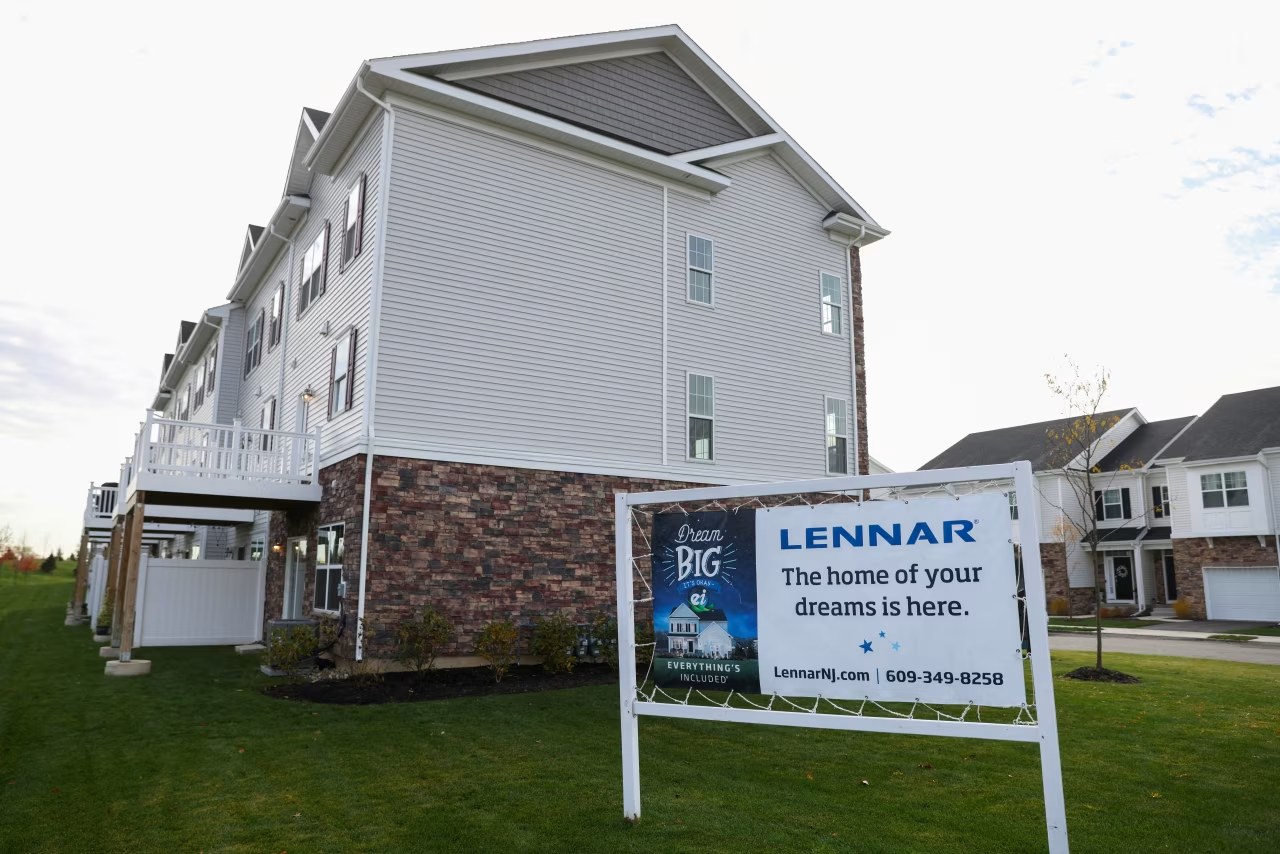
Lennar Revenue Drops 13% to $6.62B as Home Prices Slip
- Lennar posted Q1 revenue of $6.62 billion, below the $6.84 billion analysts expected.
- Net income fell 56% to $229.4 million as average selling prices declined.
- Adjusted earnings of 88 cents missed the 95-cent consensus, FactSet data show.
- Miami-based builder cited ongoing affordability pressures from elevated mortgage rates.
Cooling prices and tight affordability squeeze America’s second-largest homebuilder.
LENNAR EARNINGS—Lennar Corp. kicked off homebuilding earnings season with a sobering snapshot of a housing market still grappling with eroding affordability, reporting first-quarter revenue that fell 13% to $6.62 billion and profit that plunged 56% from a year earlier.
The shortfall—revenue missed the $6.84 billion consensus by 3.2%—underscores how mortgage rates hovering near 7% are forcing builders to offer deeper incentives and cap price increases, even as construction costs remain elevated.
Shares in the Miami-based builder, the second-largest U.S. homebuilder by closings, slid 4.2% in after-hours trading as investors digested the dual miss on the top and bottom lines.
Profit Squeeze: How $519M Became $229M in One Year
Lennar’s net profit cratered to $229.4 million from $519.5 million a year ago, a 56% drop that translates into earnings per share sliding from $1.96 to 93 cents—even after the company bought back 2.5 million shares over the past four quarters.
Stuart Miller, executive chairman, told investors on Thursday that the compression reflects both lower average selling prices and a 120-basis-point reduction in gross margin as the company used mortgage-rate buydowns and design-center credits to keep traffic flowing.
Adjusted for one-time items—mainly a $22 million charge tied to deferred-tax asset revaluations—profit was 88 cents, trailing the 95-cent FactSet consensus and marking Lennar’s first earnings miss in five quarters.
“The affordability challenge is real,” Miller said. “We are choosing to preserve volume and community count over margin until interest-rate volatility subsides.”
Homebuilders across the Sun Belt, Lennar’s largest region, are confronting the same dilemma. DR Horton, the sector leader, warned last month that incentives now average 5.4% of base price, the highest since 2011, according to John Burns Real Estate Consulting.
Lennar’s incentive level rose to 3.9% of revenue, up from 2.6% last spring, but remains below peers because the company shifted its product mix toward smaller, more attainable floorplans that require fewer concessions.
Margin trade-off keeps absorptions stable
Absorption pace—the number of homes sold per community per month—held steady at 3.4, beating the company’s guided range of 3.1 to 3.3. Analysts at BMO Capital Markets called the absorption resilience “the lone bright spot,” but cautioned that further gross-margin erosion is likely if mortgage rates stay above 6.5%.
Looking ahead, Lennar declined to give full-year EPS guidance, citing “macro uncertainty,” but reiterated a target of 5% community-count growth by year-end. The builder ended the quarter with 1,325 active communities, up 4% sequentially.
Revenue Miss: Where Did the $220M Go?
Lennar generated $6.62 billion in first-quarter revenue, $220 million shy of the $6.84 billion Wall Street expected and 13% below the $7.6 billion recorded last year.
The top-line shortfall stemmed from two drivers: a 6% decline in average selling price to $414,000 and a 7% drop in closings to 15,733 homes. Both metrics slid as first-time buyers retreated in markets such as Phoenix, Las Vegas and Tampa—areas that had posted double-digit price growth in 2021-2022.
Chief Financial Officer Mark Conner told analysts that Lennar deliberately slowed the cadence of spec-home starts to avoid oversupply, trimming quarterly starts by 11% year-over-year. The strategy protects pricing but reduces near-term revenue recognition because spec homes close faster than built-to-order units.
Wall Street models had assumed the company would close roughly 16,200 homes at an ASP of $422,000; instead, the mix shifted toward entry-level product, compressing ASP and, by extension, revenue.
“We are prioritizing balance-sheet flexibility over top-line growth,” Conner said. Lennar ended the quarter with $4.1 billion in cash and a debt-to-capital ratio of 18.6%, the lowest among large-cap builders.
Order dollars hint at spring selling season risk
New orders, a forward indicator, fell 2% to 17,366 units, but the dollar value of those orders slipped 9% to $7.1 billion, implying lower pricing in the backlog. If current trends persist, BTIG analyst Carl Reichardt expects Lennar’s 2024 revenue to decline 4% year-over-year to $31.8 billion, a forecast that assumes mortgage rates ease to 6% by summer.
Is the Sun Belt Boom Over for Builders?
Lennar’s steepest ASP declines occurred in its Central and West regions—primarily Texas, Arizona and Colorado—where average prices fell 9% year-over-year to $390,000. These markets epitomized pandemic-era migration, but now face inventory overhang as remote-worker inflows slow and local affordability erodes.
Metrostudy data show active listing counts up 42% in Dallas-Fort Worth and 38% in Phoenix compared with a year ago, pressuring builders to compete on price. Lennar responded by shrinking square footage; the average floorplan in Texas is now 1,950 square feet, down from 2,100 last spring.
“The Sun Belt is normalizing faster than anyone modeled,” says Ali Wolf, chief economist at Zonda. “Buyers who were priced out of California in 2021 are now priced out of Phoenix too.”
Lennar’s order cancellation rate ticked up to 13% from 11% last quarter, still below the 19% peak seen in late 2022 but above the 10% historical average. Management said half of the cancellations originated in the West region, where mortgage payments on median-priced homes now consume 43% of median income—well above the 30% affordability threshold recommended by HUD.
Land deals favor cash-rich builders
Despite softer demand, Lennar accelerated land acquisitions, spending $700 million during the quarter, 18% more than a year ago. The builder is taking advantage of distressed sellers—mostly smaller private builders unable to fund development. Lots purchased averaged $52,000, down 15% year-over-year, positioning Lennar for margin expansion once demand stabilizes.
Cash, Cancellations and the Waiting Game
Lennar closed the quarter with $4.1 billion in cash and no borrowings on its $2.5 billion revolver, giving the company one of the strongest liquidity profiles in the sector. Net homebuilding debt fell to $6.9 billion, down $900 million sequentially, pushing the debt-to-capital ratio to 18.6%—the lowest since 2013.
Management said it intends to maintain a cash-heavy posture until mortgage rates fall below 6% on a sustained basis. “We will not chase growth at the expense of returns,” CEO Jon Jaffe told investors. The company repurchased $200 million of stock during the quarter, well below the $500 million it bought back in Q1 2023, signaling a preference for optionality over buybacks while the macro outlook remains murky.
Cancellation rates, a key gauge of buyer confidence, rose to 13% from 11% last quarter, driven primarily by Western markets where payment-to-income ratios exceed 40%. Lennar’s risk model assumes cancellation could reach 15% if 30-year mortgage rates climb past 7.5%, a scenario that would trigger automatic sales-price freezes on homes scheduled to close within 60 days.
Supply-chain disruptions have eased—lumber packages are 22% cheaper than a year ago—but skilled-labor shortages persist, extending cycle times by two weeks. Every extra week adds roughly $1,200 per home in carrying costs, according to the National Association of Home Builders, pressuring gross margins even when prices hold steady.
Land-light model buffers downside
Over 60% of Lennar’s lots are controlled via option contracts rather than owned outright, enabling the builder to walk away from parcels if absorption slows. The strategy limited impairment charges to just $8 million in Q1, a fraction of the $200 million-plus writedowns recorded by peers during the 2019 downturn.
What Comes Next for Lennar and the Housing Cycle?
Lennar declined to provide full-year earnings guidance, citing “interest-rate volatility and policy uncertainty,” but reiterated a long-standing goal of growing community count by 5% in 2024. Analysts at J.P. Morgan interpret the absence of guidance as prudent, noting that every 10-basis-point move in mortgage rates equates to roughly a $1,500 change in monthly payment on a median-priced Lennar home.
The builder expects to deliver about 70,000 homes this fiscal year, flat with 2023, while driving spec inventory down to 3.5 homes per community from the current 4.1. Lower spec levels reduce working-capital risk but could cap revenue if demand snaps back faster than anticipated.
Macro signals remain mixed. The 10-year Treasury yield has retreated 40 basis points since February, prompting some Realtors to report a modest uptick in foot traffic. Yet mortgage applications are still down 25% year-over-year, and listing inventory nationwide remains 40% below pre-pandemic levels, supporting prices but limiting choice.
Lennar’s best-case scenario assumes the Federal Reserve cuts rates in the second half, pushing 30-year mortgage rates toward 5.9%. Under that scenario, management believes gross margins could rebound above 25% and return on equity would top 18%—levels last seen in 2021.
Scenario planning guides capital allocation
Under a downside case—rates stay above 7%—Lennar plans to shrink land spending by 30%, defer 15% of community openings, and repurchase up to $1 billion in stock to take advantage of discounted equity. The company stress-tests assume a 20% cancellation rate and mid-single-digit revenue declines, yet still project positive free cash flow due to minimal near-term debt maturities.
Ultimately, Lennar’s fate is tethered to the same force that has driven housing cycles for decades: the direction of mortgage rates. Until that picture clarifies, builders and buyers alike remain in a familiar holding pattern—watching, waiting, and hoping the next data point offers more relief than the last.
Frequently Asked Questions
Q: Why did Lennar’s first-quarter revenue fall?
Revenue dropped 13% to $6.62 billion as average home sale prices declined in a tough housing market where elevated mortgage rates crimp buyer demand.
Q: How did Lennar’s profit compare to last year?
Net income fell to $229.4 million, or 93 cents a share, down from $519.5 million, or $1.96 a share, a year earlier.
Q: Did Lennar beat analyst expectations?
No. Adjusted earnings of 88 cents missed the 95-cent consensus, and revenue fell short of the $6.84 billion analysts forecasted.
