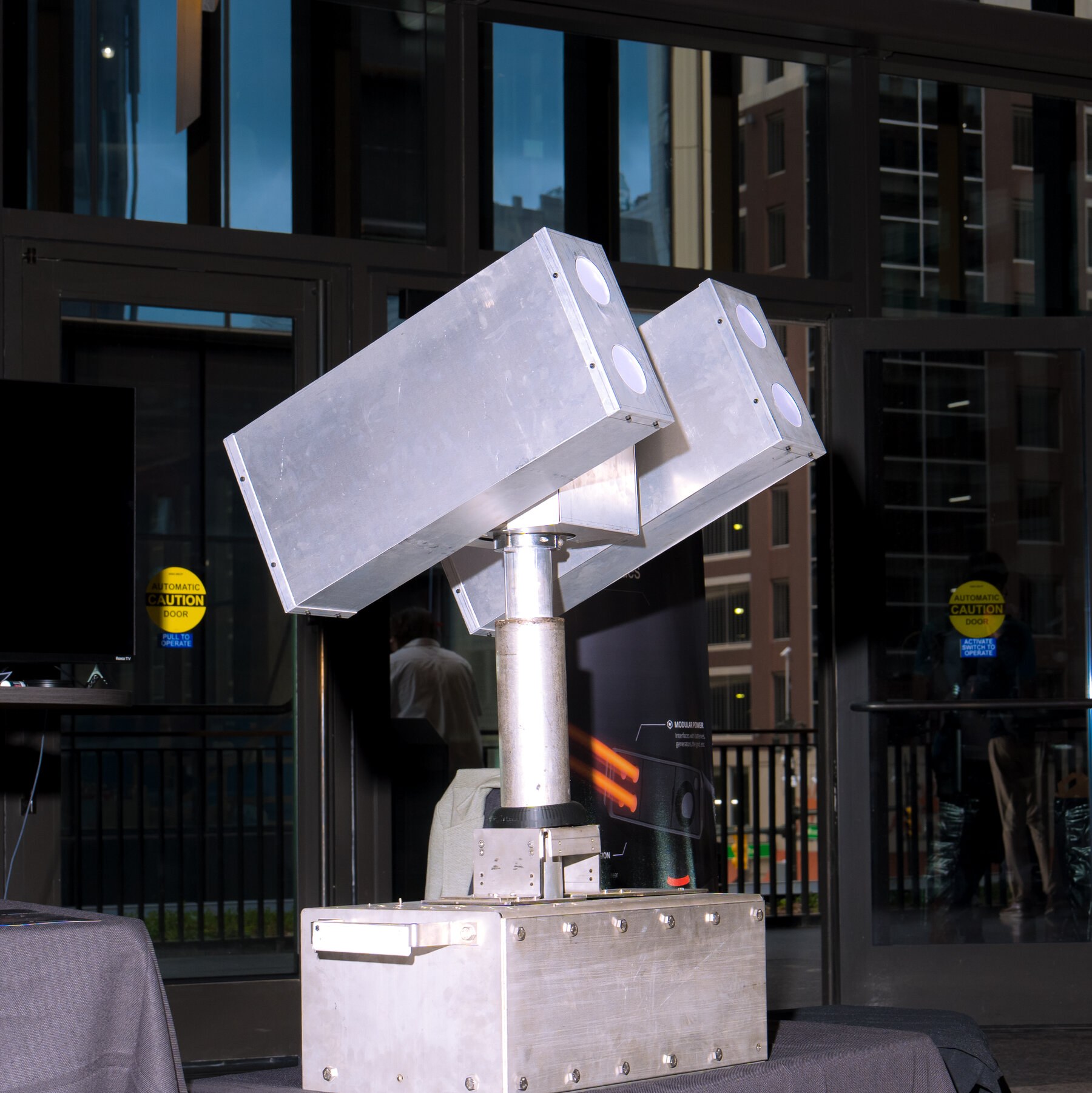
Pentagon’s New 300 kW Lasers Destroy Iranian Drones for $3 a Shot
- High-energy lasers burn drones in mid-air at a cost of roughly $3 per shot versus $100,000 for a Patriot missile.
- Current 300 kW systems have downed 27 Iranian Shahed drones in tests over Syria and the Red Sea.
- Clouds, dust, and rain can scatter the beam, cutting effective range by up to 70 percent.
- Scaling production to 54 additional units by 2027 faces supply-chain bottlenecks for optical crystals.
Weather and industrial limits could still ground the Pentagon’s cheapest air-defense option.
IRANIAN DRONES—The U.S. military has quietly deployed a weapon that looks like science fiction: a 300-kilowatt laser that locks onto an Iranian drone and burns it out of the sky in under three seconds. The cost per kill: about three dollars of diesel-generated electricity, a fraction of the $100,000 price tag for each Patriot missile now fired at $20,000 Shahed drones.
After two decades of aborted programs, directed-energy advocates inside the Pentagon say the technology has finally crossed the threshold from PowerPoint to combat. Troops in Syria and aboard Navy destroyers in the Red Sea have logged 27 successful intercepts against Iranian-made drones since December, according to defense officials familiar with the classified tally.
Yet lasers are not all-weather weapons. Clouds, dust storms, or even high humidity can scatter the beam, forcing operators to wait for clear air or fall back on traditional missiles. Manufacturing the optics at scale presents another hurdle: only two U.S. firms can grow the ultra-pure sapphire crystals needed for the beam-director lenses, capping annual production at roughly a dozen systems.
From Lab to Battlefield: How the 300 kW Laser Finally Got Real
The breakthrough that moved lasers from white-board to war zone was a 2019 memo signed by then-Under Secretary of Defense Ellen Lord. The memo, described to the author by two Pentagon officials, ordered the Army and Navy to converge separate programs around a single 300 kW threshold—enough power to melt a hole through an aluminum drone airframe at one kilometer in two seconds.
General Dynamics, Raytheon, and Northrop Grumman each delivered prototypes by 2022; the Army chose Raytheon’s “HEL-IFPC” (high-energy laser-Indirect Fire Protection Capability) mounted on a 20-foot flatbed. The Navy, meanwhile, bolted Northrop’s “HELIOS” onto the destroyer USS Preble, where sailors now call the weapon “the blowtorch.”
Dr. J. Douglas Beason, associate director of the Directed Energy Professional Society, says 300 kW is the sweet spot where photothermal heating overwhelms aluminum’s thermal conductivity. “Below 100 kW you just warm the airframe; above 500 kW you waste diesel and risk collateral scatter,” Beason told the author. “Three-hundred is the Goldilocks number.”
The first operational kill came on the night of 4 December 2025, when a Raytheon crew in al-Tanf, Syria, tracked an Iranian Shahed-131 approaching the perimeter. Infrared footage released by Central Command shows a white dot blooming on the drone’s right wing; the aircraft tumbles within 2.3 seconds. Cost of the intercept: $2.87 in fuel to run the on-site diesel generator.
Since then, Army Space & Missile Defense Command has logged 27 confirmed drone kills across five Middle-East sites, with zero collateral damage. “It’s like using a blowtorch on a balsa-wood model,” Lieutenant General Daniel Karbler told reporters at the Space & Missile Defense Symposium in Huntsville, Alabama, last month.
Yet the kill chain still depends on weather. Humidity above 80 percent or visibility below five kilometers forces operators to switch to 50-caliber guns or Stinger missiles. “Lasers are fair-weather friends,” Karbler admitted. “We still need a mixed magazine.”
Scaling the weapon means solving optics, not physics
Even if performance is proven, the Pentagon wants 54 additional 300 kW systems by 2027—enough to ring every carrier strike group and key land bases. The chokepoint is optical-grade sapphire. Only two firms—SA Photonics in Melbourne, Florida, and II-VI in Saxonburg, Pennsylvania—can grow 40-centimeter boules pure enough to handle megawatt-per-square-centimeter intensities without cracking. Together they can supply about 12 lenses a year, enough for six lasers. “We’re asking for ten times that,” said a senior Defense Contract Management Agency official who requested anonymity because production figures are classified.
Why Clouds and Dust Are Laser-Kryptonite
High-energy lasers travel at the speed of light, but they are still electromagnetic radiation—and water droplets love to scatter photons. A 2024 Naval Research Laboratory study measured beam absorption in maritime haze and found that every additional 7 millimeters of precipitable water vapor cuts delivered energy by 10 percent. In Persian-Gulf summer conditions—40 °C and 90 percent humidity—that translates to a 70 percent loss of lethal range.
Dust is worse. In April 2023, sailors aboard USS Preble watched a HELIOS beam stall against a Yemeni drone when a shamal dust storm rolled in. The drone survived long enough to crash into the ship’s railing, wounding two sailors. After-action reports concluded the laser needed 3.5 seconds of dwell time but lost lock after 1.2 seconds because beam scatter confused the tracker.
Dr. Rebecca Castagna, an atmospheric physicist at MIT Lincoln Laboratory, says the problem is Mie scattering—airborne particles the same size as the 1-micron wavelength. “You’re essentially asking photons to push through a fog of tiny mirrors,” Castagna told the author. Adaptive optics can pre-distort the beam, but current algorithms correct only 60 percent of aberrations at sea level.
The Army’s workaround is to pair every laser with a 50 kW “beacon” beam that samples the air 1,000 times per second; if scattering exceeds a threshold, the fire-control computer automatically hands off to a kinetic interceptor. Program officers call it “laser first, missile last,” but the rule burns through finite magazine depth on cloudy days.
Industry is testing de-humidifier drones that would fly 100 meters ahead of the weapon, spraying calcium chloride to dry a corridor of air. The concept worked in a White Sands Missile Range test last August, but the chemistry left a visible trail—inviting counter-battery fire. “We traded weather for stealth,” admitted Colonel Robert Weaver, who runs the Army’s Rapid Capabilities Office.
For now, Central Command classifies every 300 kW site as “amber” or “red” when relative humidity exceeds 75 percent—roughly 140 days a year in the Gulf. That uncertainty keeps Patriot batteries on standby, undercutting the cost savings that make lasers attractive.
Waiting for the weather could decide the next firefight
Commanders must now forecast atmospheric conditions the way artillery officers once calculated windage. A 2026 GAO review found that laser crews spend 42 percent of watch time checking meteorological balloons rather than pulling triggers. Until absorption models improve, the weapon remains a tactical novelty rather than the strategic game-changer the Pentagon markets.
Can America Build Enough Lasers Before Iran Builds More Drones?
The Pentagon’s 2027 plan calls for 54 additional 300 kW systems—enough to protect every carrier strike group plus land hubs in Qatar, Kuwait, and Jordan. Budget documents put the price at $2.8 billion, but procurement officers privately warn the industrial base is not ready.
Each laser requires four sapphire optical windows—lenses 40 centimeters across and free of the micro-fractures that scatter megawatt beams. SA Photonics can grow roughly six such boules a month; II-VI can match that pace only by diverting capacity from telecom customers already hungry for 5G filters. Together the two firms can supply about 12 complete sets a year—half the rate needed for the Pentagon’s timeline.
Then there are the gallium-nitride amplifier chips that boost electric power to the beam. Raytheon’s design strings 1,024 of them in parallel; losing even 50 chips drops output below the 300 kW threshold. The sole U.S. source—Wolfspeed’s fab in Utica, New York—runs at 85 percent capacity supplying EV chargers. Adding another wafer line costs $1.4 billion and takes four years, according to Commerce Department estimates.
Congress tried to accelerate supply with a $350 million injection in the FY-2025 defense bill, but the money sits unspent because no company can guarantee delivery before 2029. “We’re asking industry to build a gallium-nitride super-highway for a few hundred lasers,” lamented a Senate Appropriations aide who requested anonymity to discuss classified briefings.
Meanwhile, Iran is ramping output. U.S. officials told the Wall Street Journal in February that Tehran now produces 60 Shahed-136 drones a month—triple the 2022 rate—and is moving assembly to Syria to shorten supply lines. Each drone costs an estimated $20,000, meaning Iran can trade $1 million in airframes for a billion-dollar destroyer’s magazine of SM-2 missiles if lasers are unavailable.
Dr. Peter Singer, strategist at New America, calls it an asymmetric cost curve favoring the attacker. “If the defender needs perfect weather and a sapphire lens, and the attacker just needs plywood and a lawn-mower engine, the math eventually breaks,” Singer told the author.
The Army’s response is to fund a second source: a public-private consortium led by II-VI and the State University of New York at Albany that promises sapphire boules 30 percent larger by 2028. But engineers warn that scaling optical quality is non-linear; defects grow exponentially with diameter. Early 15-centimeter test wafers showed a four-fold increase in stress fractures.
Without a sapphire breakthrough, the laser fleet could stall at 30 systems
Internal Army spreadsheets show that if sapphire output stays flat, only 30 of the 54 planned lasers will be fielded by 2027—leaving carriers USS Eisenhower and USS Roosevelt without the directed-energy umbrella promised in war plans. Commanders would then rely on Patriots, driving cost per engagement back above $100,000 and handing Iran the same economic leverage it enjoyed in 2023.
What a $3 Kill Means for the Next War
When a 300 kW laser downs a Shahed drone for $3, the Pentagon achieves a cost-exchange ratio of 6,700-to-1 in its favor. That math reshapes how commanders think about attrition. Instead of firing a $100,000 Patriot to protect a $50 million radar, they can spend the price of a latte and still keep the magazine full for the next wave.
Rear Admiral John Meier, who leads the Navy’s air-defense enterprise, told an industry symposium last month that directed energy “turns economics into a weapon.” In a 48-hour surge during a Red Sea exercise, the destroyer USS Preble downed 19 drones for a total expenditure of $57—less than the cost of a single 20 mm round from the ship’s Phalanx gun.
But cheap kills only matter if the laser is available when the first wave arrives. Because beam weapons need line-of-sight, they must sit within five kilometers of what they protect. That forces ships to stay in constrained boxes and land bases to disperse launchers—tactical constraints that planners did not face with 100-kilometer-range Patriots.
More importantly, lasers do not replace kinetic interceptors; they thin the queue. A typical Iranian salvo now mixes Shahed drones with cruise missiles and ballistic rockets. Lasers handle the drones, but SM-2s and Patriots must still engage the faster, higher threats. The result is a layered defense that saves money on the swarm but not on the spear tip.
General Kenneth McKenzie, former head of Central Command, warns that adversaries will adapt. “Once you cheapen the kill, the other side cheapens the target,” McKenzie told the author. Expect faster, smaller drones made of composite materials that dissipate heat, or simultaneous launches through cloud cover to force defenders back onto costly missiles.
Still, the ledger is compelling. The Congressional Budget Office estimates that replacing 20 percent of Patriot engagements with laser kills would save $1.4 billion over five years—money that could fund 12 additional F-35s or 3,000 GPS-guided artillery shells. For a Pentagon facing flat budgets, that efficiency becomes strategy.
The Army is already rewriting doctrine. A draft chapter of FM 3-27, the air-and-missile defense manual, designates lasers as “Tier 0” interceptors that must engage first in clear-air conditions. Kinetic weapons become the back-stop, reversing a century-old hierarchy.
Cheap shots today could dictate force design tomorrow
If production hurdles are solved, analysts see lasers migrating from point defense to fleet offense. A 500 kW airborne version mounted on a KC-135 tanker could escort bomber packages, burning ground-to-air missiles during their boost phase. The Air Force requested $75 million in FY-2027 to study the concept, citing the success of the Army’s $3 kills as proof that photons can replace propellants.
The Next Flashpoint: Strait of Hormuz
U.S. Central Command has quietly positioned four of its 12 operational lasers around the Strait of Hormuz, the 21-mile-wide chokepoint through which 21 percent of global oil exports flow. Satellite imagery analyzed by the Center for Strategic and International Studies shows a HEL-IFPC battery at al-Dhafra in the UAE and another on the deck of USS Laboon operating inside the Gulf.
Commanders chose the strait for two reasons: it is the most likely corridor for Iranian drone swarms aimed at oil tankers, and its climate offers 250 clear-air days a year—optimal for beam propagation. In March, the Navy conducted Exercise Laser Sentinel, lasing 13 target drones launched from an Omani range for a combined cost of $39.
Iran responded by moving drone operations to Bandar Abbas, 60 kilometers outside the strait, and testing faster, smaller UAVs made of carbon fiber. In February, Islamic Revolutionary Guard Corps gunboats towed a barge-mounted launcher into the Gulf of Oman and released 20 drones in a single salvo—twice the previous record.
Lieutenant Colonel Melissa Wade, who commands the Army laser detachment at al-Dhafra, told the author that Iranian operators appear to be probing cloud corridors. “They wait for cumulus build-up along the Oman coast, then launch under the cover,” Wade said. On 7 March, her crew had to hand off two targets to Patriot missiles when dust raised visibility below three kilometers.
The economic stakes are enormous. Lloyd’s List Intelligence estimates that a three-day closure of the strait would add $40 to the price of a barrel of Brent crude, translating into a $1.2 trillion annual tax on global GDP. Keeping the waterway open is now as much about $3 laser shots as about carrier strike groups.
Allies are taking notice. Saudi Arabia signed a $320 million foreign-military sales request in January to buy two HEL-IFPC systems, while Israel’s Defense Ministry is negotiating co-production of optical crystals at a facility near Beersheba. The goal is a regional laser umbrella stretching from Djibouti to Kuwait, though U.S. export-clearance rules could slow deliveries until 2029.
Dr. Ariane Tabatabai of the German Marshall Fund warns that over-reliance on clear-weather weapons could tempt Tehran to escalate during monsoon season. “If the defender’s golden bullet is a sunbeam, the attacker buys clouds,” Tabatabai told the author. Analysts expect Iran to field radar-guided drones that can navigate inside fog, forcing defenders back onto costly interceptors and restoring Tehran’s economic leverage.
A sun-drenched strait may decide whether lasers graduate from novelty to deterrent
Success at Hormuz would validate directed energy as a coalition technology, much like Aegis evolved from U.S. Navy-only to NATO standard. Failure would push planners toward more expensive kinetic layers, erasing the cost advantage that makes lasers revolutionary. The next 18 months could determine whether $3 shots become the backbone of Gulf defense or a footnote in procurement history.
Frequently Asked Questions
Q: How much does it cost to fire a military laser?
The Department of Defense estimates a 300 kW high-energy laser costs about $3 per shot—versus $100,000-plus for a Patriot missile—making it attractive for swatting cheap Iranian drones.
Q: Can lasers work in bad weather?
Rain, dust, or thick clouds can scatter or absorb the beam, cutting effective range by up to 70 percent; operators wait for clear air or pair lasers with kinetic interceptors.
Q: How many anti-drone lasers does the U.S. have?
The Army and Navy have fielded 12 300 kW prototypes across four Middle-East bases; the Pentagon wants 54 more by 2027 but supply-chain bottlenecks for optical crystals could slow output.
