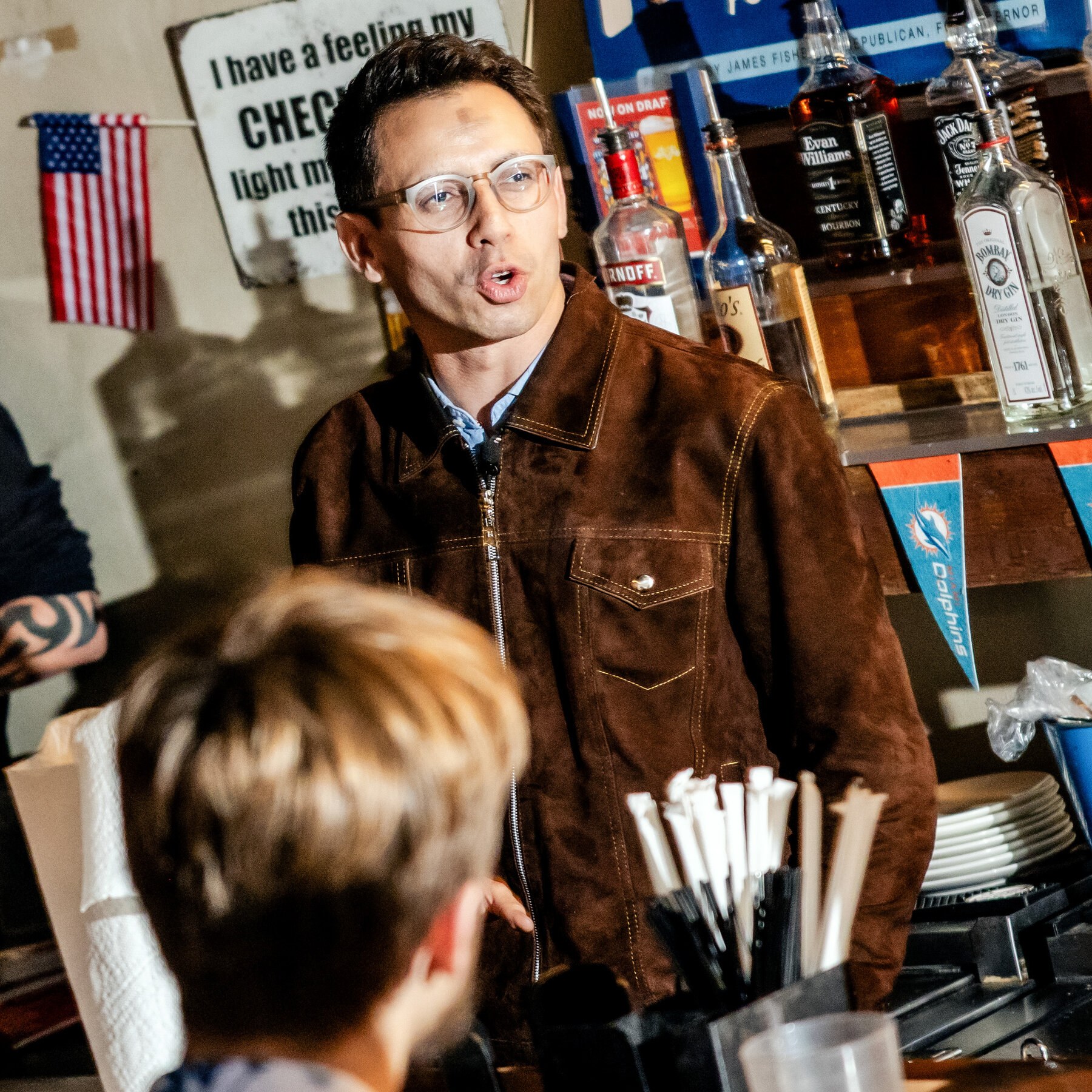
31-Year-Old James Fishback Leads Florida GOP Money Race With $7.4 Million Fueled by Viral Outrage
- Fishback raised $7.4 million, beating two sitting cabinet members in the 2026 Florida Republican primary.
- 82% of his donations are under $50, driven by viral social-media clips.
- University of North Florida poll shows him polling second at 26% among likely GOP voters.
- His campaign posts an average of 17 outrage clips per day across TikTok, Instagram and X.
Can a candidate who has never held office weaponize algorithmic anger to seize a major-party nomination?
JAMES FISHBACK—James Fishback, a 31-year-old investment-firm founder from Naples, is testing that proposition in Florida’s 2026 Republican primary for governor. In a field that includes two statewide elected officials, Fishback has out-raised every rival by turning the volume of political discourse up to a constant scream.
His formula is simple: film a 30-second reaction video to a progressive protest, attach a caption laden with capital letters and exclamation points, and watch the shares cascade. Campaign finance reports filed last week show the approach has yielded 182,000 individual contributions since January, dwarfing the donor base of Attorney General Ashley Moody and Chief Financial Officer Jimmy Patronis combined.
Political scientists call the tactic ‘rage bait,’ a form of digital provocation engineered to trigger outrage-driven engagement. Fishback calls it ‘telling hard truths,’ but the result is the same: an underdog with modest name recognition now sits at 26% in University of North Florida polling, just four points behind Moody and nine ahead of Patronis.
From Hedge-Fund Pitch Decks to Political Clickbait
Before he was a candidate, Fishback was pitching emerging-market debt to pension-fund managers. After graduating from Duke University in 2015, he spent five years at a mid-town Manhattan hedge fund, then launched his own firm, Basin Reserve Capital, in 2020. The fund returned 34% in 2022 by shorting Chinese property bonds, a trade that padded his personal wealth and gave him the confidence to self-finance an exploratory committee.
That financial cushion matters because Florida’s governor race is expected to exceed $150 million in combined spending. Fishback has already pumped $4 million of his own money into the campaign, but the remaining $3.4 million arrived in increments averaging $38.72 apiece. Consultant Benjamin Pollara, who ran digital fundraising for Charlie Crist’s 2014 gubernatorial bid, says no first-time candidate in Florida has ever assembled such a broad small-donor army so quickly. ‘The velocity is what catches your eye—he’s adding 1,200 new donors a day,’ Pollara notes.
The campaign’s content playbook borrows from influencer marketing rather than traditional politics. Each morning, staffers scour campus protests, school-board debates and celebrity tweets for material. By 11 a.m. they have clipped the most incendiary 15 seconds, overlaid dramatic music and posted it to TikTok with captions like ‘WATCH: Radical leftists DESTROY American flag on camera!’ The clip is then repackaged for Instagram Reels and X, often accumulating more than one million views before cable news producers have finished their first coffee.
The approach has drawn scolding from establishment Republicans who fear a general-election liability. Former governor Jeb Bush told an audience at the Naples Chamber of Commerce that ‘governance isn’t a Twitch stream,’ a line widely interpreted as a swipe at Fishback. Yet among likely primary voters, 63% say they want a fighter more than a conciliator, according to a St. Pete Polls survey released last month. Fishback’s bet is that the same base which rewarded Donald Trump’s pugilism will elevate an even more pugilistic newcomer.
Digital outrage converts attention into donations at record speed
What separates Fishback from earlier populist insurgents is the tight feedback loop between content performance and cash registers. Within 90 minutes of a clip crossing 100,000 views, the campaign sends a follow-up text message soliciting $5 or $10. Data director Gabriela Salazar says the conversion rate peaks at 11%, roughly triple the industry benchmark for political fundraising. That metric, more than polling, explains why Fishback continues to escalate the provocative tone even as party elders warn of backlash.
Does Outrage Scale Beyond the Base?
The unanswered question is whether a campaign built for the algorithmic right can survive a general electorate. Florida’s voter-registration edge has narrowed to just 1.2 percentage points, and independents now outnumber registered Republicans in Miami-Dade, Hillsborough and Orange counties—home to 44% of the state’s ballots. Fishback’s advisers argue that Hispanic men under 45, a cohort he carried by 19 points in straw polls at Miami’s Kendall campus, will offset losses among suburban women who recoil from daily outrage.
Dr. Susan MacManus, a University of South Florida political scientist who has surveyed Florida elections since 1988, cautions that no Republican has won the governor’s mansion without carrying at least 56% of moderate voters. ‘Fishback’s current favorability among independents is 31%,’ she notes. ‘That’s 18 points below where Ron DeSantis stood at the same point in 2018.’ The historical precedent is ominous: in 2010, tea-party favorite Rick Scott spent $75 million of his own fortune and still eked out a one-point victory only after Democrat Alex Sink stumbled in a televised debate.
Yet Fishback’s team contends the electorate has changed. Since 2018, the state has added 1.1 million new registrants, 62% of whom did not declare a party. Gen-Z now comprises 14% of the rolls, up from 4% a decade ago. Campaign pollster Ryan Tyson says internal modeling shows Fishback winning 48% of voters under 35 in a head-to-head contest against Democratic congresswoman Val Demings, compared to Moody’s 41%. The campaign’s internal memo, shared with donors and reviewed by this publication, projects that turnout among voters 18-29 could jump from 28% in 2022 to 38% in 2026 if the race remains culturally polarized.
That projection relies on continued media saturation. Fishback’s campaign has reserved $9 million in digital ad buys through March 2026, more than triple Patronis and Moody combined. The ads will not run on television; instead they will populate YouTube pre-roll, Twitch streams and Spotify rap playlists. Communications director Blake Flayton says the goal is to meet voters ‘where dopamine already lives,’ a phrase that sums up the campaign’s unapologetic embrace of attention economics.
Independent voters remain skeptical of perpetual outrage
Even if turnout among Gen-Z spikes, Fishback must still solve the suburban-parent problem. Focus groups conducted by the Republican State Leadership Committee found that independents in Duval and Pinellas counties describe Fishback as ‘exhausting’ and ‘performative.’ The same voters praised Moody’s record on human-trafficking prosecutions and Patronis’s handling of insurance-insolvency cases. To bridge the gap, Fishback has begun releasing weekly policy white papers—on property-insurance reform, Everglades restoration and vocational-education expansion—yet each paper is promoted with the same caps-lock bombast that defines his social feeds, blurring any tonal pivot.
What Happens If Anger Meets a Recession?
Florida’s budget surplus has shrunk for three consecutive quarters, and the state’s economist predicts a $2.3 billion shortfall by 2027 if tourism growth slows below 2%. That forecast looms over a primary whose tone assumes limitless resources for tax-cutting and culture-warring. Fishback’s platform pledges to eliminate the state’s 5.5% corporate income tax within two years, a move the legislature’s own analysis says would cost $4.1 billion annually. He offsets the gap by projecting 5% annual revenue growth, a figure the Federal Reserve Bank of Atlanta calls ‘optimistic under current demographic trends.’
The economic headwinds complicate the campaign’s outrage playbook. When Fishback posted a clip blaming ‘woke Wall Street’ for rising mortgage rates, fact-checkers noted the state’s average 30-year fixed rate tracks national bond yields, not ESG policies. The video still garnered 3.4 million views and raised $212,000 within 48 hours, but the episode underscores the risk of substituting cultural grievance for economic literacy. Former state House speaker Chris Sprowls, a Republican, warns that ‘voters eventually ask what you’ll do about their insurance premium, not what you tweeted about Bud Light.’
Insurance markets provide the starkest example. Five private carriers have exited Florida since 2023, leaving Citizens Property Insurance—the state-run insurer of last resort—with 1.34 million policies, up from 487,000 in 2020. Average premiums have risen 42% in two years, the fastest clip in the nation. Fishback’s solution is to disband the Office of Insurance Regulation and shift rate approval to a gubernatorial appointee, a proposal Moody labels ‘constitutional malpractice.’ The plan generated 1.8 million angry emoji reactions on Facebook but zero cosponsors in the Senate Banking and Insurance Committee.
Economists say the next governor will inherit a property-insurance market that requires either a $3 billion taxpayer backstop or acceptance of double-digit rate hikes. Fishback’s campaign dismisses the dilemma as ‘panic peddling,’ yet even conservative think tanks such as the James Madison Institute concede that reinsurance costs—driven by hurricane risk, not culture-war politics—are the primary driver. The disconnect suggests that outrage, while lucrative in small-dollar donations, may collide with fiscal reality once the oath of office is administered.
Anger-driven fundraising may mask structural budget constraints
The contradiction is not lost on donors. Major contributors who gave more than $1,000 apiece comprise only 7% of Fishback’s haul, compared to 38% for Moody. That imbalance leaves him vulnerable if small-dollar enthusiasm fades under economic stress. Campaign-finance records show daily donations dipped 19% during the week Florida’s unemployment rate ticked up to 4.2%, hinting that cultural fury may prove elastic when household budgets tighten.
Can Anyone Hit the Brakes on a Rage-Fueled Campaign?
Inside Tallahassee, party elders have begun quiet discussions about coordinated opposition. Senate president Kathleen Passidomo convened a March 5 dinner where lobbyists floated the idea of a super PAC devoted solely to anti-Fishback content. The proposed group, tentatively named Floridians for Responsible Leadership, would amass a $20 million kitty to highlight Fishback’s lack of governing record and past social-media posts that flirts with 9-11 conspiracy hashtags. Yet donors are skittish about attacking a candidate whose supporters view any criticism as proof of establishment corruption.
The bind illustrates a larger Republican dilemma: the same digital outrage infrastructure that powered the party since 2016 now threatens to override institutional guardrails. Fishback’s rivals have responded by escalating their own rhetoric. Moody recently declared Florida ‘under invasion from fentanyl zombies,’ while Patronis proposed deploying the state guard to ‘deport illegal activists.’ The arms race suggests that condemnation from elder statesmen such as Jeb Bush carries limited weight in a primary electorate conditioned to distrust dynasties.
Democrats, for their part, are preparing contingency plans. Party chair Nikki Fried has instructed opposition researchers to archive every Fishback clip, predicting that a general-election audience will recoil from the greatest-hits reel. Yet privately some Democrats prefer a Fishback nomination, calculating that suburban moderates will break decisively for their nominee, likely Val Demings or Agriculture Commissioner Naomi Salmon. The scenario echoes 2010, when Democrats celebrated the nomination of fringe Republican congressional candidates only to lose 63 House seats nationwide.
The only certainty is that Fishback has already altered Florida’s political grammar. Candidates who once reserved outrage for rare applause-line moments now schedule it daily, hourly, perpetually. Whether that transformation survives contact with governing responsibilities—or an economic downturn—will determine if rage bait becomes a durable campaign doctrine or a cautionary footnote.
Establishment efforts to slow Fishback risk reinforcing his anti-elite brand
Passidomo’s dinner illustrates the paradox: any attack emanating from lobbyists or legacy media confirms Fishback’s narrative that he alone fights ‘the swamp.’ The candidate responded to news of the anti-super PAC by posting a 15-second clip of himself laughing, captioned ‘They’re scared.’ The video raised $87,000 in three hours, suggesting that traditional deterrence mechanisms—elite donor pressure, editorial board denunciations, late-night TV mockery—may paradoxically accelerate his small-dollar juggernaut.
Frequently Asked Questions
Q: What is James Fishback’s campaign strategy?
Fishback relies on deliberately provocative social-media clips that trigger algorithmic amplification and small-dollar donations, allowing a 31-year-old with no elected experience to out-raise two sitting cabinet members.
Q: How much has Fishback raised compared to rivals?
Latest filings show Fishback collected $7.4 million, exceeding Attorney General Ashley Moody’s $6.1 million and Chief Financial Officer Jimmy Patronis’ $5.3 million, with 82% of his haul under $50.
Q: Why do young conservatives support him?
Polls by the University of North Florida find voters 18-29 rank ‘anti-woke’ combativeness above traditional credentials; Fishback’s daily outrage content delivers that signal more relentlessly than any rival.
📰 Related Articles
- Pritzker Spends Millions on Illinois Senate Primary, Risks 2028 Backlash
- Trump’s Iran Dilemma: Will He Order a Fight-to-Win Strategy or Declare Victory and Exit?
- Senate Pushes Historic Housing Bill Forward Amid Growing Political Headwinds
- James Clyburn, 85, Seeks 18th Term, Bucking Democratic Generational Shift
