1,200 Departures Grounded After Odor Inside Potomac TRACON Halts D.C. Airspace
- A “strong odor” inside the FAA’s Potomac TRACON facility forced a ground stop at Reagan National, Dulles, BWI and Richmond airports.
- Transportation Secretary Sean Duffy confirmed the disruption on social media, citing safety precautions while technicians investigated.
- The incident underscores the vulnerability of a single radar room that handles 70% of flights within 50 miles of the capital.
- No injuries or contamination were reported; normal operations resumed after HVAC repairs late Friday.
A mysterious smell inside a suburban Virginia control center froze the nation’s capital airspace for hours, exposing how one building can silence four major airports.
D.C. AIRPORTS—Shortly after 11 a.m. on Friday, controllers at the Potomac Terminal Radar Approach Control facility in Leesburg, Virginia, detected a pungent odor wafting through the radar room. Within minutes, the Federal Aviation Administration halted all departures from Ronald Reagan Washington National, Washington Dulles International, Baltimore/Washington International Thurgood Marshall and Richmond International airports—an unprecedented simultaneous ground stop triggered by nothing more than a smell.
The incident, confirmed by Transportation Secretary Sean Duffy on social media, stranded an estimated 165,000 passengers and rippled through the national air-traffic network. While no toxins were ultimately detected, the event highlights a critical choke point: 70% of all flights within a 50-mile radius of Washington depend on the 37-year-old facility now at the center of a safety review.
Inside the Leesburg Radar Room: How One Smell Paralyzed D.C. Airspace
The Potomac TRACON sits unassumingly in an office park off Route 7, yet its radar screens choreograph every approach, departure and transition for 46,000 square miles of airspace stretching from Charlottesville to southern Pennsylvania. When controllers reported a sharp, acrid odor at 11:07 a.m., standard protocol required an immediate evacuation of the operations floor. Within 12 minutes, the FAA’s Command Center in Warrenton, Virginia, issued a ground stop for the four major airports served by the facility.
Controllers were relocated to a backup room in the same building, but capacity dropped 60%, forcing the agency to accept only emergency medical and military flights. Technicians traced the smell to an overheated hydraulic pump in the HVAC system; while air-quality tests found no hazardous substances, the scent lingered for hours, prolonging the halt. By 3:30 p.m., repairs allowed partial operations, yet the FAA did not lift the ground stop entirely until 7:18 p.m.—8 hours and 11 minutes after the first whiff.
Single-point failure risk
Aviation safety experts have long warned that consolidating radar approach services into a handful of regional facilities creates brittle infrastructure. “Potomac is a textbook example,” says John Lehman, a former Navy secretary who chaired the 2019 FAA Management Advisory Council. “One odor, one electrical fire, one cyber intrusion, and the nation’s capital becomes a no-fly zone.” The TRACON handles roughly 1.8 million instrument operations per year, making it the third-busiest approach control facility in the United States after Southern California TRACON and New York TRACON.
Friday’s shutdown affected 1,200 departures and 900 arriving flights, according to FlightAware data, with average delays peaking at 187 minutes. Reagan National, whose runway intersects restricted airspace over the Potomac River, was especially hard hit: 84% of its daily schedule was either delayed or canceled. BWI and Dulles fared marginally better because they can accept some arrivals via adjacent TRACONs, yet even those flows were throttled to 30% of normal rates.
Passengers in the Dark: 165,000 Travelers Stranded With Little Real-Time Info
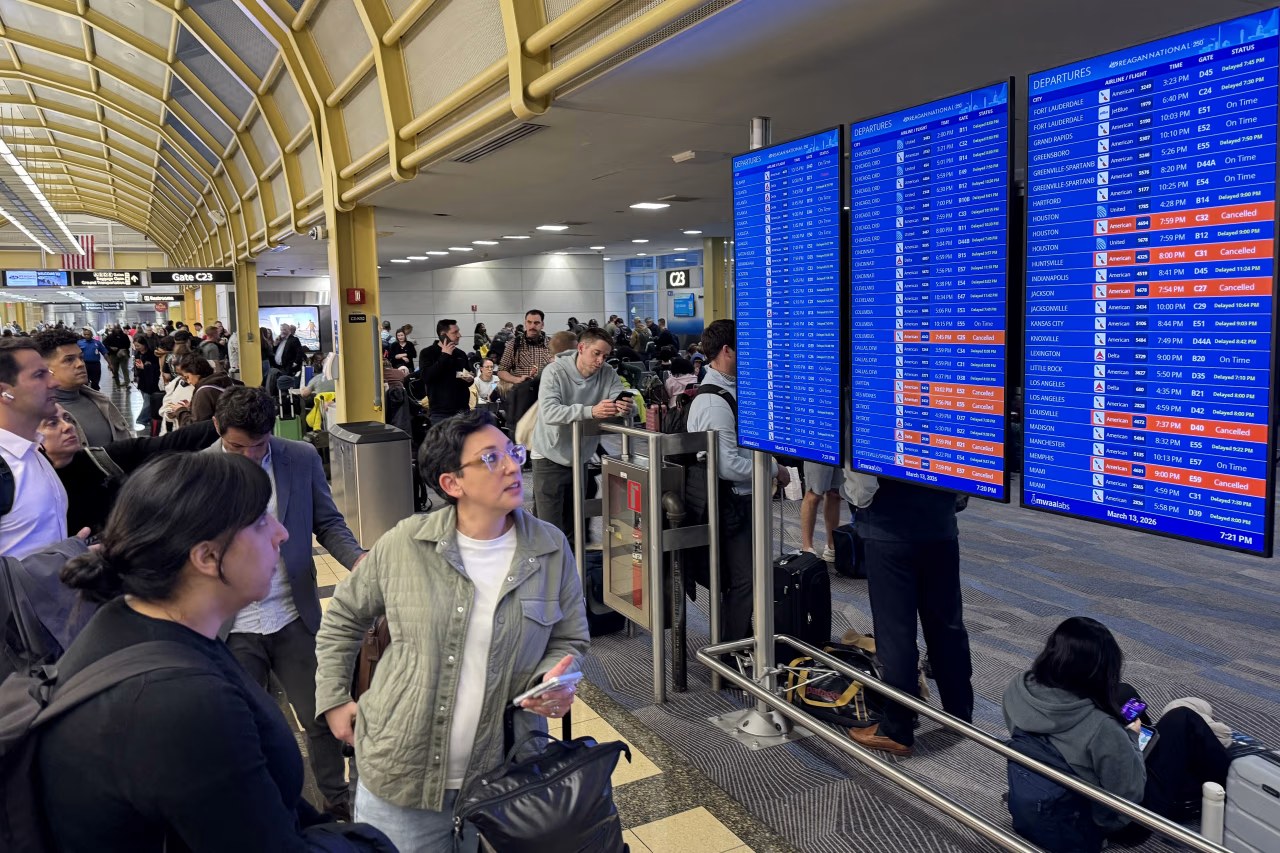
Inside Reagan National’s Terminal B, the departure boards flipped from yellow “delayed” to red “canceled” in waves. Business traveler Maya Patel had cleared security at 10:45 a.m. for an 11:30 shuttle to Boston; she finally re-booked on an 8:15 p.m. flight that left after midnight. “No gate agent knew anything,” Patel said in an interview. “The FAA alert just said ‘strong odor,’ which sounds trivial until you realize every flight is grounded.”
The lack of granular information is a systemic weakness. FAA notices to airlines are coded for crew use, not passenger comprehension. Carriers must translate jargon into gate announcements, often with a 30- to 60-minute lag. On Friday, American Airlines issued its first customer notification at 12:07 p.m.—nearly an hour after the ground stop began—while Southwest’s app simply displayed “air traffic control programs in effect.” Industry analysts say clearer passenger-facing alerts could reduce congestion in terminals and call centers.
Cost to travelers and airlines
The Airline Passenger Experience Association estimates that passengers lose $52 per hour in productivity, meals and ground transport when domestic flights are delayed more than three hours. Multiply that by 165,000 affected travelers and the economic hit tops $8.5 million for the day. Airlines shoulder crew overtime, aircraft repositioning and re-booking expenses; for a major carrier, MIT research pegs the average cost of a canceled narrow-body flight at $16,500. With 1,200 departures scrubbed, direct airline losses approach $20 million, not including downstream network effects.
Consumer-rights advocates argue the FAA should mandate real-time public disclosure when ATC closures affect more than 100 flights. “Passengers deserve to know why their plane isn’t moving,” says William McGee, aviation adviser at the American Economic Liberties Project. “‘Strong odor’ could mean anything from burnt toast to a chemical attack—transparency builds trust.” The FAA counters that security protocols restrict what can be released while an incident is unfolding.
Why Does One Building Control 70% of D.C. Flights?
The roots of today’s vulnerability trace to 1987, when the FAA merged five smaller approach-control towers around Washington into the Potomac Consolidated TRACON. The consolidation saved an estimated $12 million annually in payroll and equipment, but it concentrated risk. Former FAA chief counsel Loretta Alkalay says the agency accepted the trade-off. “Congress wanted efficiency; redundancy was expensive,” Alkalay notes. “Now we’re seeing the downside when one HVAC pump overheats.”
Modernization efforts have lagged. The Leesburg building, completed in 1987, still relies on original ventilation shafts and a single chiller loop. A 2020 Department of Transportation inspector-general audit found that 62% of FAA en-route and approach facilities have no fully staffed, geographically separate backup site. By contrast, the nation’s 22 en-route centers each have a designated shadow facility, but TRACONs do not. The FAA’s NextGen program has prioritized satellite-based navigation over physical infrastructure redundancy.
Comparative redundancy
Southern California TRACON, which handles slightly more traffic, operates a dual-site model: primary operations in San Diego and a hot-standby suite in Santa Ana. If one site fails, controllers can pick up traffic within 15 minutes. The New York TRACON splits sectors across Long Island and upstate locations. Potomac has no such split; its backup room shares the same HVAC backbone, which failed Friday.
Congressional appropriators have repeatedly declined to fund a second Potomac facility, citing $450 million in estimated construction and staffing costs. Instead, the FAA has pursued a software solution called ERAM that can transfer radar data to adjacent centers. Yet ERAM still requires certified controllers familiar with local airspace, a resource scarce enough that the agency imposed the ground stop rather than attempt a hand-off.
What Happens Next: Policy Fixes and Funding Battles Ahead
Friday’s shutdown is already reverberating on Capitol Hill. House Transportation Committee chair Rep. Rick Larsen said he will hold a hearing next month on ATC facility resilience, demanding a timeline for Potomac backup infrastructure. Sen. Mark Warner, whose Virginia constituents include 420 Leesburg-based controllers, is drafting legislation that would earmark $200 million for a split-site retrofit and require the FAA to identify the ten most vulnerable TRACONs within 90 days.
The FAA’s 2025 budget request includes $95 million for facility hardening—triple last year’s allocation—but that line item competes with hiring 1,800 new controllers to ease nationwide staffing shortages. Industry lobbyists want Congress to approve a dedicated trust fund fed by a $1 per-ticket surcharge, modeled after the existing Airport Improvement Program. Airlines for America estimates the fee would raise $650 million annually, enough to build redundant TRACONs at the five busiest hubs within a decade.
Technology vs. concrete
Some experts argue remote-tower technology could eliminate the need for duplicate buildings. The FAA has certified two virtual tower prototypes in Colorado and upstate New York, using high-definition cameras and fiber links to feed imagery to off-site controllers. Potomac, however, processes complex military and VIP traffic corridors over the capital, where encryption and low-latency requirements make virtualization harder. “You can’t have a 200-millisecond delay when Air Force One is on approach,” notes R. John Hansman, director of MIT’s International Center for Air Transportation.
For passengers, the near-term fix is procedural: better communication and passenger-rights protections. The Department of Transportation is considering a rule that would require airlines to provide meal vouchers for delays exceeding three hours when the cause is within the FAA’s control, a category that includes facility evacuations. If adopted, travelers caught in the next odor incident could at least dine on the airline’s dime while they wait for the smell to clear.
Frequently Asked Questions
Q: Which airports were affected by the odor-related ground stop?
Ronald Reagan Washington National, Washington Dulles International, Baltimore/Washington International Thurgood Marshall, and Richmond International—all fed by the Potomac TRACON facility—were halted for several hours while technicians traced the smell.
Q: How many flights were delayed or canceled?
The FAA implemented a full ground stop, scrubbing roughly 1,200 departures and delaying another 900 arrivals across the four airports before normal operations resumed late Friday evening.
Q: What caused the strong odor inside the control facility?
Investigators traced the pungent smell to an overheated hydraulic pump in the building’s HVAC system; no toxins were detected, but the scent forced evacuation of the radar room as a safety precaution.
Q: Is the Potomac TRACON a critical single point of failure?
Yes; the Leesburg facility sequences 70% of commercial and general-aviation traffic within a 50-mile radius of the capital, meaning any localized disruption—odor, fire, cyber—immediately paralyzes the entire D.C. airspace.
