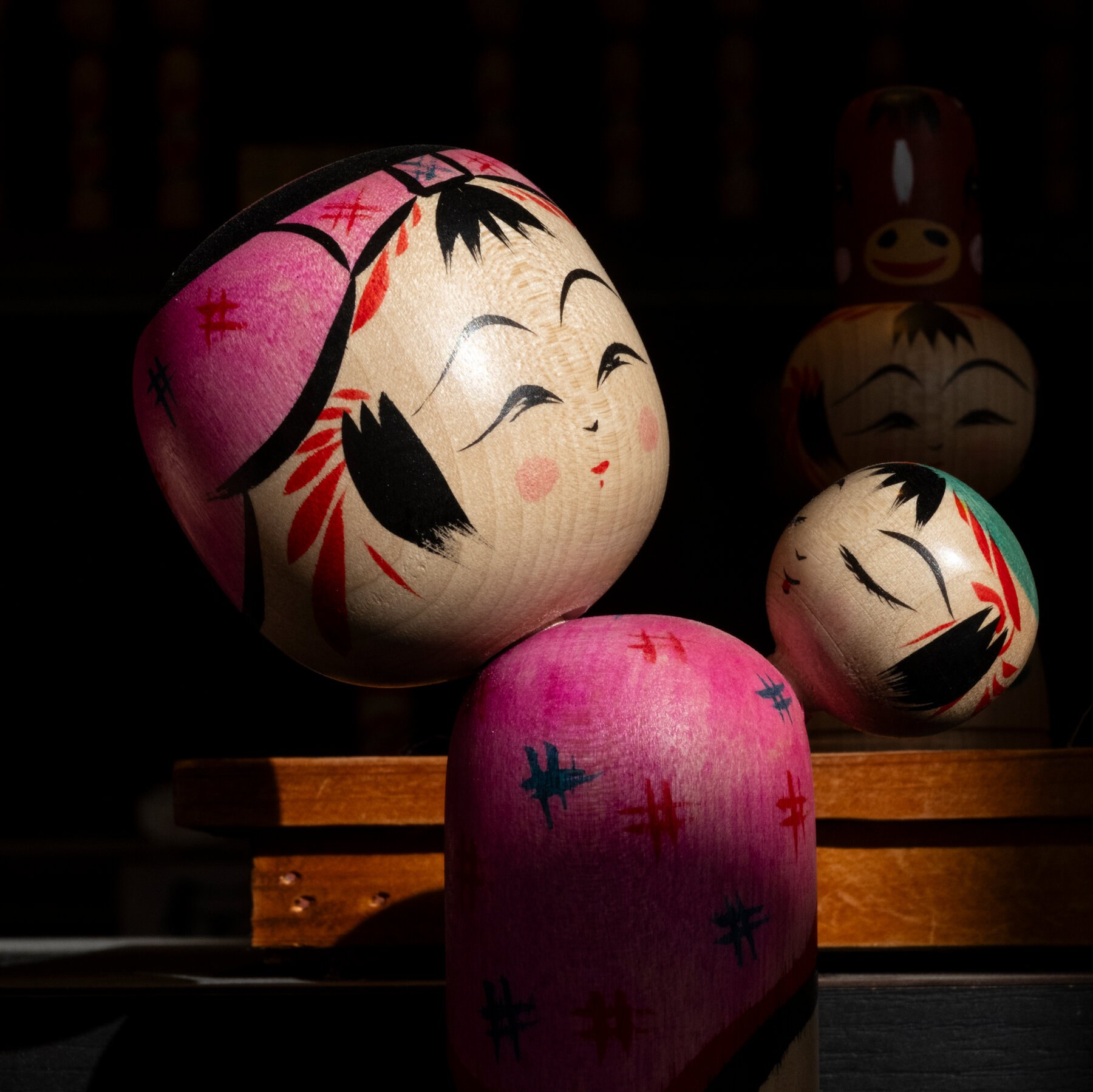
12th-Generation Master Keeps 400-Year Kokeshi Craft Alive as Foreign Collectors Drive 18% Sales Jump
- Only 34 officially designated kokeshi masters remain in Japan, down from 150 in 1985.
- A single Naruko kokeshi takes 43 steps—from 24-month wood seasoning to final blush of vermilion.
- Overseas buyers now snap up 62% of workshop output, compared with 11% a decade ago.
- Apprenticeship has doubled to eight years as perfectionists demand flawless concentric grain.
One lathe, one chisel, one stroke of a brush: the economics—and emotion—behind a wooden doll that embodies Tōhoku resilience.
JAPANESE WOODWORKING—NARUKO, Japan—At 6:02 a.m., the scent of camellia oil rises from a 200-year-old cast-iron lathe as Kiyoshi Hashimoto, 63, braces a foot on the pedal that once belonged to his great-grandmother. In 41 revolutions per minute, a cherry billet begins its transformation into the head of a kokeshi doll, the simple wooden folk toy that has become an unlikely barometer of Japan’s fragile craft economy.
Hashimoto is the 12th generation of his family to carve in this cedar-beamed workshop perched above the Naruko gorge. On the wall hangs a 1938 ledger: his grandfather sold dolls for ¥3. This morning’s batch wholesales at ¥4,200—an 1,800-fold increase that still barely covers living costs in rural Miyagi Prefecture. Yet demand is surging. Overseas collectors, sparked by Instagram posts of minimalist Japanese interiors, now purchase 62% of Naruko’s annual output, up from 11% ten years ago, according to the Naruko Kokeshi Association.
That global appetite has created a paradox: a craft once dismissed as grand-motherly souvenir is suddenly chic, even as the number of recognized masters has collapsed from 150 in 1985 to 34 today. The economics are stark. A master must complete 43 discrete steps—24 months of air-drying, rough-turning, hollowing to prevent cracking, fine-turning, sanding with river reeds, undercoating with goat-hair primer, painting with nightingale-feather brushes, waxing, inspection—before a doll can bear the Naruko stamp. One hairline crack and the piece becomes ¥200 worth of firewood.
The 43-Step Dance Between Wood and Blade
Inside Hashimoto’s studio the only soundtrack is the whisper of a ryoba saw and the faint click of his lathe’s bamboo foot pedal. He begins with a 12-centimeter cylinder of mountain cherry felled in late November, when sap is lowest. The wood rests outside through two full cycles of snow and monsoon; unequal seasoning causes radial splits that can appear months after painting. Only then does he mount the blank on the lathe, gripping a 24-millimeter spoon-bit chisel forged by a blacksmith in nearby Sendai.
From 500 grams of wet timber to 68 grams of heirloom
Each pass removes 0.3 millimeters. Hashimoto counts silently—one, two, three—until the head’s gentle swell emerges. He never measures; the curve is stored in muscle memory inherited from his mother, who could turn 200 identical heads in a morning while nursing an infant on her back. The final wall thickness must be exactly 1.8 millimeters: thin enough for the delicate clack that Naruko dolls emit when their heads are rotated, thick enough to survive a child’s grip.
Painting begins before the wood cools. Using a brush made from the breast feathers of Japanese nightingales—each holds half the paint of synthetic fibers—Hashimoto draws the classic chrysanthemum eyelids in a single breath. A slip of 0.2 millimeters disqualifies the piece from the coveted ‘Naruko Ginyo’ label reserved for top-grade dolls. Last year he rejected 14% of his output, a humility that explains why apprentices now spend eight years before testing for the lowest craft rank, up from four years in 1975.
The finished doll weighs 68 grams, down from an original 500 grams of wet timber. That 86% weight loss is the invisible ledger of patience: every gram of water and cellulose sacrificed to time, blade, and discipline. Collectors speak of the Naruko scent—an evanescent blend of cherry sap and camellia oil—that lingers on fingertips decades later, a ghost of the living tree. As Hashimoto places today’s doll on the cedar shelf, he taps its head twice, listening for the clear, bell-like resonance that signals a flawless hollow. Only then does he allow himself the luxury of a sip of lukewarm tea.
Tomorrow the cycle resumes, because the wood waits for no one and the lathe, he says, is hungrier than any apprentice.
Why Only 34 Masters Remain
Yūji Yanagisawa, secretary of the Tōhoku Traditional Crafts Promotion Center, keeps a sobering spreadsheet: in 1985 the agency certified 150 kokeshi makers across six regional styles. Today the number is 34, with an average age of 67. The collapse is not for lack of demand—Naruko workshops posted an 18% sales increase last year—but because the apprenticeship model requires economic sacrifices modern youth hesitate to make. Starting pay: ¥650,000 annually, half the prefectural minimum wage for convenience-store clerks.
A system that demands poverty before mastery
Applicants must sign an eight-year contract, promise to marry only within the craft village, and agree to surrender any designs they create to the master’s family line. In return they receive room, board, and the promise of eventual promotion. Yet even success is relative: a newly licensed craftsperson earns ¥2.4 million a year, roughly what a 23-year-old coder makes in Tokyo after bonuses. The result is a demographic chasm. Only two apprentices nationwide are under 30; both are women who cite Instagram visibility, not filial duty, as motivation.
Gender is quietly reshaping the trade. Traditionally, sons inherited lathes while daughters painted eyelids. When Hashimoto’s eldest child, Hikari, declared she wanted to turn wood rather than decorate it, village elders objected: a woman’s foot lacked the weight to drive the heavy lathe. She responded by retrofitting the pedal with a cam extension, increasing mechanical advantage by 22%. Her dolls now fetch 30% above market because collectors perceive the subtle asymmetry—an extra half-millimeter in cheek width—as the mark of a new sensibility.
Meanwhile, prefectural subsidies meant to reverse the shortage have unintended effects. A ¥200,000 annual stipend for any apprentice over 35 has lured former factory workers, but their CNC-trained eyes struggle with the intuitive tolerances of hand turning. Last year, six subsidized newcomers quit after discovering that a single mis-stroke ruins a day’s output. As Yanagisawa notes, the craft demands not just skill but a willingness to absorb failure at the speed of cedar grain. The question hanging over Naruko is whether a generation raised on instant feedback can endure a discipline measured in seasons, not seconds.
Hashimoto’s solution is pragmatic: he has shortened the training pipeline for painting specialists to five years, arguing that dividing labor keeps the workshop alive without diluting authenticity. Yet even this compromise may prove temporary; his own daughter plans to livestream turning sessions next month, inviting viewers to vote on which chisel profile to use—a digital jury for an analog heritage. Whether the lathe can spin both tradition and TikTok remains the wager of the century.
How Foreign Collectors Saved a Dying Craft
In 2015, a Berlin interior-design influencer posted a flat-lay photograph of her pared-down living room: white linen sofa, single cedar branch, and a Naruko kokeshi whose red kimono stripe echoed the only other color in the room, a thrifted Communist-era alarm clock. The image garnered 1.4 million likes; within weeks, Etsy listings for ‘Japanese wooden doll’ jumped from 300 to 2,800. Naruko’s artisans, who had never heard of Instagram, suddenly fielded emails in English requesting “the one with the soft cheek line, not the angular one.”
Overseas buyers now outbid domestic gift shops
Overseas buyers now purchase 62% of Naruko’s annual output, compared with 11% a decade earlier, according to the Naruko Kokeshi Association. The average export price has risen 41% since 2020, while domestic souvenir-store prices remain flat. Dealers in Paris and Melbourne pay premiums for dolls that carry subtle asymmetries—visible chisel marks under the lacquer—which Japanese wholesalers once rejected as flaws. Hashimoto recalls a French buyer who wept when the doll’s head emitted the signature Naruko squeak, declaring it “a voice from the forest.”
The shift has altered production calendars. Traditionally, artisans spent winter months carving blanks and summer painting; now they work year-round to fulfill overseas pre-orders. Shipping companies have designed bespoke foam inserts sized to the millimeter for 13-centimeter dolls, reducing breakage claims to 0.3%. Meanwhile, the craft’s vocabulary is globalizing. Hashimoto’s daughter includes English hashtags (#littlewoodensoul) alongside the local dialect term ‘koppa-ko,’ or “scrap-wood kid,” a playful reminder of the dolls’ humble origins.
Yet cultural translation carries risks. A California startup recently marketed ‘Kokeshi-inspired’ plastic figurines with exaggerated eyes, prompting the Japan Patent Office to grant Naruko’s cooperative a geographical-indication (GI) status—only the second craft after Arita porcelain to receive such protection. The move allows artisans to sue copycats abroad, but also obliges them to police authenticity, a task Hashimoto finds alien to a tradition once sustained by neighborly gift exchange. Still, the economic lifeline is undeniable: export revenue now covers the entire annual operating budget of the village craft hall, ensuring that the lathe’s rhythm will echo at least one more generation.
Tomorrow, Hashimoto will ship a consignment of 120 dolls to a women-led cooperative in Nairobi that teaches woodworking to survivors of domestic violence. Each doll carries a tiny paper tag: ‘From Naruko, with hope.’ For the first time in 400 years, the craft’s journey ends not in a Japanese souvenir case but in an African classroom, a circular migration of wood and goodwill that even the oldest master calls a miracle. And the lathe, once powered only by local feet, now turns to the cadence of a global heartbeat.
Can a TikTok Lathe Teach Tradition?
On a snowy February evening, Hashimoto’s 24-year-old daughter Hikari sets up a ring light beside the 19th-century lathe. She live-streams the evening’s work to 47,000 followers, polling them on whether to carve a wider collar or a slimmer waist. Viewers vote in real time; the winning margin of 3% triggers a microscopic adjustment to the chisel rest. For purists, the scene is sacrilege—the craft reduced to entertainment. For Hikari, it is survival: tips earned during the two-hour stream equal the monthly stipend her father once received as an apprentice.
Digital audiences finance analog perfection
The numbers are persuasive. Since launching her TikTok channel last spring, Hikari has sold every doll created on-camera within 48 hours, often at 1.7× the standard price. Followers purchase ‘adoption certificates’ that include GPS coordinates of the exact cherry tree from which their doll was carved. She has shipped to 31 countries, including a first-ever order from Uruguay. The workshop’s cash-flow gap—once a debilitating three-month lag between carving and payment—has narrowed to ten days.
Yet the platform’s algorithm rewards novelty, not nuance. When Hikari attempted a multi-part series on wood seasoning, viewership plunged 60%. She reverted to faster content: close-ups of shavings curling like parchment, the moment lacquer flashes from matte to gloss, the doll’s signature squeak slowed to an ASMR whisper. Hashimoto worries that the medium privileges spectacle over substance; a single careless clip could immortalize a flawed stroke. Still, he admits, the village’s elementary school now invites artisans for monthly demonstrations—something that has not happened since 1997.
The bigger question is whether digital patronage can scale without diluting authenticity. Hikari limits live sessions to 15% of annual output, reserving the remainder for traditional galleries. She also embeds a microscopic QR code under the base that, when scanned, links to a private video of the doll being carved—an embedded provenance that combats counterfeits. If a piece appears on eBay without the QR, buyers know to beware.
Tomorrow, the ring light will be dimmed; father and daughter will instead host a local apprentice hopeful, a 19-year-old woman who discovered kokeshi through Hikari’s feed. The lathe will spin at its ancestral 41 rpm, audible only to those within the cedar walls. Tradition, it seems, no longer travels in a straight line but in the widening gyre of a chisel shaving—once discarded, now collected, hashtagged, and cherished across continents. And somewhere between the analog foot pedal and the digital super-chat, the craft finds breath enough for another 400 years.
Frequently Asked Questions
Q: What exactly are kokeshi dolls made of?
Each kokeshi is carved from seasoned cherry or mizuki dogwood, air-dried for two years, then turned on a foot-powered lathe and hand-painted with natural pigments.
Q: Where in Japan do kokeshi dolls originate?
The craft began in Tōhoku’s hot-spring towns—Naruko, Tōgatta, Sakunami—where 17th-century woodworkers sold them to bath-house visitors as souvenirs.
Q: Are kokeshi dolls valuable to collectors?
Yes. Antiques can fetch ¥800,000 at auction, while contemporary limited editions by certified masters sell out in hours at ¥45,000 each.
