Gasoline up 65¢ and diesel $1.13 in two weeks as Iran mines and drones choke key oil chokepoints
- AAA data show U.S. gasoline has risen 65 cents and diesel $1.13 since the conflict began.
- Iran’s arsenal of sea mines, ballistic missiles and fast boats is targeting Red Sea and Persian Gulf shipping lanes.
- Global benchmark Brent has touched its highest level in nearly four years, lifting domestic pump prices.
- Despite record U.S. oil output, consumers face a new energy tax while West Texas drillers collect windfall profits.
A regional war is re-introducing a 1970s-style oil shock into an economy already grappling with sticky inflation and high interest rates.
IRAN CONFLICT—The first salvos landed not on Iranian soil but on the commercial arteries that move one-fifth of the world’s seaborne crude. Within days, Iran-backed forces fired missiles at tankers, scattered magnetic mines across shipping lanes and deployed explosive-laden drone boats against the giant dual pipelines of energy commerce: the Strait of Hormuz and the Bab el-Mandeb chokepoint at the mouth of the Red Sea.
The economic fallout was swift. Brent futures leapt to levels last seen in the autumn of 2022, translating into the fastest two-week surge in U.S. fuel prices since Iraq’s 1990 invasion of Kuwait. American motorists, who had been enjoying sub-$3 gasoline, suddenly confronted a 65-cent spike, while truckers absorbed a $1.13 jump in diesel that rippled through freight, farming and airline balance sheets.
Yet the shock arrives at a moment when the United States produces more crude than it imports, a structural shift that cushions—but does not eliminate—domestic vulnerability. The question now is whether the conflict remains a contained regional skirmish or metastasizes into a months-long siege of energy infrastructure that forces the Federal Reserve to choose between tolerating higher inflation or tightening policy into a slowing economy.
The Strategic Chokepoints Iran Is Weaponizing
Iran’s military doctrine treats the 21-mile-wide Strait of Hormuz as an economic lever. Roughly 21 million barrels of crude, condensate and refined products pass through the waterway daily, according to the U.S. Energy Information Administration. Add the 6.2 million barrels that transit the Bab el-Mandeb each day and Tehran can menace nearly one-third of seaborne oil with relatively cheap asymmetric tools: sea mines cost as little as $5,000 apiece, while a Shahed-136 drone is priced under $30,000.
Maritime insurers have already slapped wartime premiums on vessels calling at Saudi and Iraqi ports, adding up to $400,000 per voyage and forcing some Greek tanker owners to reroute cargoes around the Cape of Good Hope—adding 18 days and half a million dollars in fuel costs. Those surcharges ultimately flow to U.S. consumers through the price of Brent, the benchmark against which most Gulf Coast refineries price imports.
Historical precedent: the 1980s Tanker War
During the Iran-Iraq war, U.S. crude imports from the Persian Gulf fell 40% between 1981 and 1986 after 259 commercial vessels were attacked, according to a 2019 Congressional Research Service study. The episode shows that even modest disruption can re-route global supply chains for years. Today the stakes are higher: Asia now depends on Middle-East crude for 70% of imports, versus 35% in 1985, meaning any sustained blockade would ignite bidding wars for Atlantic Basin barrels and inflate prices worldwide.
Energy Aspects, a London consultancy, estimates that if Iran manages to halt traffic through either chokepoint for just 30 days, global spare capacity—currently 4% of demand—would be exhausted, pushing Brent above $120/bbl. Such a spike would erase the equivalent of 0.7 percentage points from U.S. GDP growth over the following year, according to Oxford Economics, by draining consumer wallets faster than shale producers can drill new wells.
Why U.S. Drillers Could Gain Even as Consumers Lose
America’s emergence as the world’s top crude producer—output hit 13.2 million barrels per day in October—insulates the country from physical shortages but not from price spikes set on the global margin. Every $1 increase in Brent adds roughly 2.5 cents to the national average gasoline price within two weeks, according to the Dallas Fed, because U.S. refiners still import heavy sour grades that complement light shale streams.
For exploration companies, the windfall is immediate. Rystad Energy calculates that at $90 Brent, the top 25 U.S. independents—including Pioneer Natural Resources, EOG Resources and Diamondback Energy—generate an additional $28 billion in annual free cash flow compared with a $70 baseline. Most of that surplus is funneled into shareholder buybacks and special dividends rather than new rigs, amplifying cash returns to investors rather than supply growth.
Regional winners: Permian Basin payrolls
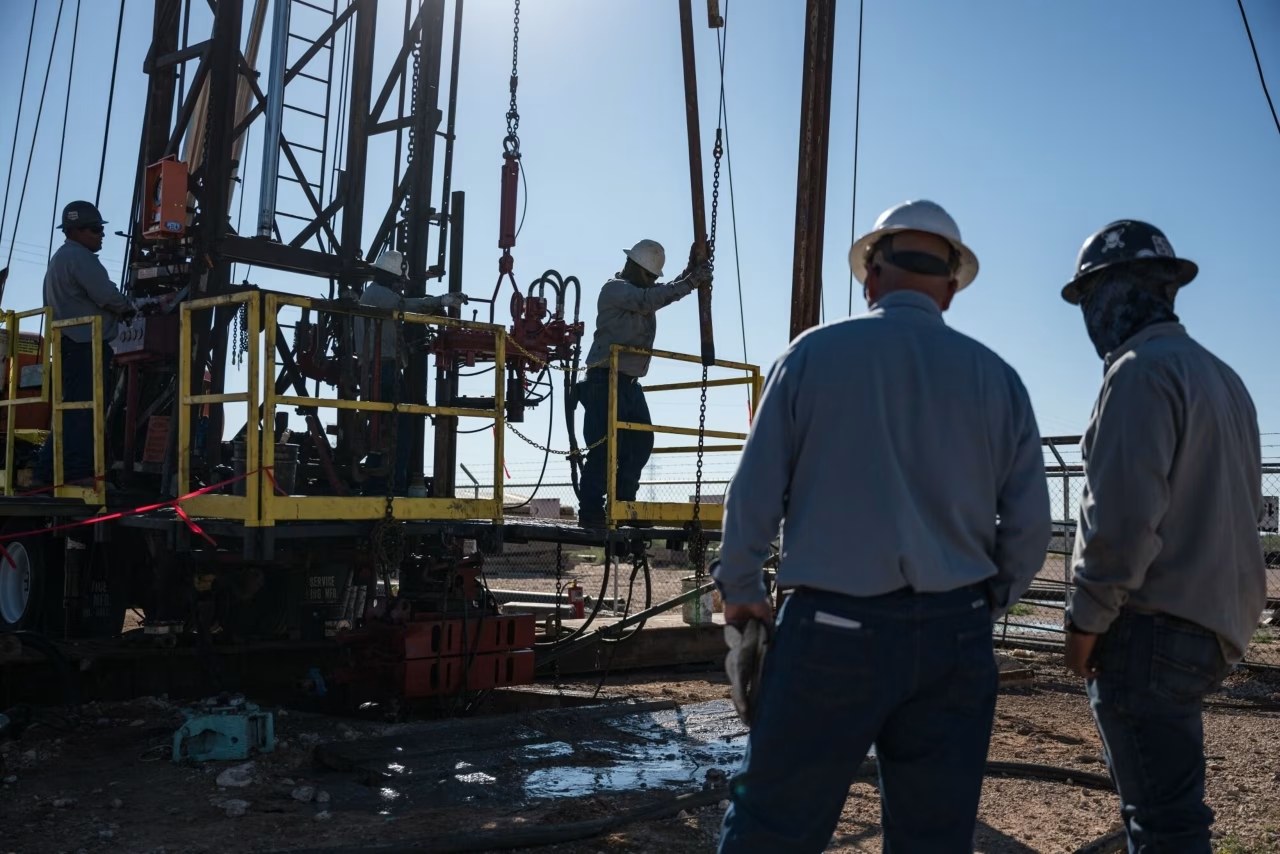
Midland-Odessa unemployment has already fallen to 2.4%, below the national 3.9% rate, as service companies raise wages 12% year-over-year to attract frac crews. State sales-tax receipts from the 11-county Permian region hit a record $2.1 billion in the latest fiscal year, funding new schools and highways. Yet the boom is geographically narrow: Texas and New Mexico account for 55% of U.S. oil production but only 9% of American employment, limiting the macro offset to household energy bills.
Goldman Sachs commodity strategist Daan Struyven cautions that the net impact on U.S. GDP turns negative once Brent sustains above $100. ‘Households spend roughly 3.5% of after-tax income on gasoline; above that threshold, real personal consumption growth slows faster than capex picks up,’ he wrote in a client note. Translation: the Permian gushes cash, but Main Street still feels poorer.
Could a Prolonged Shock Push the Fed Toward Stagflation?
Federal Reserve Chair Jerome Powell has long argued that energy shocks are transitory if inflation expectations remain anchored. The problem: headline CPI already prints at 3.7%, core is stuck at 4.0%, and consumers are again paying 4-handle gasoline just as student-loan payments restart. A sustained $20 oil spike would add roughly 0.6 percentage points to headline CPI within six months, according to BNP Paribas economist Carl Riccadonna, complicating the Fed’s last-mile battle against services inflation.
History offers a sobering guide. During the 1990 Gulf War, oil doubled in three months; U.S. GDP contracted an annualized 3.6% in Q4 1990 even though the Fed cut rates. Today the starting point is tighter: policy rates stand at 5.5%, not 8%, and fiscal space is limited by a $1.7 trillion deficit. That leaves the Fed with an unpalatable choice: tighten into a slowing economy and risk credit events, or tolerate faster inflation and risk de-anchoring expectations.
Market pricing: terminal rate expectations rise
Fed-funds futures now imply a 38% probability of another 25-basis-point hike by March, up from 18% before the conflict began, while the two-year Treasury yield has climbed back above 5%. Equity sectors most exposed to discretionary spending—hotels, restaurants, airlines—have underperformed the S&P 500 by 6–8% in two weeks, a pattern consistent with prior oil shocks, according to Ned Davis Research.
Former IMF chief economist Olivier Blanchard warns that if Brent holds above $110 for a year, U.S. unemployment would rise 0.4 percentage points above baseline, effectively eliminating the soft-landing narrative. ‘The Fed cannot print barrels of oil,’ he tweeted. ‘It can only decide who bears the cost—bond holders via higher real rates, or workers via higher unemployment.’
Which Industries Beyond Energy Actually Benefit?
While consumers feel the pinch, pockets of the economy stand to gain. Defense contractors are the clearest winners: Raytheon’s Standard Missile-2 interceptors, used by U.S. Navy destroyers in the Red Sea, carry a unit cost of $2.1 million; each engagement against a $30,000 drone still burns inventory that must be replenished. Since the conflict began, the iShares U.S. Aerospace & Defense ETF has outperformed the S&P 500 by 9%, led by RTX, L3Harris and KBR.
Farmers, paradoxically, also stand to gain. Wheat futures in Chicago have rallied 14% because the Black Sea and Persian Gulf together move 30% of globally traded grain. Higher grain prices offset elevated diesel costs for Midwest row-crop operations, while U.S. corn and soybeans become cheaper relative to Ukrainian or Russian supplies, boosting export competitiveness.
Solar and battery makers see new demand
Energy-security anxieties are accelerating corporate procurement of on-site solar and battery storage. According to Wood Mackenzie, commercial and industrial rooftop PV installations are now forecast to grow 28% in 2024, up from a pre-war estimate of 19%, as logistics firms seek to insulate themselves from diesel volatility. Tesla Energy has raised its Megapack backlog to 18 months, the longest since 2022’s Ukraine invasion.
Still, these positives are niche. S&P Global estimates that defense, agriculture and clean-tech combined account for 4% of U.S. GDP, too small to offset the drag from higher household energy bills. The net effect is redistribution, not expansion: money flows from coastal consumers to Permian roughnecks, from airlines to missile makers, leaving overall growth weaker than before the first mine was laid.
What Would It Take for Washington to Tap the SPR Again?
The Biden administration drained the Strategic Petroleum Reserve by 221 million barrels in 2022, cutting inventories to 347 million barrels—the lowest since 1983. Refill purchases have only restored 12 million barrels so far, leaving limited dry powder. Under current law, an emergency sale requires a presidential finding of ‘severe energy supply interruption’ and congressional notification, but no additional appropriation.
Energy Secretary Jennifer Granholm told reporters that the SPR ‘is a tool, not a solution,’ signaling reluctance to stage another mega-release unless the Strait is physically blockaded. Instead, officials favor coordinated International Energy Agency draws and quiet diplomacy with Saudi Arabia to delay the OPEC+ production cut scheduled for the first quarter.
Logistical hurdle: sour crude mismatch
Two-thirds of remaining SPR barrels are medium-sour grades, while U.S. Gulf Coast refiners optimized for shale’s ultra-light output now need heavier molecules. A 30-million-barrel release might therefore yield only half its theoretical cooling effect on product prices, according to ClearView Energy Partners. The upshot: any SPR intervention will be tactical, not transformative.
Market observers note that the mere announcement of a coordinated IEA release can shave $5–7 off Brent within 48 hours, but the impact fades within a month if physical supply remains disrupted. With Iran showing no signs of de-escalation, traders are increasingly pricing a risk premium that policy cannot easily arbitrage away.
How Long Before the Next Chapter in the Strait?
Tehran’s calculus revolves around pain thresholds. U.S. officials assess that Iran will continue harassing shipping until either sanctions relief is negotiated or its proxies achieve deterrence against Israeli strikes. The Islamic Revolutionary Guard Navy has rehearsed swarm-boat attacks and mine deployment for two decades; its current tempo—twelve flagged incidents in fourteen days—matches exercise cycles observed in 2015 and 2019, according to Navforcent classified briefings cited by the Journal.
Insurance data provide an early-warning gauge. So-called Additional Premium rates for Gulf voyages have jumped from 0.075% of hull value to 0.35%, the highest since the 2019 Abqaiq attack on Saudi Aramco. If rates exceed 0.5%, commodity traders say, many European refiners will formally bar vessels that have called at Iranian ports in the past 12 months, effectively splitting the tanker market into ‘clean’ and ‘dirty’ segments reminiscent of the 1980s.
Scenario analysis: 90-day disruption
Using a satellite-linked Automatic Identification System database, researchers at the Council on Foreign Relations model a 90-day partial blockade that removes 4 million barrels per day from the market. Their simulation shows Brent averaging $115, U.S. headline CPI peaking at 5.2%, and real GDP growth falling to 0.8% annualized—close to stall speed. The probability of such a scenario over the next six months has risen to 30%, from 10% pre-conflict, according to prediction-market aggregator PredictIt.
Absent a diplomatic off-ramp, the most likely trajectory is episodic escalations followed by tacit understandings: limited U.S. strikes on IRGC naval assets, Iranian deniable attacks on tankers, and a gradual rerouting of trade that embeds a $15–20 risk premium in oil for the foreseeable future. For American motorists, that translates into gasoline stuck above $3.50 a gallon—and for the Fed, a policy stance that stays higher for longer.
Frequently Asked Questions
Q: How much has gasoline risen since the Iran conflict began?
According to AAA data cited by the Wall Street Journal, the average U.S. pump price for regular gasoline has jumped 65 cents since the first week of hostilities, while diesel has surged $1.13, marking the fastest two-week spike since the 1990 Gulf War.
Q: Is the U.S. still vulnerable to Middle-East oil shocks?
Yes. Although America now pumps more crude than it imports, global benchmark Brent sets the marginal price for gasoline. Roughly 20% of worldwide seaborne oil transits the Strait of Hormuz; prolonged disruption would ripple through diesel, jet fuel and petrochemical costs, eroding consumer spending power.
Q: Which U.S. regions could benefit from higher oil prices?
West Texas’ Permian Basin, North Dakota’s Bakken and New Mexico’s Delaware Basin are best positioned. Every $10 rise in Brent adds an estimated $3 billion in annual free cash flow to the top ten U.S. independents, according to Rystad Energy, funding rigs, pipelines and local tax revenues.
