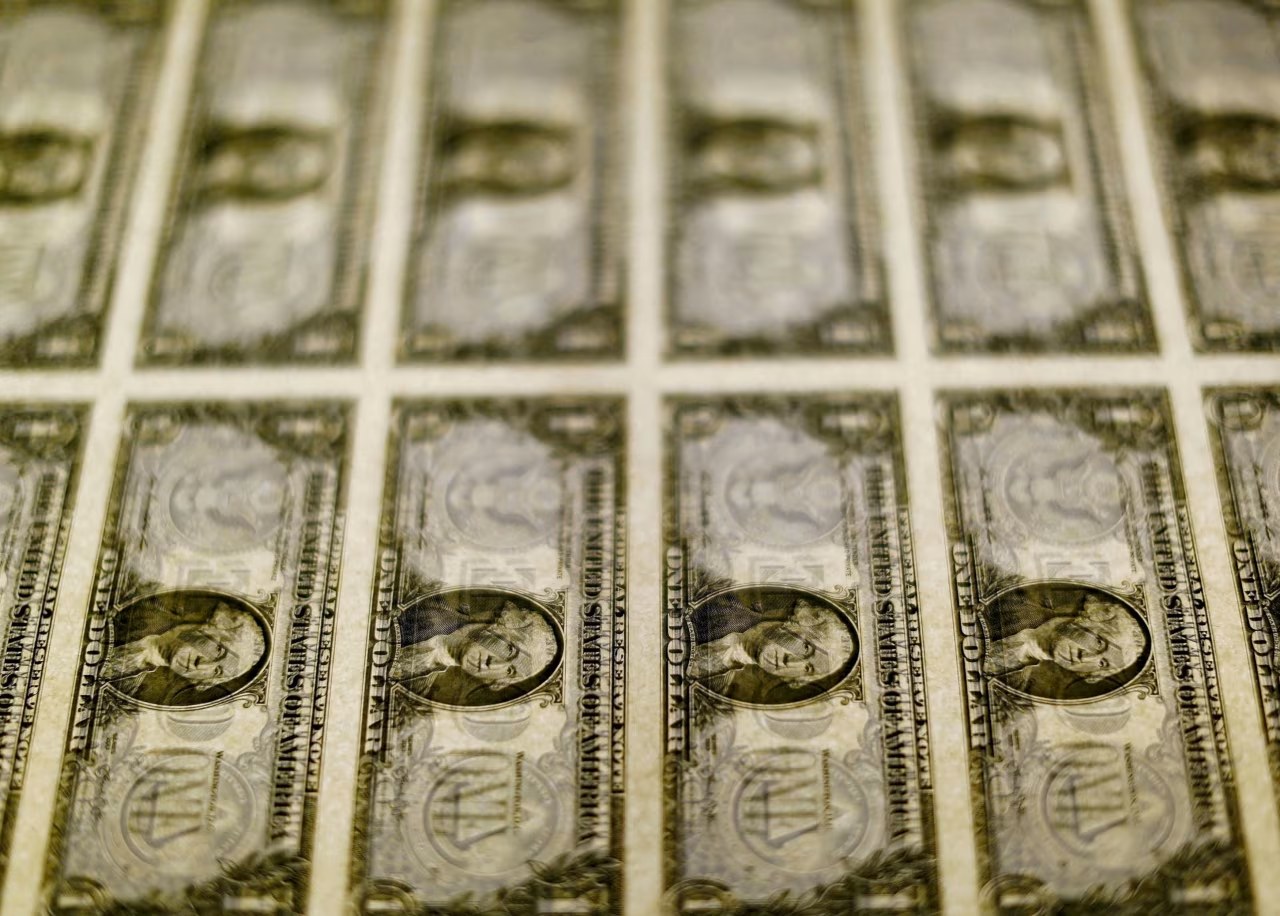
DXY Dollar Index Hits 100.30, Its Strongest Level in 14 Weeks, as Iran Vows to Keep Strait of Hormuz Shut
- The U.S. dollar’s benchmark gauge touched 100.299 early Friday, the loftiest print since late January.
- Iran’s newly elevated supreme leader, Mojtaba Khamenei, pledged to sustain the fight and maintain the strait’s closure, threatening one-fifth of seaborne oil flows.
- Brent crude surged above $102 a barrel, amplifying safe-haven demand for the greenback.
- ING’s Chris Turner says investors ‘cannot see wanting to fight this dollar rally’ given open-ended crisis risk.
Safe-haven bid intensifies as traders price in prolonged energy-supply risk
US DOLLAR—The U.S. dollar extended its winning streak to a fresh three-and-a-half-month apex Friday, with the ICE U.S. Dollar Index—DXY—peaking at 100.299 as headlines from Tehran and Washington reinforced the view that the Middle-East flare-up has no quick off-ramp.
Currency desks across London and New York spent the overnight session paring short-dollar bets after Iran’s leadership reiterated its intention to keep the Strait of Hormuz closed, a move that would choke roughly 21 million barrels a day of seaborne oil and liquefied natural gas.
Energy markets responded immediately: Brent crude leapt more than 4% to $102.05 while gold punched to a one-month top, and the dollar—still the world’s default liquidity haven—absorbed the lion’s share of risk-averse capital.
Safe-Haven Dollar: Why Traders Keep Buying Greenback When Tanks Roll
The dollar’s Friday surge is textbook risk-off behaviour, but the scale—up 1.8% on the week—owes as much to structural positioning as to headlines. Asset-managers entered April with near-record shorts in the DXY, Commodity Futures Trading Commission data show, betting a Fed cutting cycle would sink the greenback. Overnight, those wagers reversed.
Reserve-currency premium meets energy-shock hedge
‘When the world’s most liquid chokepoint is in play, the dollar becomes both a haven and an energy hedge,’ says George Saravelos, Deutsche Bank’s global head of FX research. America’s shale boom flipped the U.S. into a net petroleum exporter in 2020; higher crude now narrows the current-account deficit, an FX positive most G-10 peers cannot claim.
Japan and the euro-area, by contrast, import more than 90% of their oil. Nomura strategist Yujiro Goto estimates every $10 rise in Brent saps 0.3% from euro-zone GDP within four quarters, pushing EUR/USD lower. Friday’s EUR/USD slide to 1.0830 from 1.0910 illustrates the asymmetry.
Options desks reinforce the mood: one-month risk-reversals on the dollar index swung to +0.9 vol, the most bullish skew since October, according to Refinitiv. Traders are paying premium for upside strikes at 101.00 and 102.00, levels last seen before the Fed’s December pivot.
Yet the rally is not limitless. A persistently strong dollar tightens global dollar funding, raising EM debt-servicing costs. The International Monetary Fund’s latest Global Financial Stability Report warns that a 5% quarterly jump in the DXY correlates with a 40bp spike in offshore dollar credit-default swap indices within six weeks. History shows that once financial-conditions tighten too far, the Fed itself intervenes—either verbally or via swap lines—to cap the greenback.
Strait of Hormuz: Anatomy of a $21 Billion-a-Week Oil Shock
Closing the 21-mile wide channel would not halt global supply outright—pipelines in Saudi Arabia and the UAE can divert roughly 4 million barrels a day—but it would add 18–25 days of transit time around the Cape of Good Hope, equal to removing 6mbd from prompt supply, Energy Aspects calculates.
Insurance, not barrels, is the first mover
War-risk premiums for tankers transiting the strait jumped to $400,000 per voyage Friday from $70,000 a week ago, according to Baltic Exchange data. Ship-owners are already requesting payment up front; at least three Very Large Crude Carriers have been diverted to East African waters, brokers say.
‘Markets are front-loading a fear premium,’ says Amrita Sen, co-founder of Energy Aspects. Brent’s $102 handle implies a $12 geopolitical risk premium; if the strait were actually blocked, Brent would need to clear $130 to destroy enough demand to balance the market, she adds.
President Trump’s Thursday remarks—prioritising non-proliferation over pump prices—signal Washington may tolerate higher crude to maintain pressure on Tehran. U.S. shale producers, meanwhile, are ramping rigs: the latest Baker Hughes count shows oil-directed rigs rose by five to 519, the fourth straight weekly gain.
Could the Fed Turn Dollar Bullishness Into a Policy Problem?
A roaring dollar complicates the Fed’s dual mandate. Import-price deflation could pull headline PCE below 2% by summer, yet Chair Powell warned in May that ‘disorderly’ FX moves can feed back into tighter credit conditions faster than any rate hike.
Dollar strength versus disinflation
Goldman Sachs economists estimate a 5% DXY rise shaves 15bp off U.S. core PCE over 12 months via cheaper imported goods. With markets pricing only 35bp of cuts for 2024, a stronger dollar effectively delivers tightening without the Fed lifting a finger.
Yet the same strength squeezes multinational earnings. S&P 500 companies derive roughly 29% of revenue abroad; every 1% DXY rise trims aggregate EPS by 0.3%, according to S&P Dow Jones Indices. Early reporters for Q2 have already cited currency headwinds: IBM trimmed guidance by 30¢, Microsoft by 27¢.
History offers a playbook. In August 2015 China’s yuan devaluation drove the DXY up 8% in six weeks; the Fed postponed rate hikes until December. In March 2020 the Fed opened dollar swap lines within days to arrest a funding crunch. Traders say a similar facility could be dusted off if EM funding stress morphs into systemic risk, capping further dollar upside.
Is Euro the Biggest Casualty of the Dollar’s Iran-Driven Rally?
EUR/USD sank below 1.0830 for the first time since February, making the euro the worst-performing G-10 currency this week. The move was turbo-charged by options expiry: €2.3 billion of strikes at 1.0850 rolled off at the New York cut, exposing a vacuum of bids, traders said.
ECB doves meet energy spike
European Central Bank Governing Council member Francois Villeroy reiterated Friday that ‘a June cut remains plausible,’ signalling the bank is willing to look through the energy shock. Money markets price 65bp of ECB easing by December versus 35bp for the Fed, widening the rate spread in the dollar’s favour.
Commerzbank strategist You-Na Park argues the divergence is overdone. ‘If Brent stays above $100, euro-area headline inflation re-accelerates, forcing the ECB to pause,’ she says. That could stabilise EUR/USD near 1.08, but only if geopolitical risk fades—a big if.
Japanese yen and British pound have also wilted, yet the euro’s heavier weight in the DXY basket means its slide has outsized impact. Friday’s 0.7% drop contributed roughly 55 basis points to the dollar index’s 0.9% daily gain, ICE weightings show.
What History Tells Us About Dollar Peaks During Middle-East Wars
Since the 1973 oil embargo, the dollar has posted an average 4.3% gain within 30 days of a major regional flare-up, LSEG data show. Yet peaks are fleeting: after Iraq’s 1990 invasion of Kuwait the DXY rose 9% in six weeks, then surrendered all gains within three months once the U.S.-led coalition secured supply routes.
Key difference: U.S. energy independence
Today America pumps 13.2mbd, matching total consumption, a seismic shift from 1990 when imports topped 40%. That buffers GDP but also sustains the rally because the current-account deficit narrows, reducing the need for dollar depreciation to restore equilibrium.
Still, stretched positioning can unwind fast. BofA’s latest FX survey shows fund managers are net long dollars for the first time since October 2022; past episodes of crowded longs triggered 3–5% pullbacks within weeks. The trigger then may come from diplomatic channels rather than oil flows: any hint of a ceasefire or partial Hormuz reopening could send algos racing for the exit, reminding investors that geopolitical risk premia are leased, not owned.
Frequently Asked Questions
Q: What is the DXY dollar index?
The DXY measures the U.S. dollar against six major peers—euro, yen, pound, Canadian dollar, Swedish krona, Swiss franc—weighted by trade volume. A rising DXY signals broad dollar strength.
Q: Why does the dollar rally when Middle-East conflicts intensify?
Investors treat the dollar as the world’s safest liquid asset. Geopolitical shocks trigger risk-off flows into U.S. Treasuries and dollar cash, lifting the currency even if U.S. assets are not directly threatened.
Q: How does a Strait of Hormuz closure affect oil prices?
Roughly 20% of global seaborne oil transits the strait. Any credible threat triggers immediate risk premium in Brent and WTI futures; Friday’s Brent spike above $102 reflects traders pricing in a prolonged disruption.
Q: Could higher crude actually help the U.S. economy?
America’s net exporter status means domestic producers earn more from price spikes, cushioning GDP. However, higher gasoline prices can still dent consumer spending—traders currently view the exporter benefit as outweighing the drag.
