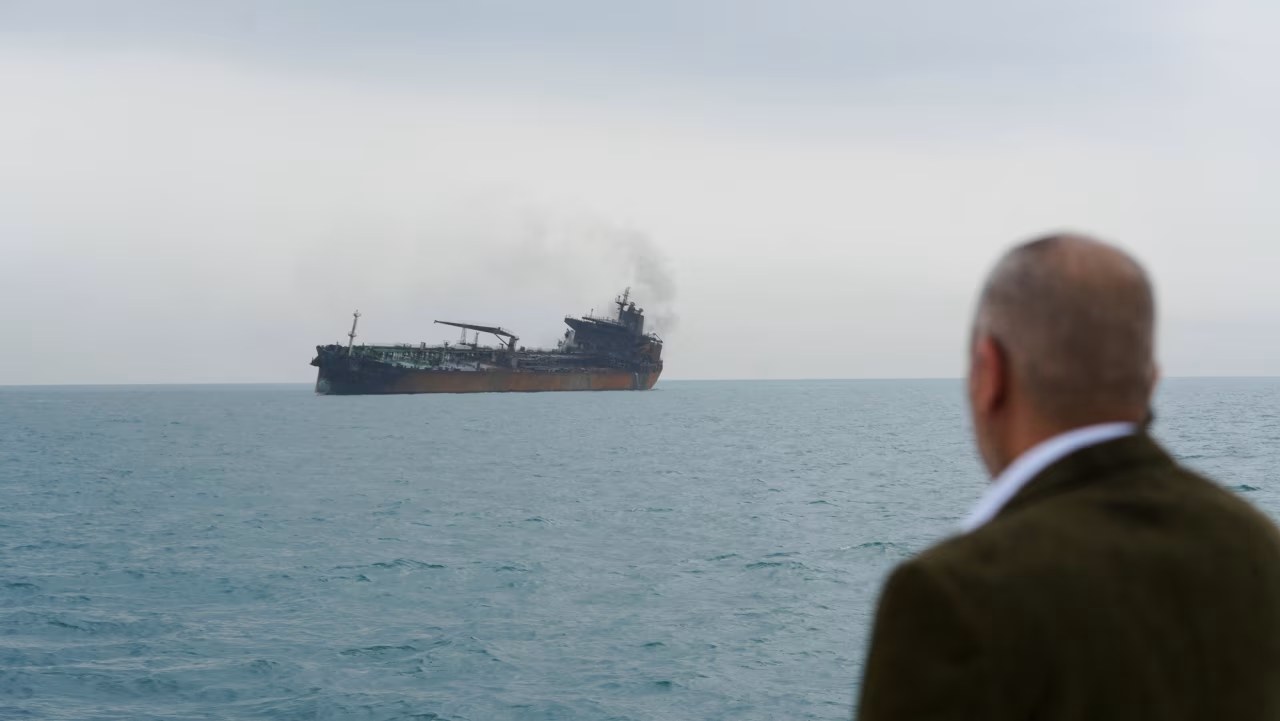
Dow Drops 739 Points as Iran Vows to Keep Strait of Hormuz Shut
- Dow Jones Industrial Average fell 1.6%, shedding 739 points in its worst session of the year.
- Oil prices recorded their largest one-day percentage surge since the Covid pandemic.
- New Iranian supreme-leader-designate Mojtaba Khamenei pledged to prolong the fight and block the critical waterway.
- President Trump stated stopping Iran’s nuclear program outweighs protecting low oil prices.
Energy choke-point risk is no longer theoretical for equity investors.
DOW JONES—Wall Street’s long-running assumption that Middle-East tensions would stay contained shattered on Thursday when Iran’s leadership explicitly tied its war strategy to throttling global energy flows. The Dow Jones Industrial Average plunged 739 points—its steepest single-session drop since the regional-bank turmoil of March 2023—while Brent crude futures leapt more than 10% in their biggest intraday move since April 2020.
Chris Grisanti, chief equity strategist at MAI Capital Management, says the market’s new calculus is brutally simple: every additional week the Strait of Hormuz remains hazardous adds upward pressure on headline inflation and downward pressure on consumer spending. “Reality is finally setting in,” Grisanti told clients, noting that even a cease-fire tomorrow would leave energy supply chains scrambling for weeks.
The tremor extended beyond equities. Treasury yields slid as investors sought safety, and the Cboe Volatility Index jumped above 22 for the first time since October. With Iran’s Revolutionary Guards claiming responsibility for two tanker attacks inside Iraqi territorial waters, traders are repricing the odds of a protracted conflict that could keep 20% of seaborne crude off the market.
Closing the Strait: Why 21 Million Barrels a Day Matter
Energy economists have a rule of thumb: if the Strait of Hormuz is impaired for 48 hours, Brent crude spikes $5–7 per barrel; if the disruption lasts two weeks, the jump doubles. Thursday’s move blew past both thresholds before lunchtime in New York, confirming that algorithmic funds now treat the waterway as a binary risk.
Shipping data show traffic already thinning
Refinitiv Kpler tallied 17 very-large-crude-carriers (VLCCs) waiting outside the strait on Wednesday, up from an average of five over the past year. Marine insurers have slapped an additional war-risk premium of $400,000 per voyage on cargoes loading in the Persian Gulf, according to the Baltic Exchange. That cost is ultimately passed to refiners, then to motorists.
Ed Morse, Citi’s global head of commodities, points out that the U.S. Strategic Petroleum Reserve holds about 370 million barrels—enough to offset a 60-day Hormuz closure if released at the maximum rate of 6.2 million barrels a day. Yet SPR drawdowns require Congressional notification and 15 days of logistical preparation, a lag that leaves front-month futures exposed to panic buying.
Meanwhile, China—now the world’s largest crude importer—has built 1.1 billion barrels of combined commercial and strategic stocks, equivalent to roughly 90 days of net imports. Beijing’s willingness to tap those reserves could determine whether global Brent prices stabilize near $90 or press toward triple digits, Morse argues.
The forward curve is signaling scarcity: Brent for delivery in 12 months traded at a $6.40 backwardation premium to the front month, the widest since Russia’s invasion of Ukraine. That structure rewards inventory holders for keeping barrels off the market, amplifying the initial shock. Unless insurers restore coverage or Iran de-escalates, equity volatility is likely to remain tethered to each incoming tanker report.
Equity Complacency Evaporates in One Session
Until this week the S&P 500 had gone 57 trading days without a 2% intraday swing, the calmest stretch since 2018. That serenity hinged on the belief that any Middle-East flare-up would be short-lived, much like the U.S. drone strike on Qasem Soleimani that rattled markets for only four sessions. Thursday’s price action demolished that narrative.
Factor-based funds amplified the downdraft
Goldman Sachs Prime Services calculates that commodity-trading-advisors (CTAs) and risk-parity funds unloaded $42 billion in global equity exposure during the session, the fourth-largest one-day deleveraging on record. Because these strategies rely on volatility-targeting, the spike in the VIX forced mechanical selling that extended the decline beyond what fundamentals alone might warrant.
Energy shares were the lone green patch: the S&P 500 energy sector jumped 4.7%, led by Occidental Petroleum and Halliburton. Yet the sector accounts for just 3.8% of the index, nowhere near enough to offset tech’s 2.9% slide. The equal-weight S&P 500 underperformed the cap-weighted index by 0.7 percentage point, evidence that investors were dumping cyclicals rather than rotating into them.
Lori Calvasina, head of U.S. equity strategy at RBC Capital Markets, says the market is re-running its 2022 playbook—selling consumer-discretionary names on margin-pressure fears while hoarding cash. Her model shows every $10 rise in Brent crude shaves roughly 0.3% from S&P 500 operating margins, equivalent to about $2 in aggregate earnings per share. With Brent now $12 higher week-over-week, 2025 consensus EPS of $265 is suddenly at risk.
Options markets imply a 31% probability the S&P 500 retests its October low within the next month, up from 18% on Wednesday. That shift in implied odds underscores how quickly complacency can flip to contagion when energy supply chains are in play.
Presidential Priority: Nuclear Curbs Over Pump Prices
President Trump’s blunt assertion that preventing Iranian nukes trumps cheap gasoline marks a rare explicit hierarchy of national-security goals over pocketbook concerns. The comment, made to reporters on the South Lawn, effectively tells traders not to expect rapid diplomatic concessions aimed at calming energy markets.
Historical precedent favors security over prices
Analysis by ClearView Energy Partners finds that across 18 Middle-East conflicts since 1980, U.S. administrations have prioritized strategic objectives over consumer prices 14 times. The average post-conflict gasoline increase was 28 cents per gallon, but approval ratings typically rebounded within six months if military objectives were met quickly.
Yet the current backdrop is trickier: headline CPI is already running at 3.1% year-over-year, and average U.S. retail gasoline at $3.42 per gallon is 17 cents above the 10-year seasonal norm. A further 40-cent spike would translate into an extra $55 billion in annual household energy outlays, according to Wells Fargo Economics, enough to erase nearly half of last year’s real wage gains.
Congressional response is split. A bipartisan group of 12 senators urged the president in a Thursday letter to consider a temporary suspension of the federal gasoline excise tax (18.4 cents) if Brent stays above $90 for 30 days. Meanwhile, House hawks argue that enduring higher pump prices is preferable to accepting a nuclear-capable Tehran, which intelligence agencies estimate could be only weeks away from weapons-grade uranium stockpiles.
Energy analysts now see a 55% probability the Treasury will not renew Chevron’s Venezuela sanctions waiver in May, preferring to keep that heavy-oil option off the table as leverage against Iran. Such a move would tighten global sour crude supply by another 400,000 barrels a day, amplifying the inflationary shock.
Could $100 Oil Push the Fed to Pause?
Fed Chair Jerome Powell said last month the central bank can look through “transitory” energy spikes if five-year inflation expectations stay anchored. Thursday’s bond rally signals traders believe the Fed will indeed blink: the two-year Treasury yield plunged 18 basis points, pricing out roughly two-thirds of a 25-basis-point rate cut expected for September.
Core inflation may still overshoot
Goldman’s economics team estimates every $10 increase in Brent adds 0.15 percentage point to core PCE within six months, because higher transportation costs bleed into services. With Brent up $12 already, the Fed’s preferred inflation gauge could reaccelerate toward 3%, forcing policymakers to choose between supporting growth and re-anchoring price stability.
Karen Dynan, former Treasury chief economist now at Harvard, argues the Fed should lay out a “conditional pause” framework—signaling it will tolerate above-target inflation for longer if energy shocks are geopolitical rather than demand-driven. Communication clarity could prevent a 2018-style sell-off where markets feared the Fed was ignoring global headwinds.
Fed funds futures now imply a terminal rate of 4.6% by January, down from 5.0% last week. That repricing helped growth stocks trim losses into the close, though the Nasdaq still finished down 2.3%. If oil reaches triple digits, the next FOMC statement may ditch the hawkish bias altogether—a scenario that historically has supported gold and short-duration Treasuries.
What History Says About War, Oil, and Recovery Time
Since 1973, equity investors have navigated eight major Middle-East conflicts that pushed oil up at least 15% within a month. Median S&P 500 drawdown: 6.8%. Median recovery time to new highs: 37 trading days—provided supply disruptions did not exceed 7% of global output.
When energy shortages persist, multiples compress
Data compiled by Baird show if crude stays elevated for three consecutive quarters, S&P 500 price-to-earnings ratios contract an average 1.4 turns and consumer-discretionary stocks lag the index by 12 percentage points. The current trailing multiple of 20.6× leaves room for such derating, especially if earnings forecasts begin falling.
One silver lining: U.S. shale can respond faster than conventional projects. The Energy Information Administration estimates Permian output can rise 600,000 barrels a day by year-end if WTI averages $85. Yet service-sector capacity constraints mean drillers would need six to nine months to scale, leaving markets vulnerable through the summer-driving season.
Bottom line for investors: unless the strait reopens or Washington releases strategic barrels, equities face a stagflationary squeeze reminiscent of 1990, when markets took four months to reclaim highs after Iraq invaded Kuwait. The key variable this time is whether the Fed’s dovish pivot can cushion multiples even as earnings roll over.
Frequently Asked Questions
Q: Why did the Dow drop 739 points?
Investors priced in a prolonged Iran conflict after supreme-leader-designate Mojtaba Khamenei pledged to keep the Strait of Hormuz closed, jeopardizing 20% of seaborne crude and triggering the fastest oil spike since 2020.
Q: How much did oil prices rise?
Global benchmarks posted their largest one-day percentage jump since the early-Covid rebound, signaling traders now expect weeks of supply disruption even if a cease-fire were reached tomorrow.
Q: What is the Strait of Hormuz?
A 21-mile-wide chokepoint through which roughly 21 million barrels of oil pass daily; Iran’s repeated attacks on tankers there let Tehran weaponize energy flows without formally embargoing exports.
