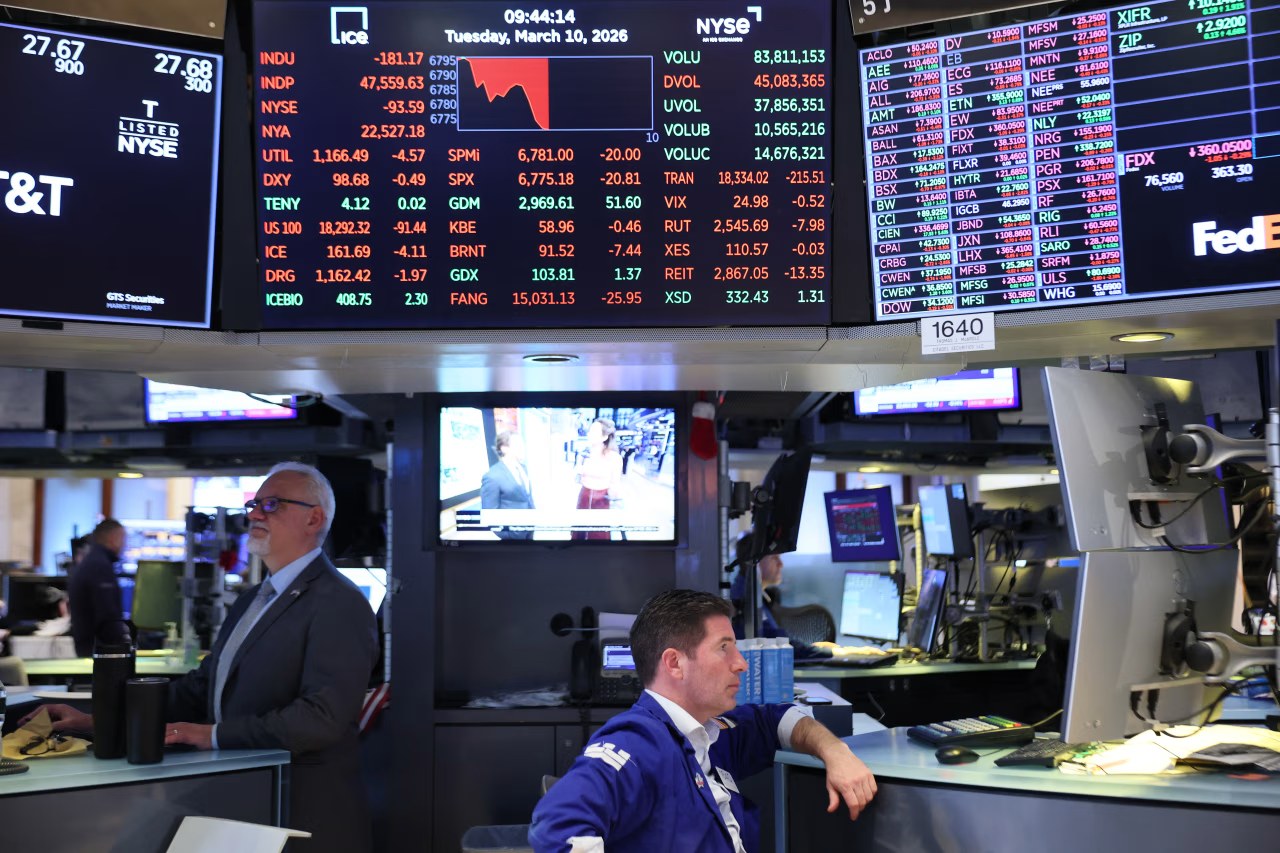
Deleted Tweet Erased $84 Million From Oil ETF in Under 10 Minutes
- U.S. crude futures plunged as much as 19% after Energy Secretary Chris Wright claimed Navy escorts resumed in the Strait of Hormuz.
- The post lived on X for roughly 10 minutes before deletion, vaporizing $84 million from a leading oil ETF.
- Department of Energy staff admitted the caption was incorrect and said the administration is still reviewing escort options.
- Benchmark Brent and WTI contracts whipsawed for a sixth straight session as drone footage from the Middle East collided with headline risk.
A single social-media misfire shows how fragile the world’s most traded commodity has become.
CHRIS WRIGHT—Oil traders have spent the week glued to infrared drone clips of missiles arcing across the night sky above the Persian Gulf, but the price chart that mattered most on Tuesday traced its sharpest dip to a 44-word tweet. At 12:46 p.m. ET, Energy Secretary Chris Wright told 30,000 followers that the U.S. Navy had “successfully escorted an oil tanker through the Strait of Hormuz,” a waterway that carries one fifth of seaborne crude. Within minutes West Texas Intermediate futures plummeted from an intraday high of $74.12 to a session low of $60.05, a 19% round-trip that vaporized more than $3 billion in notional value across the futures curve.
The post itself vanished almost as quickly, yanked offline after agency staff realized the accompanying video was mis-captioned. By then the damage was done: the $11 billion United States Oil Fund saw its market capitalization drop $84 million between 12:47 p.m. and 12:57 p.m., according to NYSE Arca data, as algorithmic funds parsed the words “ensure oil remains flowing” and hit sell.
“Markets are operating on hair-trigger reflexes,” says Helima Croft, head of global commodity strategy at RBC Capital Markets. “When a cabinet-level official appears to confirm military de-escalation, the machines don’t wait for footnotes.” The episode underscores how, in a world of zero-commission retail flows and headline-scraping algos, energy policy can be moved by a typo.
What Actually Happened in the Strait—and on the Timeline?
The Strait of Hormuz is only 21 nautical miles wide at its narrowest, yet 21 million barrels of crude, condensate and refined products pass through daily, according to the U.S. Energy Information Administration. Any hint that traffic could be rerouted or protected from Iranian seizure threats reverberates instantly through Brent and WTI contracts.
According to three shipping brokers in Dubai and Singapore, no U.S.-flagged warship was within visual range of a laden tanker at the time of Wright’s post. Vessel-tracking data from MarineTraffic shows the Suezmax Heritage I was the last petroleum carrier to transit the strait under U.S. Navy observation—on a different calendar day. The video clip that accompanied the since-deleted tweet was filmed during that earlier passage, but the caption mistakenly implied it was live.
Timeline of a tweet-driven plunge
12:46 p.m. ET—Post appears on @SecWright account. 12:47 p.m.—WTI drops $1.40. 12:49 p.m.—Volume spikes to 1.2 million contracts, triple the 20-day average. 12:52 p.m.—The United States Oil Fund loses $60 million in market cap. 12:54 p.m.—Gasoline futures slide 6 cents. 12:57 p.m.—Post deleted. 1:03 p.m.—Crude recovers half its losses. “Markets moved first, asked questions later,” says Michael Tran, energy strategist at RBC.
Department officials now say they are reviewing “other options” to resume safe passage, including the potential for future escorts, but have provided no timetable. Until clarity emerges, every tanker master and charterer must price in headline volatility on top of war-risk premiums that already add 5–7% to freight rates, according to Clarksons Platou Securities.
How a Single Tweet Moved Futures Faster Than OPEC Meetings
Previous jaw-boning by energy officials has roiled markets, but never at the blistering speed seen Tuesday. When OPEC+ ministers announce production cuts, crude usually needs 15–30 minutes to price in the headline because physical traders must confirm delegate counts, communiqué language and secondary sources. Wright’s tweet compressed that cycle into 180 seconds.
High-frequency shops now parse @SecWright, @POTUS and @IDF tweets through natural-language models that assign sentiment scores within 200 milliseconds, according to a person at one Chicago proprietary-trading firm. Once a confidence threshold is breached, algorithms lift or hit every visible bid. “We’re not trading fundamentals; we’re trading the probability that other algos will react,” the trader said.
Comparing tweet shocks to geopolitical events
During the 2019 Abqaiq attack, Brent spiked 19% in one day, but the move took four hours. When Russia invaded Ukraine in 2022, ICE Brent gapped 17% overnight—still slower than Tuesday’s intraday swing. “Policy uncertainty now travels at fiber-optic speed,” says Bob McNally, president of Rapidan Energy and a former White House adviser.
Retail investors amplified the shock: the United States Oil Fund, which holds near-month WTI swaps, traded 42 million shares Tuesday, triple its 30-day average. Options volume hit an all-time high of 1.1 million contracts, with puts outnumbering calls 3-to-1, Cboe data show. The fund ended the day with assets of $11.0 billion, down from $11.1 billion at noon—a $100 million swing compressed into the tweet window.
Why ETF Flows Now Dwarf Physical Fundamentals
The United States Oil Fund is designed to track front-month WTI, but it must roll expiring contracts during a five-day window each month. That structure makes the ETF hypersensitive to sudden sentiment shifts rather than storage or inventory stats. When Secretary Wright’s post crossed, USO’s net asset value fell 3.4% in six minutes while spot crude slid only 2.1%, amplifying the underlying move.
About 42% of USO holders are retail accounts using zero-commission platforms, according to the fund’s sponsor. During prior Middle-East scares, these investors typically buy calls; on Tuesday they crowded into puts, driving the fund’s options-implied volatility to 68%, a level last seen in April 2020 when WTI traded negative. “The options tail is wagging the ETF dog,” says James West, senior analyst at Evercore ISI.
Authorized participants step back
When volatility exceeds 50%, authorized participants—banks that create or redeem ETF shares—widen bid-ask spreads to offset hedging costs. On Tuesday the spread on USO reached 28 cents, quadruple its yearly average, discouraging arbitrage and allowing the fund to decouple from net asset value. The result: a tweet that mentioned no ETF and no ticker still ricocheted through 96 million shares of daily volume.
Fund sponsors have petitioned the SEC to allow monthly rolling over four days instead of five, a tweak that would narrow tracking error but do little against headline risk. Until then, a cabinet member’s typo will keep rippling through retail portfolios faster than any supertanker can steam through Hormuz.
Could Regulators Force Social-Media Silence on Commodity Policy?
The Commodity Futures Trading Commission has historically policed manipulation, not misinformation. Yet the speed with which Wright’s tweet moved prices is prompting calls for stricter protocols. CFTC Chair Rostin Behnam told lawmakers last month that “unverified statements from officials can undermine market integrity,” but the agency has no rule that bars cabinet members from opining on supply chains.
Europe is moving faster. Starting in 2026, the EU’s Digital Services Act will require “high-reach” government accounts to pre-verify posts that reference critical infrastructure if the content could move regulated markets. Violators face fines up to 6% of global turnover. No equivalent statute exists in the U.S., leaving traders to parse @SecWright the same way they parse Beyoncé lyrics for crypto ticker mentions.
Proposed fixes inside the beltway
Two bipartisan bills circulating in the House Financial Services Committee would mandate a 30-minute delay for federal officials’ social-media statements that reference commodity exports, unless the post is cleared by agency lawyers. “We already have a 15-minute blackout for Fed governors on policy-sensitive topics,” notes Rep. Ralph Norman, R-S.C., a co-sponsor. “Energy markets deserve the same stability.”
Industry lobbyists counter that forced silence could violate the First Amendment and push price-sensitive commentary onto encrypted channels where regulators can’t see it. For now, the only safeguard is an internal Department of Energy rule instituted after Tuesday’s fiasco: press aides must obtain Pentagon confirmation before posting any claim about naval escorts. The episode guarantees that the next policy leak—intentional or not—will be scrutinized under a stopwatch rather than a statute.
Will Oil Markets Stay Hostage to Headlines?
Implied volatility on three-month WTI options remains elevated at 42%, a level that implies 3% daily swings even without fresh headlines. The persistence reflects not just Iran-Israel tensions but the new reality that a 280-character misfire can outrank OPEC communiqués. Until physical supply is visibly rerouted—or military escorts become routine—every geopolitical tweet will trade like an oil inventory report.
Investors are adapting. Flows into the $1.4 billion iShares Oil & Gas ETF, which caps single-stock weightings at 8%, have risen 26% this month, while USO saw outflows of $220 million over the same span. “People want energy exposure without headline leverage,” says Gargi Chaudhuri, head of iShares investment strategy at BlackRock. Fund sponsors are also accelerating the launch of “buffer” ETFs that absorb the first 10% of downside in exchange for capped upside—essentially insurance against the next errant tweet.
What could restore calm
Shipping executives say visible naval convoys, not tweets, would cut the war-risk premium embedded in freight rates, which currently add about $1.20 per barrel to delivered crude in Asia. The Pentagon has drawn up plans for a multilateral escort operation dubbed Safe Passage, but allies want diplomatic cover first. Until ships steam in convoy, the cheapest volatility hedge remains the mute button—an inadequate tool in an age where markets price rhetoric faster than warships can sail.
Frequently Asked Questions
Q: Why did oil prices drop after the Energy Secretary’s tweet?
Traders interpreted the post as proof that U.S. Navy escorts would keep tankers moving through the Strait of Hormuz, reducing the risk premium baked into crude futures.
Q: How much market value was lost during the tweet window?
Roughly $84 million evaporated from the largest oil-linked ETF in the ten-minute span the message remained online, according to exchange data.
Q: Is the Navy actually escorting tankers through the strait?
U.S. officials later clarified that no escorts are underway; the Department of Energy blamed an incorrect caption added by staff.
