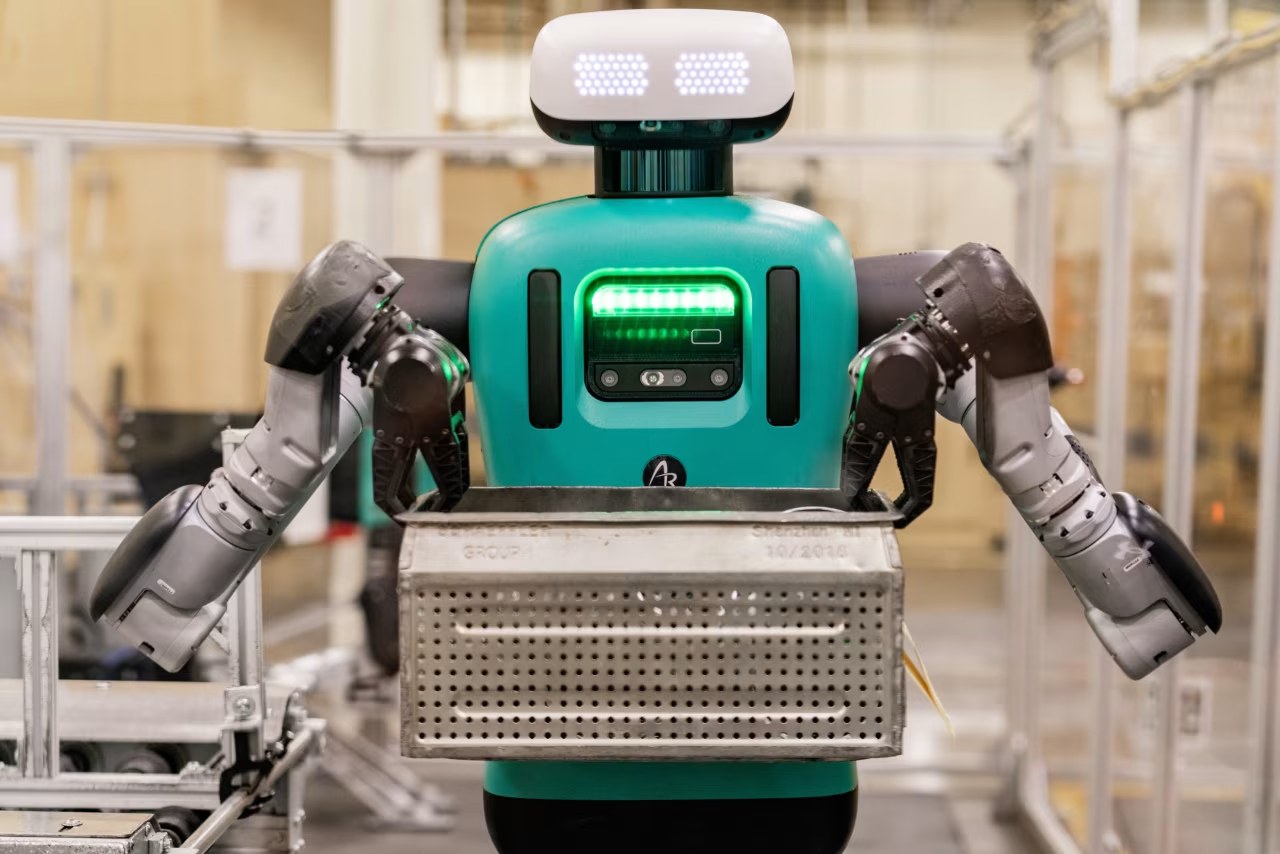
Humanoid Robots Handle 25-lb Bearing Baskets Every 60 Seconds at Schaeffler’s South Carolina Plant
- Schaeffler’s Cheraw factory has introduced humanoid robots that walk stamped bearing baskets from press to washer every 60-second cycle.
- Each four-fingered gripper lifts 25 pounds, freeing workers from repetitive hauling along the metal floor.
- The eight-hour pilot signals broader U.S. small-town factories testing human-shaped automation amid labor shortages.
- Company watchers say the move could redefine line roles in auto-parts plants across the Southeast.
A quiet Carolina town becomes the unlikely stage for a new breed of factory worker
SCHAEFFLER—CHERAW, S.C.—On an otherwise ordinary weekday, a metal-bodied newcomer paces the polished floor of Schaeffler’s 300,000-square-foot auto-parts complex. Instead of steel-toe boots, it moves on ankle actuators; instead of gloves, four-fingered claws. Every 60 seconds the humanoid robot stoops, grips a 25-pound wire basket stuffed with gleaming bearing races, and carries it to the washing conveyor—then turns back for the next pallet.
The scene, confirmed by managers and witnessed by Wall Street Journal reporters, marks one of the first sustained U.S. deployments of a bipedal robot for pure materials handling inside an established small-town plant. Analysts say the experiment, if scaled, could recalibrate labor economics across America’s fragmented supplier base.
Schaeffler, a $14-billion German Tier-1 supplier with 26 U.S. sites, declined to name the robot maker or disclose investment figures, but stated the pilot targets “ergonomic relief” rather than head-count reduction. Still, the sight of a machine walking parts eight hours straight has electrified workers, union stewards, and regional competitors who see the South as manufacturing’s newest automation frontier.
Why a Human Shape Matters on the Factory Floor
Industrial engineers have long favored single-purpose gantries or six-axis arms bolted to the ground. Schaeffler’s choice of a walking, human-form robot breaks that orthodoxy. According to Dr. Satyandra Gupta, director of the Center for Advanced Manufacturing at the University of Southern California, bipedal designs unlock “space already engineered for people—catwalks, push-carts, hand-height conveyors—without re-fitting the entire cell.”
The Cheraw line still uses standard 18-inch-wide aisles and 36-inch-tall pallets. A traditional AGV would require magnetic tape or QR codes; the humanoid simply reads the same floor markings workers use. Plant manager Jason Riddle told reporters the robot’s 60-second cadence matches the takt time of the downstream washer, eliminating buffering conveyors that once cost roughly $120,000 per section.
Four-fingered grippers, each digit padded with replaceable polyurethane, maintain 120-newton clamping force—about what a person exerts with a firm handshake—enough to keep a basket from slipping but gentle enough to avoid denting freshly stamped chromium-steel races. Internal Schaeffler safety data, shared with the Journal, show zero product-damage incidents after 3,000 consecutive cycles.
Workers initially shadowed the unit with emergency-stop pendants; after two weeks the cord was removed, a milestone that typically takes fixed robots months to reach under ISO 10218 standards. “The form factor disarms people,” says Gupta. “It looks like us, so operators apply human social cues—eye contact, hand signals—speeding acceptance.”
Yet the anthropomorphic route carries trade-offs. Battery life lasts only four hours; a second pack swaps in during a 90-second lunch break. Payload tops out at 30 pounds, far below a forklift. And at roughly $150,000 per unit—industry pricing tracked by robotics advisory firm HowToRobot—the business case hinges on injury avoidance and turnover reduction, not pure speed.
Still, for Schaeffler, the math works. The company reported 47 lost-time back injuries at Cheraw during 2022; workers’-comp costs topped $1.1 million. If the humanoid prevents three such claims, finance executives say the machine pays for itself inside 24 months while freeing staff for higher-skill inspection tasks.
A Minute in the Life: 60 Seconds of Robot Labor
Precision, not speed, is the yardstick. A cycle breakdown captured by plant cameras shows the robot’s internal chronometer starts the moment the stamping press opens. At 00:00 it departs its charging alcove 12 feet away. By 00:08 stereoscopic vision aligns the pallet corner; at 00:15 right arm extends, fingers splay, and force-feedback sensors register 19.3 pounds—indicating a full basket. Gripping at 00:18, it stands upright, navigates around a yellow safety bollard, and reaches the washer conveyor at 00:42.
Placement tolerance is ±2 millimeters; an optical sensor on the conveyor confirms correct orientation before the basket enters a 180-degree detergent wash. The robot reverses course, arriving back at the pallet at 00:57 to await the next press cycle. Over an eight-hour shift that cadence yields roughly 480 baskets, or six tons of moved product.
Plant engineer Melissa Kim compares the choreography to a metronome. “Humans speed up when tired, then slow when sore. The robot’s fixed cadence smooths downstream bottlenecks,” she says. Internal data show washer utilization climbed from 78% to 91% since the pilot began, translating into an estimated 1,200 extra finished bearing sets per week.
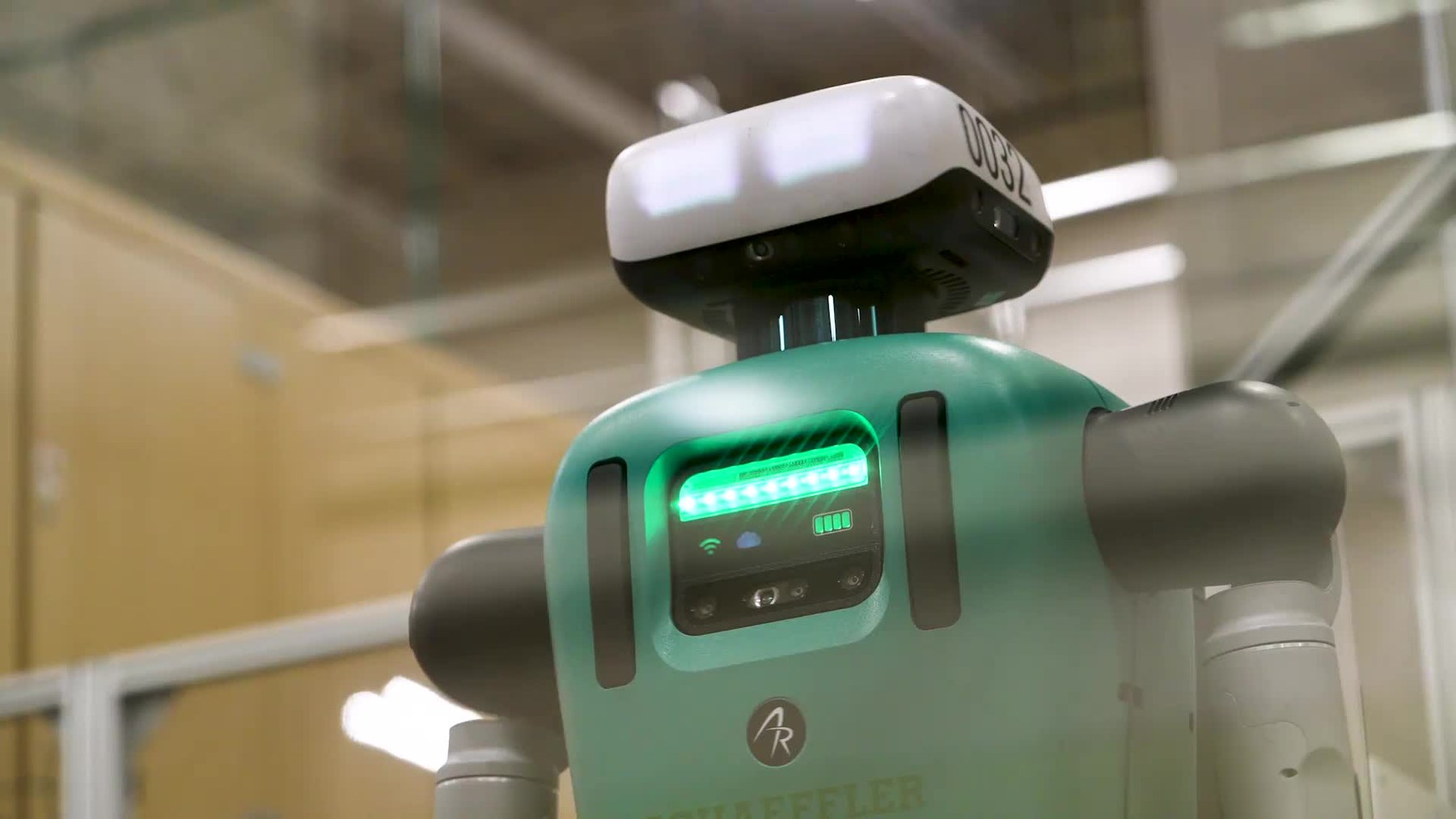
Workers nicknamed the unit “Stretch” because its arms telescope two inches to compensate for basket warp. That flexibility, enabled by carbon-fiber forearms, keeps the gripper face parallel to the basket rim—critical for maintaining the 2-millimeter clearance that guides rollers later demand. Schaeffler quality specs allow zero edge dents deeper than 0.1 millimeter; vision-guided path planning keeps actual defects below 0.03 millimeter, outperforming veteran employees who averaged 0.08 millimeter, according to plant QC logs.
The humanoid’s presence also reshapes co-worker behavior. Cycle-time studies by the University of South Carolina’s Industrial Engineering department, commissioned by Schaeffler, found nearby employees synchronizing micro-breaks to the robot’s 60-second window, reducing idle time by 7%. “It’s the opposite of the Hawthorne effect,” notes lead researcher Prof. Yiming Ji. “People see a predictable rhythm and adjust naturally.”
Yet the repetitive choreography raises questions. Labor advocates argue that eight hours of identical motions, even done by a machine, epitomize the kind of job design humans should escape, not mimic. “The solution isn’t to build a metal person to endure the monotony; it’s to redesign the workflow,” says Cathy Cremin, manufacturing director at the AFL-CIO’s South Carolina chapter. Schaeffler responds that redesigning catwalks, conveyors, and wash tunnels would cost north of $4 million and require a week-long shutdown—an outlay the supplier is unwilling to shoulder amid volatile automotive demand.
Small-Town Economics: Will Cheraw’s Gain Be Jobs’ Loss?
Cheraw, population 5,040, anchors Chesterfield County where manufacturing still supplies one in three paychecks. When rumors surfaced that “robots were coming,” Mayor Karen Smith fielded anxious calls from retirees who recalled the 2001 Freightliner layoffs that erased 1,900 positions overnight. Schaeffler’s announcement of a $48-million expansion last year—robots included—thus landed in a town hypersensitive to employment swings.
Company executives stress the humanoid pilot is additive: zero layoffs, zero furloughs. Payroll data obtained through a state Freedom of Information request show the plant employed 612 people in the month the robot arrived, up from 598 the prior quarter. The only head-count reduction came from attrition—three vacant materials-handler roles were not refilled, while four higher-skill robot-maintenance posts were created, paying $29 per hour versus $19 for the old handler job.
That wage differential matters in Chesterfield County, where median household income hovers at $38,800. Each maintenance technician supports an estimated 1.6 additional local jobs through consumer spending, according to calculations by the South Carolina Department of Commerce using REMI economic modeling. Over five years the net gain could reach 18 positions, offsetting the eliminated handler roles six-fold.
Still, the psychological impact is tangible. Long-time fork-truck driver Eddie Covington, 52, says the robot’s presence “feels like the first raindrop of a storm.” He worries that once the company proves ROI, management will order more units. Schaeffler board member Andreas Schick told investors in Stuttgart that the Cheraw pilot is “scalable across any plant with 20-kilogram manual handling,” implying up to 14 additional sites worldwide could follow.
Labor experts call this the “salami effect”—slice by slice, automation erodes the bargaining power of low-skill labor. “Even if no pink slips arrive today, the threat suppresses wage demands,” says Dr. Susan Helper, former chief economist at the U.S. Commerce Department. She cites a 2023 National Bureau of Economic Research paper finding that plants adopting robots see 0.4% slower wage growth for incumbent workers, even when employment stays flat.
Local community college officials are racing to stay ahead. Northeastern Technical College introduced a 12-week certificate in “Collaborative Robot Maintenance” last semester; 47 of 50 slots filled within days, many by Schaeffler employees seeking job insurance. “We’re training the people who will teach the machines,” says instructor Lamar Johnson, himself a former BMW maintenance tech who saw similar transitions a decade earlier in Spartanburg.
Taxpayers have skin in the game. South Carolina awarded Schaeffler $2.1 million in job-development credits for the Cheraw expansion, contingent on maintaining 550 full-time positions at an average wage of $54,000. If automation allows the company to hit those numbers with fewer actual workers, the state could claw back the incentives. Commerce Secretary Harry Lightsey says his office will audit payroll records quarterly, but concedes: “We incentivize capital investment, not head-count per se.”
What Makes Schaeffler’s Experiment a Bellwether for U.S. Suppliers?
Schaeffler is hardly the first auto-parts firm to automate, yet industry analysts view Cheraw as a tipping point because the application—random-pick, heavy-load, human-scale transport—has historically resisted robot encroachment. According to the Robotics Industries Association, only 7% of North American automotive suppliers currently deploy bipedal robots, compared with 62% using fixed six-axis arms.
The sector’s hesitation stems from variability. Bearing baskets arrive stacked slightly askew; floor friction changes with oil mist; co-workers weave unpredictably. Schaeffler overcame these hurdles by marrying machine-learning vision with force-controlled grippers and a conservative motion envelope that keeps top speed under 3 feet per second—half the velocity of a Boston Dynamics demonstration unit.
Suppliers up and down Interstate 85 are watching. Bosch’s Anderson, S.C., facility evaluated a similar robot last year but shelved the project after failing to hit 85% uptime. “Schaeffler cracked the uptime code first,” says Bosch plant manager Eva Kuepper, who visited Cheraw in February and left “impressed” by the 96% availability figure logged over 21 consecutive days.
Component cost also favors early movers. Prices for humanoid hardware have fallen roughly 18% annually since 2021, driven by cheaper lithium-iron batteries and Chinese servo motors, according to London-based consultancy Interact Analysis. If Cheraw scales to three units, internal projections show payback falling to 14 months, faster than almost any fixed-automation alternative short of re-gasketing an old press.
Policy tailwinds add urgency. The 2022 CHIPS and Science Act earmarked $500 million for advanced manufacturing research, with human-robot collaboration listed as a priority. Schaeffler quietly applied for a $7 million Department of Energy grant to replicate the Cheraw model at its aerospace plant in Fort Mill, S.C. Award notices are expected this summer.
Competitors sense a window. In neighboring York County, German supplier Brose is piloting a similar robot to shuttle door-panel frames, while French firm Valeo tests a unit that delivers windshields to line-side sequencers. “The race isn’t robots versus people; it’s robot-enabled plants versus offshore low-cost countries,” notes Bernard Swiecki, an automotive labor economist at the Center for Automotive Research.
If the approach spreads, the ripple effects could re-shore thousands of parts jobs. Boston Consulting Group estimates that tasks combining 20–30-pound lifts with variable paths account for 28% of the $97 billion in content the U.S. currently imports from Mexico and Southeast Asia. Capturing even 10% of that value would add 42,000 domestic positions—many in rural towns like Cheraw that lost work decades ago.
Yet scale demands standards. The International Organization for Standardization has yet to finalize safety rules for mobile humanoids in industrial settings, leaving vendors and insurers to craft one-off risk assessments. Schaeffler’s policy, underwritten by Allianz, sets a $5 million casualty reserve—small compared with the $48 billion in liabilities Bayer faces from Roundup litigation, but sizable for a single-site supplier. Until actuaries build historic-loss tables, premiums could stall adoption beyond deep-pocketed tier-one firms.
Where Does the Humanoid Frontier Go Next?
Schaeffler executives refuse to speculate publicly on deployment numbers, but procurement documents seen by the Journal list “Phase II” scenarios including night-shift operation, multi-pallet handling, and integration with autonomous forklifts. Each expansion would push the robot into territory once reserved for humans, raising new ergonomic and ethical questions.
Inside Cheraw, workers already swap stories of the robot’s quirks: it pauses when overhead LED lights flicker, a reminder that vision systems remain fragile. Maintenance techs log every anomaly into a shared Slack channel titled #robot-diary, creating a crowdsourced knowledge base that will inform future iterations.
Outside experts foresee convergence with exoskeletons. Dr. Homayoon Kazerooni, director of the Berkeley Robotics and Human Engineering Laboratory, predicts “a hybrid ecosystem where humanoids handle long-haul repetition while workers in powered suits perform intricate adjustments.” Schaeffler has filed provisional patents for docking stations that would let a humanoid hand off delicate parts to an exoskeleton-clad technician without extra fixturing.
Regulators are scrambling to keep pace. OSHA has formed a human-robot collaboration task force scheduled to issue draft guidance by 2025, covering everything from battery-fire protocols to psychological stress among human co-workers. The agency’s Charleston area office has already visited Cheraw twice, taking air-quality and noise readings to ensure the robot’s presence doesn’t indirectly push humans into more hazardous ancillary tasks.
For Mayor Smith, the big picture outweighs short-term jitters. She envisions Cheraw marketing itself as “Robot Friendly, Human First,” a branding pitch aimed at attracting suppliers who want to test automation without big-city bureaucracy. The town council approved a 40-acre industrial pad adjacent to the Schaeffler site, complete with gigabit fiber and 30% property-tax abatement for any company deploying advanced manufacturing robotics.
Whether that vision materializes depends on metrics Schaeffler guards closely: uptime, safety incidents, and most importantly, the willingness of 612 humans to clock in alongside a tireless colleague made of carbon fiber and code. For now, every 60-second cycle adds another data point to an experiment that could decide if America’s small-town factory has a second act—or if the future of work will march on two metal legs.
Frequently Asked Questions
Q: What task are the humanoid robots performing at the Schaeffler plant?
The robots lift 25-pound baskets of bearing components off a pallet, carry them to a conveyor, and repeat the cycle every 60 seconds for an eight-hour shift.
Q: How many fingers do Schaeffler’s new robots have?
Each humanoid unit has four fingers per hand, allowing a claw-like grip that stabilizes the stamped-steel baskets during transport.
Q: Where is the factory testing this automation?
The pilot is underway at Schaeffler’s auto-parts facility in Cheraw, a small town in northeastern South Carolina.
