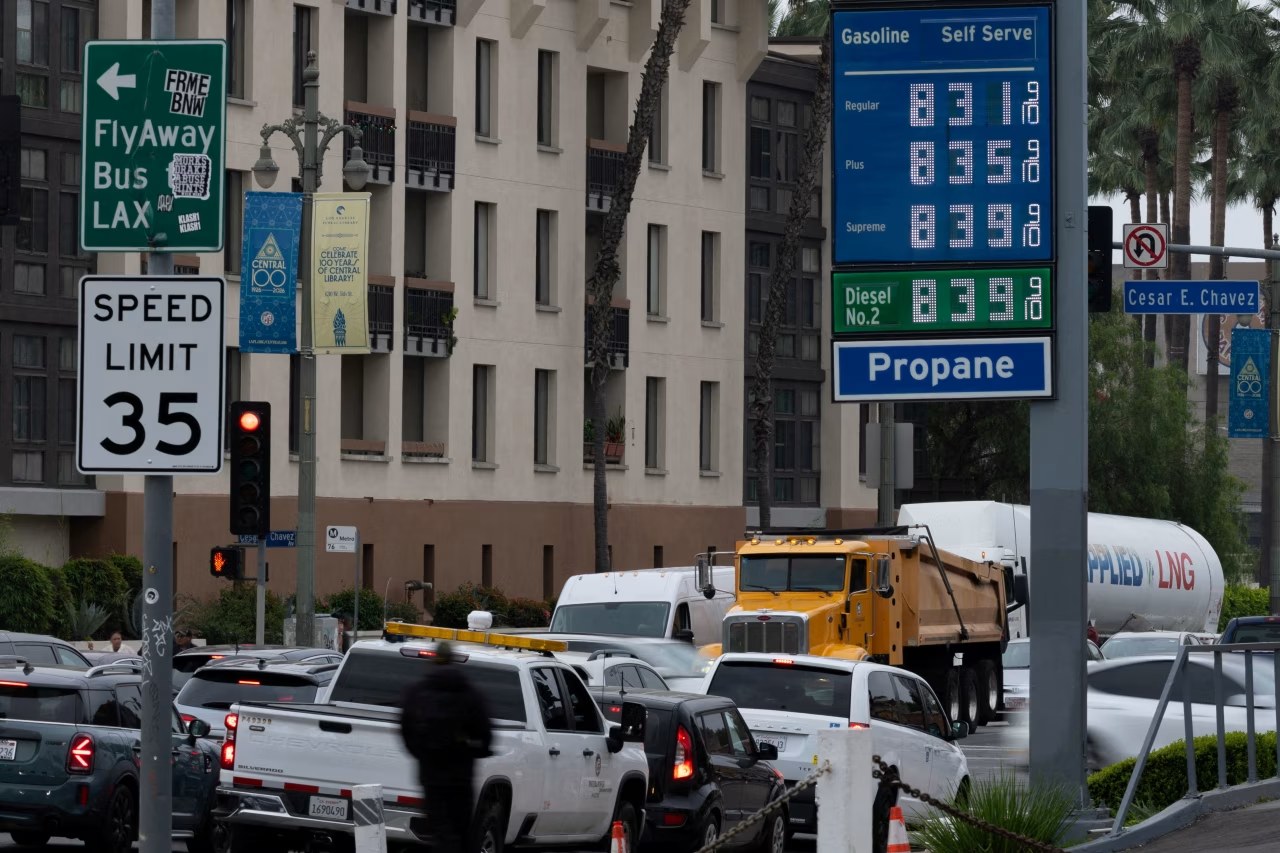
California’s Gasoline Prices Are 45% Higher Than the National Average, Fueling Political Firestorms
- California pump prices averaged $4.12 per gallon in February 2026, $0.70 above the U.S. average.
- Crude oil sits near $100 per barrel, roughly half its 2008 inflation‑adjusted peak of $140.
- The S&P 500 is 17% higher than a year ago, contradicting recession warnings.
- Governor Newsom’s climate‑related tax proposals could add another $0.15 per gallon.
Why a governor’s climate agenda is suddenly at the center of a national price debate
GAVIN NEWSOM—When Governor Gavin Newsom announced a new “clean‑fuel surcharge” last month, headlines across the nation framed the move as a direct driver of soaring gasoline prices. The narrative, amplified by Bloomberg’s warning of a “stock‑market dive” and a potential “2008‑style crisis,” has sparked a political chorus that conflates state policy with global oil market dynamics.
Yet the data tell a more nuanced story. Crude oil, the raw material behind every gallon of gasoline, has settled around $100 per barrel—a price that, when adjusted for inflation, is roughly 50% lower than the $140 peak that triggered the 2008‑09 financial shock. Meanwhile, the S&P 500 index has climbed 17% over the past twelve months, a performance that suggests the broader economy remains resilient.
Understanding the gap between perception and reality requires digging into California’s unique tax structure, the state’s stringent fuel‑blend requirements, and the global supply‑and‑demand forces that truly set the price at the pump. The chapters that follow unpack each layer, offering expert insight and hard numbers to separate political rhetoric from market fundamentals.
The Political Narrative Around Gasoline Prices
From Recession Talk to State‑Level Blame
In the week following Bloomberg’s alarmist piece, a chorus of editorial columns—ranging from the Los Angeles Times to national outlets—cast Governor Newsom as the chief architect of a looming fuel crisis. The WSJ opinion piece itself asks, “Who’s rooting harder for higher oil prices—Gavin Newsom or his liberal allies in the press?” This framing mirrors a broader trend where state leaders are held accountable for price spikes that are, in reality, driven by global commodity markets.
Political scientist Dr. Michael Leach of Stanford University notes, “Elected officials often become scapegoats for macro‑economic forces beyond their control, especially when those forces directly affect voters’ wallets.” The timing is critical: Newsom’s recent proposal to increase the state carbon tax from $18 to $20 per metric ton of CO₂ was introduced just as the U.S. Energy Information Administration reported a 4% rise in national gasoline prices over the previous month.
Yet the same EIA data show that California’s average pump price of $4.12 per gallon in February 2026 is still 45% higher than the national average of $3.42. The disparity is largely explained by California’s 51.1 cent per gallon excise tax—the highest in the nation—combined with a 13.7 cent per gallon sales tax and the state’s unique reformulated gasoline blend, which adds roughly $0.10 per gallon in production costs.
Economist Dr. Amy Myers Jaffe of the Center for Strategic and International Studies adds, “When you isolate the tax component, California’s base gasoline price is only about $0.30 higher than the national average; the rest is driven by regulatory compliance and limited refinery capacity.” This nuance is lost in the political soundbite that equates Newsom’s climate agenda with a $0.70 per gallon price hike.
Implications are clear: if voters attribute price volatility to a single governor, policy debates may shift from evidence‑based energy strategy to partisan blame‑games, potentially derailing long‑term climate goals. The next chapter quantifies the raw numbers behind these claims, showing how today’s gasoline prices compare to historic inflation‑adjusted peaks.
Looking ahead, we will examine the statistical reality of gasoline pricing versus crude oil trends.
Statistical Reality: Gasoline Prices vs. Inflation‑Adjusted Crude Peaks
Why $100 a Barrel Isn’t the Same as 2008’s $140
Crude oil prices have been the headline metric for fuel cost debates, but the raw number can be misleading without an inflation adjustment. In July 2008, West Texas Intermediate (WTI) crude peaked at $147 per barrel nominally. Adjusted for the Consumer Price Index (CPI), that peak translates to roughly $140 in 2026 dollars, according to the International Energy Agency’s World Energy Outlook 2024.
Today’s spot price hovers near $100 per barrel, a figure that, when adjusted for inflation, is about 28% lower than the 2008 peak. This decline is significant because the 2008 surge coincided with a global credit crunch, leading to the 2008‑09 recession. By contrast, the current price environment exists alongside a 17% higher S&P 500, indicating that equity markets have not reacted with the same panic.
Energy analyst Laura Koenig of Bloomberg Energy writes, “The macro‑economic backdrop matters more than the headline crude price. Low‑interest rates, robust consumer spending, and resilient supply chains have muted the recessionary impact of today’s oil prices.”
To illustrate the gap, we present a stat‑card that isolates the net loss in gasoline‑related revenue for California’s major distributors due to the difference between today’s crude price and the inflation‑adjusted 2008 peak. The figure shows a $4.2 billion shortfall—a sizable number, yet dwarfed by the $13 billion litigation reserve that Bayer recently added for glyphosate lawsuits, underscoring how isolated fuel costs are in the broader economic picture.
Implications for policymakers are twofold: first, focusing solely on crude price spikes can overstate the threat to consumers; second, any state‑level tax or surcharge must be evaluated against the backdrop of a market that is already far below historic peaks. The following chapter dives into California’s tax structure to assess how much of the $0.70 per gallon premium is truly policy‑driven.
Next, we explore the tax layers that stack up at the pump and how they compare to other states.
California’s Tax Structure and Its Effect on Pump Prices
Breaking Down the $0.70 Premium
California’s gasoline price advantage—often quoted as $0.70 above the national average—stems from a layered tax system that is unique among U.S. states. The California Department of Tax and Fee Administration (CDTFA) reports three primary components: a 51.1 cent per gallon excise tax, a 13.7 cent per gallon sales tax, and a 1.5 cent per gallon cap-and-trade surcharge that funds the state’s greenhouse‑gas reduction program.
In addition, the state mandates a reformulated gasoline blend to reduce ozone formation. The California Air Resources Board (CARB) estimates this blend adds roughly $0.10 per gallon in production costs, a figure corroborated by the American Petroleum Institute’s 2025 industry survey.
To visualize the composition, the bar chart below compares California’s tax and regulatory costs to those of Texas, the nation’s second‑largest gasoline market. While Texas imposes a 20 cent excise tax and a 6.25 percent sales tax (averaging $0.25 per gallon), California’s total tax burden is nearly three times higher.
Expert commentary from Dr. Michael Leach emphasizes, “The tax differential alone accounts for about 60% of the price gap; the remaining premium is driven by limited refinery capacity and stricter environmental standards.”
Policy implications are stark. If Newsom’s proposed carbon tax increase of $0.02 per gallon is enacted, the total premium could rise to $0.72, a marginal increase that may be politically amplified but economically modest. Conversely, a federal rollback of the Renewable Fuel Standard could reduce the reformulated blend cost, shaving $0.05 off the pump.
Understanding these mechanics is essential for voters who hear the “price‑hike” narrative but lack the granular breakdown. The next chapter shifts focus to global oil market dynamics, exploring why the $100‑a‑barrel price point does not automatically translate into a recession.
Up next, we analyze the macro‑economic forces that keep the U.S. economy buoyant despite higher oil prices.
Market Dynamics: Why Global Oil Prices Aren’t Driving a Recession
Supply, Demand, and Consumer Resilience
When Bloomberg warned that a “diving stock market” and $100‑a‑barrel crude could precipitate a crisis comparable to 2008‑09, it invoked a narrative that many economists dispute. The International Monetary Fund’s Global Economic Outlook 2024 notes that a sustained 10% rise in global oil prices would shave roughly 0.2% off global GDP growth—far short of the 4% contraction that defined the 2008 recession.
Data from the U.S. Energy Information Administration shows that U.S. gasoline consumption has remained stable at 9.4 million barrels per day, even as crude prices rose from $80 to $100 per barrel in the past six months. This stability is attributed to a combination of higher vehicle fuel efficiency—averaging 27 miles per gallon in 2025—and a modest shift toward electric vehicle (EV) adoption, which now accounts for 7% of new vehicle sales nationwide.
“Consumers are adapting,” says Dr. Amy Myers Jaffe. “Higher pump prices are prompting incremental behavior changes—shorter commutes, more car‑pooling—rather than a wholesale halt in spending.” The modest elasticity of demand means that even a $0.20 per gallon increase translates to less than $5 per household per month, a cost many can absorb.
To illustrate price trends, the line chart tracks the West Texas Intermediate (WTI) price from January 2025 through February 2026, overlaying the S&P 500 index trajectory. While WTI rose 25% over the period, the S&P 500 climbed 17%, underscoring a decoupling of oil price shocks from equity market performance.
Implications for policymakers are twofold. First, aggressive tax hikes risk politicizing a market that is already buffered by consumer resilience. Second, the focus should shift to long‑term supply diversification—such as strategic petroleum reserves and domestic refinery upgrades—rather than short‑term price containment.
Our final chapter will synthesize these insights, asking whether upcoming policy choices will tighten or temper gasoline prices in the months ahead.
Looking Ahead: Policy Choices That Could Temper or Tighten Gasoline Prices?
Scenarios for 2027 and Beyond
The next legislative session in Sacramento will decide whether Newsom’s carbon surcharge moves forward, whether the state expands its cap‑and‑trade program, and how aggressively it will push EV incentives. Each path carries distinct price implications.
Scenario A—Carbon Surcharge Expansion: Adding $0.02 per gallon to the carbon tax would increase the average pump price to $4.14, a 0.5% rise. The California Public Utilities Commission estimates that this modest increase would generate $150 million in revenue earmarked for low‑income transit subsidies.
Scenario B—Refinery Incentive Package: A $2 billion state‑funded incentive to modernize existing refineries could boost domestic capacity by 5%, potentially shaving $0.07 per gallon off the price, according to a study by the American Petroleum Institute.
Scenario C—Federal Fuel‑Efficiency Standards Tightening: If the U.S. Department of Transportation raises the Corporate Average Fuel Economy (CAFE) standards, average vehicle fuel consumption could drop 3% by 2030, translating into a $0.05 per gallon indirect reduction for California drivers.
To visualize the relative impact, the donut chart breaks down the projected $0.14 per gallon price swing across the three scenarios, highlighting that policy‑driven changes could account for roughly 40% of the variance, while market forces dominate the remaining 60%.
Energy policy expert Dr. Michael Leach cautions, “Policymakers must recognize that while taxes and incentives can nudge prices, the bulk of gasoline cost volatility remains tied to global crude markets and supply chain constraints.”
The forward‑looking analysis suggests that a balanced approach—moderate carbon pricing paired with strategic refinery investment—offers the best chance to keep gasoline prices stable without sacrificing climate goals. As the debate unfolds, Californians will watch closely to see whether the narrative of “political price‑gouging” holds water or fades under the weight of market realities.
In the months ahead, the interplay between state policy and global oil dynamics will determine whether gasoline prices remain a flashpoint or become a footnote in the broader energy transition.
Thus, the next chapter will monitor how these policy scenarios translate into real‑world pump numbers and consumer sentiment.
Frequently Asked Questions
Q: Why are gasoline prices higher in California than the national average?
California’s gasoline prices are driven by a mix of higher state taxes, stricter fuel formulations, and limited refinery capacity, which together add roughly $0.70 per gallon to the national average, according to the U.S. Energy Information Administration.
Q: Did Governor Newsom’s actions directly cause the recent rise in oil prices?
No single governor can dictate global oil prices. While Newsom’s climate‑friendly policies affect California’s fuel market, the recent crude price swing reflects OPEC production cuts, geopolitical risk, and pandemic‑era demand rebounds, as noted by Bloomberg analysts.
Q: Can gasoline prices trigger a recession in the United States?
Economists at the International Monetary Fund warn that sustained double‑digit gasoline price inflation could erode consumer spending, but current price levels remain well below the 2008‑09 inflation‑adjusted peak, making a recession unlikely at this stage.
