U.S. crude jumps $12 in 48 hours as CEOs warn Trump team of $100-plus risk if Hormuz chokepoint tightens
- Exxon CEO Darren Woods told officials oil could overshoot current levels if speculators pile in.
- Chevron’s Mike Wirth and ConocoPhillips’ Ryan Lance echoed worries over refined-product shortages.
- West Texas Intermediate rallied from $87 to $99 between Wednesday and Friday.
- No immediate policy response emerged from the White House meetings.
Executives say narrow strait that carries one-fifth of world oil is the flashpoint driving next price spike
STRAIT OF HORMUZ—The chiefs of America’s three super-major oil companies walked into the White House this week carrying a stark warning: the Iran-linked disruption in the Strait of Hormuz is not priced in, and both crude and fuel markets are one speculative surge away from triple-digit barrels.
Over two days of closed-door sessions with Energy Secretary Chris Wright and Interior Secretary Doug Burgum, Exxon Mobil’s Darren Woods, Chevron’s Mike Wirth and ConocoPhillips’ Ryan Lance laid out scenarios in which gasoline and diesel inventories—already at five-year lows—could shrink further, pushing retail prices to levels last seen during the 2008 commodity boom.
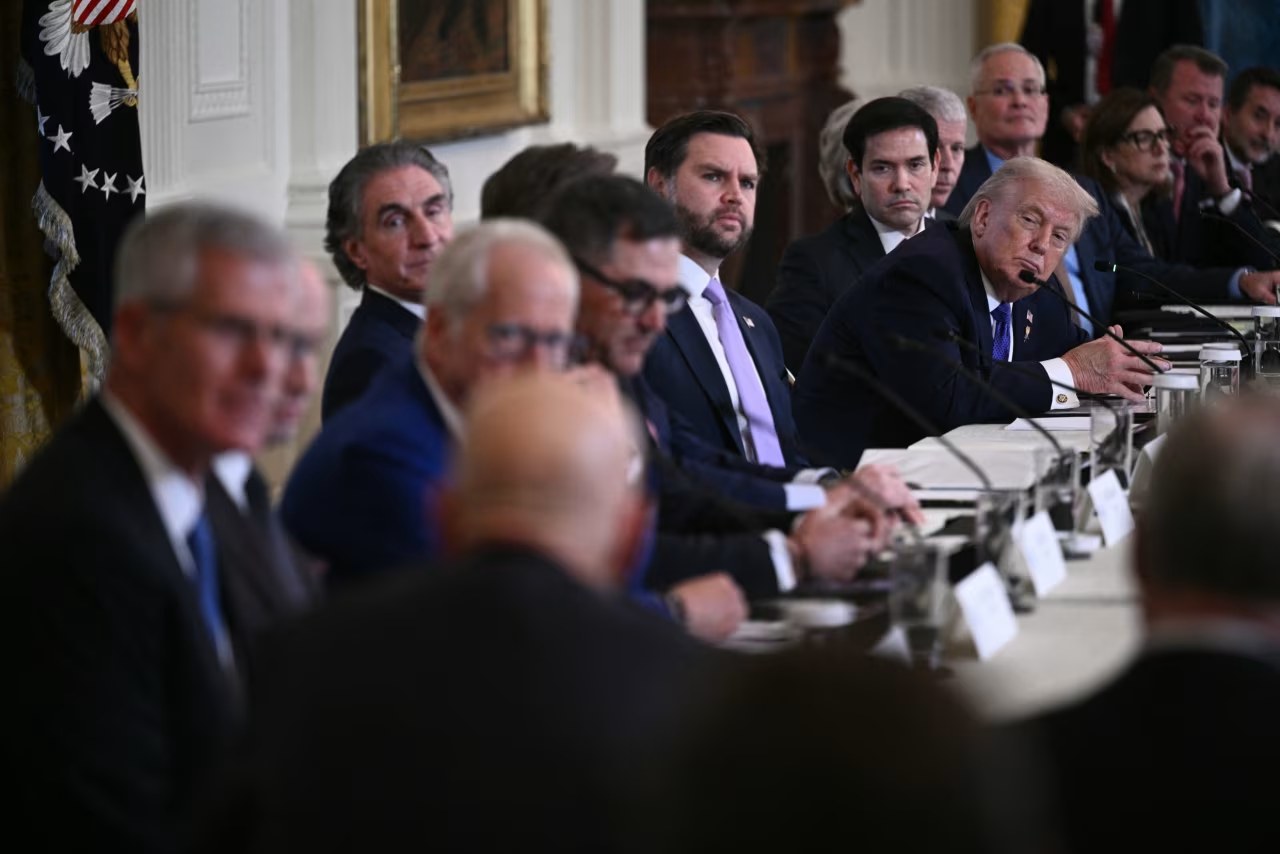
President Donald Trump did not attend, but officials pressed the CEOs on how high prices could climb and what policy levers might calm futures markets. The answer, according to people in the room, was unsettling: volatility is baked in as long as Hormuz remains a geopolitical tinderbox.
Inside the West Wing Briefing: What the CEOs Actually Said
The gatherings on Wednesday followed a pattern that has become familiar in energy crises: executives laid out supply-chain fragility, officials asked for price forecasts, and both sides left without a silver bullet. According to two people who took notes, Exxon’s Darren Woods told Wright and Burgum that while current fundamentals justify $90–$95 Brent, a wave of speculative length on futures markets could add another $10–$15 within weeks.
Chevron’s Mike Wirth followed with a specific metric: U.S. distillate stocks are now 15 percent below the ten-year seasonal average, and European diesel inventories are at their lowest since the International Energy Agency began tracking weekly data in 2010. ConocoPhillips’ Ryan Lance added that any physical disruption of just 500,000 barrels per day through Hormuz would erase the world’s thin spare-capacity cushion, forcing refiners to bid aggressively for cargoes.
Policy options were limited
Officials floated the possibility of another Strategic Petroleum Reserve release, but Woods reminded them that last year’s 180-million-barrel drawdown has left the caverns at their lowest level since 1983. A second option—waiving the Jones Act to allow foreign-flagged vessels to move gasoline between U.S. ports—was seen as helpful but marginal, because the bottleneck is abroad, not domestic.
The CEOs departed without a communiqué, and crude kept climbing. By Friday’s settle, WTI had added 13.8 percent in two sessions, the fastest two-day rise since Russia invaded Ukraine.
Why the Strait of Hormuz Is the Market’s Single Point of Failure
The 21-mile-wide shipping lane between Iran and Oman handles about 21 million barrels per day of crude, condensate and refined products, according to the U.S. Energy Information Administration. That is roughly one in every five barrels consumed globally, and there is no practical alternative route for the 3.5 million barrels that Qatar exports each day as liquefied natural gas.
Analysts at RBC Capital Markets estimate that insurance premiums for vessels transiting the strait have already quadrupled since tit-for-tat tanker seizures began, adding $2.50–$3 per barrel to delivered costs in Asia. If Iran were to escalate by mining the waterway, crude could spike $20–$30 within days, said Helima Croft, former CIA analyst and now head of commodity strategy at RBC, in a note to clients.
Spare capacity is thin
OPEC’s effective spare capacity is estimated at 3.1 million barrels per day, with 2.2 million of that inside Saudi Arabia. Yet Saudi Aramco’s maximum sustainable output of 12 million barrels per day has never been tested for more than 90 days, according to the Oxford Institute for Energy Studies. A 500,000-barrel-per-day disruption would absorb 16 percent of that cushion; a 2-million-barrel loss would erase it entirely.
The CEOs emphasized that even if Washington persuades Riyadh to open the taps, the world’s refining system is calibrated to lighter grades, not the heavier Saudi crude, meaning product shortages could still occur.
How High Can Prices Go? Lessons From Past Supply Shocks
The last three major supply disruptions—1990 Iraqi invasion of Kuwait, 2003 Venezuela strike, 2022 Russia invasion of Ukraine—each added 60–120 percent to front-month crude within 90 days. Adjusted for inflation, the 2008 peak of $147 per barrel Brent translates to roughly $215 today, according to Federal Reserve data.
Katherine Spector, head of commodity strategy at JPMorgan, told clients that if the market prices in a 2-million-barrel-per-day loss from Hormuz, Brent could test $115. If the outage reaches 4 million and lasts more than six months, $150 becomes plausible. The CEOs did not quote precise targets, but Woods noted that open interest in $120 and $130 call options has doubled since January.
Product cracks amplify pain
Retail gasoline prices track not just crude but refining margins. U.S. crack spreads—the difference between crude input and gasoline output—have surged to $28 per barrel, double the five-year average for April. With global refinery utilization already above 85 percent, any feedstock shortage would send those spreads higher, translating directly into pump prices that could exceed $5 per gallon national average, according to Patrick De Haan at GasBuddy.
The executives warned that political fallout from such levels could dwarf the inflationary pressures that dogged the Biden administration, because the spike would be sudden, not gradual.
Is the Strategic Petroleum Reserve Still a Viable Weapon?
The U.S. Strategic Petroleum Reserve (SPR) ended last year at 347 million barrels, down from 621 million in 2020. Energy Department data show that 180 million barrels were sold during the previous administration’s releases, and Congress mandated another 35 million barrels be sold through 2026 to fund deficit-reduction packages. That leaves roughly 55 days of import cover at current consumption rates, compared with 90 days required by International Energy Agency rules.
Exxon’s Woods told officials that any new drawdown larger than 30 million barrels would begin to threaten the reserve’s operational integrity, because cavern pressures decline and brine handling becomes more complex. An Energy Department study published last year concurred, noting that sustained draws above 1 million barrels per day risk cavern roof collapse.
Replacing barrels is expensive
Congress has authorized the department to repurchase crude when WTI averages $67 or below. With front-month futures at $99, refilling the reserve would cost taxpayers roughly $10 billion more than planned. Meanwhile, China has added 200 million barrels to its own strategic stocks since 2022, according to Kayrros, a satellite analytics firm, giving Beijing more leverage to cushion domestic prices than Washington currently has.
The CEOs argued that instead of another release, the administration should expedite permits for Gulf Coast export projects and streamline pipeline approvals to move domestic light sweet crude to coastal refineries, but those measures are medium-term, not immediate relief.
What Happens Next? Three Scenarios Markets Are Gaming Out
Inside trading floors the base case is a 500,000-barrel-per-day disruption lasting three months, pushing Brent to $105 and U.S. gasoline to $4.30 per gallon. Scenario two—an Iranian mining campaign that cuts 2 million barrels per day for six months—sees Brent averaging $125 and retail gasoline touching $5.20. The tail case, a full Hormuz closure, is deemed low probability but would send Brent to $180, according to Goldman Sachs commodity strategist Daan Struyven.
Executives left the White House without promises, but people close to Wright say the administration is weighing a diplomatic channel via Oman to secure a partial de-escalation. Meanwhile, the Navy’s Fifth Fleet has increased patrols, but commercial insurers remain skittish, keeping war-risk premiums elevated.
Corporate hedging accelerates
Airlines and road-transport firms have lifted the share of 2026 jet-fuel and diesel demand they pre-purchase to 42 percent, the highest since 2011, according to data from CME Group. That hedging wave itself adds upward pressure on near-dated futures, reinforcing the very volatility the CEOs warned about.
The next inflection point comes when the International Maritime Organization’s monthly vessel-transit data is released next week. If tanker transits fall below 60 per day—versus the normal 75—expect another leg higher in crude, and renewed pleas from the White House for OPEC to open the spigots.
Frequently Asked Questions
Q: Why are U.S. oil executives meeting with Trump officials now?
CEOs of Exxon, Chevron and ConocoPhillips briefed Energy Secretary Chris Wright and Interior Secretary Doug Burgum after U.S. crude surged from $87 to $99 a barrel in two days, citing heightened risk of supply cuts through the Strait of Hormuz.
Q: How much oil flows through the Strait of Hormuz?
Roughly 21 million barrels per day—about one-fifth of global supply—pass through the 21-mile-wide channel, making any prolonged disruption a direct threat to gasoline and diesel markets worldwide.
Q: Could oil prices rise above $100?
Exxon CEO Darren Woods told officials that speculative buying could easily push crude past current levels, while refined-product inventories in the U.S. and Europe are already below seasonal averages, amplifying upside risk.
