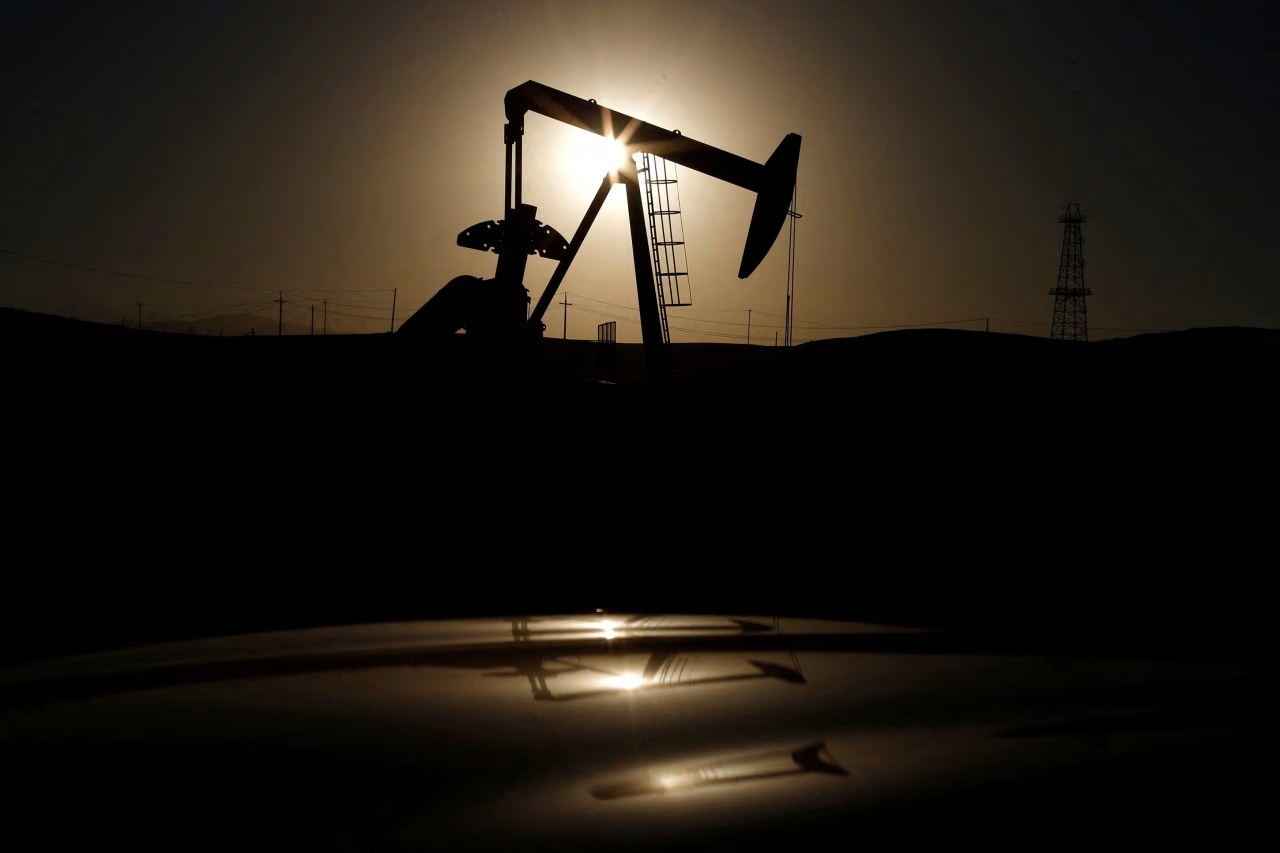
Oil Futures Surge as U.S. Threatens Iran’s Strait of Hormuz Oil Supply
- WTI and Brent prices climb 1.1% and 1.5% amid fresh military threats.
- Rystad Energy warns a 70% drop could push Middle East output to just 6 m b/d.
- Strait of Hormuz, a choke point for 20% of global oil, is at the center of the tension.
- U.S. bombing of Iran’s Kharg Island sparks a new chapter in oil market volatility.
Oil markets feel the tremor of geopolitical tension as U.S. forces strike Iran’s key export hub.
OIL FUTURES—In the early hours of a Friday trading session, the price of West Texas Intermediate (WTI) crude rose 1.1% to $99.81 a barrel, while Brent futures climbed 1.5% to $104.68. The uptick comes after President Trump announced a bombing campaign against Iran’s Kharg Island, the country’s largest oil export terminal, and warned of further strikes if the Strait of Hormuz does not allow tankers to pass freely. This development has reignited fears that a full‑scale conflict could cut Middle Eastern supply by a staggering 70%, according to Rystad Energy’s latest assessment.
While the market’s immediate reaction is a surge in prices, the long‑term implications hinge on how quickly the geopolitical flashpoint resolves and whether the global supply chain can absorb a sudden shock. In the chapters that follow, we trace the chain of events from the military strike to the market’s response, compare the projected production shortfall to historical precedents, and examine what this could mean for investors, consumers, and the broader energy landscape.
Geopolitical Flashpoint: The Kharg Island Strike and Its Immediate Market Impact
Kharg Island: Iran’s Crude Heartbeat
Kharg Island, situated off the Persian Gulf coast, hosts Iran’s largest oil export terminal. Its strategic value lies not only in the volume of crude it processes—roughly 20% of the nation’s output—but also in its proximity to the Strait of Hormuz, the world’s most critical oil transit chokepoint. A disruption here reverberates across every tanker that threads through the 100‑mile waterway, where an estimated 20% of global oil flows.
On the Friday that sparked the latest surge in oil futures, President Trump announced that U.S. forces had bombed military targets on Kharg Island. The strike was a direct response to Tehran’s alleged attempts to restrict free passage of oil tankers through the strait, a claim that has been a point of contention for years. The U.S. also threatened to target additional Iranian oil infrastructure sites if the Strait of Hormuz did not allow tankers to transit freely, escalating the rhetoric to a near‑military level.
Immediate Market Reaction
The news was met with a swift reaction on the New York Mercantile Exchange and the Intercontinental Exchange. WTI crude futures jumped 1.1% to $99.81 a barrel, while Brent futures climbed 1.5% to $104.68. Traders cited the possibility of a supply bottleneck, with analysts warning that any sustained disruption could trigger a price rally that might outpace the recent 2023 highs.
Historically, the Strait of Hormuz has been a flashpoint for market volatility. In 1979, the Iranian Revolution led to a sharp spike in oil prices that lasted for months. More recently, the 2019 U.S.‑Iran standoff saw a 15% rise in Brent prices, underscoring the sensitivity of crude markets to geopolitical risk. The current situation is no different, but the scale of potential disruption—estimated at 70% of Middle Eastern output—could push the market into a new era of volatility.
While the immediate price increase is a signal of heightened risk, the longer‑term trajectory depends on diplomatic developments, the resilience of alternative supply routes, and the ability of other producers to compensate for a sudden shortfall. The next chapter will quantify that potential shortfall and its implications for the global oil supply chain.
Rystad Energy’s 70% Production Shock: What a Six-Million Barrel Scenario Means
Rystad’s Worst‑Case Projection
Rystad Energy’s recent analysis—circulated via email to industry insiders—warns that a full‑scale conflict could reduce Middle Eastern crude production to approximately six million barrels per day. This figure represents a 70% drop from the pre‑conflict baseline of roughly 18.5 million barrels per day, a level that has been sustained since the early 2010s. The analysis underscores that such a reduction would not only affect regional output but also ripple through global supply chains, potentially forcing other producers to ramp up production to fill the void.
To contextualize the magnitude of this shortfall, consider that the United States and Canada together produce about 12.5 million barrels per day, while the European Union’s combined demand stands at around 8.5 million barrels per day. A six‑million‑barrel reduction would thus represent a significant portion of global demand, especially given that the Middle East accounts for roughly 40% of world crude exports.
Comparative Analysis: Baseline vs. Worst‑Case
While the exact numbers are speculative, the stark contrast between the baseline and the worst‑case scenario is clear. A 70% cut would not only constrain supply but also increase the price elasticity of demand, pushing prices toward historical highs. The chart below illustrates this comparison, highlighting the dramatic contraction in output that could occur under a severe conflict scenario.
Price Dynamics: WTI and Brent Futures React to Strait of Hormuz Threats
Current Price Snapshot
At the close of Friday’s trading session, front‑month WTI crude futures were priced at $99.81 a barrel, up 1.1% from the previous close. Brent futures, the international benchmark, traded at $104.68 a barrel, reflecting a 1.5% increase. These figures represent the market’s immediate response to the threat of a 70% reduction in Middle Eastern output, a scenario that would push prices toward the $120‑$130 per barrel range seen during the 1979 crisis.
Analysts note that the price differential between WTI and Brent—about $4.87—remains consistent with historical patterns, where Brent typically commands a premium due to its higher sulfur content and the fact that it is a global benchmark. The recent surge, however, has narrowed the spread slightly, as investors anticipate a more uniform impact across all crude grades.
Statistical Snapshot of Futures Prices
The following stat card captures the key price points for the front‑month contracts, providing a quick reference for market participants and policy makers alike.
Historical Echoes: Past Oil Crises and Market Resilience
Lessons from the 1979 Revolution
The Iranian Revolution of 1979 is often cited as the archetypal example of how political upheaval can destabilize global oil markets. The sudden loss of Iranian supply caused Brent to surge from $17 to $30 per barrel within weeks, a 77% jump that reverberated through the global economy. In contrast, the 2019 U.S.-Iran standoff saw a 15% rise in Brent, a more muted response attributable to a broader diversification of supply routes and a more resilient global infrastructure.
Comparative Impact Assessment
When comparing the current situation to past crises, analysts point out that the 70% production cut forecasted by Rystad Energy would represent a far more severe shock than either of those events. The potential for a sudden, large‑scale reduction in supply could strain storage facilities worldwide, force rapid adjustments in hedging strategies, and trigger a surge in downstream prices for gasoline and petrochemicals.
Market Resilience and Adaptation
Despite the severity of the potential shock, the market has historically shown a capacity to adapt. Following the 1979 spike, OPEC and non‑OPEC producers increased output by an average of 1.5 million barrels per day over the next two years. Similarly, the 2019 crisis saw a swift realignment of shipping routes, with tankers rerouting through the South China Sea to mitigate the risk of strait closures.
These historical precedents suggest that while the immediate price spike is inevitable, the market will likely seek equilibrium through a combination of production adjustments, inventory releases, and strategic reserve utilization. The next chapter will explore how these dynamics play out across the global energy supply chain.
The Ripple Effect: Impact on Global Energy Markets and Investor Sentiment
Supply Chain Vulnerabilities
A 70% contraction in Middle Eastern output would force global markets to reconfigure supply lines. Countries like Saudi Arabia and Iraq, which together contribute roughly 30% of the region’s output, would need to increase production to offset the shortfall. However, ramp‑up times for oil fields can span months, creating a window of heightened price volatility.
Investor Sentiment and Hedging Strategies
Institutional investors, from pension funds to hedge funds, have reacted with a surge in long positions in crude futures and a corresponding increase in options premiums. The Chicago Board Options Exchange reported a 12% rise in open interest for oil options following the announcement, reflecting heightened risk aversion.
Timeline of Key Events and Market Reactions
To understand the progression of events and their market implications, the following timeline charts the critical milestones from the initial strike to the latest price movements.
Frequently Asked Questions
Q: What caused the recent rise in oil futures?
The uptick stemmed from President Trump’s announcement of a bombing campaign against Iran’s Kharg Island, the country’s main oil export terminal, and threats to strike additional Iranian oil infrastructure if the Strait of Hormuz does not allow free transit.
Q: How much could Middle East production drop if the conflict escalates?
Rystad Energy estimates a worst‑case scenario where Middle East crude output could fall to around six million barrels per day—about a 70% reduction from pre‑conflict baseline levels.
Q: Which oil benchmarks are most affected by the Strait of Hormuz tension?
Both West Texas Intermediate (WTI) and Brent crude futures have risen, with WTI up 1.1% to $99.81 a barrel and Brent up 1.5% to $104.68 a barrel during the latest trading session.
Q: What is the strategic importance of Kharg Island?
Kharg Island houses Iran’s largest oil export terminal and is a critical node for the country’s crude shipments; its disruption could severely constrain global supply flows.
