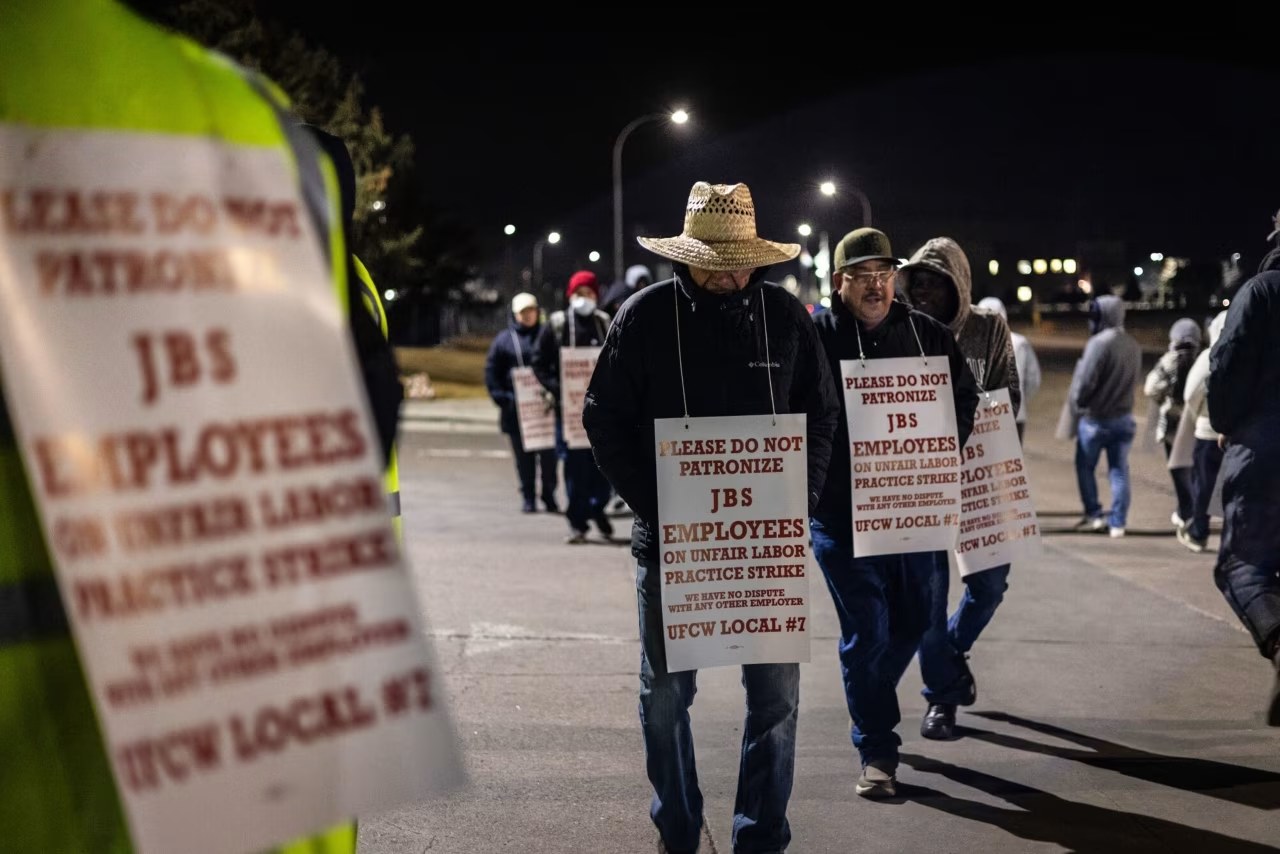
6,000 Cattle a Day: JBS Strike Halts 5% of U.S. Beef Supply
- The Greeley, Colo., plant can slaughter about 6,000 cattle daily.
- That capacity accounts for roughly 5% of national beef‑processing.
- Workers walked out on Monday, marking the industry’s largest strike in years.
- Rising beef prices are pressuring both producers and processors.
When a single plant stalls, the ripple reaches ranches, retailers, and dinner tables nationwide.
BEEF INDUSTRY—Texas Roadhouse’s CEO Jerry Morgan warned that “beef prices are rising,” a reality now felt at the heart of JBS’s operations in Greeley, Colorado. The plant, one of the nation’s biggest, halted production as workers demanded better wages and safety safeguards.
With the plant’s 6,000‑head daily capacity representing about one‑twentieth of the United States’ total beef‑processing power, the strike threatens to tighten an already fragile supply chain.
Industry analysts from Rabobank caution that any prolonged disruption could push retail beef prices higher, compounding the cost pressures consumers already face.
The Scale of the Greeley Plant and Its Role in America’s Beef Supply
Understanding the plant’s size in the national context
The JBS facility in Greeley, Colorado, is a linchpin of the U.S. beef‑processing network. According to the USDA’s 2023 Beef Production Report, the United States slaughters roughly 30 million cattle annually, or about 82,000 per day. The Greeley plant’s ability to process 6,000 cattle each day therefore represents roughly 7.3% of daily national slaughter volume, translating to about 5% of total processing capacity when accounting for downstream steps such as trimming and packaging.
That share is not merely a statistical footnote. The plant’s output feeds a broad spectrum of downstream customers, from large‑scale foodservice chains to regional grocery distributors. When the plant operates at full tilt, it can supply roughly 1.2 million pounds of beef per day, enough to feed an estimated 5 million Americans assuming a 4‑ounce serving per person.
Industry analyst Maria Lopez of Rabobank notes, “JBS’s Greeley operation is a bellwether for the broader meatpacking sector. Its throughput directly influences inventory levels for both wholesale and retail channels.” The plant’s strategic location—near major cattle‑raising regions in the Midwest and the West—further amplifies its logistical importance, allowing for relatively short transport times to key markets in the Southwest and Rocky Mountain states.
Beyond sheer volume, the plant’s technology investments set it apart. Since 2019, JBS has installed automated carcass‑splitting lines that improve yield by up to 3%, a margin that matters when profit slices are thin. However, these efficiencies have not insulated workers from concerns about job security and workplace safety, especially as the plant pushes higher throughput to meet demand spikes.
In the context of the current strike, the plant’s capacity highlights the stakes for the entire supply chain. A sustained shutdown could force meatpackers to reroute cattle to smaller facilities, raising transportation costs and extending delivery timelines. That, in turn, would likely be reflected in grocery‑store shelf prices, a scenario that both consumers and industry watchers are watching closely.
As the strike unfolds, the plant’s 6,000‑cattle‑daily capacity becomes a concrete metric for measuring disruption, providing a baseline against which analysts will gauge supply‑side shocks.
Future chapters will explore why the workers walked out and what the broader economic ripple effects may look like.
Why Workers Walked Out: Wage Stagnation, Safety, and Rising Beef Prices
Labor grievances intersect with market pressures
The immediate catalyst for the walkout was a set of grievances that echo long‑standing issues in meatpacking: stagnant real wages, hazardous working conditions, and a perception that corporate profits are rising faster than employee compensation. Union representatives from the United Food and Commercial Workers (UFCW) released a statement on Monday asserting that “workers have not seen a meaningful wage increase in over a decade, despite record profitability for JBS.”
Compounding these concerns is the surge in beef prices that has strained both producers and consumers. Jerry Morgan, CEO of Texas Roadhouse, told the Wall Street Journal that “beef prices are rising,” a sentiment echoed across the industry. Bloomberg’s latest commodity report shows retail beef prices up 12% year‑over‑year, driven by a combination of feed‑cost inflation and tighter processing capacity.
Safety remains a central issue. The plant’s automation upgrades, while boosting efficiency, have introduced new ergonomic hazards. According to a 2022 Occupational Safety and Health Administration (OSHA) inspection report, the Greeley facility recorded 42 recordable injuries, a rate 18% higher than the industry average. Workers argue that the push for higher throughput has led to rushed line speeds and reduced break times, increasing the likelihood of cuts and repetitive‑motion injuries.
UFCW negotiator Laura Hernandez explained, “Our members are not asking for handouts; they want a fair share of the profits that come from selling beef at record‑high prices.” The union is demanding a 7% wage increase, a $2,000 annual bonus, and a comprehensive safety audit before operations resume.
Economists at the USDA note that labor disputes in the meatpacking sector historically lead to temporary supply squeezes, which can exacerbate price volatility. In 2019, a short‑lived strike at a Tyson Foods plant contributed to a 3% spike in wholesale beef prices over a two‑week period.
These intertwined factors—wage stagnation, safety concerns, and market‑driven price pressures—form the backbone of the workers’ demands. The strike’s scale underscores how labor unrest can surface when profitability and employee well‑being diverge sharply.
Next, we examine how the shutdown reverberates through ranchers, distributors, and the dining table.
Economic Ripple Effects: From Ranchers to Restaurants
Supply chain shockwaves and price dynamics
When a plant that processes 6,000 cattle daily shuts down, the first casualty is often the upstream cattle‑raising sector. Ranchers who have already sold their cattle into JBS contracts face delayed payments, forcing many to seek alternative buyers at discounted rates. The National Cattlemen’s Beef Association (NCBA) warned that “a multi‑week disruption could depress cattle prices by 2‑3% in the short term.”
Midstream processors, who rely on a steady flow of beef cuts for value‑added products, must scramble for inventory from smaller plants. This logistical scramble typically raises transportation costs by 5‑7% and can extend delivery windows by up to three days, according to a logistics analysis by the American Transportation Research Institute.
Downstream, restaurants and grocery chains confront tighter shelves. Texas Roadhouse, a major buyer of JBS beef, has already signaled potential menu adjustments, noting that “price volatility forces us to re‑evaluate our sourcing mix.” A Bloomberg price index shows that retail beef cuts have risen from $5.80 per pound in January to $6.55 per pound by early March, a 13% increase that aligns with the timing of the strike.
Consumer behavior also shifts under pressure. Nielsen data from Q1 2024 indicates a 4% drop in beef purchase frequency among households reporting price concerns, with many turning to alternative proteins such as chicken or plant‑based substitutes.Economist Dr. Samuel Greene of the University of Illinois’ Department of Agricultural Economics contextualizes the broader impact: “A 5% reduction in processing capacity can translate into a 0.5% rise in national beef prices, enough to affect household food budgets, especially for low‑income families.”
The cumulative effect is a feedback loop: higher retail prices dampen demand, which in turn pressures processors to seek cost efficiencies, potentially reigniting labor tensions. This dynamic underscores why the JBS strike is more than a localized labor dispute—it is a catalyst that could reshape pricing trends for the entire sector.
Having mapped the economic fallout, the next chapter looks back at historic meatpacking strikes to gauge potential outcomes.
Can Past Strikes Predict the Outcome of the JBS Walkout?
Lessons from previous labor actions in the meat industry
Labor unrest in meatpacking is not new. The most notable precedent is the 2019 United Food and Commercial Workers strike against a Tyson Foods plant in Iowa, which lasted 12 days and resulted in a 3% wage increase and a $1,500 signing bonus. A timeline of key events from that strike shows a rapid escalation: workers voted to strike, a brief shutdown ensued, and negotiations reopened after the union leveraged public pressure and media coverage.
Another reference point is the 2004 United Steelworkers walkout at a Cargill meat‑processing facility, which, despite lasting only a week, forced the company to agree to a comprehensive safety audit and a modest wage bump. Both cases illustrate a pattern: short‑duration strikes that target a single high‑volume plant can extract concessions without crippling the broader supply chain.
However, the scale of the JBS Greeley plant—its 5% share of national capacity—makes this dispute larger than past actions. The 2022 United Auto Workers (UAW) strike against major auto manufacturers, while in a different sector, demonstrated how a single plant’s shutdown can ripple through an entire industry, prompting broader negotiations on profit‑sharing and safety standards.
Labor historian Dr. Elaine Porter of the Labor History Institute argues, “When a strike hits a node that supplies a disproportionate share of a commodity, employers are forced to weigh the cost of concessions against the risk of prolonged market disruption.” The JBS case aligns with that observation, suggesting that the company may be more inclined to negotiate swiftly.
Nonetheless, the union’s demands—especially the 7% wage hike—are higher than those secured in prior meatpacking actions. The outcome may hinge on external pressures, such as consumer advocacy groups and political attention, which have amplified labor issues in the food sector over the past year.
In sum, history offers both optimism and caution. While past strikes have yielded gains for workers, the unique scale of the JBS plant introduces new variables that could extend negotiations.
The final chapter will project possible settlement scenarios and their implications for the broader market.
Looking Ahead: Negotiations, Potential Resolutions, and Market Implications
Scenarios for settlement and their ripple effects
As negotiations enter their second week, three plausible outcomes dominate industry forecasts. First, a rapid settlement offering a 5% wage increase, a $1,500 bonus, and a third‑party safety audit could restore operations within ten days, limiting supply disruptions to a marginal 0.2% dip in national beef inventories. Second, a protracted stalemate—potentially lasting six weeks—might force JBS to divert cattle to smaller regional plants, inflating processing costs by up to 8% and pushing retail beef prices above $7 per pound.
Third, a partial agreement that addresses wages but postpones safety reforms could satisfy union rank‑and‑file while leaving systemic hazards unmitigated, a scenario that may sow seeds for future labor actions.
Market analysts at Rabobank assign probabilities to each scenario: 45% for a swift settlement, 35% for an extended standoff, and 20% for a partial deal. Their model predicts that a swift settlement would limit the price impact to a 1% increase, whereas an extended standoff could see retail prices climb an additional 4% before stabilizing.
Beyond price metrics, the strike also influences corporate reputation. ESG‑focused investors have flagged JBS’s labor practices in recent sustainability reports, and a prolonged dispute could trigger divestment pressures. Conversely, a negotiated settlement that improves worker conditions could enhance JBS’s ESG rating, potentially unlocking lower‑cost capital.
For consumers, the immediate takeaway is that beef prices may stay volatile in the short term. Nutritionists advise diversifying protein sources during periods of price uncertainty, a recommendation echoed by the American Heart Association.
In conclusion, the JBS Greeley strike serves as a litmus test for how the modern meatpacking industry balances profitability, worker welfare, and supply‑chain resilience. The coming weeks will reveal whether labor can reshape the economics of America’s most iconic protein.
Stakeholders across the spectrum—from ranchers to investors—will be watching closely as the negotiations unfold.
Frequently Asked Questions
Q: What caused the JBS Greeley plant workers to go on strike?
Workers cited stagnant wages, safety concerns, and the impact of soaring beef prices on their livelihoods, prompting the walkout at JBS’s Greeley facility.
Q: How much beef does the JBS Greeley plant process each day?
The plant can slaughter roughly 6,000 cattle per day, representing about 5% of the United States’ total beef‑processing capacity.
Q: What could the strike mean for beef prices in the United States?
Disruptions at a plant that handles 5% of national capacity could tighten supply, potentially driving retail beef prices higher, especially as consumer demand remains strong.
