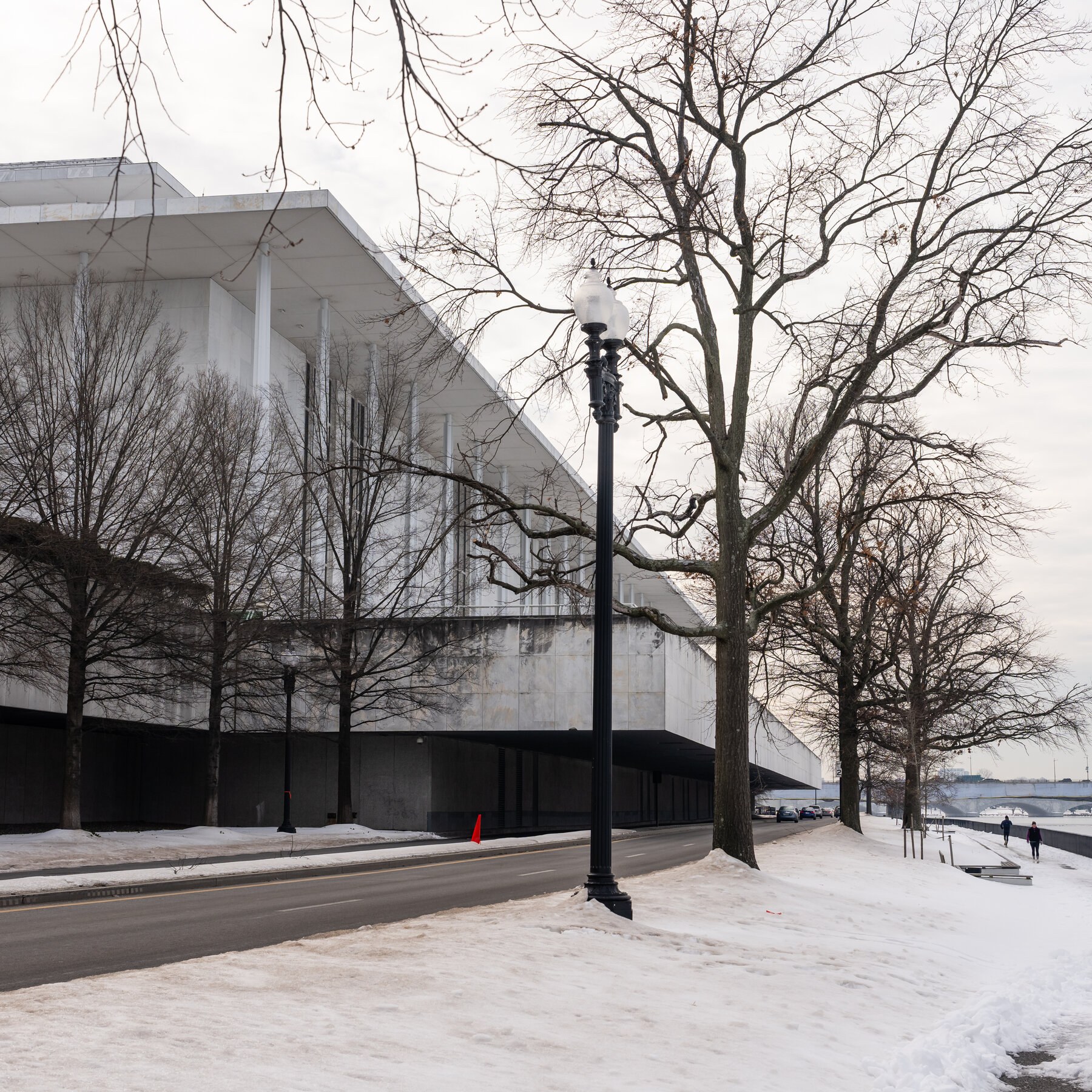
Trump Calls Kennedy Center Trustees to Vote on July 6 Shutdown After Purging Half the Board
- President Trump convenes the board Monday to approve a two-year closure starting July 6, according to an agenda obtained by The New York Times.
- Federal Judge Christopher Cooper ordered the documents released to Rep. Joyce Beatty after she sued for the right to speak at the meeting.
- The agenda includes remarks by Trump and outgoing president Richard Grenell, plus a resolution on the Washington National Opera’s separation.
- Beatty can attend and object but cannot vote under Cooper’s narrow ruling; further litigation is expected after the vote.
The nation’s busiest performing-arts complex faces its most radical overhaul since opening in 1971.
KENNEDY CENTER—President Donald Trump will chair a specially convened session of the John F. Kennedy Center for the Performing Arts board of trustees on Monday, pressing for a vote to shutter the institution for renovations beginning July 6, an internal agenda obtained by The New York Times shows. The move accelerates a plan first hinted at in February when Trump announced he had replaced more than half the board and installed himself as chairman.
The meeting caps a 48-hour scramble in federal court after Representative Joyce Beatty, Democrat of Ohio and an ex officio trustee under the center’s congressional charter, argued she had been illegally excluded from deliberations. Late Sunday evening—moments after Judge Christopher R. Cooper of the U.S. District Court for the District of Columbia required disclosure—the agenda was emailed to remaining trustees, listing votes on closure, leadership remarks, and the future of the Washington National Opera.
While Cooper granted Beatty the right to appear and voice opposition, he withheld any ruling on her voting power or on the merits of the shutdown, setting the stage for a dramatic public showdown inside the marble-lined boardroom overlooking the Potomac.
How Trump Tightened Control of the Kennedy Center in Under Two Months
The speed of Trump’s consolidation is without precedent in the 55-year history of the federally chartered cultural institution. On February 3, the White House announced the resignation of six trustees whose terms had expired, replacing them with loyalists including former acting director of national intelligence Richard Grenell and campaign donor Diane Hendricks. Two weeks later, Trump named himself chairman, a position traditionally rotated among civic leaders and philanthropists.
By March 13, Grenell—who had served as the center’s day-to-day president since 2025—was quietly told to step aside, according to two people familiar with the conversation. The agenda for Monday’s meeting lists both Trump and Grenell as speakers, suggesting the outgoing president will publicly defend the closure plan before trustees vote.
“This is a classic administrative capture strategy,” says Sean Wilentz, a Princeton historian who has written on presidential cultural policy. “By controlling the board, Trump can repurpose a bipartisan monument into a personal legacy project, much like past presidents have tried with the FBI headquarters or post-office naming.”
The center’s enabling statute requires a 24-member board: eight appointed by the president, eight by Congress, and eight public members elected by the existing board. Beatty, as House sponsor of the 2022 reauthorization bill, sits ex officio. After the purge, 18 of 24 trustees are Trump appointees, guaranteeing majority support for any resolution.
Financial stakes behind the closure
Annual operating revenue tops $200 million, drawn from ticket sales, venue rentals, and congressional appropriations of roughly $40 million. A two-year shutdown would idle 2,100 full-time and seasonal employees and cancel more than 2,000 performances, according to internal labor union estimates shared with The Washington Post last month. Trustees have not yet disclosed how lost revenue would be replaced or whether Congress would continue appropriations during a closure.
Forward-looking sentence: With board control secured, the administration now faces the harder task of justifying the shutdown to lawmakers who hold the purse strings.
Why Rep. Beatty Went to Court to Stop the Closure
Representative Joyce Beatty’s lawsuit, filed March 12 in the U.S. District Court for the District of Columbia, argues that Trump’s removal of trustees and exclusion of congressional ex officio members violates both the Kennedy Center Act and the Administrative Procedure Act. Her complaint seeks an injunction barring the board from voting Monday without her participation.
“The Kennedy Center belongs to the public, not to one president,” Beatty said in a statement after Friday’s emergency hearing. “Silencing a statutory trustee to rush through a closure undermines both transparency and the bipartisan spirit that built this institution.”
Judge Cooper’s Saturday ruling was narrowly tailored. He declined to block the meeting but ordered that Beatty receive all documents shared with trustees, including budgets and architectural plans, and that she be given a speaking slot during Monday’s session. He postponed judgment on whether she possesses voting rights, noting the issue turns on statutory interpretation best addressed after the board acts.
Legal scholars say Cooper’s caution reflects federal courts’ reluctance to micromanage internal governance of cultural institutions. “Judges generally defer to boards on operational decisions unless there’s clear evidence of illegality,” explains Kathryn Kovacs, a Rutgers law professor who specializes in federal cultural-property statutes. “By allowing Beatty to appear, Cooper preserved judicial options without creating a constitutional showdown.”
Potential next steps if the board votes to close
Beatty’s attorneys have signaled they will seek a second injunction once a closure resolution is passed, arguing the decision is arbitrary because trustees have not disclosed renovation costs, funding sources, or environmental impact assessments required under the National Environmental Policy Act for major federal facilities. A new filing could land before the same judge within 72 hours of Monday’s vote.
Forward-looking sentence: Whatever happens in court, the political battle over the center’s future is only beginning.
What a Two-Year Shutdown Would Mean for Artists, Audiences, and D.C.’s Economy
More than two million visitors pass through the Kennedy Center’s marble halls each year, generating an estimated $615 million in direct and indirect spending for the District of Columbia, according to a 2023 economic-impact study commissioned by the city. A July 6 closure would wipe out the 2026-27 and 2027-28 seasons, idling resident companies including the National Symphony Orchestra and Washington National Opera.
“We have 87 musicians on full-time contracts,” said Ed Malaga, president of Local 161-710 of the American Federation of Musicians. “If the hall goes dark, our members lose salary, health insurance, and pension credits overnight.” Ballet companies, Broadway touring productions, and local children’s theater programs would also be displaced, because the center serves as D.C.’s only 2,000-plus-seat road house.
Hotel operators fear ripple effects. “Weekends with big performances drive occupancy above 85 percent,” says Solomon Keene, president of the Hotel Association of Washington. “Without the Kennedy Center, we’re looking at a 5- to 7-percent drop in RevPAR citywide.”
Supporters of the closure argue renovation is overdue. The building’s last major upgrade was in 1997, and a 2019 engineering report found $225 million in deferred maintenance, including failing HVAC systems and roof leaks that have already forced the cancellation of several shows. Trustees backing Trump say a two-year shutdown will allow a comprehensive modernization without piecemeal disruptions.
International comparisons: Covent Garden and Opéra Bastille
London’s Royal Opera House underwent a three-year closure in the 1990s, ultimately doubling its budget to £214 million and requiring a 46-percent increase in public subsidy. Paris’s Opéra Bastille closed for 18 months in 2015 for technical upgrades; costs ballooned from €55 million to €110 million. Both projects faced parliamentary inquiries over cost overruns, precedents that Kennedy Center watchdogs routinely cite.
Forward-looking sentence: Whether D.C.’s cultural flagship can avoid similar overruns depends on transparent budgeting still missing from Monday’s agenda.
Could Congress Block Funding for Trump’s Renovation Plan?
The Kennedy Center receives about $40 million annually in federal appropriations, making it one of the few performing-arts venues in the world with direct taxpayer support. That money is authorized by the House Appropriations Subcommittee on the Interior, Environment, and Related Agencies—precisely the panel on which Beatty sits. If the board votes Monday to close, the next battleground will be the 2027 budget cycle.
“We can zero out every dime if the administration refuses to justify this closure,” Beatty warned in a private caucus meeting last week, according to a Democratic aide present. At least 14 House Democrats have pledged to sponsor an amendment stripping renovation funds unless the Government Accountability Office conducts a full audit of projected costs.
Republicans are divided. Some deficit hawks welcome the chance to cut cultural spending, but others, like Representative Eleanor Holmes Norton, the non-voting delegate for D.C., warn closure could alienate suburban voters. “The Kennedy Center is a bipartisan jewel,” Norton said. “Turning it into a political football risks backlash in Northern Virginia and Maryland districts we need to hold.”
Historical precedent offers cautionary tales. In 1990, Congress withheld $34 million from the center after trustees approved a controversial satellite campus plan, forcing cancellation of the expansion. A 2013 Government Accountability Office review of that episode concluded: “Without clear milestones and public cost disclosure, legislators lack evidence-based justification for continued capital support.”
Outlook for Senate appropriators
Senate Democrats need only three Republican defections to attach a rescission rider to the 2027 funding bill. Lobbyists for arts groups are targeting Senators Susan Collins, Lisa Murkowski, and Bill Cassidy—each of whom sits on the Interior subcommittee and has previously supported cultural funding. Collins’s office told The Portland Press Herald she wants “a detailed business plan before committing taxpayer dollars to any closure.”
Forward-looking sentence: Monday’s vote may determine whether the Kennedy Center becomes a line-item casualty in the looming appropriations fight.
Is the Washington National Opera’s Exit a Done Deal?
Item 7 on Monday’s agenda is a terse resolution: “To acknowledge the separation of the Washington National Opera from the John F. Kennedy Center.” The wording offers no timeline, no financial terms, and no explanation—a silence that has fueled speculation of an abrupt divorce after 52 years.
The Opera, founded in 1956, moved into the Kennedy Center at the complex’s 1971 opening and has served as the anchor tenant in the 2,300-seat Opera House. Under general director Timothy O’Leary, the company has posted balanced budgets for eight consecutive seasons and reported a 92-percent average seat occupancy, according to its most recent tax filings.
“We have received no formal notice of separation,” O’Leary said in a Sunday night email to singers and staff, a copy of which was reviewed by The Times. “Should the board vote to end our residency, we will seek alternative venues while protecting our artistic integrity.”
Arts administrators say eviction would be logistically complex. The Opera’s $37 million annual budget relies on in-kind services—costume shops, orchestra pits, marketing office space—provided by the center. Relocating could require millions in upfront capital and a new rental agreement at the D.C. Armory or National Theatre, neither of which has the Opera House’s fly-tower height or orchestra pit depth.
Historical context: the 2009 near-split
In 2009, the Opera threatened to leave after disagreements over revenue sharing, but a last-minute deal saved the marriage. Then-chairman David Rubenstein negotiated a 20-year residency extension in exchange for $20 million in capital upgrades. That agreement contains a clause allowing either party to terminate with five-years’ notice, suggesting any immediate separation could trigger breach-of-contract litigation.
Forward-looking sentence: Monday’s resolution, if passed, could open a new front in both legal and artistic warfare over the nation’s capital cultural landscape.
What Happens if the Board Votes Yes—And What if It Doesn’t?
If trustees approve the closure resolution Monday, the Kennedy Center will enter uncharted territory. Federal law requires a 30-day notice to employees for mass layoffs, meaning layoff letters could hit mailboxes as early as Tuesday. Ticketing staff have already drafted refund scripts for 2026-27 season subscribers, according to a call-center supervisor who requested anonymity because staff have been warned against speaking to media.
Construction fencing could go up around the River Terrace by Memorial Day, with interior demolition starting July 6. An administration official told The Times the White House wants a “phased closure” so the Washington Ballet’s June 28 performance of “Sleeping Beauty” can still close the season. After that, only a security skeleton crew would remain.
Yet a board vote is not the final word. Under the Kennedy Center Act, any “substantial alteration” to the facility must be reported to Congress within 30 days, giving lawmakers a legislative window to block funding. Beatty and Senate Democrats are already drafting a joint resolution of disapproval under the Congressional Review Act, a rarely used tool that allows Congress to overturn agency actions.
A failed vote—unlikely given Trump’s 18-6 majority—would still leave the president options. He could unilaterally remove additional trustees under the statute’s “good cause” provision and replace them with loyalists, then reschedule the vote. Alternatively, the Office of Management and Budget could withhold maintenance funds, effectively forcing a closure through fiscal strangulation.
The wildcard: public opinion
An NBC/Washington Post poll released Sunday shows 53 percent of registered voters in the D.C. metro area oppose the closure, with 29 percent in favor and 18 percent undecided. Opposition jumps to 67 percent among independents, a constituency crucial to suburban Republicans in 2028. “If constituents start flooding our offices, the politics could flip fast,” said a senior GOP appropriations aide who requested anonymity because leadership has not formally whipped the issue.
Forward-looking sentence: Monday’s roll-call will set off a chain reaction—legal, legislative, and cultural—that will determine whether the Kennedy Center remains a shared national stage or becomes the latest front in America’s partisan wars.
Frequently Asked Questions
Q: When will the Kennedy Center close if the board approves?
The agenda circulated to trustees sets a shutdown date of July 6 for a two-year renovation, but approval is required at Monday’s board meeting before the timetable becomes final.
Q: Why did Rep. Joyce Beatty sue over the board meeting?
Beatty, an ex officio trustee, argued Trump’s purge of the board violated her right to participate; Judge Cooper ordered that she receive documents and be allowed to speak on Monday.
Q: What changes beyond closure are on the table?
The agenda lists a resolution on separating the Washington National Opera and signals potential architectural changes, fueling speculation Trump may add his name to the building.
