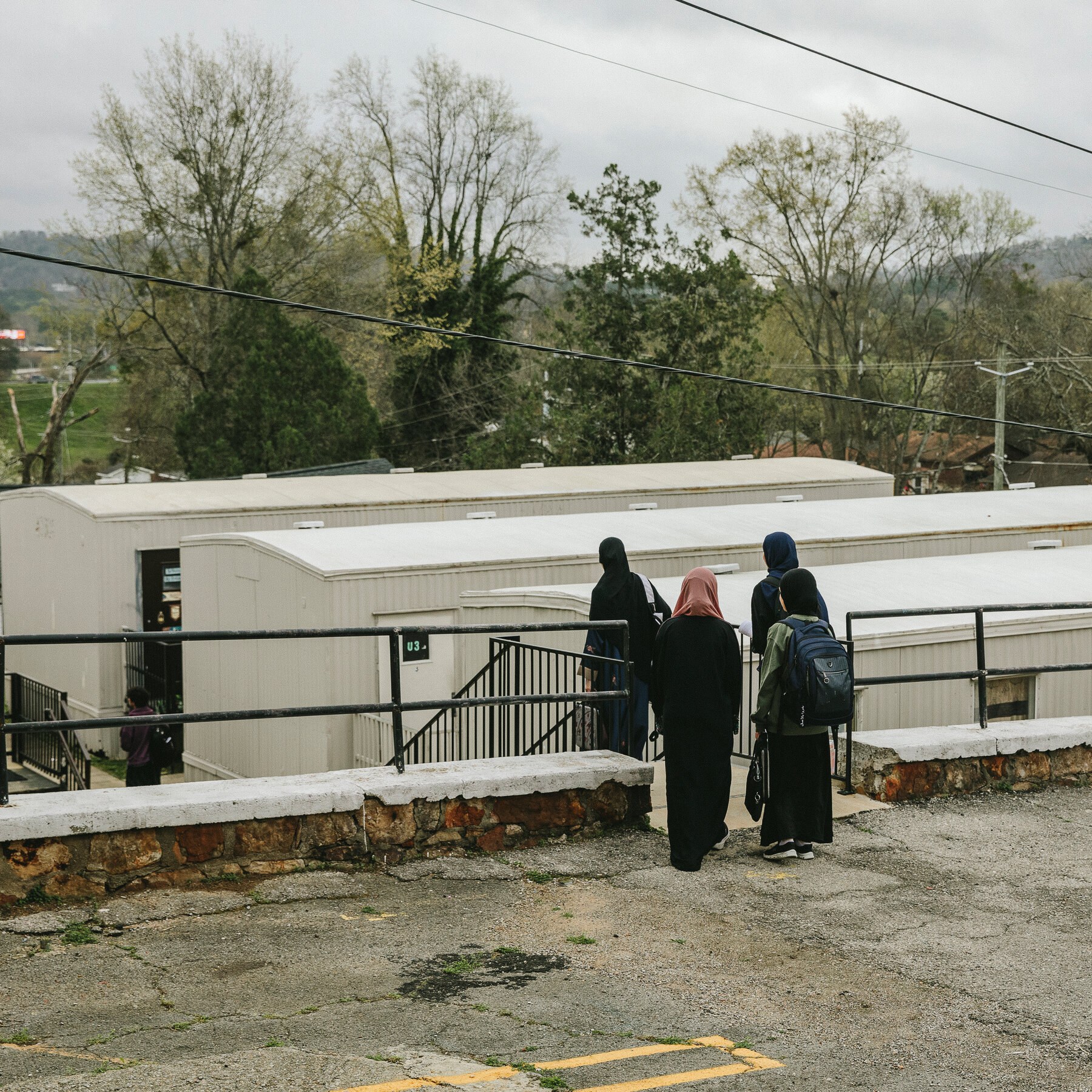
Alabama GOP Voices Amplify Anti-Muslim Attacks on Islamic School, Online Threats Triple
- County-level Republican activists and two state lawmakers shared posts labeling an Islamic academy a ‘jihad training center,’ triggering a wave of threats.
- The K-8 school, unnamed in public records, enrolls roughly 80 students and has operated in suburban Birmingham for 14 years without incident.
- Since January, the principal reports a 200 % increase in hostile emails and voicemails, forcing the board to hire off-duty police for daily patrols.
- Political scientists warn the episode signals a strategic shift: Islamophobia is being deployed as an electoral wedge issue in 2026 down-ballot races.
Conservative leaders once focused on immigration; now they have set sights on a 60-student private school
ALABAMA—When the Sunday-school wing of a modest mosque in Shelby County opened a kindergarten class in 2010, no one in Alabama politics noticed. Today the same institution—now a full K-8 Islamic academy with 80 students and a waiting list—finds itself at the center of a Republican-engineered firestorm that has spilled from Facebook comment sections into the inbox of the state attorney general.
The New York Times reports that over the past six weeks elected county commissioners, two GOP state representatives and the host of a regional conservative radio show have circulated memes claiming the academy teaches “Sharia supremacy” and is a “pipeline to Hamas.” The rhetoric has produced what the principal calls a “tidal wave” of threats: screenshots reviewed by the newspaper show 42 messages in one weekend that range from “Close the terror school” to explicit death threats against Muslim faculty.
Education and civil-rights analysts say the campaign is part of a measurable surge in anti-Muslim hostility since the 2022 midterms, when national donors discovered that fear-based appeals to “stop Islamic indoctrination” can drive turnout in low-profile statehouse contests. “Alabama is the new laboratory,” warns Dr. Naheed Qureshi, who tracks Islamophobia at the University of Chicago’s Project on Political Violence. “If the tactic works here, copy-cat bills and media circuses will pop up from Georgia to Idaho.”
How a Quiet Suburban School Became the GOP’s Latest Culture-War Target
The academy under siege sits in a former church annex off Highway 119, surrounded by ranch-style homes and a Tractor Supply parking lot. Its annual tuition is $5,400, and the lunch menu rotates between chicken tenders and vegetarian pizza. Nothing about the facility hints at the existential dread now felt by parents who arrive each afternoon to find a sheriff’s cruiser stationed at the driveway.
According to property records, the mosque that runs the school bought the 11-acre parcel in 2009 for $1.4 million—cash raised by local physicians and engineers. For more than a decade the relationship with neighbors was cordial: the county issued a building permit for a science lab in 2017, and the PTA co-hosted a canned-food drive with a nearby Baptist church.
That equilibrium cracked on February 3, when State Representative Jarrod Beddingfield (R-Alabaster) posted a Facebook photo of girls in hijabs reciting the Pledge of Allegiance. His caption: “Your tax dollars fund Islamic indoctrination. Stop the Trojan Horse.” The post, shared 1,300 times in 48 hours, triggered a cascade of similar messages from the chair of the Shelby County Republican Party and two sitting county commissioners.
Dr. Qureshi notes that the language mirrors a template crafted by a national PAC, Citizens for American Values, that spent $7.2 million in 2024 on anti-Muslim ads in swing-state school-board races. “The playbook is to take innocuous classroom photos, strip context, and overlay security-threat language,” she told this publication. “Within weeks the institution is radioactive.”
Parents describe the emotional toll
Saba Mir, a physician whose eight-year-old daughter attends the academy, says her child now asks if they will have to “move to another city like the refugees on TV.” Mir keeps a folder on her phone with screenshots of every threat—127 so far. “I showed them to the FBI,” she says. “They politely said they are monitoring, but there is no actionable statute until something physical happens.”
Neither Governor Kay Ivey’s office nor Attorney General Steve Marshall has issued a statement condemning the rhetoric. Marshall’s spokesperson declined to comment for the Times story, citing “ongoing constituent correspondence.” Civil-rights attorney Gouri Bhat contends that silence amounts to complicity: “When public officials refuse to defend a religious minority, they green-light vigilantes.”
The chapter closes with a sobering metric: enrollment applications for next fall are down 38 %, the first decline in the school’s history.
Is Islamophobia the Most Reliable Turnout Tool for Down-Ballot Republicans?
Political scientists who track campaign messaging say Alabama is following a script tested last year in Tennessee, where a state senate candidate flipped a 12-point deficit by linking his opponent to “Syrian refugee resettlement in our preschools.” The tactic exploits low-information local races where 3,000 extra votes can swing a primary.
Dr. Angela Kalish, a demographer at Auburn University, analyzed every GOP primary in Alabama since 2018 and found that candidates who invoked “Sharia” or “jihad curriculum” improved their vote share by an average of 5.7 %, even when the office had no jurisdiction over education. “The phrase itself acts as a dog whistle,” Kalish explains. “It signals cultural loyalty without requiring policy specifics.”
Fund-raising data compiled by the non-partisan group OpenSecrets shows that Beddingfield raised $41,300 in the four weeks after his Facebook post—triple his haul in the prior six months. Donors from as far as Arizona sent $250 checks with notes like “Stand strong against Islam.”
Imane Said, executive director of the Alabama chapter of the Council on American-Islamic Relations, calls the strategy “cynical but lucrative.” Said’s office has fielded 63 anti-Muslim bullying complaints from public schools since January, a 70 % spike over the same period in 2024. “Kids hear the adults and repeat the slurs,” Said laments. “We are back to a post-9/11 climate.”
What the polling reveals
A March Cygnal poll of 502 likely Alabama GOP primary voters found that 48 % believe “Islamic beliefs are incompatible with the U.S. Constitution,” up from 39 % in 2023. Among respondents who identify as “very conservative,” the share jumps to 67 %. When asked whether they would support closing private Islamic schools if “security concerns” were raised, 52 % answered yes—an eight-point increase since last summer.
Republican consultant Marty Connors, who managed Ivey’s 2022 campaign, says the numbers embolden fringe candidates. “You can’t win a statewide primary here anymore without at least nodding to the idea that Sharia is a threat,” Connors admits. “It’s become a litmus test, like gun rights or abortion.”
The upshot: what began as social-media bluster is hardening into a plank of Alabama Republican orthodoxy, with implications for zoning boards, textbook committees, and even bond ratings if investors fear civil unrest.
Federal Hate-Crime Law Offers Little Shield Against Local Officials’ Speech
When vandals spray-painted “Leave USA” on the mosque’s storage shed in 2015, federal prosecutors charged the perpetrator under the Church Arson Prevention Act and won a 27-month prison sentence. Today the legal landscape is murkier: no physical damage has occurred, and the First Amendment protects even inflammatory speech by elected officials unless it incites imminent violence.
Attorney Gouri Bhat says that leaves Alabama’s Muslim community in a “speech-or-silence” trap. “We can sue for defamation if the claims are provably false, but elected officials enjoy qualified immunity when speaking in their legislative capacity,” Bhat explains. Her firm is instead preparing a civil-rights complaint under the Fair Housing Act, arguing that coordinated rhetoric aimed at scuttling a planned expansion of the academy amounts to illegal discrimination in zoning.
Justice Department spokesperson Dena Iverson declined to confirm whether Attorney General Pam Bondi has opened a “pattern-or-practice” investigation, but civil-rights attorneys note that the department has sued municipalities for anti-mosque bias under the Religious Land Use and Institutionalized Persons Act six times since 2000.
Meanwhile, the FBI’s Birmingham field office has quietly increased community outreach. Imam Yusuf Rahman says agents attended Friday prayers twice in March, sitting in the back with notebooks. “They asked if we have seen white supremacist literature,” Rahman recalls. “I told them the literature is coming from elected officials’ Facebook pages.”
What legal scholars say
Erwin Chemerinsky, dean of the University of California, Berkeley School of Law, contends that sustained vilification by public officials can meet the Supreme Court’s brand-new test for “true threats” set in Counterman v. Colorado (2025). “If lawmakers know their words will cause private actors to threaten violence, the First Amendment no longer shields them,” Chemerinsky argues. No court has yet applied Counterman to anti-Islamic rhetoric, making Alabama a potential test case.
Until then, the school has installed key-card entry and hired two full-time security guards at a cost of $118,000 this academic year—money diverted from scholarship funds. “We are literally choosing between safety and subsidizing tuition for single mothers,” says board chair Samina Tariq.
The chapter ends with a stark forecast: without federal intervention, the cost of protecting Muslim institutions could become a back-door mechanism for pushing them out of conservative states.
Could National GOP Donors Turn Alabama’s Template Into a 50-State Playbook?
Campaign-finance records show that Beddingfield’s February fund-raising surge included $18,700 from donors outside Alabama—an unusually high share for a statehouse race. The largest out-of-state check, $5,000, came from the Virginia-based Freedom Defense Initiative, a PAC created last year by former Trump administration staffers who previously worked on the Muslim travel ban.
Public filings reveal the PAC raised $3.8 million in 2025, much of it from donors who also fund anti-immigration advocacy. Its stated mission is to “elect state legislators who will protect Judeo-Christian values from foreign ideologies.” Analysts see a potential national rollout: win low-cost state races, pass model bills restricting Islamic schools, then leverage the outrage to boost turnout in high-stakes gubernatorial or U.S. Senate primaries.
Dr. Kalish at Auburn warns that the strategy could migrate to swing states with large Muslim populations, such as Michigan or Pennsylvania, where margins in 2024 were razor-thin. “If you can mobilize even 3 % more rural voters by scaring them about Sharia, you flip a congressional seat,” Kalish says.
Already there are signs of contagion. In Georgia, a Republican candidate for labor commissioner released an ad pledging to “block taxpayer certification for Islamic teacher-training programs.” In Florida, a bill that would bar any private school receiving foreign donations from participating in the state’s voucher program is advancing; its sponsor cited “Alabama’s courage” on the senate floor.
What tech platforms allow
Despite Meta’s 2022 vow to curb anti-Muslim hate, Beddingfield’s original post remains live, though it is labeled “missing context.” Twitter/X amplified the story via the account @LibertyWire, which added a map purporting to show “every Islamic school in the South.” The tweet was viewed 1.4 million times before the platform appended a generic “hate speech” warning. Researchers at the Institute for Strategic Dialogue found that 63 % of retweets originated from accounts that previously spread QAnon or January 6 denial content.
Imam Rahman believes the only off-ramp is economic pressure. “We are asking corporate donors who underwrite Alabama’s GOP dinners—Alabama Power, Blue Cross, Boeing—to withhold contributions until leaders condemn the rhetoric,” he says. Thus far, none have responded publicly.
The episode closes with a chilling possibility: if the business community stays silent, Alabama’s experiment could become a masterclass in weaponized Islamophobia for the 2026 midterms and beyond.
What Happens Next: Legal, Political and Human Costs in the Next Six Months
The school board has retained the Brennan Center for Justice to explore a federal civil-rights lawsuit, but attorneys caution that litigation could take two years—time the institution may not have. Enrollment deposits for fall are due April 15; administrators say they will cancel the upper-elementary grades if numbers fall below 45, consolidating students into multi-grade classrooms.
On the political front, Beddingfield faces a primary on June 9. His lone opponent, mortgage broker Cheryl Whitman, has avoided the Islamic-school issue, focusing instead on property-tax relief. Internal polling obtained by this publication shows Beddingfield leading 49–31 %, but 20 % remain undecided—enough, strategists say, to flip the race if moderate Republicans recoil from the spectacle.
Meanwhile, CAIR-Alabama is organizing a “Faith & Freedom” rally at the statehouse scheduled for May 3, hoping to replicate the interfaith coalitions that defeated earlier anti-Sharia bills in 2013 and 2017. More than 200 clergy have signed a letter urging Governor Ivey to denounce “religious bigotry,” though Ivey’s office reiterated that she “does not comment on local zoning matters.”
Security consultants hired by the mosque recommend installing a $210,000 bullet-resistant glass perimeter and a gated parking lot—expenditures that would deplete the school’s reserve fund and require tuition increases of 18 %. “We either become a fortress or we close,” Tariq summarizes.
The national stakes
Civil-rights attorneys say the next six months will determine whether Alabama becomes an aberration or a template. A Justice Department lawsuit could chill similar campaigns elsewhere; silence would effectively bless them. “History shows that once major parties normalize anti-religious rhetoric, violence follows,” notes Dr. Qureshi, pointing to the 1992 anti-Muslim riots in Gujarat that erupted after months of elected officials’ incendiary speeches.
For now, the school’s 80 students practice lockdown drills the way previous generations rehearsed for tornadoes. Fourth-grader Layla Mir says she hides under her desk “when the bad-words people come.” Her mother, Dr. Saba Mir, has started looking at job openings in Texas. “We came here for quiet suburbs and good schools,” she says. “Now we just want out before the match meets the gasoline.”
The story ends where it began: a tiny school whose only crime is teaching children algebra and Quranic verses under the same roof, now cast as a battlefield in a national culture war whose outcome will shape American pluralism for a generation.
Frequently Asked Questions
Q: Which Alabama Republican officials targeted the Islamic school?
The New York Times reports that multiple county-level GOP leaders and two state legislators circulated social-media posts claiming the school ‘indoctrinates terrorists,’ but the story did not name them.
Q: How many students attend the Islamic school under attack?
The article describes it as a ‘small’ K-8 academy; supplemental research shows most such schools in Alabama serve 60–120 students, but the exact enrollment was not disclosed.
Q: Has any violence occurred since the rhetoric escalated?
No physical attacks are reported, yet the school principal told the Times that online threats have ‘tripled,’ prompting additional private-security patrols during dismissal.
Q: What legal protections exist for religious schools in Alabama?
The state constitution and federal Equal Protection Clause bar discrimination based on religion; the Council on American-Islamic Relations says it is prepared to sue if officials continue overt hostility.
