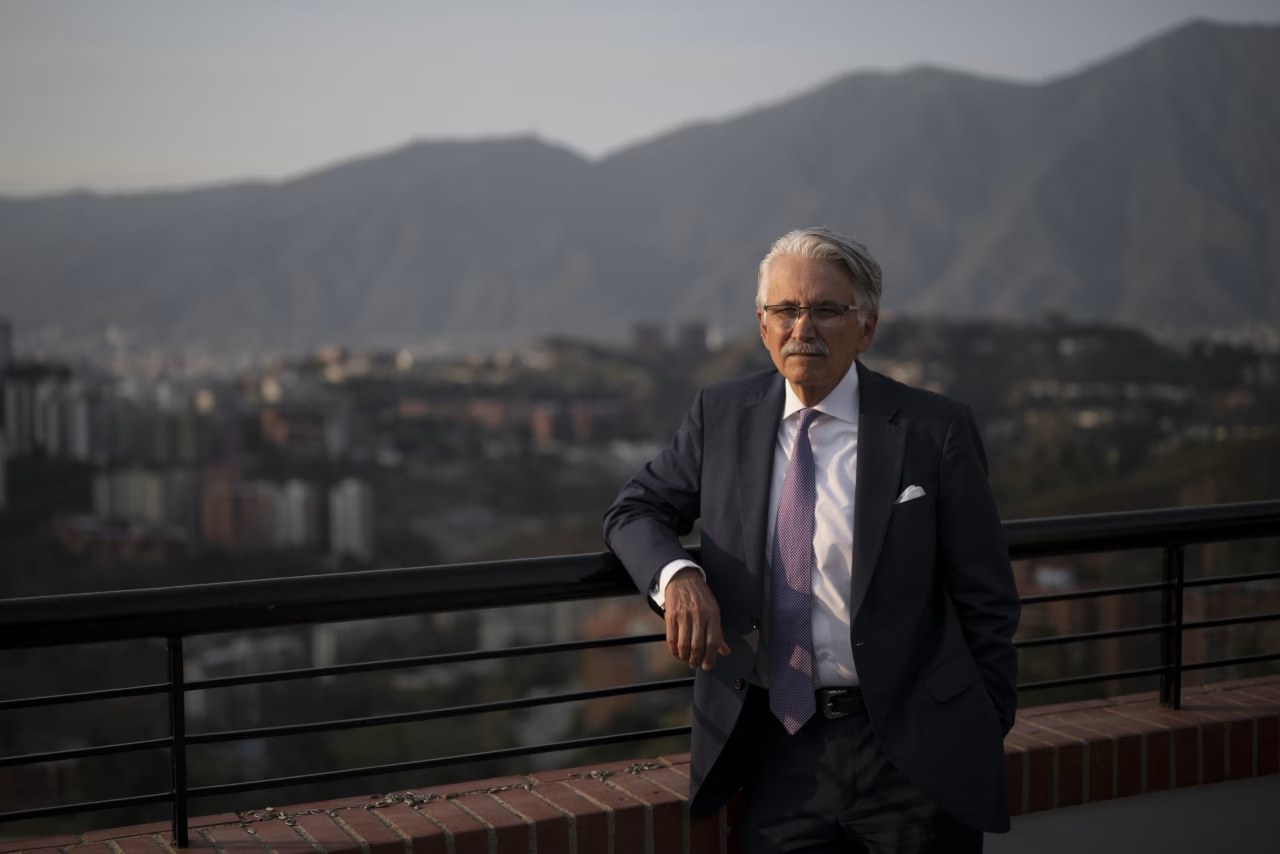
CIA Asked Ex-Chevron Executive Ali Moshiri to Pick Post-Maduro Venezuela Leader, WSJ Reports
- Trump White House tasked CIA with identifying a successor to Nicolás Maduro months before the 2020 narco-terrorism indictment.
- Retired Chevron vice-chair Ali Moshiri briefed Langley on which Venezuelan oil technocrats could stabilize crude output and U.S. relations.
- Dialogue shows energy-sector pragmatism shaping Washington’s regime-change calculus, according to people familiar with the talks.
- Moshiri’s consulting firm, Amos Global Energy, later sought but did not receive a State Department contract for Venezuela transition planning.
A rare glimpse into how America’s top spies outsourced succession planning to an oilman who once negotiated royalties directly with Hugo Chávez.
CHEVRON—In the months before the Trump administration indicted Venezuelan President Nicolás Maduro on narco-terrorism charges, senior CIA officials convened an unusual sounding board: Ali Moshiri, the recently retired head of Chevron’s exploration and production arm in Africa and Latin America.
According to people with direct knowledge of the exchanges, the agency asked Moshiri to rank potential replacements for Maduro, prioritizing candidates who could resurrect Venezuela’s collapsing oil sector without antagonizing Washington’s sanctions regime.
The episode, disclosed by The Wall Street Journal, underscores how Trump-era national-security planners merged intelligence objectives with energy-industry realism when weighing the ouster of a leftist autocrat who still controls the world’s largest proven crude reserves.
From Tehran to Caracas: Ali Moshiri’s 43-Year Rise Inside Chevron
Ali Moshiri joined Chevron in 1976 as a petroleum engineer in Tehran, just as Iran’s oil nationalization wave began reshaping Western access to Persian Gulf reserves. Over four decades he climbed the corporate ladder, postings in Angola, Kazakhstan and Venezuela forging a reputation for closing deals with resource nationalists others deemed untouchable.
By 2005 he was president of Chevron Africa & Latin America Exploration & Production, overseeing assets that pumped 680 000 barrels per day and generated $11 billion in annual revenue. Colleagues told trade publication Energy Intelligence Moshiri’s fluent Spanish and Farsi, plus his willingness to accept majority-state equity, opened doors when rivals balked.
Negotiating with Chávez
In 2006 Moshiri flew to Caracas and personally negotiated a conversion of Chevron’s profit-sharing contracts into joint ventures helmed by PDVSA, accepting a 60 % government stake to keep acreage in the Orinoco Belt. The move preserved 180 000 b/d of output and set a template ExxonMobil and ConocoPhillips rejected—leading to their 2007 nationalization and exit.
Energy historian Bernard Mommer, a former PDVSA board member, credits Moshiri with understanding that oil rents are political rents
—a mindset CIA briefers wanted distilled into names of Venezuelan technocrats capable of balancing fiscal demands of the state with investors’ need for legal certainty.
Moshiri retired in 2017, the same year the Trump administration labeled Venezuela’s government a dictatorship
and Chevron received a Treasury license to keep minimal operations in the country. His retirement package included a Houston office, a Chevron consulting retainer and, crucially, continued security clearance granted to executives working in sensitive jurisdictions—credentials Langley later saw as useful.
Three months before the April 2020 indictment of Maduro on drug-trafficking charges, Moshiri incorporated Amos Global Energy LLC in Texas, marketing himself as a geopolitical fixer for energy investors. Corporate filings list no public clients, but people familiar say CIA officials approached him informally, eager to graft his institutional memory onto U.S. transition planning.
Why the CIA Wanted an Oil Executive’s Shortlist for Caracas
When the White House signed a classified March 2020 directive tasking agencies with accelerating Maduro’s exit, CIA’s Venezuela mission center lacked granular intelligence on which chavista insiders might defect, according to two former officials. Analysts could map factional spats inside the cabinet, but had limited insight into who could manage the crown jewel: PDVSA.
Crude output had cratered from 3.2 million b/d in 2008 to 540 000 b/d, and Washington feared a rapid collapse could trigger a migrant surge toward Colombia and the Caribbean. The agency wanted names of oil-savvy
moderates who could reassure bondholders, the U.S. Treasury and Chevron, which still held a sanctions waiver to keep its Petropiar joint venture alive.
Moshiri’s Briefing Deck
Over two secure video calls in May 2020, Moshiri presented a five-slide deck that ranked six regime figures by three metrics: technical competence, acceptability to the opposition-controlled National Assembly, and likelihood of honoring contractual obligations to foreign drillers. Tareck El Aissami, then oil minister, scored high on loyalty to Maduro but low on trust with investors; PDVSA president Asdrúbal Chávez (Hugo’s cousin) was viewed as pragmatic but politically weak.
Moshiri’s preferred dark-horse pick, according to a person who saw the slides, was former PDVSA refining vice-president Luis Reyes, an alumnus of the University of Kansas who had negotiated joint-venture terms with Chevron in the 1990s. Reyes had stayed mostly outside factional infighting, a trait Langley interpreted as evidence he could be flipped
if promised sanctions relief and access to frozen accounts in U.S. banks.
CIA officers took no position on any name, but forwarded the assessment to National Security Council lawyer John Eisenberg, whose office was drafting an executive order that would ultimately offer sanctions waivers for any Venezuelan official who recognized opposition leader Juan Guaidó as interim president. The order was never signed; momentum shifted to the Justice Department’s narco-terrorism indictment unveiled on 26 March 2020, the same day the State Department offered a $15 million reward for Maduro’s capture.
Energy Diplomacy: When Oil Trumps Ideology
Chevron’s continued presence in Venezuela under sanctions illustrates a wider pattern: Western energy majors often outlast State Department boycotts, betting that pragmatism will eventually prevail. ExxonMobil and ConocoPhillips refused to accept 2007 nationalizations, pursuing arbitration that awarded them $14 billion judgments still unpaid. Chevron, by contrast, stayed, swallowing minority stakes and waiting for policy shifts.
The gamble paid off in November 2022 when Washington extended Chevron’s license, allowing it to export 180 000 b/d to U.S. refiners and earn a margin of roughly $15 a barrel despite 50 % windfall taxes Caracas imposed. That equates to $985 million annual cash flow—money Moshiri argued could anchor broader macro-stability if a friendly government took over.
‘Transactional Realism’
Energy scholar Amy Myers Jaffe of Tufts University calls this approach transactional realism
: accepting that authoritarian governments control 72 % of proven global reserves, companies weigh geology above governance. Moshiri’s briefings echoed that logic, telling CIA interlocutors that any post-Maduro regime would still demand 51–60 % state equity—terms Washington must accept to revive output and curb migration.
Human-rights groups criticize the mindset. Geoff Ramsey of the Washington Office on Latin America warns that prioritizing barrels over accountability risks legitimizing corruption networks
inside the military that currently control crude smuggling. Yet for policymakers, near-term supply security often outweighs longer-term governance goals, especially after Russia’s invasion of Ukraine tightened global markets.
The CIA’s outreach to Moshiri thus fits a historical pattern: in 1953 the agency relied on British Petroleum’s Iranian assets to gauge popular sentiment before ousting Prime Minister Mohammad Mossadegh; in 1973 it tapped ARAMCO executives for intelligence on Saudi succession. What is novel is the overt request for a ranked succession list, showing how energy-sector data points now feed directly into covert action planning.
What Happened After the CIA Briefings?
The indictment of Maduro on 26 March 2020 shifted U.S. strategy from quiet succession engineering to public pressure. Any residual utility of Moshiri’s shortlist evaporated when key figures he profiled—El Aissami, Chávez, Reyes—rallied behind Maduro, fearing extradition. By December 2020 the opposition’s parallel legislature quietly shelved its own transition blueprint, citing lack of international consensus.
Chevron’s waiver, however, remained intact. Under General License 41 issued by Treasury’s Office of Foreign Assets Control, the company retained rights to lift, ship and market Venezuelan crude provided royalties are paid to escrow accounts controlled by interim leader Juan Guaidó—an arrangement that technically survived the 2023 lifting of some sanctions before partial re-imposition in 2024.
Moshiri’s Next Moves
Amos Global Energy submitted a proposal to the State Department’s Bureau of Western Hemisphere Affairs in August 2020 seeking a $2.1 million contract to design a PDVSA restructuring plan
in the event of a political transition. The bid was rejected after inter-agency lawyers flagged potential conflict-of-interest, given Moshiri’s ongoing consulting fees from Chevron. He continues to advise private equity funds eyeing distressed Venezuelan debt, telling investors any future government will need to raise $35–40 billion to restore output to 2 million b/d.
CIA officials briefed on the matter say the episode has not deterred the agency from tapping industry expertise, but future engagements will route through the National Intelligence Manager for Energy, a post created in 2022 to centralize commercial-sector liaison. For Venezuela, the lesson is stark: exile politics in Washington matter less than who can turn the taps back on, a calculus Ali Moshiri understood better than most.
Is Relying on Oil Executives for Intel a Risk for U.S. Credibility?
Congressional overseers have raised concerns that recruiting industry figures like Moshiri can blur the line between intelligence gathering and corporate lobbying. Senator Tim Kaine, a Virginia Democrat, requested in 2021 that the CIA inspector-general review whether energy-sector briefings improperly influenced sanctions licensing. The inquiry remains classified.
Legal experts note the National Security Act permits the CIA to solicit information from U.S. persons, but prohibits using covert action to benefit any single company. Because Chevon stood to gain from a stable PDVSA, Moshiri’s dual role as ex-executive and paid adviser created what Professor Jack Goldsmith of Harvard Law calls an optics nightmare
even if no law was broken.
Reputation Costs
For Venezuela’s opposition, reliance on oil veterans reinforces Maduro’s narrative that Washington’s real goal is oil colonialism.
Pollster Datanálisis found that 63 % of Venezuelans support foreign humanitarian aid yet only 29 % back U.S. oil companies returning under current terms. Any future transition government must balance fiscal needs against nationalist sentiment.
Meanwhile, global rivals are watching. Russia’s Rosneft and China’s CNPC have extended billions in oil-backed loans; both countries vetoed a U.S.-backed U.N. resolution on Venezuelan elections in 2023. Analysts warn that over-reliance on private-sector intelligence could undercut multilateral coalitions Washington needs to enforce any future political settlement.
The CIA declined to comment on Moshiri’s involvement, but a senior official told the Journal the agency routinely engages subject-matter experts
and follows ethics protocols. Whether future engagements will tilt U.S. policy toward oil-sector interests remains an open question—one that will shape not just Venezuela’s future, but how intelligence agencies worldwide incorporate corporate expertise into statecraft.
Frequently Asked Questions
Q: Who is Ali Moshiri, the former Chevron executive linked to the CIA?
Ali Moshiri rose from Chevron’s Tehran-born engineer in 1976 to president of exploration & production for Africa and Latin America, overseeing multibillion-dollar projects in Angola, Nigeria, Kazakhstan and Venezuela. After retiring in 2017 he founded Houston-based Amos Global Energy, advising governments and national oil companies on geopolitical risk.
Q: Why did the CIA approach an oil executive about Venezuela’s political future?
Agency officials wanted sector-specific insight on which Venezuelan technocrat could stabilize oil output—once 3.2 million b/d, now below 700 000 b/d—while aligning with U.S. sanctions policy. Moshiri’s four-decade relationships with PDVSA engineers and ministers made him a rare outside evaluator of managerial competence inside Caracas.
Q: What makes energy companies comfortable negotiating with autocratic regimes?
Oil majors prize long reserve life and low extraction costs over governance scores. Chevron’s 2019 license to operate in Venezuela under U.S. sanctions illustrates how firms accept fiscal unpredictability and political risk when fields generate 30-40 % returns, far above North American shale’s 8-12 % average.
