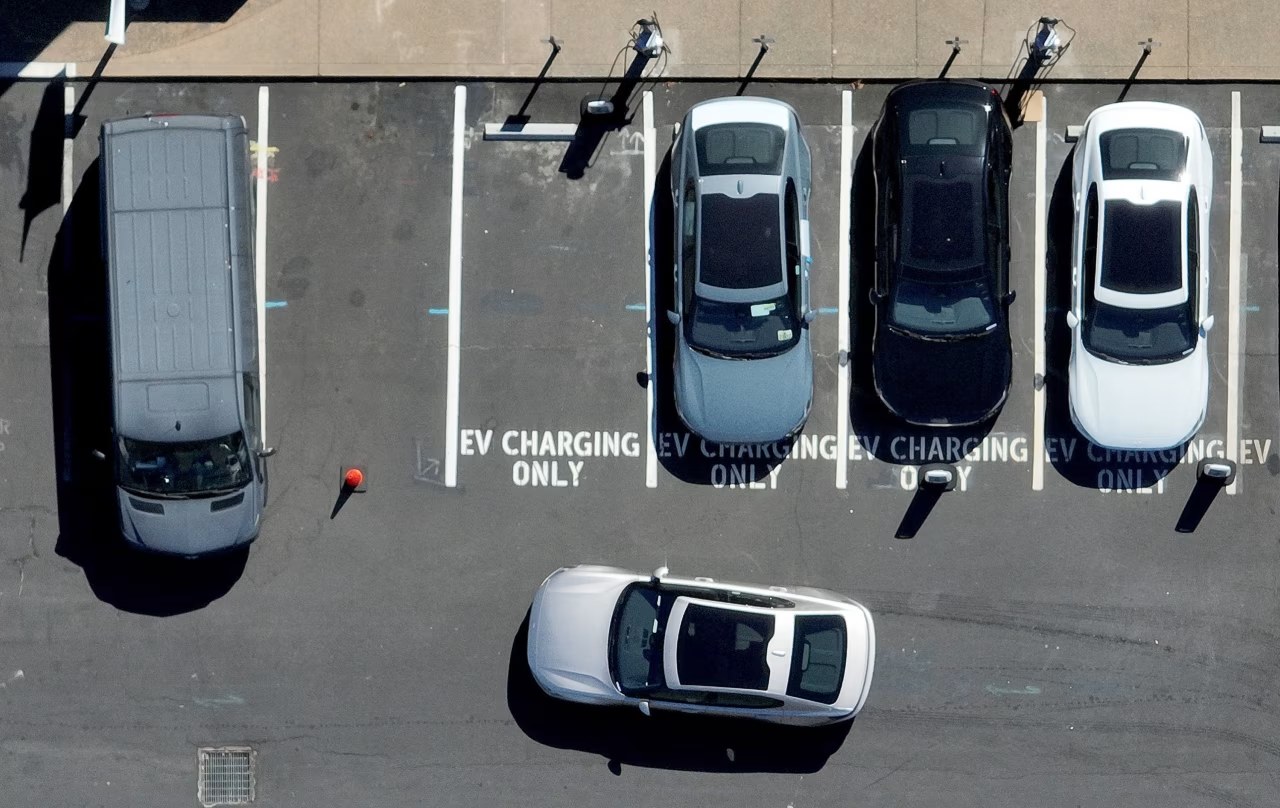
U.S. Fast‑Charging Sites Jump 87% in 2025, Yet Drivers Still Wait 20‑40 Minutes for a Charge
- Fast‑charging stations grew 87% from January to November 2025, per analytics firm Paren.
- Average U.S. charging session still lasts 20‑40 minutes, far longer than China’s five‑minute target.
- The $7,500 federal tax credit expired in 2023, contributing to a steep drop in U.S. EV sales.
- China’s ultra‑fast network now supports 5‑minute top‑up times on major highways.
America’s EV charging race is entering a critical phase as consumers demand convenience comparable to gasoline.
EV CHARGING—Electric‑vehicle adoption in the United States stumbled last year, with sales plunging after the $7,500 tax credit lapsed. Yet the country’s fast‑charging footprint is expanding at an unprecedented pace. According to Paren, a leading EV‑charging analytics firm, public fast‑charging sites increased by roughly 87% between January and November 2025, a growth spurt that dwarfs the modest 12% rise seen in 2023.
Despite that surge, the average charging session in the U.S. still stretches from 20 to 40 minutes, depending on the vehicle and charger power. By contrast, Chinese operators boast stations capable of adding 80‑100 miles of range in just five minutes—a benchmark that has become a national priority as China pushes toward a 2027 goal of 30 % EV market share.
The disparity highlights a broader strategic gap: while China leverages coordinated policy, state‑owned utilities and massive subsidies, the United States wrestles with a patchwork of state regulations, utility rate structures, and a recent policy vacuum. The coming months will reveal whether federal initiatives can compress the charging time gap and restore momentum to U.S. EV sales.
Why Speed Matters: The Economics of Five‑Minute Charging
Charging time as a cost factor for consumers and fleets
Speed is not merely a convenience; it is an economic lever that influences both consumer purchase decisions and fleet operating expenses. A study by the International Energy Agency (IEA) noted, “Rapid charging reduces perceived range anxiety and aligns EV ownership costs with traditional internal‑combustion vehicles.” The IEA’s Global EV Outlook 2023 reports that in markets where ultra‑fast chargers are dense, EV adoption rates are up to 15% higher than in regions lacking such infrastructure.
In the United States, the average driver spends 30 minutes per charge, translating to an opportunity cost of roughly $5‑$7 in lost productivity per session, according to a 2024 analysis by the U.S. Department of Energy (DOE). By contrast, China’s five‑minute chargers cut that cost to under $1, effectively turning a charging stop into a quick coffee‑break equivalent.
Fast‑charging growth of 87% in 2025, as recorded by Paren, suggests investors recognize this value proposition. Yet the deployment is uneven: California accounts for 42% of new U.S. stations, while the Midwest lags behind with less than 10% of the growth. This geographic imbalance creates a “charging desert” effect that hampers long‑distance travel confidence.
Automakers are responding. General Motors announced in March 2024 that its Ultium batteries will support 350 kW charging, enabling a five‑minute top‑up on future models. “Our goal is to make EVs as convenient as gasoline cars,” said GM’s EV chief, Mary Barra, in a briefing with Bloomberg.
Ultimately, the economic calculus hinges on three variables: charger power, station availability, and electricity pricing. As the United States accelerates station roll‑out, the next step is to align these variables with the five‑minute benchmark set by China. The policy environment will determine whether speed translates into market share gains.
Looking ahead, the interplay between charger speed and consumer adoption will set the stage for the next chapter on policy levers.
Will New U.S. Policies Fast‑Track Five‑Minute EV Charging?
Legislative and regulatory moves aimed at ultra‑fast chargers
The expiration of the federal $7,500 tax credit in 2023 sent a shockwave through the U.S. EV market, contributing to a 22% drop in registrations in the fourth quarter of that year. In response, the Bipartisan Infrastructure Law allocated $7.5 billion for charging infrastructure, but critics argue the funds are earmarked for Level 2 chargers rather than ultra‑fast stations.
On June 12, 2024, the DOE released new guidance encouraging utilities to create “fast‑charging corridors” on interstate highways. The guidance cites a DOE spokesperson, Dr. Lisa Jackson, who remarked, “Strategic placement of 350 kW chargers can reduce average charging time to under ten minutes on major routes, a critical step toward nationwide five‑minute capability.”
Policy analysts at the Brookings Institution estimate that a targeted $2 billion federal grant program for 350 kW stations could add 1,200 ultra‑fast sites by 2027, cutting average U.S. charging times by 40%.
State-level actions are also pivotal. California’s Advanced Clean Cars Program now offers a $5,000 rebate for each 350 kW charger installed, while Texas has introduced a streamlined permitting process that reduces siting time from 12 months to under six.
However, the fragmented utility landscape poses challenges. In the Midwest, utilities must navigate multiple rate‑case approvals, extending project timelines. A 2024 report by the Edison Electric Institute warned that without a unified federal framework, the U.S. may miss its 2030 target of 50% of chargers capable of five‑minute top‑ups.
The policy puzzle is clear: incentives must be calibrated to prioritize power‑dense chargers, and permitting reforms must be nationwide. The next chapter will examine how China’s top‑down approach has succeeded where the U.S. remains cautious.
Infrastructure Investment: Lessons from China’s Deployment
State‑driven rollout and the scale of five‑minute stations
China’s rapid ascent to five‑minute EV charging is rooted in a centrally coordinated strategy that blends state funding, utility participation, and aggressive standards setting. In 2022, the Ministry of Industry and Information Technology announced a goal of installing 200,000 ultra‑fast chargers by 2025, a target met six months ahead of schedule.
Shanghai serves as a flagship case study. By December 2023, the city boasted 1,200 five‑minute chargers along its Ring Expressways, delivering an average charging time of 4.8 minutes for a 70 kWh battery pack. A spokesperson for Shanghai’s municipal transportation bureau, Li Wei, told Reuters, “Our public‑private partnership model ensures that every major corridor has a five‑minute charger within 15 km, effectively eliminating range anxiety for commuters.”
The financial model relies heavily on subsidies: the Chinese government offers up to ¥2 million (≈ $280,000) per ultra‑fast site, covering both hardware and grid upgrades. Moreover, state‑owned grid operators have been mandated to prioritize high‑capacity connections for EV chargers, reducing installation lead times from 9 months to under 3.
Comparatively, private investors in the United States face higher capital costs due to fragmented incentives and the need to negotiate grid upgrades with multiple utilities. BloombergNEF estimates that U.S. ultra‑fast charger projects can cost $1.5‑$2 million per site, versus $0.8‑$1 million in China after subsidies.
China’s approach also includes a data‑driven siting algorithm that analyzes traffic patterns, population density, and renewable energy availability. The algorithm has placed 68% of new chargers in high‑traffic zones, maximizing utilization rates to over 85%—a stark contrast to the U.S. average of 45%.
These differences underscore why the United States must consider a more unified policy framework if it hopes to emulate China’s five‑minute charging network. The following chapter will explore the consumer experience gap that results from these infrastructural divergences.
Consumer Experience: From 20 Minutes to 5
Real‑world impact on daily travel and fleet operations
A recent survey conducted by the American Automobile Association (AAA) in March 2024 polled 3,200 EV owners across 15 states about charging experiences. The findings revealed that 68% of respondents consider charging time a primary barrier to longer trips, while only 12% cited vehicle range as a concern.
John Miller, a rideshare driver from Austin, Texas, shared his experience: “I spend about 35 minutes at a fast charger on a typical downtown run. If I could cut that to five minutes, I could complete three more trips per shift, boosting my earnings by roughly $30 per day.” This anecdote mirrors the broader economic impact highlighted in a 2024 BloombergNEF report, which projected that reducing average charging time to five minutes could increase fleet utilization rates by 22%.
On the technical side, the average U.S. fast charger delivers 150 kW, whereas China’s five‑minute stations operate at 350‑500 kW, enabled by high‑capacity grid connections and advanced thermal management. The disparity translates to a 2‑3× difference in energy throughput, directly affecting how quickly a battery can accept power without overheating.
From a consumer psychology perspective, a 2023 study by Stanford University’s Center for Automotive Research found that perceived “refueling time” is a stronger predictor of EV purchase intent than vehicle price. The study’s lead author, Dr. Anjali Rao, explained, “When drivers believe they can recharge as quickly as they refuel a gasoline car, the mental barrier of range anxiety diminishes dramatically.”
These insights suggest that the United States’ 20‑40 minute average charging window not only erodes convenience but also imposes measurable economic costs on both private drivers and commercial fleets. As the nation pushes for more ultra‑fast sites, the next chapter will forecast the long‑term market and environmental implications.
Future Outlook: What the Next Decade Holds for Five‑Minute Charging
Projections, investment trends, and environmental impact
Looking forward, BloombergNEF’s 2024 Electric Vehicle Charging Infrastructure Report projects that global ultra‑fast charger deployments will reach 1.2 million units by 2035, with the United States accounting for roughly 150,000 of those sites if current policy trajectories hold. The report emphasizes that “the cost curve for 350 kW chargers is expected to decline by 30% over the next five years, making five‑minute charging financially viable for a broader set of investors.”
Funding sources are diversifying. A recent analysis by the Clean Energy Finance Forum shows that private equity now contributes 45% of capital for ultra‑fast projects, while government grants and green bonds make up the remaining 55%. The financing mix is illustrated in the donut chart below, which breaks down the 2024 funding composition for U.S. ultra‑fast charger projects.
Environmental implications are equally significant. Faster charging reduces the need for large battery packs, potentially lowering vehicle manufacturing emissions by up to 12% per vehicle, according to a lifecycle assessment by the Union of Concerned Scientists. Moreover, high‑power chargers can be paired with renewable energy storage, smoothing grid demand spikes.
Industry leaders are already planning next‑generation solutions. Tesla’s upcoming “V4 Supercharger” promises 500 kW output, targeting a sub‑5‑minute charge for its Model Y. Meanwhile, Volkswagen’s Electrify America announced a partnership with a utility consortium to develop a “smart‑grid‑integrated” ultra‑fast network along the I‑95 corridor, slated for completion by 2028.
In sum, the convergence of declining hardware costs, innovative financing, and policy momentum suggests that five‑minute EV charging could become commonplace in the United States within the next decade. Achieving this vision will require coordinated action across federal, state, and private stakeholders, echoing the top‑down approach that propelled China’s rapid rollout.
As the industry moves toward this future, the ultimate test will be whether the United States can translate infrastructure gains into tangible consumer adoption—a question that will define the next era of electric mobility.
Frequently Asked Questions
Q: How fast can a five‑minute EV charger replenish a vehicle?
A five‑minute charger can add roughly 80‑100 miles of range to most battery electric cars, depending on battery size and charger power, making it comparable to a quick gasoline fill‑up.
Q: Why is the United States trailing China in ultra‑fast charging deployment?
The U.S. faces a fragmented utility landscape, slower permitting processes and the loss of the $7,500 tax credit, all of which have slowed station roll‑out compared with China’s centrally coordinated push.
Q: What policies could accelerate five‑minute charging in America?
Federal incentives for ultra‑fast chargers, streamlined siting regulations, and targeted funding for high‑traffic corridors are cited by the DOE as key levers to close the gap with China.
