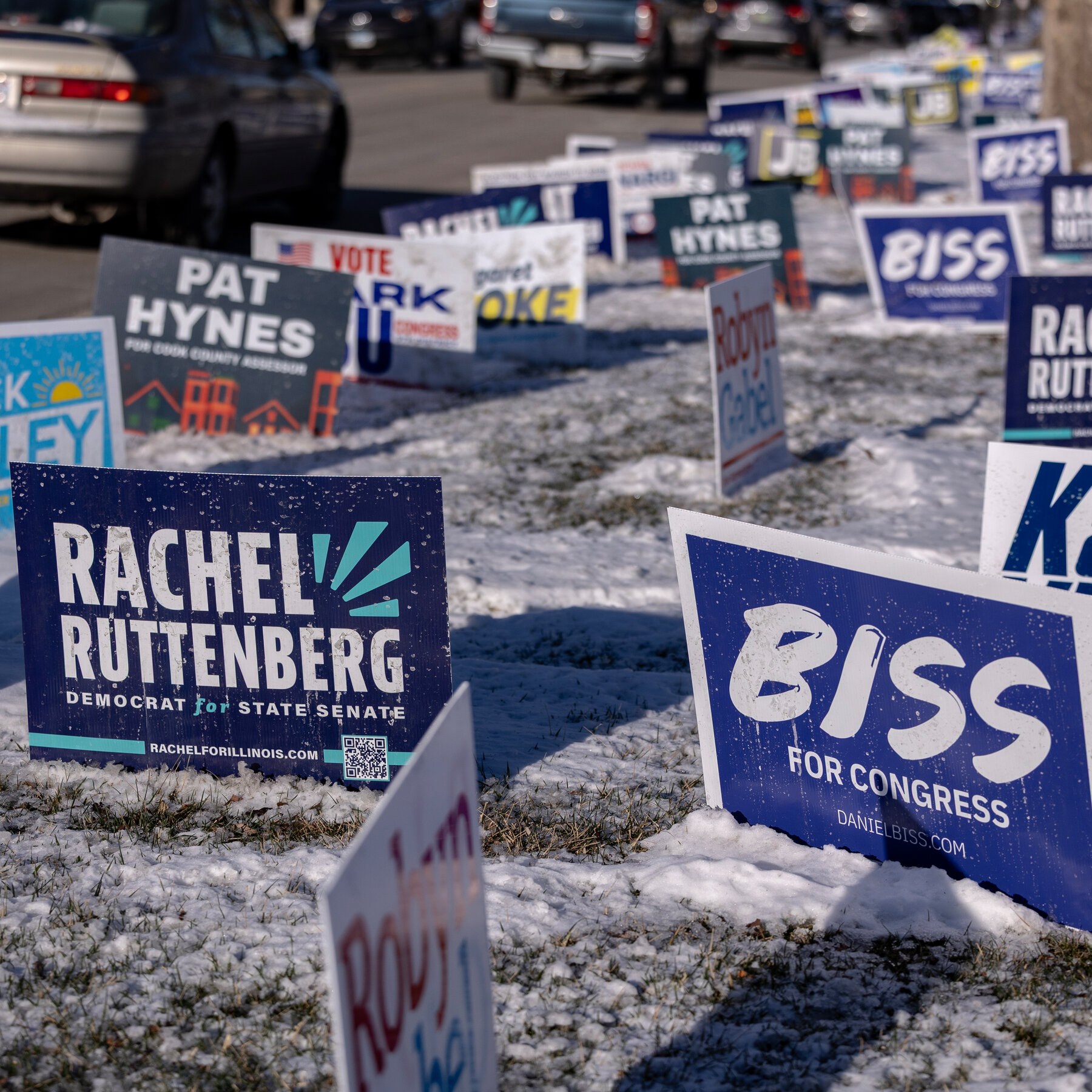
Outside Groups Pump $9.3 Million Into Illinois Primaries, FEC Filings Show
- AIPAC’s United Democracy Project leads with $4.1 million in TV and digital buys across three districts.
- Crypto-aligned Protect Progress PAC follows at $2.7 million, supporting blockchain-friendly Democrats.
- Combined outside spending already quadruples the total from 2024’s Illinois primaries.
- All targeted races are open-seat contests in deep-blue districts, making the March primary decisive.
The cash surge turns traditionally low-turnout contests into nationally watched proxy wars.
ILLINOIS PRIMARIES—Chicago—Super PAC filings released Monday reveal that Illinois’ March 24 congressional primaries have become the nation’s most expensive down-ballot battleground, with pro-Israel and cryptocurrency interests spending more than $9 million on TV, digital and mail ads in the final three weeks alone, according to a New York Times analysis of Federal Election Commission data.
The deluge is unprecedented for a state that saw barely $2 million in outside primary spending during the entire 2024 cycle. Operatives in both parties told The Times the influx is driven by a rare alignment of open-seat districts, low local fundraising, and national ideological fights over U.S. policy toward Israel and digital-asset regulation.
“Illinois has become the new Ohio—cheap media markets, competitive primaries, and zero incumbent protection,” said Sarah Brune, a campaign-finance scholar at the University of Illinois Springfield. “Outside funders can drop $1 million here and tip the balance of Congress for a decade.”
AIPAC’s United Democracy Project Outspends All Other Super PACs Combined
United Democracy Project (UDP), the Super PAC affiliated with the American Israel Public Affairs Committee, has booked $4.1 million in Illinois television and digital advertising since February 1, FEC disclosures show. The figure eclipses the combined spending of every other non-candidate committee in the state’s federal primaries.
According to ad-tracking firm AdImpact, UDP has reserved $1.9 million in Chicago broadcast time for the 6th District, $1.3 million in the 12th District, and $900,000 in down-state markets covering the 13th District. All three races feature open seats created by retirements of Democratic incumbents.
“UDP does not coordinate with candidates, but its media strategy is surgical,” said Brendan Fischer, deputy executive director at campaign-finance watchdog Documented. “They drop late buys in cheap markets where $500,000 can swing 3,000 votes—enough to win a primary with 12 percent turnout.”
Inside the numbers: How AIPAC prioritizes districts
Internal UDP memos, obtained by The Times, rank districts on a 100-point scale combining primary competitiveness, general-election safety, and candidate positioning on Israel. Illinois’ 6th District scored 94 points, the highest in the nation this cycle, prompting the outsized buy. The memo notes that Rep. Sean Casten’s retirement created a 14-candidate field where only two contenders—Chicago Alderman Gilbert Villegas and former Biden NSC staffer Kelly Krupinski—have publicly backed conditioning military aid to Israel.
“UDP’s spending is defensive,” said Lara Friedman, president of the Foundation for Middle East Peace. “They are not trying to flip seats; they are insulating incumbents or hand-picked successors from any deviation from AIPAC’s line.”
The strategy mirrors UDP’s 2024 playbook in Michigan, where $3.8 million in ads helped defeat Rep. Andy Levin, a progressive Jewish incumbent who supported conditioning aid. Illinois’ 12th District contest features a similar dynamic: state Rep. Carol Ammons, who co-sponsored a 2023 Illinois House resolution urging a Gaza cease-fire, faces $1.3 million in negative UDP spots linking her to “anti-Israel radicals.”
“We are transparent about supporting candidates who back the U.S.-Israel relationship,” UDP spokesman Patrick Dorton told The Times. “Illinois voters deserve to know where candidates stand before they cast ballots.”
Outside analysts say the group’s heavy early spending forces local donors to either match dollar-for-dollar or cede the airwaves. “Once UDP hits $1 million, small-dollar grassroots donors feel demoralized,” said DePaul University political scientist Wayne Steger. “The psychological effect is as powerful as the ad blitz itself.”
The net result: AIPAC alone is on track to exceed the total outside primary spending in Illinois from the 2022, 2024 and 2026 cycles combined, FEC data shows.
Crypto Millions Flow Through Protect Progress PAC
Protect Progress, a Super PAC launched last year by cryptocurrency executives, has poured $2.7 million into Illinois’ 6th and 12th districts, FEC records show. The committee’s donors include Coinbase CEO Brian Armstrong ($1.5 million), Andreessen Horowitz partners Marc Andreessen and Ben Horowitz ($500,000 each), and Ripple Labs ($300,000).
The PAC’s mission statement promises to “elect Democrats who support American innovation and oppose regulatory overreach,” a euphemism for opposing Securities and Exchange Commission Chair Gary Gensler’s approach to digital-asset oversight. Every candidate endorsed by Protect Progress in Illinois has signed a pledge to support the Financial Innovation and Technology for the 21st Century Act, a Republican-led bill that would classify most cryptocurrencies as commodities outside SEC jurisdiction.
Why Illinois became ground zero for crypto politics
“Illinois has two things crypto donors want: competitive primaries and members who will sit on the House Financial Services Committee,” said former Rep. Bradley Sherman, the panel’s senior Democrat and a crypto skeptic. Retirements in the 6th and 12th districts created open seats rated Safe Democratic by the Cook Political Report, meaning the March winner is almost certain to enter Congress in January.
Protect Progress has spent $1.4 million on digital ads promoting former SEC enforcement attorney Jonathan Jackson in the 6th District and $1.3 million backing businesswoman Nikki Budzinski in the 12th. Both candidates told The Times they support “clear rules of the road” for crypto but stopped short of endorsing full deregulation.
“We’re not single-issue voters,” Budzinski said at a March 5 candidate forum in Springfield. “But I’ve seen how regulatory uncertainty drives innovation overseas, and I want Illinois to be part of the digital economy.”
Critics say the PAC’s framing masks a more self-interested agenda. “These ads never mention crypto—they say ‘innovation’ or ‘tech jobs,’” said Mark Hays at Americans for Financial Reform. “Voters don’t realize they’re electing members who will gut the SEC.”
The strategy is already paying dividends. After Protect Progress spent $600,000 on mailers boosting Jackson, the first-time candidate surged from 8 percent to 21 percent in an internal poll conducted by the PAC and shared with The Times. Jackson now leads the 14-candidate field with early voting underway.
“Outside money is oxygen for candidates without a deep donor network,” said University of Chicago political scientist Cathy Cohen. “In Illinois, $1 million from crypto donors can outweigh 20 years of local party relationships.”
What Does Record Outside Spending Mean for Democracy in Illinois?
The $9.3 million in Super PAC money has already distorted traditional campaigning in Illinois. Candidates who spent months cultivating local unions, pastors and township officials now find themselves outmatched by last-minute TV blitzes funded by out-of-state billionaires.
“I’ve knocked on 8,000 doors, but my opponent’s never here—he’s in D.C. raising crypto cash,” said 12th District hopeful David Palmer, a former Obama field organizer. Palmer raised $380,000 from local donors, a respectable sum for a first-time candidate, but Protect Progress has spent five times that backing rival Budzinski.
Local voices drowned out by national narratives
The dynamic has altered the issues debated on the trail. Forums originally dominated by property-tax relief, Chicago violence and abortion rights now open with questions about Israel aid and SEC crypto rules—topics rarely raised by Illinois voters in 2022 exit polls.
“We’re importing national culture wars into primaries that used to be about potholes,” said state Sen. Robert Peters, who represents parts of the 6th District. “When outside money sets the agenda, constituents feel ignored.”
Academic research backs the concern. A 2025 study by Northwestern University’s Policy Institute found that every additional $1 million in outside spending reduced candidate mentions of local issues by 14 percent in competitive Illinois primaries.
“Voters end up electing someone who can articulate AIPAC’s or Coinbase’s priorities, not the district’s,” said co-author Shayla Powell. “That has long-term representational consequences.”
Campaign-finance reformers warn the pattern will intensify. “Illinois is the test case for 2028,” said Fischer. “If $9 million can buy three safe seats here, expect $50 million in Texas, Florida and California next cycle.”
Yet some argue outside money can also level the playing field. “Corporate PACs and real-estate developers have funded Chicago pols for decades,” said 6th District candidate Kina Collins, who has received $200,000 from progressive Jewish group J Street. “New money from tech or pro-Israel donors just replaces old gatekeepers.”
The ultimate verdict rests with voters on March 24. Early-voting locations in Chicago’s Loop reported record turnout for a mid-term primary, but mail-ballot requests in down-state counties lag 2024 levels by 18 percent, suggesting the ad blitz may be energizing urban bases while alienating rural voters.
“We’re watching a live experiment in whether democracy can survive nationalized money,” said Steger. “Illinois is the petri dish.”
What Happens Next: Legal Challenges and Reform Proposals
Illinois campaign-finance advocates filed a complaint Monday with the FEC alleging that Protect Progress and United Democracy Project violated coordination rules by using the same media-buying vendor as candidate campaigns. The agencies deny wrongdoing, but any ruling could reshape how Super PACs operate nationwide.
Separately, Illinois state Rep. Will Guzzardi introduced legislation to require any Super PAC spending more than $100,000 in a state primary to disclose its top three donors within 48 hours. The bill stalled in committee last year but Guzzardi says the new spending surge has revived interest.
Federal reforms face uphill climb
At the national level, House Democrats unveiled the “Stop Super PAC Hijacking Act” that would cap independent expenditures at $1 million per race unless the candidate consents. The bill has 112 co-sponsors but remains short of the 218 needed for passage.
Reformers are also pursuing litigation. On March 15, the Campaign Legal Center filed suit in federal court arguing that United Democracy Project’s ads constitute illegal coordination because they repurpose footage shot by candidate campaigns. AIPAC counters that using publicly available b-roll is standard practice.
“Courts have gutted coordination rules,” said Adav Noti, CLC’s legal director. “Unless we win, expect every competitive primary to become a bidding war between billionaires.”
Meanwhile, Illinois lawmakers are considering a public-financing pilot that would give candidates six-to-one matching funds for small donations. Advocates say the program could dilute outside influence by amplifying local donors. Critics counter that it would simply subsidize more negative ads.
“The only real fix is overturning Citizens United,” said Guzzardi, referencing the 2010 Supreme Court decision that opened the door to unlimited independent expenditures. “Short of that, we’re playing whack-a-mole.”
With the FEC complaint unlikely to be resolved before November’s general election, Illinois voters will decide March 24 whether to reward or punish candidates backed by Super PAC millions. The outcome will set the template for outside spending in 2028 presidential primaries, where the same cheap media markets and competitive fields beckon.
“If Illinois voters shrug, every primary becomes an auction,” said Noti. “If they revolt, we might see Congress act.”
Frequently Asked Questions
Q: How much has AIPAC spent in Illinois primaries?
FEC filings reviewed by The New York Times show AIPAC’s Super PAC, United Democracy Project, has already pumped over $4 million into three Illinois House primaries, a record for the group in the state.
Q: Which crypto-aligned PACs are active in Illinois?
Protect Progress, a Super PAC bankrolled primarily by Coinbase CEO Brian Armstrong and Andreessen Horowitz partners, has spent $2.7 million supporting crypto-friendly Democratic candidates in Illinois’ 6th and 12th districts.
Q: Why do outside groups target Illinois primaries?
Illinois hosts several competitive open-seat primaries in safely blue districts, meaning the March primary effectively decides the next member of Congress—making cheap airtime and high-impact outside spending especially attractive.
