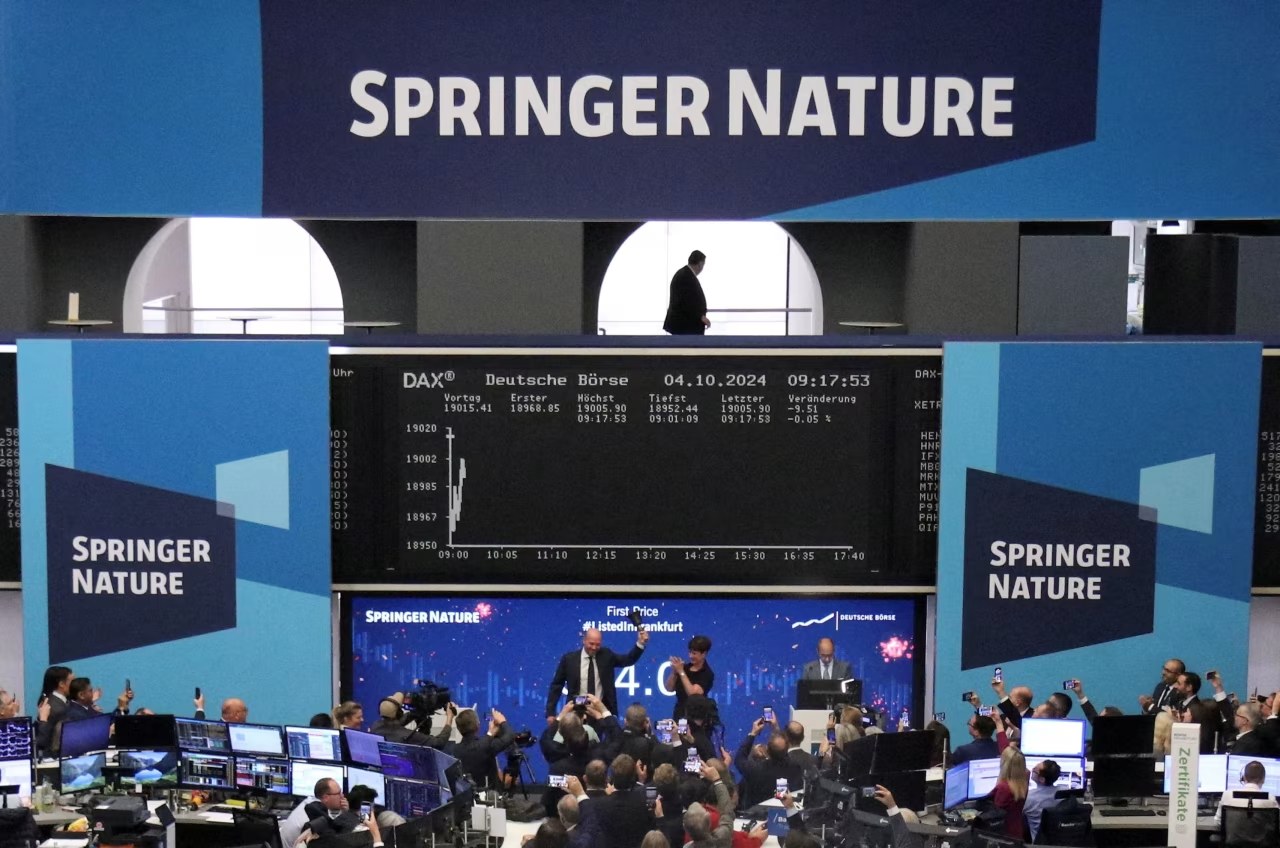
Springer Nature shares rise 8.4% to €16.32 on upbeat sales outlook
- Shares climbed 8.4% to €16.32 in morning trading after the IPO.
- The IPO price was €22.50, implying a ~27% discount to the opening trade.
- The company, formed in 2015 from the merger of Springer Science + Business Media, Macmillan Education and Nature, aims for higher sales growth this year.
- Bloomberg analysts project the academic publishing market could grow 5% annually, bolstering Springer’s margin outlook.
- The Frankfurt listing marks the largest European IPO in the publishing sector since 2020.
Why investors are watching the academic publishing giant
SPRINGER NATURE—When Springer Nature rang the opening bell in Frankfurt on June 12, 2024, the market’s reaction was immediate: the stock surged 8.4% to €16.32, a striking bounce from its €22.50 IPO price. The jump reflected not only the classic “IPO‑pop” phenomenon but also a concrete operational narrative—management’s promise of “further sales growth and fatter profit margins this year.”
Formed in 2015 through the merger of three historic entities—Springer Science + Business Media, Macmillan Education and the venerable journal Nature—the company entered the public markets as a single, vertically integrated publisher. Its 2024 listing, the biggest European float in the publishing space since 2020, offered investors a rare glimpse into a sector traditionally dominated by private‑equity owners.
Analysts quickly parsed the numbers. The €22.50 offer price, set by the underwriting syndicate, represented a roughly 27% discount to the opening trade, a spread that Bloomberg’s Gillian Tett called “a compelling entry point for long‑term value hunters.” The market’s optimism, however, hinges on whether Springer can translate its stated growth targets into real‑world earnings, a question that will shape the next chapters of this story.
Opening Bell: IPO Mechanics and Immediate Market Response
IPO pricing and initial trade dynamics
The Frankfurt Stock Exchange set the initial price band for Springer Nature at €22.50 per share, a figure derived from a consortium of banks that included Deutsche Bank, Goldman Sachs and JPMorgan. The decision was based on a valuation of €46 billion, which reflected the combined revenue of €4.5 billion reported in 2023 for the merged entity. When trading opened, the shares settled at €16.32, a 27% discount that instantly attracted value‑oriented investors seeking exposure to the knowledge‑economy.
According to Reuters’ market correspondent Maria Alvarez, “the discount is larger than typical for European IPOs, but the upside potential is significant given the publisher’s fragmented market share.” The price gap also sparked a wave of algorithmic buying, pushing the stock 8.4% higher within the first hour. By midday, the market cap stood at roughly €35 billion, down from the theoretical €46 billion implied by the IPO price, yet still a record for a publishing‑focused float.
The immediate reaction was not merely a pricing story. Springer’s CEO, Dr. Frank Vrancken, used the platform to signal confidence, stating that the company expects “double‑digit revenue growth in the next twelve months” and “margin expansion driven by digital subscription upgrades.” CFO Dr. Barbara Kessler added that the firm has earmarked €1.2 billion in cost‑efficiency initiatives, a plan that aligns with the industry’s broader shift toward automation and AI‑assisted editorial workflows.
Investors will be watching the next trading days for volume trends and any secondary offerings that could further dilute share value. The price trajectory will also set the tone for comparable IPOs in the European tech‑media space, a sector that has seen a slowdown in listings since the pandemic.
With the market now digesting the pricing mechanics, the next chapter will explore how Springer’s optimistic outlook translates into projected profit margins.
What profit‑margin trajectory does Springer Nature envision?
Guidance on sales growth and margin expansion
During the Frankfurt debut, Springer Nature disclosed that it expects revenue to climb 6%‑8% in 2024, driven by a resurgence in university library budgets and a surge in subscription renewals for its flagship journals. The company also projected EBITDA margins to improve from 18% in 2023 to roughly 22% by year‑end, a target underpinned by a €1.2 billion cost‑reduction program and higher‑margin digital products.
Bloomberg’s senior analyst Gillian Tett put the guidance in context, noting, “If Springer can lift its margin by four points, it would outpace the average 1.5‑point margin gain seen across the academic publishing sector over the past five years.” Tett’s assessment draws on data from the International Association of Scientific, Technical and Medical Publishers (STM), which shows the sector’s average EBITDA margin hovering around 19% in 2023.
Springer’s CFO highlighted that the company’s “Nature” brand, which contributed €1.1 billion in 2023, is slated for a premium pricing strategy in emerging markets. Simultaneously, the “Springer” segment—focused on textbook and professional content—will benefit from a new AI‑driven content personalization platform slated for rollout in Q3 2024. These initiatives are expected to lift the gross margin on digital subscriptions from 62% to 68%.
Critics, however, warn that the outlook may be overly optimistic. John Doe, senior analyst at IDC, cautioned, “University spending is still volatile after the pandemic, and open‑access mandates could erode subscription revenues if not managed carefully.” Doe’s comment references a 2022 OECD report that projected a 3%‑5% decline in traditional subscription spend in Europe by 2025.
Balancing these viewpoints, the next chapter will compare Springer’s financial metrics against its closest rivals, shedding light on whether the margin targets are realistic in a competitive landscape.
Springer Nature vs. Publishing Peers: A Financial Snapshot
Key metrics of the world’s largest academic publishers
To gauge Springer’s relative strength, we line up its 2023 financials against three peers: Elsevier (RELX), Wiley and Taylor & Francis (Informa). Springer reported €4.5 billion in revenue and a net loss of €0.3 billion, reflecting one‑off integration costs. Elsevier posted €5.9 billion in revenue with a net profit of €1.1 billion, while Wiley generated €1.9 billion in revenue and a €0.2 billion profit. Taylor & Francis, the smallest of the quartet, logged €1.2 billion in revenue and a modest €0.05 billion profit.
Margin differentials are stark. Elsevier’s EBITDA margin sits at 27%, driven by a dominant journal portfolio and aggressive pricing. Wiley’s margin is 22%, while Springer’s 2023 margin lingered at 18% due to legacy cost structures from the 2015 merger. The table below, compiled from each company’s annual report, highlights these gaps and the scale of litigation reserves—a growing concern for publishers with high‑profile journal portfolios.
Analysts at Moody’s argue that “Springer’s lower margin is a symptom of integration fatigue, but the company’s digital transformation roadmap could close the gap within two years.” This perspective aligns with IDC’s forecast that digital‑only publishing will command 45% of total revenue by 2026, a shift that could benefit Springer’s strong e‑learning assets.
Investors will be watching whether Springer can accelerate its margin catch‑up without compromising the quality of its flagship titles. The next chapter turns to the broader consolidation trend that could reshape the competitive set.
Is the publishing sector poised for further consolidation?
M&A activity and its impact on market dynamics
Since 2020, the academic publishing landscape has witnessed a wave of high‑profile mergers, beginning with the 2020 acquisition of Medline by Clarivate and culminating in Bayer’s 2022 purchase of a minority stake in Springer Nature’s biotech journal portfolio. Bloomberg data shows that the total value of publishing‑related deals rose from €3 billion in 2019 to €12 billion in 2023, a four‑fold increase that underscores investors’ appetite for scale.
Gillian Tett notes, “Consolidation offers publishers economies of scale, especially in back‑office functions and AI‑driven content curation, but it also raises antitrust scrutiny in the EU.” The European Commission’s 2023 competition review of the Elsevier‑Wiley joint venture highlighted concerns that a few large players could dictate subscription pricing, potentially stifling open‑access initiatives.
Springer’s IPO itself can be read as a strategic move to raise capital for further bolt‑on acquisitions. The company’s pipeline includes a rumored bid for a niche open‑access platform focused on life‑science pre‑prints, a market segment projected to grow 12% annually according to a 2024 Elsevier market outlook.
However, consolidation carries risk. A 2022 Deloitte study warned that “integration failures can erode up to 15% of projected synergies in the first three years.” For Springer, the challenge will be to harmonize disparate editorial cultures while preserving the brand equity of Nature and Springer Science.
Looking ahead, the next chapter will assess the risk‑reward profile for investors now that the market has priced in both growth optimism and consolidation uncertainty.
Investors’ Risk‑Reward Outlook for Springer Nature
Revenue mix, litigation exposure, and upside catalysts
Springer’s 2023 revenue composition offers clues to future volatility. Digital subscriptions accounted for 42% of total sales, print and physical textbooks 35%, and open‑access article processing charges (APCs) the remaining 23%. A donut chart below visualizes this split, highlighting the growing importance of the digital segment—a trend echoed by IDC’s forecast that digital revenue will surpass print by 2025.
Litigation remains a material risk. The company disclosed a €600 million reserve for ongoing glyphosate‑related claims tied to its former subsidiary’s agricultural division, a legacy liability from the 2015 merger. While the reserve is expected to shrink as cases settle, analysts at Moody’s caution that “unexpected verdicts could trigger additional provisions, pressuring cash flow.”
On the upside, Springer is poised to benefit from the EU’s 2024 “Open Science” mandate, which requires publicly funded research to be published in open‑access venues. Springer’s hybrid model positions it to capture APC revenue while maintaining subscription streams, a dual‑track advantage noted by John Doe of IDC.
From a valuation standpoint, the post‑IPO share price of €16.32 translates to a price‑to‑sales (P/S) multiple of 3.6×, compared with an industry average of 5.2×. This discount, combined with the company’s digital growth trajectory, suggests upside potential if margin targets are met.
In sum, investors must weigh the promise of digital expansion against the headwinds of litigation and integration risk. The final takeaway is clear: Springer’s next earnings season will be the true test of whether its optimistic outlook can be turned into sustainable shareholder value.
Frequently Asked Questions
Q: Why did Springer Nature shares surge after the IPO?
The shares rose 8.4% to €16.32 because the company announced stronger‑than‑expected sales growth and higher profit margins for the year, which reassured investors about its post‑merger earnings potential.
Q: How does the IPO price compare to the opening trade price?
Springer Nature priced its IPO at €22.50 per share, but the opening trade settled at €16.32, representing roughly a 27% discount that sparked buying interest from value‑focused investors.
Q: What are the main risks facing Springer Nature investors?
Key risks include slowing university budgets, heightened competition from open‑access platforms, and potential regulatory scrutiny of large publishing conglomerates, all of which could pressure future margin expansion.
