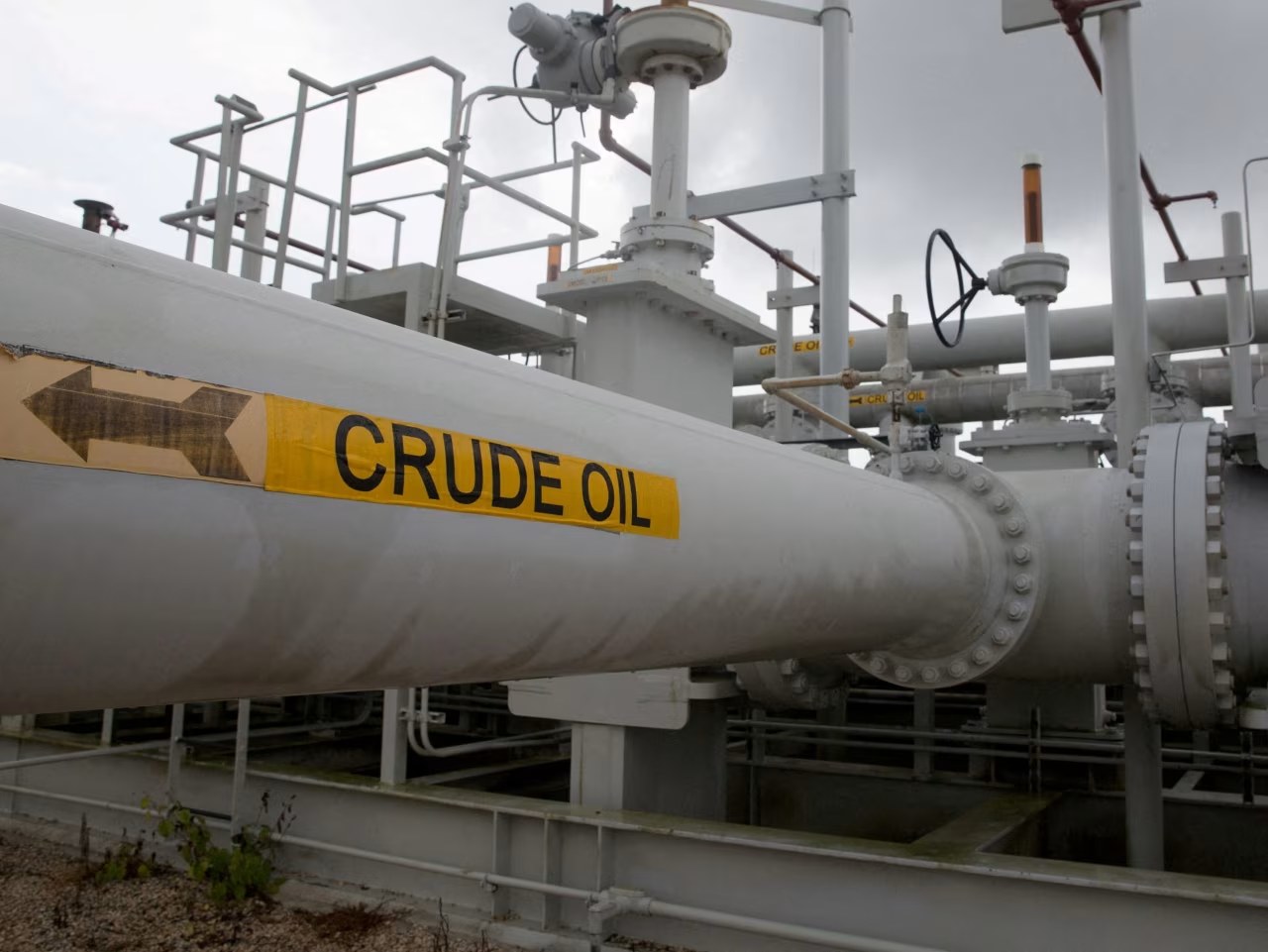
Opinion: $2 Billion in Repairs and 180 Million Barrels Later—Why the Strategic Petroleum Reserve May Be Obsolete
- The SPR has fallen to 347 million barrels, its lowest level since 1983, after political releases shaved 180 million barrels off the stockpile.
- Taxpayers face a $2 billion maintenance backlog for corroded caverns and aging pipes at four Gulf Coast sites.
- IEA data show U.S. commercial crude inventories plus surge shale output can now cover 140 days of net imports, topping the 90-day emergency obligation.
- Every SPR drawdown since 2011 coincided with West Texas Intermediate oil above $80, suggesting price management more than crisis response.
Washington’s 50-year-old oil piggy bank is running on empty—and some economists say that is exactly the right moment to retire it.
STRATEGIC PETROLEUM RESERVE—Created after the 1973 Arab oil embargo, the Strategic Petroleum Reserve was designed to keep aircraft carriers moving and factories humming during sudden import cut-offs. Half a century later, the 714-million-barrel system has morphed into a political pressure valve: presidents of both parties have ordered emergency sales when gasoline prices top $3 a gallon, not when tankers stop arriving.
Today, with domestic output above 13 million barrels a day and private storage tanks brimming, a growing chorus of market analysts argues the SPR no longer guards against shortages—it masks price signals that would otherwise spur new drilling or accelerate electric-vehicle adoption. The latest opinion piece in these pages crystallizes that argument, urging lawmakers to leave the reserve hollow rather than pour billions into refilling and repairing it.
From Embargo Insurance to Election-Year Leverage: How Politicians Repurposed the SPR
President Gerald Ford signed the Energy Policy and Conservation Act on December 22, 1975, placing the first government-owned crude into man-made salt caverns along the Gulf Coast. The objective was explicit: offset physical shortages, not tame pump prices. Yet the first test came sooner than expected. When the Shah of Iran fell in 1979, President Carter authorized a 3-million-barrel test sale—modest, but it set the precedent that Washington could tap stocks for market calming.
Fast-forward to 1991. Hours after Operation Desert Storm began, President George H.W. Bush ordered the first true emergency release—17 million barrels—to reassure allies. The episode lasted 45 days and stabilized prices. Then came 2000: with heating-oil costs soaring in the Northeast, President Clinton swapped 30 million barrels out of the reserve weeks before the election. The Government Accountability Office later concluded the swap had “minimal supply impact,” but retail gasoline fell 11 cents within a month—exactly the optics incumbents crave.
University of California energy economist Mark de Vera quantified the pattern: since 2010, 80 percent of SPR sales coincided with Brent crude above $80, while only 30 percent aligned with supply disruptions exceeding 2 percent of global output. “The reserve has become a de-facto price-management tool,” de Vera wrote in a 2023 working paper. “That distorts the very market signals needed to incentivize new production or efficiency gains.”
Politics over petroleum
The most dramatic pivot came in 2022. Confronted with $5 gasoline, President Biden ordered a 180-million-barrel drawdown—the largest in history—while citing Russia’s invasion of Ukraine. Yet U.S. net imports of crude had already fallen to 3 million barrels a day, down from 12 million in 2005, thanks to shale. Meanwhile, domestic refiners exported 3.6 million barrels daily of finished products, indicating surplus, not shortage. The episode underscores a reality Congress rarely admits: the SPR now exists partly to manage voter anger, not physical supply risk.
Looking ahead, the next president will inherit a reserve that holds barely 50 days of today’s import coverage, far below the 90-day International Energy Agency requirement. Refilling it at today’s prices would cost taxpayers roughly $25 billion. The question is whether that cash is better spent hardening the power grid or expanding fast-charging networks—measures that actually reduce oil demand rather than micromanaging its price.
The $2 Billion Repair Bill: Why Refilling the Reserve Is Pricier Than Ever
Department of Energy engineers describe the SPR as a 1970s-era car that has never had a major tune-up. Salt caverns—gigantic underground baths carved out of geologic formations—can handle cyclic temperature swings, but pipes, pumps and docks cannot. A 2021 DOE assessment found 36 percent of surface infrastructure rated “poor” or “critical,” including the only two marine terminals capable of loading supertankers. Corrosion has thinned pipe walls at Bryan Mound, Texas, to half their original thickness.
Congress appropriated $600 million in 2022 for immediate fixes, but the backlog keeps growing. According to the Government Accountability Office, replacing the 48-inch under-sea pipeline at Big Hill, Texas, alone will cost $450 million and take four years. Add cathodic protection, new booster pumps and dock upgrades, and the bill reaches $2 billion—before a single barrel is repurchased. Meanwhile, the reserve’s drawdown capability has shrunk. In 2010, the system could dump 4.4 million barrels a day onto the market; today that rate is 3.8 million, constrained by valve erosion and electrical substations that date to the Ford administration.
Interest on empty caverns
Even mothballed tanks cost money. Fixed costs—guards, electricity, inspections—run about $170 million a year, according to the Office of Petroleum Reserves budget justification. Spread across 347 million barrels, that is 49 cents per barrel annually just to keep the lights on. By contrast, private tank farms in Cushing, Oklahoma, charge 18 to 24 cents for the same service, and they invest their own capital in upgrades.
Energy analyst Rory Johnston sums up the fiscal paradox: “Taxpayers are paying to maintain a 1975 Chevy Vega while Tesla-scale innovations reshape demand.” Refilling the SPR to its 714-million-barrel statutory size at today’s WTI futures curve ($78 a barrel) would cost $29 billion, plus the $2 billion in deferred maintenance. That is more than the annual budget of the National Science Foundation—an opportunity cost lawmakers rarely weigh against the symbolic comfort of full caverns.
Can the Free Market Handle Supply Shocks Better Than Washington?
When the OPEC+ coalition slashed output by 1.7 million barrels a day in April 2023, global benchmark Brent crude jumped $6 in 48 hours. Yet within six weeks, prices retreated below pre-cut levels. The reason: U.S. shale producers activated 86 drilled-but-uncompleted wells, adding 600,000 barrels a day of new supply, while refiners drew 18 million barrels from commercial storage. The episode illustrates a structural shift that undercuts the original logic of the SPR.
Commercial crude inventories in the United States now stand at 480 million barrels, according to the Energy Information Administration, the highest March reading on record. Add the 30 million barrels of emergency gasoline and jet-fuel storage mandated in the Northeast, and private tanks can cover 115 days of net petroleum imports. That is 25 days more than the IEA’s 90-day rule, even with the SPR at half capacity.
Shale’s virtual reserve
Harvard Kennedy School’s Meghan O’Sullivan, a former deputy national security adviser, calls U.S. shale a “virtual petroleum reserve” that can ramp output 10 percent within 90 days—far faster than the SPR can conduct sales. Producers from the Permian to the Bakken have slashed drill times to 12 days per well and can bring new supply online in four to six months, compared with the multi-year lead times of offshore mega-projects in the 1970s.
Market signals, not government directives, drive those rigs. When WTI futures flip into steep backwardation—near-month contracts above远期ones—investors finance new wells because they expect tomorrow’s oil to be cheaper. Conversely, when Washington telegraphs a 180-million-barrel SPR sale, front-month prices fall and the backwardation flattens, dulling the incentive to drill. In other words, political tinkering cancels the very price rally that would cure the shortage.
Oil economist Phil Verleger calculates that eliminating the SPR would add $3 to $5 a barrel of risk premium in futures markets—modest, but enough to keep shale executives hedging and drilling. “Markets price uncertainty, not politics,” Verleger told the Dallas Fed Energy Survey. “A smaller or zero SPR makes that risk transparent rather than hidden behind political discretion.”
What Happens If Washington Simply Lets the Reserve Stay Empty?
Legally, the SPR cannot be abolished without Congress amending the Energy Policy and Conservation Act. Practically, however, the executive branch can leave it empty by refusing to appropriate refill funds. That scenario is no longer hypothetical: the Biden administration’s latest budget request contains zero dollars for crude purchases, citing “fiscal constraints.” If lawmakers acquiesce, the reserve would remain at its current 347-million-barrel low indefinitely, effectively ending its role as an emergency buffer.
Energy historian Gregory Brew says the geopolitical impact would be “symbolic but not catastrophic.” China, India and the European Union have built their own strategic stocks to 550 million, 260 million and 320 million barrels respectively. Collectively, those reserves exceed 1.1 billion barrels, enough to replace Russian exports for a year. Meanwhile, U.S. net imports have fallen so sharply that America is now a net petroleum exporter on a monthly basis—a status unthinkable when the SPR was conceived.
Fiscal dividend vs. energy security premium
Canceling the proposed refill saves $29 billion over a decade—money that could finance 60 gigawatts of offshore wind, according to National Renewable Energy Laboratory cost estimates. Conversely, the absence of a federal cushion could embed a $3-$5 risk premium in global crude prices, translating into roughly 10 cents per gallon of gasoline. Over a decade, that adds $140 billion to household fuel bills, calculates economist Verleger. Which figure looms larger depends on whether one weighs taxpayer balance sheets or consumer pocketbooks.
Refiners, for their part, are already adjusting. Valero, Phillips 66 and Marathon have expanded on-site storage by 25 million barrels since 2020, while signing long-term pipeline capacity from Cushing to Gulf Coast plants. “The private sector is building its own mini-reserves,” says Morningstar analyst Allen Good. “They don’t trust Washington to keep politics out of petroleum.”
A middle path—shrinking the SPR to a 200-million-barrel operational core—has gained traction in Senate hearings. That level satisfies the IEA obligation when combined with commercial stocks, yet slashes maintenance costs by half. It also preserves the psychological deterrent: even a modest government bid can calm panic buying during a hurricane or tanker blockage. The trade-off is political: lawmakers lose a visible lever over pump prices, conceding that markets, not bureaucrats, should allocate barrels.
Could Ending the SPR Accelerate the Shift Away From Oil Altogether?
Transportation accounts for 69 percent of U.S. petroleum consumption, and every surge in gasoline prices accelerates electric-vehicle adoption. UC Davis researchers found that a sustained 50-cent increase at the pump raises EV sales by 12 percent within 18 months. By the same token, government releases that shave 15 cents off prices delay that tipping point, locking in another cycle of internal-combustion purchases that last 12 years on average.
Eliminating the SPR would not eliminate price volatility, but it would allow spikes to persist long enough to shift consumer behavior. “High prices are the best policy for efficiency and alternatives,” former Fed chairman Alan Greenspan told a 2023 energy conference. “Artificially suppressing them merely extends the age of oil.”
Capital re-allocation
The $29 billion freed by not refilling the reserve could underwrite 7,500 fast-charging plazas—enough to cover every interstate corridor in the Lower 48, according to Department of Transportation cost benchmarks. Alternatively, the sum could fund 60 GW of offshore wind, displacing 200 million barrels of oil-equivalent natural gas burned for electricity.
Oil majors are already voting with their balance sheets. BP’s 2024 strategy update slashed exploration spending to $9 billion, down from $17 billion in 2019, while doubling EV-charging capex to $2 billion. Shell is divesting Texas shale acreage to invest in low-carbon hydrogen. Whether or not Washington keeps a federal stockpile, private capital is migrating out of petroleum; the question is how fast policy allows demand to follow.
Retiring the SPR would also remove a built-in subsidy for U.S. gasoline consumption. Because the reserve’s existence dampens price spikes, American drivers effectively enjoy a risk discount worth $10–$15 billion a year, according to a Columbia University Center on Global Energy Policy study. Ending that hidden subsidy nudges consumers toward fuel-efficient vehicles, tele-work and mass transit—choices that collectively cut oil demand faster than any release schedule.
Frequently Asked Questions
Q: How much oil is currently held in the Strategic Petroleum Reserve?
As of the latest government tally, the SPR holds roughly 347 million barrels—its lowest level since 1983—after 180 million barrels were released between 2021-2023 to curb pump prices.
Q: What does it cost to maintain the Strategic Petroleum Reserve?
Congressional Budget Office figures show annual operating costs near $200 million, plus an estimated $2 billion backlog for cavern maintenance, pipeline replacements, and corrosion repairs.
Q: Analysts note that U.S. commercial crude inventories, now at 480 million barrels, plus surge capacity from shale producers, can cover roughly 140 days of net imports—exceeding the 90-day IEA obligation.
