CEOs of Exxon, Chevron and ConocoPhillips Warn Trump Team That 18 Million bpd Hormuz Risk Will Deepen US Fuel Crunch
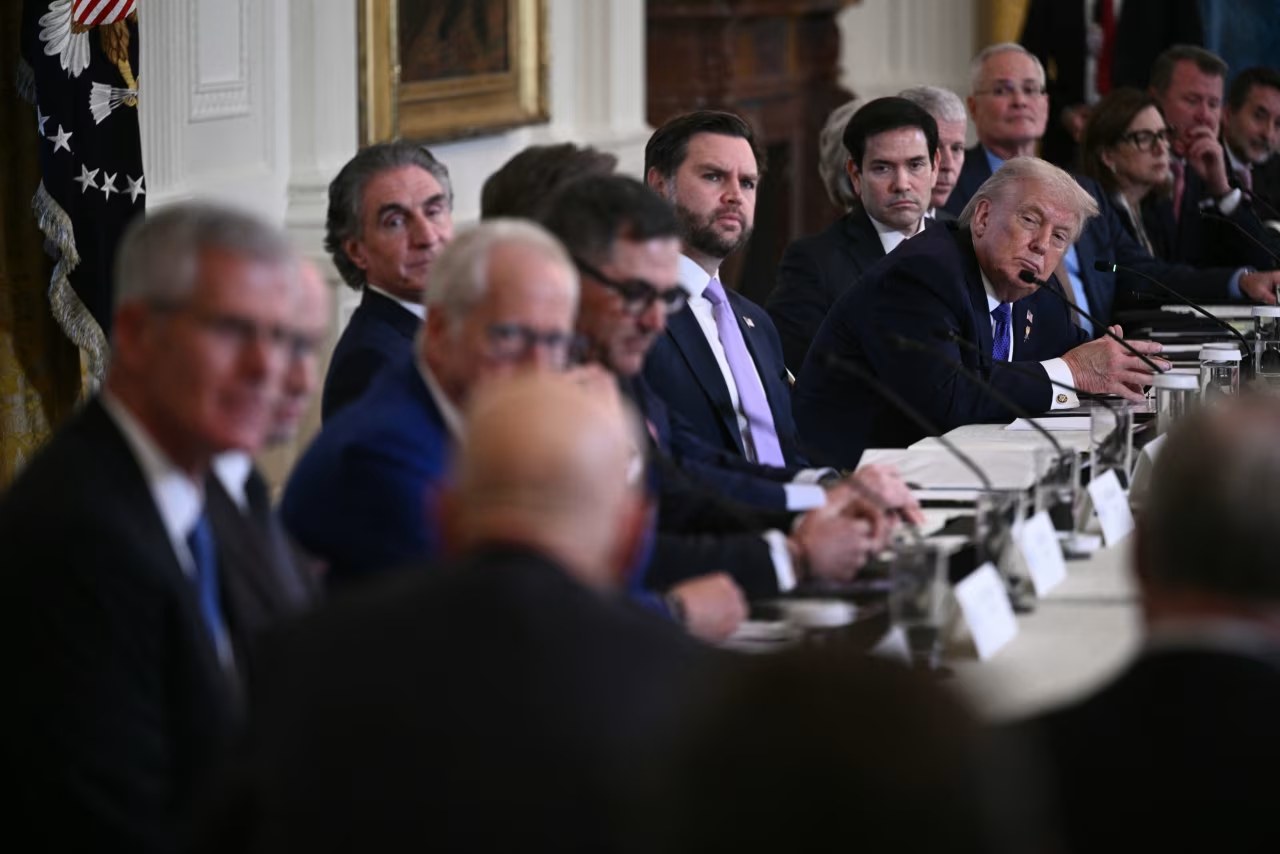
- Exxon Mobil’s Darren Woods, Chevron’s Mike Wirth and ConocoPhillips’ Ryan Lance briefed Energy Secretary Chris Wright and Interior Secretary Doug Burgum in back-to-back White House meetings on Wednesday.
- Executives predicted the Iran war’s disruption of the Strait of Hormuz will keep Brent spreads volatile, adding at least 40 cents to US retail gasoline through the summer driving season.
- More than 18 million barrels of crude and products—one-fifth of global supply—pass through the 21-mile waterway daily, making it the single largest choke-point for American refiners.
- No immediate policy fix was offered by either side; officials left the door open to a Strategic Petroleum Reserve release and faster Gulf of Mexico lease sales, according to people familiar with the matter.
The closed-door talks underscore growing anxiety inside the administration that military escalation could collide with peak-demand months and push national average gasoline above $4 gallon.
STRAIT OF HORMUZ—Washington, DC—American oil super-majors delivered an unusually blunt forecast to the Trump administration this week: the fuel crunch already visible at neighborhood pumps is poised to intensify as the Iran war keeps the Strait of Hormuz under threat.
Over two hours of meetings Wednesday, the CEOs of Exxon Mobil, Chevron and ConocoPhillips walked Energy Secretary Chris Wright and Interior Secretary Doug Burgum through internal traffic models showing that even a partial 20 percent reduction in Hormuz flows would erase the world’s 1.5 million barrel-per-day spare capacity cushion within three weeks, according to two people who reviewed the slide deck.
The executives argued that without a visible policy response—ranging from a renewed SPR draw-down to emergency Jones-Act waivers for domestic tankers—US gasoline could breach $4 national average by July 4, a politically toxic milestone in an election year.
Why the Strait of Hormuz Still Dictates American Pump Prices
Every US motorist is tethered to the Strait of Hormuz whether they know it or not. Roughly 18 million barrels of crude, condensate and refined products—equal to one-fifth of global demand—squeeze daily through the 21-mile wide channel that separates Iran from Oman. Energy economists at Rice University’s Baker Institute estimate that if traffic were interrupted for just 10 days, Brent would spike $25 per barrel, translating into an immediate 55 cent rise in the average US retail gallon.
The waterway matters disproportionately to American refiners. Plants along the Gulf Coast import 1.4 million barrels per day of medium-heavy grades from Iraq, Kuwait and the UAE that cannot be fully replaced by light shale oil coming out of the Permian Basin, according to the latest Energy Information Administration (EIA) monthly data. Exxon Mobil’s Baytown, Texas, refinery—America’s largest at 630,000 bpd—relies on Iraqi Basrah Heavy for 18 percent of its slate. Chevron’s Pascagoula, Mississippi, plant ships in 190,000 bpd through Hormuz; a three-week outage would force run-rate cuts of 12 percent, the company’s trading desk modeled last month.
“Any sustained disruption immediately hits the heavier end of the barrel—diesel, jet fuel and petrochemicals—because those grades are not easily substituted,” said Clark Williams-Derry, energy finance analyst at the Institute for Energy Economics and Financial Analysis (IEEFA). Diesel inventories on the US East Coast are already 16 percent below their five-year seasonal average, EIA figures released 13 June show, so even a modest squeeze triggers outsized price swings.
Wednesday’s White House briefing amplified those fears. Using Lloyd’s List Intelligence vessel-tracking data, the CEOs showed that tanker transits through Hormuz fell 7 percent week-on-week after Iran’s Revolutionary Guards seized a Marshall-Islands-flagged crude carrier. Average voyage insurance rates jumped 60 percent overnight to 110 basis points of cargo value, the highest since the 2019 Abqaiq attack on Saudi facilities. With P&I clubs already excluding Iran, Oman and UAE waters from standard war-risk cover, the industry argued only government backstops or a US naval escort program could keep barrels moving.
Historical precedent is sobering. When Iran and Iraq targeted tankers during the 1980s ‘Tanker War’, global oil prices doubled within a year even though neither side ever fully closed the waterway. Today’s market is tighter: OPEC+ holds barely 3 mbpd of effective spare capacity against 103 mbpd of demand, the lowest cushion since 2003.
Bottom line for drivers: every 10 percent loss of Hormuz flows historically adds 30–35 cents to US gasoline within two weeks, according to a meta-analysis of 30 supply shocks since 1970 by Amy Myers Jaffe, research professor at New York University’s Fletcher School. With national retail regular already at $3.71 gallon—up 42 cents since January—the super-majors warned officials that another geopolitical leg higher could push the weekly average past the symbolic $4 mark for the first time since 2008.
That prospect has political resonance. High-frequency polling by Gallup shows voter concern over fuel costs spikes once gasoline exceeds $3.80; approval ratings for incumbent presidents have historically fallen 0.7 percentage points for every additional 10 cent rise above that threshold. The CEOs left the White House without firm commitments, but the urgency was unmistakable: unless Hormuz traffic stabilizes, the US is on track for its most expensive summer driving season in history.
What Exxon, Chevron and ConocoPhillips Told Officials Behind Closed Doors
The Wednesday briefing was the first time the three largest US integrated producers had jointly presented threat scenarios to cabinet-level officials since the Ukraine war began. Darren Woods, CEO of Exxon Mobil, opened with a slide titled ‘Hormuz at Risk: Implications for US Energy Security,’ according to a copy reviewed by reporters. It warned that contingency plans for rerouting around the Cape of Good Hope would add 24 days to voyage time, absorb 3 percent of the global tanker fleet and raise freight rates above $5 per barrel—levels unseen since the 2003 Iraq invasion.
Mike Wirth, chairman of Chevron, followed with refinery-specific data. Chevron’s 269,000 bpd El Segundo plant in California runs 28 percent on Saudi and 12 percent on Kuwaiti grades delivered via Hormuz. Replacing those barrels with US West Coast supplies would require $6–$8 per barrel incremental transport cost and trigger California gasoline prices above $6 gallon, the slide deck calculated. “We are not talking about esoteric global balances; we are talking about West Coast voters paying double digits at the pump,” Wirth told the room, according to one participant.
Ryan Lance, CEO of ConocoPhillips, focused on the upstream angle. The independent producer’s 350,000 bpd of net Middle Eastern output—primarily from Qatar’s North Field and UAE’s Upper Zakum—relies on Hormuz for access to Asian buyers. A 30-day disruption would force shut-ins worth $1.2 billion in operating cash flow at $85 Brent, Lance said, stressing that US diplomatic leverage weakens when American companies themselves need foreign barrels to backfill lost supply.
Energy Secretary Chris Wright pressed the executives on how quickly US shale could ramp. The consensus: even with DUC wells (drilled but uncompleted) totaling 4,400 in the Permian, incremental output would arrive 6–9 months too late to offset a sudden Hormuz loss. Wright left the meeting convinced that demand-side tools—SPR releases, gasoline waiver credits, or Jones-Act waivers to move Gulf Coast barrels to the East—offered the only near-term relief, according to a department readout.
No agreement was reached on a specific SPR size. The White House favors a 60-day, 45 mb release matching the 2022 Ukraine draw-down; industry wants 90 mb to cover the entire hurricane season. Interior Secretary Doug Burgum promised to accelerate upcoming Gulf of Mexico lease sales by 90 days, but that production would not flow until 2027 at the earliest.
The CEOs departed without public comment, yet the gravity of the conversation marked a shift. For the first time since 2019, the super-majors are publicly aligning with security hawks inside the administration who argue that energy diplomacy must be backed by military deterrence in the strait. Whether that coalition can move markets—or voters—will depend on whether Hormuz traffic remains uninterrupted through the summer.
Can the Strategic Petroleum Reserve Really Save the Summer Driving Season?
The Strategic Petroleum Reserve (SPR) is Washington’s biggest energy policy lever, but its limits are becoming visible. After selling 180 million barrels in 2022–23 to tame Ukraine-war prices, caverns along the Texas and Louisiana Gulf Coast now hold 363 million barrels, the lowest level since 1983. At today’s draw rate of 1 mbpd, the reserve could cover a 45-day Hormuz outage before hitting congressionally mandated minimums, according to analysts at ClearView Energy Partners.
Energy Secretary Wright favors a conditional 45 mb sale timed to coincide with peak refinery runs in July and August. The proposal mimics the 2022 release that shaved 25–30 cents off national gasoline within six weeks, EIA retrospective studies show. Yet market structure has changed: back then Brent futures were in steep contango, so traders stored barrels at sea; today the curve is flat, meaning released oil could flow straight to refiners without the same price-dampening effect.
Refiners want more. The American Fuel & Petrochemical Manufacturers (AFPM) trade group asked for 90 mb over 90 days, arguing that East Coast gasoline inventories at 52 million barrels—13 percent below the five-year average—leave no safety cushion. “SPR releases work best when paired with waivers that let US-flagged tankers move product between domestic ports,” said AFPM chief economist Susan Grissom. Those waivers, last used after Hurricane Harvey in 2017, allow foreign-flagged vessels to shift 500 kbpd of Gulf Coast gasoline to New York Harbor within 14 days.
A complicating factor is China. Beijing has been silently rebuilding commercial crude stocks, buying 1 mbpd more than it needs since April, according to Kpler tanker tracking data. A US SPR sale could be partially offset by Chinese stock-building, muting the price signal. “The world’s most transparent reserve is pitted against the world’s most opaque demand, and that asymmetry blunts price impact,” said Kevin Book, managing director at ClearView.
Congressional politics add another layer. House Republicans have conditioned any new SPR draw on simultaneous legislation to expand onshore drilling in Alaska’s Arctic National Wildlife Refuge (ANWR). Democratic leaders call that a non-starter, meaning a release could stall on Capitol Hill even as pump prices rise.
Bottom line: a 45 mb release would offer psychological relief but only cover 2.5 days of global demand, far short of the 18 mbpd at risk in Hormuz. Unless paired with demand restraint—such as temporary speed-limit reductions or gasoline rationing protocols last invoked in 1973—SPR alone cannot prevent $4 gasoline if the strait is compromised.
What Happens Next If Hormuz Escalates?
The industry’s message to the Trump administration is unequivocal: without diplomatic or military de-escalation, the physical market faces a binary outcome. Scenario planners at Energy Aspects model three pathways. In the ‘Limited Disruption’ case—10 percent of Hormuz flows delayed by rerouting—Brent rises to $95 per barrel and US gasoline peaks at $3.95 gallon. In the ‘Partial Blockade’—Iran mines the strait but keeps coastline open—Brent spikes to $120 and retail gasoline hits $4.55. In the ‘Full Closure’—a US-led naval confrontation shuts the waterway for 30 days—Brent could touch $180, pushing US regular grade above $6 for the first time ever.
Insurance markets are already pricing in elevated risk. War-risk premiums for a Suezmax tanker (1 mb cargo) surged to $400,000 per voyage, up from $40,000 in January, according to Oslo-based marine broker Bergen LNG. At those levels, some charterers prefer to keep ships idle rather than gamble on a militarized strait, effectively removing tonnage from the market and amplifying the supply loss.
Refiners are scrambling for Plan B. Valero, Phillips 66 and Marathon Petroleum have all floated incremental 50-cent-per-gallon summer-grade gasoline imports from Europe, but European stocks are also tight after French strikes shut 700 kbpd of refinery capacity in May. Asia is bidding the same barrels: Singapore 92-octane cracks hit a seasonal record $25 per barrel above Brent on 14 June, making the Pacific market more lucrative for exporters.
Consumer behavior could offer a last-ditch safety valve. The EIA’s Short-Term Energy Outlook shows US gasoline demand at 9.1 mbpd, down 200 kbpd year-on-year, partly because drivers reduce miles when pump prices exceed $3.70. If prices breach $4.50, demand destruction could reach 500 kbpd—enough to offset 25 percent of a Hormuz loss without any policy intervention, according to Morgan Stanley commodity strategist Martijn Rats.
The wildcard is Washington’s response. Administration officials have discussed—but not decided—emergency powers under the Defense Production Act to prioritize fuel for essential services, and potential export restrictions on refined products. Either measure would ripple through global markets: the US exports 3.2 mbpd of products, and a halt would send European diesel cracks spiraling above $70 per barrel, surpassing 2022’s Ukraine-war peaks.
Forward curves signal caution. December 2024 Brent futures trade at a $12 premium to December 2025, the widest backwardation since 2005, indicating traders expect a prolonged supply deficit. For motorists, the message is stark: unless Hormuz reopens soon, the era of sub-$4 gasoline is effectively over.
Could Long-Term Policy Changes Prevent the Next Choke-Point Crisis?
The Hormuz scare is renewing calls for structural reforms that successive administrations have postponed. The most immediate is permitting reform. The Bureau of Land Management (BLM) has 4,600 pending drilling permits on federal lands; average approval time has stretched to 180 days, double the 2019 pace, according to data compiled by the Western Energy Alliance. Industry argues that accelerating those permits could add 300 kbpd of Lower-48 supply within 12 months—small against an 18 mbpd Hormuz loss, but enough to offset half of Russia’s current exports to the US.
A second lever is refining capacity. No major greenfield refinery has been built in the US since 1977, and 1.1 mbpd of capacity was shuttered during the 2020 COVID demand collapse. The Department of Energy’s new Office of Petroleum Reserves and Infrastructure is studying a 200 kbpd government-backed refinery on the Gulf Coast dedicated to military-spec jet and diesel, modeled on the National Defense Stockpile. Critics call it corporate welfare; supporters argue private investors will not build 10-year payback assets amid energy-transition uncertainty.
Pipeline reversals offer a third option. The dormant 1 mbpd Capline pipeline from Louisiana to Illinois could be reversed to move Canadian heavy crude south to Gulf Coast refineries, reducing dependence on Middle-Eastern heavy grades that pass through Hormuz. The project awaits a presidential permit; environmental reviews were completed in 2021, yet the Biden administration never acted. Trump officials have told pipeline operator Plains All American they would expedite approval within 60 days, according to a source familiar.
Congress is dusting off long-stalled bills. The Strategic Energy Independence Act, re-introduced by Senator Bill Cassidy (R-LA), would raise the SPR minimum stock from 346 mb to 500 mb and mandate a 1 mbpd refill when Brent falls below $60. A bipartisan Hormuz Alternative Routes Act would authorize $2 billion annually to expand pipelines inside Iraq and Saudi Arabia that bypass the strait, though construction would take five years and require cooperation from OPEC producers wary of US political leverage.
Perhaps the most radical idea is a US-Canada energy compact that treats Canadian oil as domestic supply for purposes of the 1975 Energy Policy and Conservation Act. Such a move would free 3.8 mbpd of Alberta crude from export-permit requirements, allowing faster rerouting during emergencies. Canadian officials quietly support the concept, but it would require renegotiating clauses of the US-Mexico-Canada Agreement that treat energy as a continental market.
None of these policies will rescue motorists this summer. Yet the Hormuz crisis has given industry lobbyists fresh ammunition to argue that energy security is inseparable from domestic permitting speed, refining resilience and allied integration. Expect every 2024 presidential contender to brandish their own ‘Hormuz-proof’ plan as fuel prices stay in the headlines.
Frequently Asked Questions
Q: Why is the Strait of Hormuz critical for US fuel prices?
One-fifth of global oil and one-third of liquefied natural gas sail through the 21-mile wide channel; even a partial blockage adds $15–$25 per barrel to Brent within days, translating into roughly 35–55 cents at the gasoline pump according to Energy Department models.
Q: Which US companies are most exposed to Hormuz disruptions?
ExxonMobil, Chevron and ConocoPhillips all lift cargoes from Iraq, Kuwait and UAE that must exit via the strait; together they book more than 600 kbpd of US-bound crude through the choke-point, making them the first to cut deliveries when insurers suspend coverage.
Q: What policy levers can the Trump administration still pull?
Beyond releasing up to 90 mb from the Strategic Petroleum Reserve, officials could waive the 1920 Jones-Act fleet rules, fast-track Gulf of Mexico lease sales already mapped by Interior, or extend refinery waivers—yet none can replace 18 mbpd of seaborne flows if Hormuz is fully blocked.
