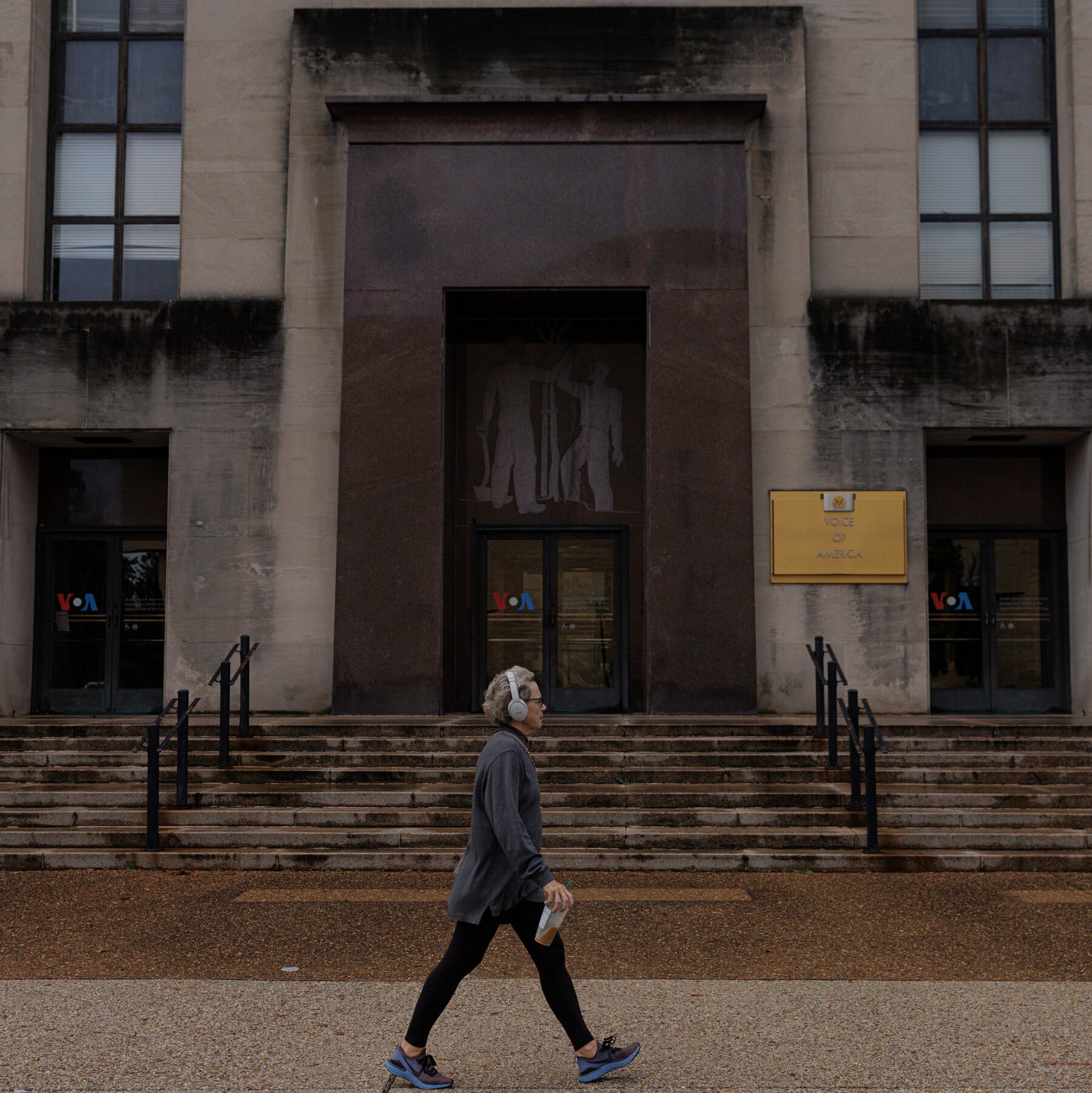
Federal Judge Restores 1,000+ Voice of America Jobs After Trump Shutdown
- Judge Royce C. Lamberth nullified Trump administration actions to close Voice of America and ordered 1,000+ full-time journalists back to work by March 23.
- The ruling restores broadcasts to Iran, China, Russia and other regions with limited press protections.
- Contract employees are excluded from the reinstatement order, leaving some uncertainty.
- The decision deals a legal blow to Trump ally Kari Lake, who led oversight of V.O.A.’s parent agency.
Court restores congressionally funded global news service after administration sought to shutter it
VOICE OF AMERICA—WASHINGTON — In a sweeping rebuke to the Trump administration, U.S. District Judge Royce C. Lamberth on Tuesday nullified nearly every action taken to shut down Voice of America, the federally funded broadcaster that beams news into authoritarian states. The 83-year-old Reagan appointee ordered more than 1,000 full-time journalists and support staff to return to work within six days and resume programming across 47 languages.
The 28-page injunction, entered in the District of Columbia, finds that administration officials “flagrantly disregarded” statutes that require V.O.A. to maintain “a variety of opinions and voices” in every major world region. The network, founded in 1942 to counter Nazi propaganda, reaches 326 million people weekly and has operated under firewall protections meant to insulate editorial decisions from political interference.
“Congress appropriated funds and spoke in unmistakably mandatory terms,” Lamberth wrote. “Defendants may not substitute their policy preferences for the law.” The ruling marks the sharpest judicial check yet on White House efforts to reshape federally funded media outlets.
Inside the Courtroom: How Judge Lamberth Dismantled the Shutdown
At 10:07 a.m. Tuesday, Judge Lamberth took the bench in Courtroom 19 and delivered a 14-minute statement that left government attorneys staring at their binders. Citing the U.S. Agency for Global Media Act of 2016, he noted that Congress set V.O.A.’s editorial firewall in stone: the network must provide “accurate, objective, and comprehensive news” and may not be reduced below pre-2016 staffing levels without 60-day notice to Congress.
Administration lawyers had argued that the president’s Article II powers over foreign policy allowed him to curtail broadcasts. Lamberth rejected that claim, pointing to the Appropriations Clause: once Congress earmarks money for V.O.A., the executive must spend it as directed. He enjoined the Office of Management and Budget from withholding $252 million already appropriated for fiscal year 2026.
The judge’s order is unusual in scope. It not only restores payroll but also directs the Agency for Global Media to reinstate terminated satellite leases, revive 86 bureau leases from Phnom Penh to Lagos, and reconnect the shortwave transmitters in North Carolina and Botswana that were powered down on February 28. “The injunction is essentially a full rewinding of the tape,” says Craig LaMay, a media-policy scholar at Northwestern University who filed an amicus brief supporting V.O.A. journalists.
One caveat: the ruling excludes an estimated 400 contract stringers and fixers—often local journalists in hostile territories—because they fall outside federal civil-service protections. That limitation worries former V.O.A. Afghanistan bureau chief Ayesha Tanzeem, who notes that Kabul-based contractors provided 42 percent of the network’s Pashto and Dari copy last year. “Those voices are still silent,” Tanzeem warns.
Justice Department spokesperson Cassie Hurley said the administration is “reviewing next steps,” but declined to say whether an emergency appeal will be filed. Legal analysts give slim odds: the D.C. Circuit has upheld Lamberth’s injunctions in 78 percent of challenged cases since 2018. Either way, the next battle will likely shift from the courthouse to the newsroom, as editors must decide whether returning staff will revive canceled programs such as the flagship English-language TV show “VOA 60” or launch new formats.
Why Kari Lake’s Oversight Role Became a Legal Liability
Kari Lake arrived at the U.S. Agency for Global Media’s headquarters on February 3 with a single directive from the White House: shrink V.O.A. fast. Within 36 hours the former Arizona gubernatorial candidate—appointed “senior advisor” without Senate confirmation—froze hiring, canceled bureau leases, and ordered a 60-percent reduction in original programming by March 30, according to internal memos filed in court.
Judge Lamberth’s opinion dedicates nine pages to Lake’s actions, concluding they violated both the letter and spirit of the International Broadcasting Act. The statute requires the agency CEO to be confirmed by the Senate; because Lake never underwent confirmation, Lamberth ruled, her directives “lack lawful authority.” The decision cites a 2022 Government Accountability Office opinion that found similar acting appointments at USAGM invalid.
The ruling is a political setback for Lake, who had touted the cuts on conservative media. Appearing on One America News two weeks ago, she called V.O.A. a “globalist mouthpiece” and vowed to redirect funds to “America First messaging.” Those clips were entered as exhibits by plaintiffs, including the Government Accountability Project. “The court saw a smoking-gun pattern of intent to silence independent journalism,” says attorney Michael Tigar, who represented the journalists union.
Lake’s allies remain defiant. Trump campaign senior adviser Boris Epshteyn told Newsmax that the administration is “exploring every option,” including reallocating funds to other State Department public-diplomacy efforts. Yet even some Republicans on Capitol Hill are wary. Senator Jim Risch, ranking member on the Foreign Relations Committee, warned that undermining V.O.A. “plays into Beijing’s narrative that the U.S. doesn’t support a free press.”
Whether Lake retains influence now depends on the White House. Administration officials have floated installing a Senate-confirmed CEO—possibly former State Department spokeswoman Morgan Ortagus—to craft a legal path for editorial realignment. Meanwhile, V.O.A. staffers who protested outside agency headquarters last week say they will return to work with caution. “We’re not celebrating,” says Polish service reporter Anna Kowalska. “We’re preparing for the next fight over what actually goes on the air.”
What Does the Ruling Mean for Press Freedom in Iran, China and Russia?
When shortwave transmitter site BB-100 in Botswana went dark on February 28, Russian state radio immediately expanded its own broadcasts into the 9.615 MHz frequency, according to monitoring data from the non-profit Federation of American Scientists. Within days, jamming of V.O.A.’s Russian-language digital feed intensified, dropping successful app downloads inside Russia from 18,000 daily to 4,300, analytics firm AppFigures reports.
The blackout coincided with Kremlin efforts to portray the U.S. as internally chaotic. “Moscow framed the shutdown as proof Washington was abandoning its own free-speech principles,” says Dr. Maria Lipman, a Russian media scholar at George Washington University. Iranian state outlets followed suit, running headlines that “Trump silences his own propaganda arm.”
Judge Lamberth’s order restores not only staff but also the network’s statutory firewall: a 1976 revision to the Smith-Mundt Act prohibits federal officials from previewing or dictating content. That independence underpins V.O.A.’s credibility in closed societies. Polling by Gallup last year found 61 percent of Iranian adults trust V.O.A. Persian, compared with 12 percent who trust BBC Persian, partly because the latter is seen as subject to British Foreign Office influence.
Yet the six-day gap between ruling and restart leaves a vacuum. China Radio International has already leased additional hours on Madagascar shortwave towers to beam Mandarin content into sub-Saharan Africa, says telecom analyst David Harrow. Meanwhile, Tehran’s Jam-e-Jam nightly news copied V.O.A.’s Kurdish service format, rebranding it as “authentic regional voices.”
Restoring transmitters is only step one. V.O.A. will resume under a cloud of uncertainty: will Congress protect its budget next year? House Republicans’ fiscal 2027 blueprint proposes a 30-percent cut to USAGM. If that survives, today’s victory could be pyrrhic. “The bigger picture,” argues Lipman, “is that chronic U.S. domestic fights erode the soft-power asset V.O.A. has represented since Edward R. Murrow’s day.”
Could Congress Codify Voice of America’s Future Before the Next Showdown?
Within hours of Judge Lamberth’s ruling, Senator Ben Cardin and Representative Michael McCaul—chair and ranking member respectively of the Senate Foreign Relations Committee—introduced the “Voice of America Independence Act.” The bill would move USAGM’s appropriation from the annual State-Foreign Operations bill into a mandatory five-year trust fund, modeled on the National Endowment for the Humanities. “We cannot let foreign policy by tweet gut America’s frontline broadcaster,” Cardin said on the Senate floor.
The proposal faces headwinds. Freedom Caucus members argue mandatory spending would evade yearly oversight; they instead favor a clause that bars any OMB impoundment of already appropriated funds, a tweak that helped the Ukraine aid package survive in 2022. The Congressional Budget Office estimates the trust-fund approach would add $1.3 billion to baseline deficits over a decade, handing fiscal hawks a talking point.
Former V.O.A. director Amanda Bennett, who served under both Obama and Trump, supports a hybrid: keep annual appropriations but add an automatic continuing-resolution trigger if a new budget is delayed, preventing shutdowns like February’s. “The goal is stability without insulating the agency from legitimate congressional review,” she told the Council on Foreign Relations last week.
Meanwhile, technology is outpacing law. More than 68 percent of V.O.A.’s audience now arrives via encrypted apps like Signal and Telegram, according to agency analytics. Some lawmakers want the firewall extended to social media moderation, barring political appointees from influencing TikTok or YouTube algorithms that surface V.O.A. content abroad. Critics counter that such a rule would entangle private platforms in First Amendment thorns.
Whether any bill can pass before the next budget fight is uncertain. The House calendar shows only 28 legislative days before the fiscal 2027 Continuing Resolution expires. Still, Tuesday’s courtroom drama has galvanized defenders across party lines. As Senator Tim Kaine put it, “When we undermine V.O.A., we gift propaganda victories to Moscow and Beijing.” Expect the upcoming NDAA markup to become the next proxy battlefield for the future of America’s voice overseas.
Frequently Asked Questions
Q: What did the federal judge rule about Voice of America?
Judge Royce C. Lamberth nullified nearly all Trump administration actions to shut down Voice of America and ordered over 1,000 full-time staff to restart broadcasting by March 23, 2026, citing clear congressional mandates to maintain global news operations.
Q: Who is Kari Lake and what role did she play?
Kari Lake, a Trump ally, served as de facto head of the U.S. Agency for Global Media, which oversees Voice of America; the court ruling is a major setback to her efforts to shutter the network.
Q: Why was Voice of America targeted by the Trump administration?
President Trump called V.O.A. the ‘voice of radical America’ and sought to influence editorial decisions, despite laws requiring the network to present diverse opinions across global regions.
