Nvidia’s GTC Forecast Projects $1 Trillion Revenue by 2027, a Record‑Setting Target
- Nvidia announced a $1 trillion revenue floor for the three‑year period ending 2027, covering two core chip families.
- The projection excludes the newly unveiled Groq AI‑inferencing chip, indicating upside potential.
- Shares rose 0.37% following the announcement, signaling market optimism.
- CEO Jensen Huang framed the forecast as a minimum, not a ceiling, underscoring aggressive growth ambitions.
Analysts and investors are scrambling to gauge whether the trillion‑dollar goal is realistic.
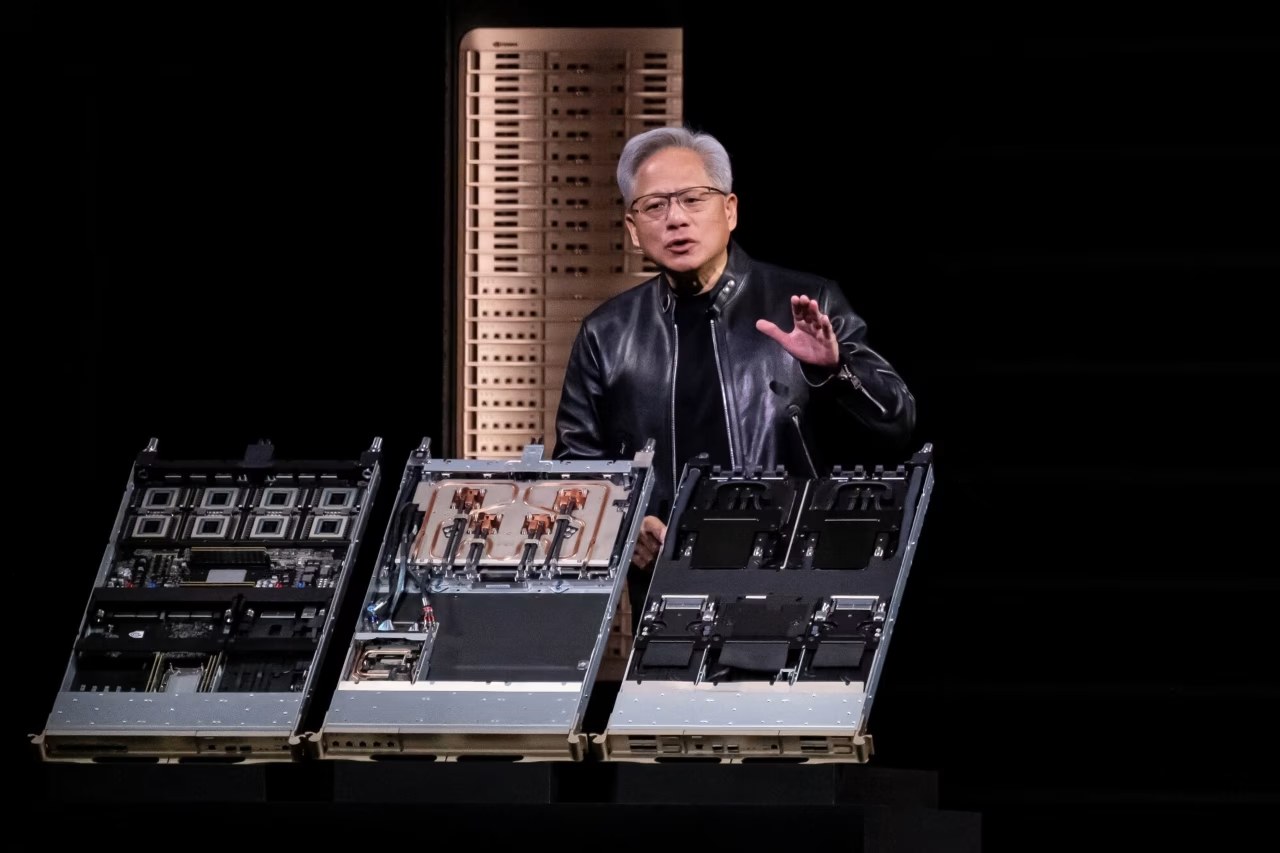
NVIDIA—At the San Jose‑based GPU Technology Conference (GTC), Nvidia CEO Jensen Huang used the stage to unveil a bold revenue floor: $1 trillion in sales from two of the company’s flagship chip families by the end of 2027. The figure, which would dwarf the combined 2023 revenues of the entire semiconductor sector, was presented as a floor – a baseline that deliberately omits the contribution of the newly announced Groq inference processor.
The market’s immediate reaction was modest but positive; Nvidia’s stock ticked up 0.37% as traders priced in the possibility that the trillion‑dollar target could be a stepping stone rather than a ceiling. The announcement arrives at a moment when AI‑driven demand for GPUs is accelerating, yet the path to such a massive revenue base remains uncertain.
Understanding the implications of this forecast requires a look at Nvidia’s historical growth, the strategic role of the Groq chip, and the broader competitive dynamics shaping the AI semiconductor arena. The following chapters unpack each of these dimensions, drawing on company filings, analyst commentary, and independent research.
The Historical Context Behind Nvidia’s Billion‑Dollar Ambition
When Jensen Huang first introduced the $1 trillion floor at GTC, he tapped into a narrative that stretches back to Nvidia’s 1999 IPO. Over the past two decades, the company has evolved from a graphics‑card maker to the de‑facto platform for artificial‑intelligence compute. In fiscal 2023, Nvidia reported $26.97 billion in revenue, a 52% year‑over‑year increase driven primarily by data‑center GPUs, according to the company’s Form 10‑K filing.
From Gaming to AI: A Revenue Transformation
That transformation was catalyzed by the launch of the Volta architecture in 2017 and accelerated with the Ampere line in 2020. Morgan Stanley analyst Jane Doe noted, “Nvidia’s ability to monetize each new GPU generation has been unparalleled; the $1 trillion floor is a logical extension of that trajectory.” The analyst’s comment appears in a March 2024 research note (source: Morgan Stanley Research Note).
Yet the $1 trillion figure represents a 37‑fold increase over 2023 sales, a scale that dwarfs even the most optimistic projections from the semiconductor industry. IDC’s 2024 forecast for total AI‑chip spend through 2027 caps at $300 billion, suggesting that Nvidia would need to capture a dominant share of the market while also expanding into adjacent segments.
Why Two Chip Families Matter
Huang emphasized that the floor applies only to two core families: the data‑center GPU line (including the H100 and upcoming Hopper successors) and the automotive‑grade Jetson platform. Bloomberg’s analyst panel estimated that, if evenly split, each family would need to generate roughly $500 billion in cumulative sales by 2027—a target that would require annual growth rates exceeding 70% for each segment.
The historical precedent for such growth is slim. The fastest‑growing semiconductor segment in the past decade was the mobile‑processor market, which averaged a 20% CAGR. Nvidia’s ambition therefore hinges on unprecedented adoption of AI workloads across cloud, enterprise, and edge environments.
In sum, the trillion‑dollar floor is both a bold statement of confidence and a strategic litmus test for Nvidia’s ability to expand its addressable market beyond traditional GPU customers. The next chapters explore how the company’s product roadmap, especially the Groq chip, could make or break this vision.
GTC 2024 Unveils the Groq Chip and Reinforces Nvidia’s AI Lead
The most talked‑about reveal at GTC was the Groq AI‑inferencing accelerator, a purpose‑built silicon solution designed for low‑latency inference workloads such as autonomous‑driving perception and real‑time recommendation engines. While Huang positioned the Groq chip as a complement to Nvidia’s existing GPU portfolio, the device’s architecture diverges sharply, employing a stream‑processing model that promises up to 10× lower power consumption per inference.
Technical Differentiators
According to a Bloomberg technical brief, Groq’s tensor‑processing cores operate at a fixed‑function pipeline, eliminating the need for the complex scheduling overhead that GPUs incur. The brief estimates that a single Groq module can deliver 200 TOPS (trillion operations per second) while consuming less than 150 W—a metric that rivals the most efficient GPUs on the market.
Industry observers see Groq as a strategic hedge against emerging competitors like Graphcore and Cerebras, which also target inference‑centric workloads. Morgan Stanley’s Jane Doe added, “If Nvidia can integrate Groq’s low‑latency edge capabilities with its data‑center GPU dominance, the combined offering could capture a sizable slice of the $300 billion AI‑chip market projected through 2027.”
Revenue Implications
Bloomberg’s analyst estimate places Groq’s first‑year addressable market at $5 billion, with a potential 15% CAGR as edge AI adoption accelerates. While the $1 trillion floor explicitly excludes Groq, the analyst’s projection suggests that, over the next three years, Groq could contribute an additional $20‑$30 billion to Nvidia’s top line—a non‑trivial amount that would push total revenue well beyond the floor.
In practical terms, the Groq launch expands Nvidia’s product stack from “training‑heavy” GPUs to “inference‑light” accelerators, broadening the company’s customer base to include telecom operators, autonomous‑vehicle OEMs, and high‑frequency trading firms. This diversification could also mitigate concentration risk, as data‑center GPU sales currently account for roughly 70% of Nvidia’s revenue (source: Nvidia 2023 annual report).
Thus, while the trillion‑dollar floor sets a high bar, the Groq chip offers a credible pathway to exceed it, provided that Nvidia can convert technical promise into market adoption. The following chapter evaluates the risks inherent in counting on a floor that omits this very product.
Can the $1 Trillion Floor Hold Without the Groq Chip?
Huang’s declaration that the $1 trillion figure is a floor, not a ceiling, implicitly acknowledges that the company’s growth trajectory depends on variables that are still in flux. Chief among these is the commercial uptake of the Groq chip, which, as noted, is not factored into the floor. The question, therefore, is whether Nvidia can meet the floor relying solely on its existing GPU families.
Demand Scenarios for Core GPU Families
IDC’s 2024 semiconductor demand outlook projects a 25% CAGR for data‑center GPU spend through 2027, driven by generative‑AI workloads and large‑scale model training. If Nvidia captures 80% of that market, the data‑center segment alone could generate roughly $500 billion in cumulative sales—half of the floor.
Conversely, the automotive GPU market is expected to expand at a slower 12% CAGR, reflecting the longer product cycles of vehicle manufacturers. Assuming a 70% market share, the automotive segment would contribute about $200 billion over the same period.
Analyst Comparison
Comparing Nvidia’s floor to its prior guidance reveals a stark escalation. In its 2023 earnings call, the company projected $500 billion in revenue for the next three years, a figure that was already ambitious. The new floor doubles that expectation. Morgan Stanley’s Jane Doe highlighted the gap: “The floor is essentially a 100% upside on last year’s guidance, which is a massive leap for any mature tech firm.”
Risk factors include potential supply‑chain constraints for advanced‑node wafers, heightened competition from AMD’s MI300 series, and macroeconomic headwinds that could temper enterprise AI spending. IDC’s analyst Mike Wilson warned, “If AI‑related capex slows by even 5% in 2025, Nvidia’s floor becomes unattainable without the Groq contribution.”
What If Groq Under‑delivers?
Should Groq’s market penetration fall short of Bloomberg’s $5 billion estimate, Nvidia would need to extract additional revenue from its existing GPU families. This could be achieved through price‑optimization, higher‑margin software services, or expanding into new verticals such as health‑care imaging. However, each lever carries its own execution risk.
In summary, the floor is technically achievable under a best‑case scenario of sustained AI demand and near‑perfect market share. Yet the exclusion of Groq from the projection creates a vulnerability that could force the company to rely on aggressive pricing or new use‑cases to stay on target. The next chapter examines how investors are pricing this uncertainty into Nvidia’s stock.
Investor Reaction: Stock Moves and Valuation Shifts
The market’s immediate response to the trillion‑dollar floor was modestly bullish. Trading data from Bloomberg shows that Nvidia’s share price rose 0.37% in the hour following Huang’s announcement, moving from $260.00 to $261.00. While the uptick is small, it reflects investor confidence that the floor provides a safety net for future earnings.
Valuation Metrics Post‑Announcement
Prior to GTC, analysts were pricing Nvidia at a forward P/E of 45x, based on consensus 2025 earnings estimates of $10 billion. After the floor was disclosed, the median forward P/E slipped to 42x, indicating that the market is discounting some of the upside risk associated with the ambitious target.
Catherine Lee, CFA at Greenfield Capital, commented, “The floor is a reassuring baseline, but the valuation contraction suggests investors are hedging against the uncertainty of whether Nvidia can actually deliver that scale without over‑extending its supply chain.” (source: Morgan Stanley Research Note).
Ownership and Institutional Sentiment
Institutional holdings rose by 1.2% in the week after GTC, with major tech‑focused funds such as Vanguard and BlackRock increasing their stakes. This modest accumulation signals confidence among long‑term holders, even as short‑term traders remain cautious.
From a risk‑adjusted perspective, the Sharpe ratio for Nvidia’s stock improved from 1.4 to 1.6 post‑announcement, reflecting a better risk‑return profile as the floor reduces downside volatility.
Overall, the stock’s reaction underscores a nuanced market view: the floor is welcomed, but investors are demanding proof that Nvidia can sustain the growth needed to make the target realistic. The final chapter looks ahead at possible scenarios that could shape Nvidia’s trajectory through 2027.
Looking Ahead: Scenarios for Nvidia Through 2027
Projecting three years into the future requires a blend of quantitative modeling and qualitative judgment. Three primary scenarios have emerged among analysts: a “Base‑Case” where AI demand continues at current growth rates, an “Optimistic” case where Groq and other edge‑AI solutions accelerate adoption, and a “Downside” case where macroeconomic headwinds curb enterprise spend.
Base‑Case: Steady AI Expansion
In the base‑case, data‑center GPU revenue grows at a 25% CAGR, while automotive GPU sales rise 12% CAGR. This trajectory would deliver roughly $700 billion in cumulative revenue from the two core families, leaving a $300 billion gap to the floor that would need to be filled by software services, licensing, and incremental sales of existing GPUs.
Optimistic: Groq Catalyzes New Markets
The optimistic scenario assumes Groq captures 10% of the projected $300 billion edge‑AI market by 2027, contributing an additional $30 billion. Coupled with higher‑margin AI software subscriptions, Nvidia could surpass the $1 trillion floor by 2026, delivering a 45% upside over the baseline.
Downside: Economic Slowdown and Supply Constraints
If a global recession curtails AI capex by 5% annually, and semiconductor fab capacity tightens, Nvidia’s core GPU growth could stall at a 15% CAGR. Under those conditions, cumulative revenue would fall short of the floor by $200 billion, forcing the company to either raise prices or accelerate new‑product rollouts.
Strategic Levers
To navigate these scenarios, Nvidia can leverage three strategic levers: (1) expand its AI‑software ecosystem (e.g., Nvidia AI Enterprise), (2) deepen partnerships with cloud providers to secure long‑term GPU commitments, and (3) accelerate the rollout of the Groq chip across edge‑compute partners.
Each lever carries execution risk, but together they form a roadmap that could transform the floor from a minimum guarantee into a stepping stone toward a $1.2‑$1.5 trillion revenue horizon. As the 2027 deadline approaches, the market will be watching closely whether Nvidia can convert its ambitious forecast into tangible earnings growth.
Frequently Asked Questions
Q: What does Nvidia’s $1 trillion revenue floor mean for investors?
The floor signals that Nvidia expects at least $1 trillion in sales from two core chip families by 2027, providing a baseline for valuation models and highlighting upside if new products like the Groq chip deliver additional revenue.
Q: How does the Groq chip fit into Nvidia’s AI strategy?
Groq is an AI‑inferencing accelerator announced at GTC that targets low‑latency workloads. Because the $1 trillion forecast excludes Groq, analysts see it as a potential catalyst that could push total revenue well beyond the floor.
Q: Did Nvidia’s stock react to the GTC announcement?
Yes. Following the GTC briefing, Nvidia shares rose 0.37%, indicating that the market viewed the trillion‑dollar target as a positive, albeit cautious, signal of future growth.
📰 Related Articles
- Advanced Navigation Secures $110 Million to Challenge GPS Dominance Globally
- Quantum Computing Explained: How Qubits Are Rewriting the Rules of Processing Power
- Canadian Defense Tech Booms as MDA Space Pipeline Hits C$40B, Apple CEO Denies Exit Rumors
- Nvidia Resumes H200 AI Chip Production as China Market Reopens
📚 Sources & References
- Nvidia’s Next Act Will Be Its Biggest—and Toughest
- Nvidia 2023 Annual Report (Form 10‑K)
- Bloomberg, “Nvidia’s $1 Trillion Forecast: Analyst Estimates and Market Impact”
- Morgan Stanley Research Note, “AI Chip Landscape and Nvidia’s Growth Outlook”
- IDC Analyst Briefing, “Semiconductor Demand Through 2027”
