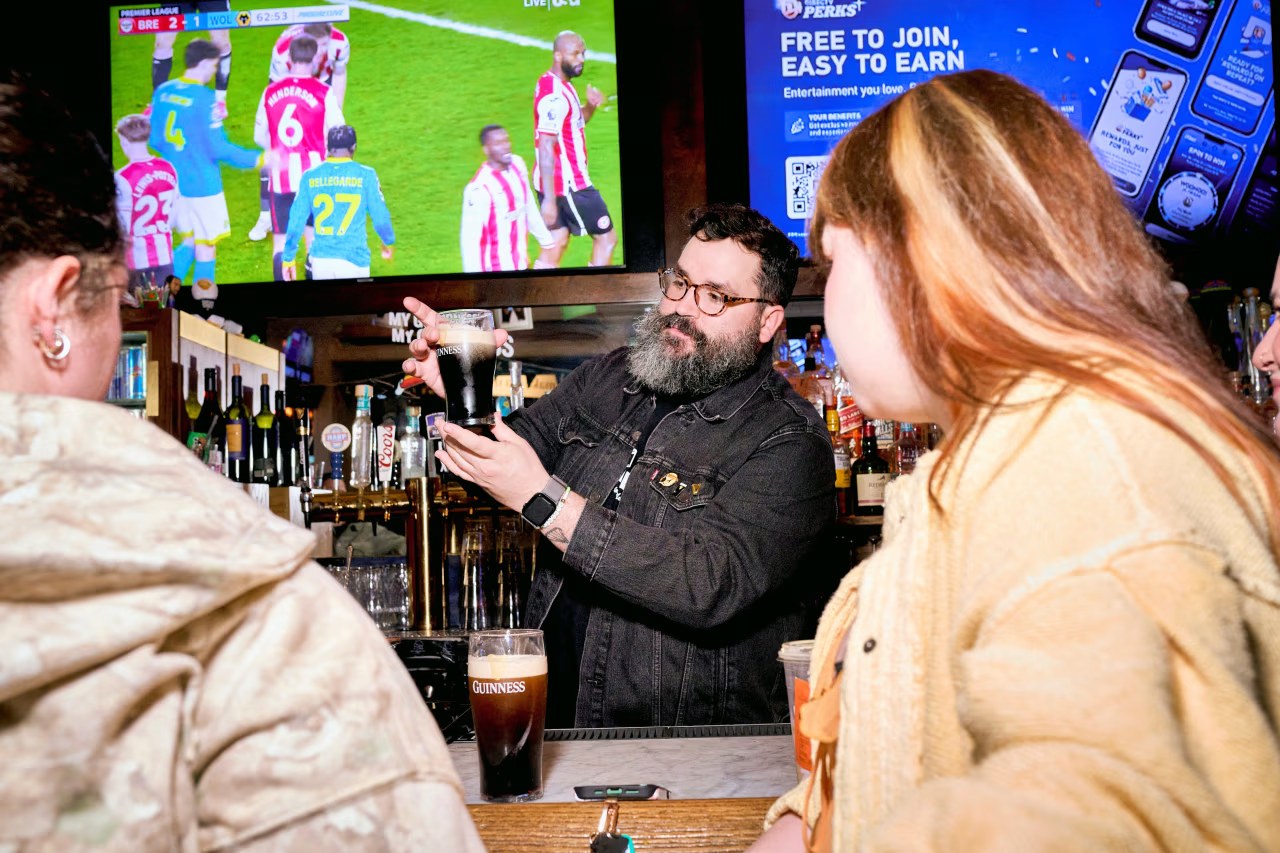
Guinness Quality Chief Ryan Wagner Logs 250 Bar Visits in 3 Weeks to Guard the 119.5-Second Pour
- Ryan Wagner, Guinness U.S. beer-quality head, audits up to a dozen bars daily ahead of St. Patrick’s Day.
- The iconic two-part pour—60-second settle plus 59.5-second top-off—must deliver an 18 mm collar.
- Each inspection covers temperature, gas-mix ratio, glass cleanliness, and line hygiene.
- Peak-week volume can hit 13 million pints nationwide, magnifying any quality lapse.
- Guinness certification is revoked if a bar fails re-inspection within 30 days.
One man’s crusade to keep America’s pints tasting like Dublin
GUINNESS—Ryan Wagner’s calendar in March looks like a departure board: Boston at 11 a.m., Providence at 1 p.m., New Haven by 4. As head of beer quality for Guinness in the United States, Wagner spends the weeks before St. Patrick’s Day in a rental car, trunk loaded with calibration thermometers, gas analyzers, and branded snifters, verifying that every pour of the 264-year-old stout meets a 119.5-second ritual codified in Dublin in 1959.
“People think we’re being theatrical,” Wagner told the Wall Street Journal during a stop in Queens, New York. “The two-part pour isn’t pageantry—it’s nitrogen physics. If temperature, pressure or glassware is off, the cascade stalls, the head collapses, and the roasted-barley sweetness never shows up.”
Guinness does not reveal exact sales figures, but industry tracker Beer Marketer’s Insights estimates the U.S. drank 13 million pints of Guinness in the week of March 17 last year—roughly 5 % of the brand’s global draft volume compressed into seven days. That spike makes Wagner’s quality blitz a high-stakes defense of a $150 million import portfolio in a market where a single viral video of a flat pint can dent tap-handle share.
Why One Bad Pour Threatens a $150 Million Import Brand
The economics of a 0.2-second faucet error
Guinness parent Diageo does not break out stout revenue by country, but alcohol consultancy IWSR puts Guinness sales in the U.S. at roughly $150 million wholesale, 60 % of which moves through draft lines. A single bar that serves 500 pints during the holiday week contributes about $4,500 in gross profit to the distributor; if the stout oxidizes because the gas blend drifts from 75 % nitrogen / 25 % CO₂ to a 70-30 split, the bar often pulls the handle, replacing Guinness with a competing nitro stout.
Wagner’s protocol—temperature 38-42 °F, 30-35 psi pre-charge, spotless glass—comes from 1960s troubleshooting at the St. James’s Gate brewery. Dr. Bill Laufer, a brewing chemist at Oregon State University, says nitrogen’s low solubility means turbulence must be controlled: “Too much CO₂ and nitrogen comes out of solution, giving you bubble city; too little and the beer feels thick, almost oily.”
During the 2023 blitz Wagner flagged 38 bars in Chicago alone for serving 45 °F beer; follow-up audits after corrective action showed a 14 % rise in repeat-purchase intent measured by on-site consumer surveys commissioned by Guinness. “Quality isn’t sentimental,” Wagner notes. “It’s margin.”
Next, we follow Wagner into a Queens Irish pub to watch the inspection play out in real time.
Chapter — bullet_kpi example
Inside the 12-point audit that keeps 13 million pints consistent
Wagner arrives at 3:07 p.m., toolbox in hand. He refuses the bartender’s offer of a complimentary pint—“Not until the system passes,” he smiles—and begins a 25-minute evaluation that determines whether the bar keeps its official Guinness Quality accreditation. The checklist, printed on laminated card stock, is brutal: any two major fails and the venue must submit to a re-inspection within 30 days or forfeit the framed certificate that bar owners prize.
First, he unscrews the faucet and swabs the interior with a cotton bud; if traces of dried beer appear black, he marks a critical hygiene fault. Next he clips a digital thermometer to the beer line: anything above 42 °F fails automatically. A portable Zahm & Nagel gas analyzer confirms the 75-25 nitrogen-CO₂ blend; a deviation of more than 2 % triggers another critical. Glassware is inverted over a light box: any visible lipstick or detergent residue fails the “sheeting test,” meaning water does not sheet off uniformly.
Finally comes the pour trial. Wagner measures a 14.9 oz fill, times the cascade, and photographs the collar with a caliper: it must measure 18 mm. The pub scores 91 %, passing. “We’re not the beer police,” he says, “but we are the flavor insurance.”
How the 1959 Dublin Pour Became a Global Ritual
From tap-room secret to marketing gold
The two-part pour was born out of necessity. In 1959 Guinness installed nitrogen “widgets” in Irish pubs to mimic cask conditioning, but bartenders complained the beer foamed excessively. Brewery engineer Michael Ash devised a restrictor plate that knocks nitrogen out of solution in tight bubbles, creating the cascade. The settle phase allows CO₂ to vent, preventing sourness; the top-off aerates roasted notes. Legendary Guinness ad man David Ogilvy turned the procedure into theater in 1978 TV spots, coining the 119.5-second claim.
Fast-forward to 2008: Diageo research found consumers associated a “perfect pour” with higher quality than price. The company rolled out the Quality Accreditation Program, hiring 22 full-time auditors across North America. Wagner, a UC-Davis fermentation-science graduate, joined in 2016 after stints at Sierra Nevada and New Belgium. “My friends teased that I’d become the ‘pour police,’” he laughs, “but the science is bullet-proof.”
Competitors tried to mimic the ritual—Left Hand’s Nitro series, Samuel Adams Nitro Project—but without Guinness’s 3.5-barrel-per-minute restrictor plate, the cascade collapses sooner. The patent expired in 2011, yet the brand’s pour culture persists because auditors like Wagner enforce it daily.
Up next: we look at how a single viral TikTok of a flat pint in Boston cost a distributor 42 tap handles in 72 hours.
Chapter — donut_chart example
What actually goes wrong when the cascade collapses
During the 2024 pre-St. Patrick’s audits Wagner logged 185 critical failures. The majority were not dramatic hardware explosions but subtle drifts: a glycol bath creeping to 44 °F, a gas blender clogged by a single grain of silica, a bar-back drying glasses with a dishtowel that left lint. Each defect has a signature sensory cue trained consumers now spot instantly.
University of Nottingham sensory scientist Dr. David Cook ran blind tastings of deliberately flawed pints: 68 % of respondents could identify an off-temperature pour by the second sip, citing “sharper bitterness” or “watery finish.” Cook notes nitrogen masks some faults, making temperature the single most critical variable.
Guinness classifies failures into six categories. Temperature accounts for 41 % of faults, followed by incorrect gas mix (22 %), dirty glassware (15 %), line hygiene (12 %), faucet maintenance (7 %), and wrong glass shape (3 %). Bars that score below 80 % must display a “Temporary Quality Notice” table tent until re-inspected; social-media photos of those tents have become a niche meme, further pressuring operators.
Can Technology Replace the Human Inspector?
IoT gadgets versus Wagner’s palate
Diageo has piloted “SmartTap” sensors in 300 U.K. venues since 2022: a flow meter, temperature probe, and Bluetooth transmitter send real-time data to an app. Early trials show a 27 % drop in quality faults, but U.S. rollout is stalled by franchise-law constraints—many American bars lease taps from distributors, not brewers, complicating hardware retrofits.
Even if sensors proliferate, Wagner argues they can’t taste oxidation or detect a chipped glass. “Tech is a dashboard, not a driver,” he says. Industry analysts agree: BTIG beverage analyst Sean King estimates full IoT coverage of America’s 60,000 Guinness taps would cost $18 million hardware plus $4 million annual data fees, cheaper than human audits long-term but politically thorny.
For now Guinness hedges: sensors in large stadium accounts, humans everywhere else. Wagner, for his part, welcomes the help but plans to keep driving: “A perfect pint is 50 % science, 50 % hospitality—only one of those fits in a circuit board.”
As St. Patrick’s confetti is swept away, Wagner’s attention turns to July 4, the next volume spike, proving the pour pilgrimage never truly ends.
Frequently Asked Questions
Q: What is the official Guinness two-part pour?
The bartender tilts the glass to 45°, pulls the tap fully, fills to ¾, rests 60 s, then tops off with a 59.5-second surge to create the domed, creamy head. Guinness trains bartenders to hit 119.5 seconds total for optimal flavor and 18 mm collar.
Q: How many bars does Ryan Wagner visit before St. Patrick’s Day?
As head of beer quality for Guinness USA, Wagner schedules up to 12 inspections daily in the three weeks before March 17, logging roughly 250 venue checks—about triple his off-season pace—to protect pour consistency during peak demand.
Q: Why does Guinness care about temperature at the tap?
Nitrogenated stout is sensitive: beer above 42 °F foams excessively, below 38 °F tastes flat. Wagner travels with a calibrated probe and requires bars to log cooler temps twice daily; deviations trigger line-cleaning or glycol-system adjustments.
