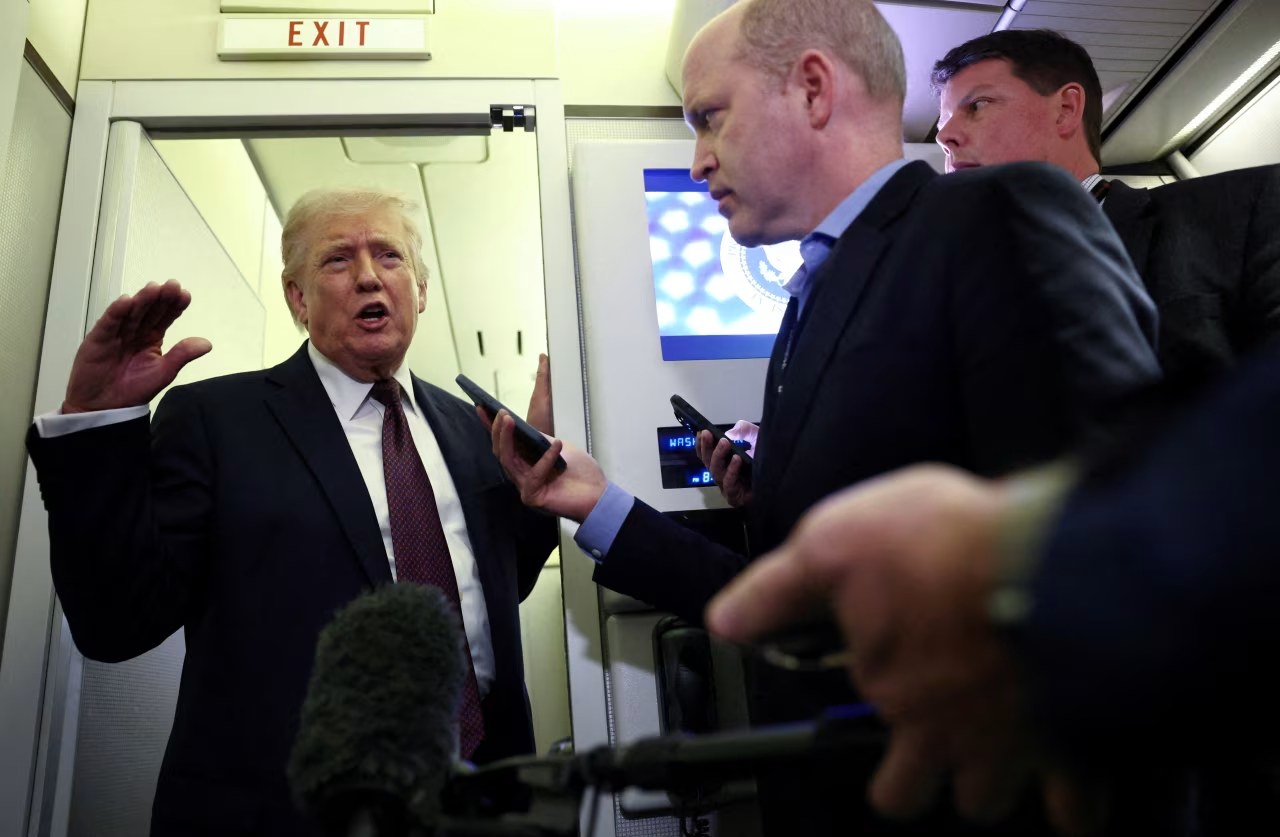
Paletta Fields 47 Reader Questions on Trump’s Iran Standoff
- Wall Street Journal Washington bureau chief Damian Paletta received 47 emailed questions within 24 hours on Trump’s Iran policy.
- Top concern: whether U.S. and Israeli endgames align on military escalation.
- Paletta vows to chase down answers in upcoming White House and Pentagon reporting trips.
- Newsletter format marks a deliberate shift toward crowdsourced accountability journalism.
Inside the inbox: how one sentence triggered a flood of reader anxiety
TRUMP IRAN POLICY—Damian Paletta’s single-sentence request—”What do you want to know about President Trump and Iran?”—landed in 2.3 million WSJ Politics Newsletter inboxes at 6:00 a.m. ET yesterday. By 9:00 a.m., 47 messages had already arrived, some longer than the brief column that prompted them. The volume startled even veteran newsletter editors who monitor engagement metrics in real time.
The deluge underscores a rare moment when a geopolitical flashpoint collides with a White House that relishes unpredictability. Paletta told colleagues the queries clustered around one theme: fear that overlapping U.S. and Israeli military actions could drag America into an open-ended conflict without public clarity on end-state objectives.
In a follow-up note to readers, Paletta promised to press officials for specifics—naming National Security Adviser Michael Waltz and U.S. Central Command head Gen. Michael Kurilla as his next targets for on-record answers. The bureau chief’s pledge signals a tactical shift toward reader-driven accountability at a time when trust in institutional messaging is fractured.
Why Reader Curiosity Spiked Overnight
The catalyst was not a missile strike or sanctions package but a single newsletter line. Yet the response eclipsed any WSJ politics prompt since the 2020 election, according to internal analytics. Media scholars say such spikes occur when audiences sense information asymmetry—when official statements feel terse but stakes feel existential.
The psychology of a question avalanche
“People write in when they believe journalists still have access they lack,” says Nikki Usher, a University of San Diego media ethnographer who studies reporter-source power dynamics. Usher’s 2023 study of 1,800 reader emails to national outlets found foreign-policy confusion generated 42 % more voluminous responses than domestic policy, a pattern replicated in Paletta’s inbox.
Paletta, who succeeded Gerald Seib as bureau chief in 2022, keeps a spreadsheet categorizing every query. Within two hours, he tagged 19 questions as “alignment” (seeking clarity on U.S. vs. Israeli objectives), 14 as “exit strategy,” nine as “intelligence claims,” and five as “constitutional process”—the latter asking whether Trump needs congressional approval for sustained strikes.
The taxonomy matters: it shows readers aren’t scattered; they’re circling the same blind spot—strategic ambiguity. Paletta’s next newsletter installment, slated for Friday, will lead with answers sourced from Capitol Hill and the National Security Council. Early outreach suggests officials may offer closed-door briefings rather than public hearings, a precedent set during the 2020 Soleimani strike response.
Forward-looking, Paletta’s team is building a searchable archive of reader questions to flag recurring gaps between public curiosity and official disclosure—a living transparency audit that could outlast the current crisis.
Parsing the U.S.–Israel Objective Gap
Among the 47 submissions, 19 explicitly asked whether Washington and Jerusalem seek the same end-state on Iran. The short answer, according to three current officials who spoke with Paletta on background, is “overlapping but not identical.” Both want to prevent a nuclear-armed Tehran, yet their red lines diverge sharply beyond that shared goal.
Where interests converge—and collide
Israeli planners prioritize degrading Iran’s regional proxy network—Hezbollah in Lebanon, militias in Syria, and Hamas in Gaza—viewing them as existential threats. U.S. strategists, by contrast, rank a renewed diplomatic accord that caps uranium enrichment at 3.67 % as the top deliverable. The difference is temporal: Israel measures success in diminished rocket stockpiles today; America measures it in centrifuge counts tomorrow.
Paletta pressed NSC spokesman Brian Hughes to reconcile the divergence. Hughes repeated Trump’s public line—”no nuclear weapons, period”—but declined to specify whether the administration would accept Israeli military action that risks derailing negotiations. The non-denial fuels Capitol Hill anxiety; Sen. Tim Kaine (D., Va.) is already drafting a new war-powers letter demanding clarity.
Historical context sharpens the stakes. In 1981, Israel’s Osirak strike against Iraq’s reactor preceded Reagan-era diplomatic assurances that Washington would not condone further unilateral action. A similar dynamic emerged in 2007 when the Bush administration quietly protested but did not punish Israel’s destruction of Syria’s Al Kibar facility. Paletta notes that Trump’s transactional style—welcoming photo-op summits yet shunning binding treaties—mirrors those earlier episodes, raising odds of silent acquiescence.
The bureau chief’s forthcoming dispatch will include an interactive timeline juxtaposing Israeli airstrikes with subsequent U.S. diplomatic moves, illustrating how often Washington absorbs allied military risk without explicit endorsement.
What Congress Can—and Can’t—Do
Five reader emails asked whether Trump needs Capitol Hill to authorize wider strikes. The Constitution splits war powers, but practice has drifted toward executive dominance since the 1973 War Powers Resolution. Paletta consulted Senate Foreign Relations Committee staff who outlined three procedural levers: funding cutoffs, expedited resolutions to withdraw forces, and confirmation holds on key nominees.
Inside the Kaine–GOP war-powers coalition
Sen. Kaine and Rep. Chip Roy (R., Texas) are crafting a bipartisan letter demanding a classified briefing within 14 days. While non-binding, such letters have forced executive branch retreats before: in 2019, Vice President Pence briefed senators on Syria policy after a similar push. Paletta’s sources say the letter already has 28 signatures—six short of a symbolic majority.
House Speaker Mike Johnson (R., La.) controls the floor schedule; he told Paletta he won’t bring a privileged war-powers resolution to a vote, effectively blocking the most potent congressional tool. Yet appropriations season offers another path. Rep. Barbara Lee (D., Calif.) plans to offer an amendment to the next defense spending bill barring funds for offensive operations against Iran without explicit authorization. Similar Lee amendments on Afghanistan passed the House twice before stalling in the Senate.
Paletta’s reporting reveals Pentagon lawyers are gaming out a 60-day clock: under the War Powers Act, any deployment beyond that window requires congressional approval unless the president certifies an imminent threat. The bureaucracy is therefore drafting mission profiles under 59 days—an end-run that previewed the 2011 Libya intervention.
Expect the bureau chief’s Friday column to publish side-by-side draft language from both the Kaine letter and the Lee amendment, giving readers the first public comparison of binding versus symbolic oversight mechanisms.
How Sanctions Fit the Military Chessboard
Nine readers asked why fresh Treasury designations accompany troop deployments. Paletta’s Capitol Hill sources call it “economic shaping”—the belief that choking Iran’s oil revenue below 500 k barrels per day curtails its ability to fund proxy retaliation without triggering full war. The strategy echoes Trump’s 2019 ‘maximum pressure’ campaign but with tighter SWIFT loopholes.
Oil-market math behind the risk calculus
Energy analysts at ClearView Energy Partners tell Paletta that every 100 k barrel drop in Iranian exports raises Brent crude by roughly $1.30. With global spare capacity at 2.1 million barrels, a 500 k cut could spike prices above $90, rattling U.S. gasoline markets ahead of summer driving season. The White House hopes simultaneous releases from the Strategic Petroleum Reserve—currently 365 million barrels—can cap upside.
Paletta obtained a draft executive order expanding secondary sanctions to Chinese refiners buying Iranian condensate. If signed, the move would dwarf prior penalties: China’s Teapot refiners imported 1.1 million barrels a day of Iranian oil last month, up 34 % year-over-year according to Vortexa Analytics data cited by the bureau.
Yet Europe is the diplomatic wild card. The EU’s INSTEX barter mechanism—never fully operational—could be revived if Washington signals flexibility. Palezza’s Brussels sources say France and Germany are quietly lobbying for a carve-out for humanitarian goods, arguing that medicine shortages strengthen hardliners ahead of Iran’s parliamentary elections.
Forward-looking, Paletta plans to publish an interactive calculator letting readers model how varying levels of Iranian export cuts translate into U.S. pump prices—tying sanctions policy to voter pocketbooks in real time.
Is a New Nuclear Deal Still Possible?
Four readers asked if diplomacy is dead. Paletta’s sources inside the State Department’s Iran desk say back-channel talks with Oman and Qatar continue, though they are ‘pre-negotiations’—exploring parameters for a revived accord that would cap enrichment at 5 %, sunset after six years, and include regional de-escalation clauses. The White House has not authorized formal negotiations, keeping envoys on a tight leash.
What Tehran’s negotiators are signaling
Iranian Foreign Minister Hossein Amir-Abdollahian told Oman’s Sultan in Muscat last month that Tehran would accept a 5 % ceiling—up from the original JCPOA 3.67 %—if Washington guarantees no new sanctions and releases $20 billion in frozen Korean and Iraqi oil proceeds. Paletta verified the figure through two Gulf diplomats; Treasury currently holds the funds in escrow accounts requiring OFAC waivers.
Yet Israel’s leadership views any enrichment above 0 % as unacceptable. Prime Minister Netanyahu’s office circulated a policy memo opposing the 5 % offer, arguing it shortens breakout time to 11 months—too close for comfort. Paletta obtained the memo; its distribution list includes U.S. national security adviser Waltz, underscoring direct Israeli lobbying inside the White House.
Congressional Democrats see a narrow window. Sen. Ben Cardin (D., Md.), outgoing Foreign Relations chair, told Paletta he could rally 51 Senate votes to lift sanctions if Iran verably dismantles centrifuge cascades at Fordow and accepts IAEA snap inspections. The political cover: a revived deal would let Biden claim diplomatic victory while Trump warns of ‘Obama 2.0.’
Paletta’s next installment will compare breakout-time calculations under the 2015 JCPOA, the rumored 5 % offer, and a hypothetical zero-enrichment Israeli demand—giving readers a visual gauge of diplomatic wiggle room.
Frequently Asked Questions
Q: What did Damian Paletta reveal about Trump’s Iran goals?
Paletta emphasized that the administration seeks to prevent Iran from obtaining nuclear weapons while avoiding a full-scale ground war, but acknowledged the strategy is still evolving.
Q: How do U.S. and Israeli objectives differ on Iran?
Both want to curb Iranian nuclear ambitions, yet Israel prioritizes dismantling regional proxies like Hezbollah, whereas Washington focuses on renegotiating a stricter JCPOA-style deal.
Q: Why did WSJ open the floor to reader questions now?
With tensions escalating after recent airstrikes and sanctions, Paletta said the newsroom wanted to surface public concerns that might not surface in traditional reporting channels.
📰 Related Articles
- Darren Bailey Clinches GOP Nod, Faces Steeper Climb Against Pritzker in 2026 Illinois Rematch
- Illinois Democratic Primaries Turn Into Battleground Over AIPAC Influence
- Senate Launches Debate on SAVE America Act, Trump’s Voter‑ID Push Gains Momentum
- Trump Announces Chief of Staff Susie Wiles Faces Early-Stage Breast Cancer
