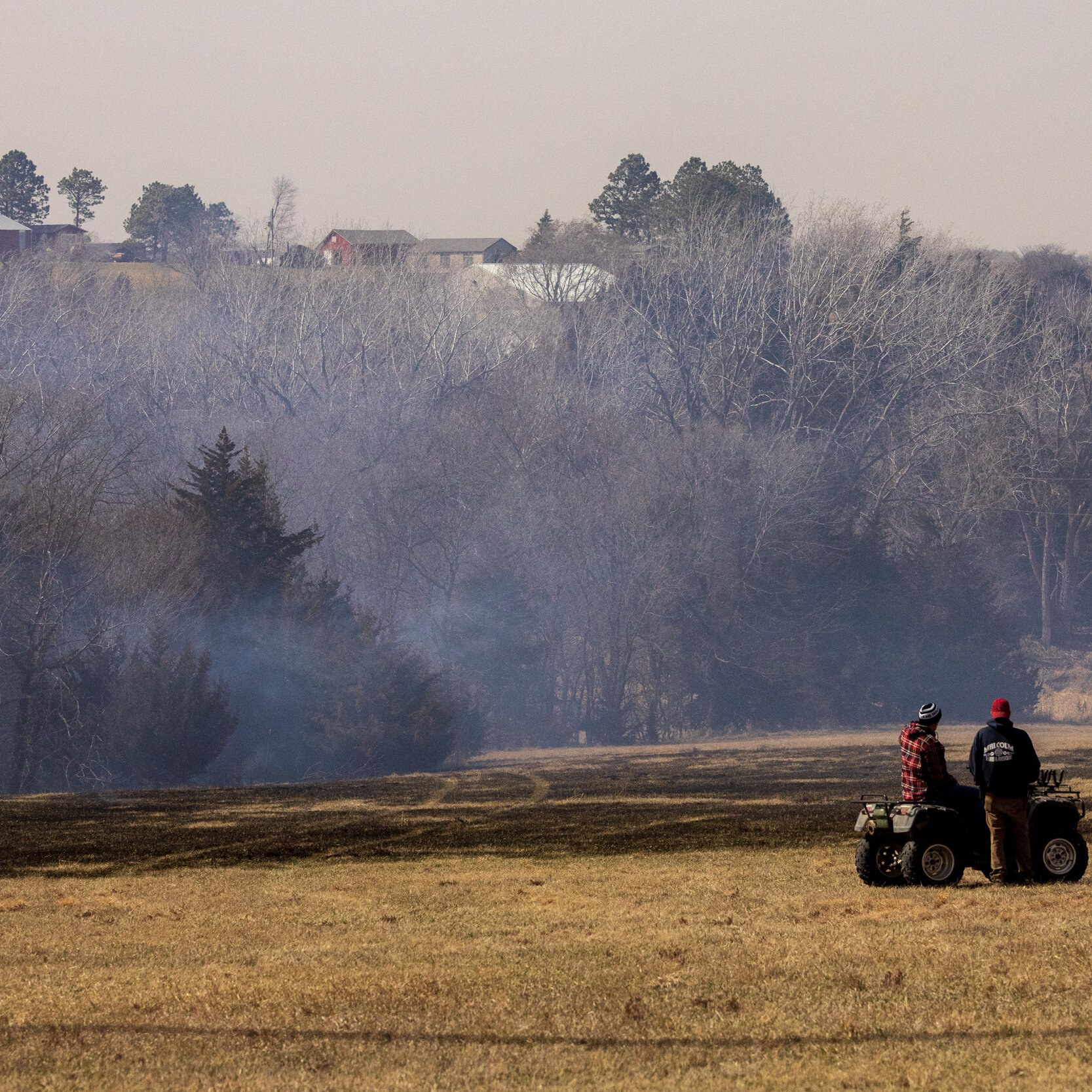
Nebraska’s Largest-Ever Wildfire Tops 800,000 Acres, 16% Contained
- The Morrill fire has blackened nearly 800,000 acres, making it the biggest wildfire recorded in Nebraska history.
- Firefighters have only 16% containment as dry grass and 40-mph wind gusts push flames across the north-central plains.
- An 86-year-old woman perished, Governor Jim Pillen confirmed, marking the fire’s first fatality.
- Ranchers in Morrill and Banner counties face extensive fence, livestock, and forage losses that could exceed $20 million.
Nebraska officials warn that the state has never seen a blaze this large so early in the year.
NEBRASKA WILDFIRE—The Morrill fire, sparked amid above-normal temperatures and drought-stressed rangeland, has already chewed through an area larger than Rhode Island. With containment lines holding on just 16 percent of the perimeter, the blaze is redefining what fire crews thought possible on the Great Plains.
“We’ve gone from snow on the ground to a fire siege in under a week,” said Nebraska Emergency Management Agency assistant director Melissa Strahl. “It’s a pace of spread we normally associate with California chaparral, not Nebraska grassland.”
State climatologists note that the region has recorded less than 30 percent of its average winter moisture, turning fine fuels into tinder. The result is a fire that doubled in size overnight and now threatens critical infrastructure along U.S. Highway 385.
From Spark to Megafire: How 800,000 Acres Burned in 72 Hours
Fire investigators traced the Morrill fire to a downed power line south of the tiny town of Hawk Springs shortly after dawn Monday. Within three hours, 30-mph winds had pushed the initial 20-acre ignition across U.S. Route 26, torching 5,000 acres of winter wheat and native bluestem before crews could establish an anchor point.
By Tuesday morning, infrared flights mapped the burn scar at 312,000 acres. That afternoon, a dry cold front shoved the wall of flames another 18 miles east, adding 400,000 acres in less than 10 hours—an expansion rate of roughly 1,100 acres per minute, according to the National Interagency Coordination Center.
Record fuels, record speed
University of Nebraska rangeland ecologist Dr. Dirac Twidwell says the combination of freeze-dried grasses and 60-year-high wind speeds created a “perfect conveyor belt” for combustion. “In the Sandhills, we usually see firelines advance at 0.5 to 1 mph,” Twidwell explained. “On Tuesday, we clocked runs of 6.2 mph—equivalent to a slow jog.”
Those rates explain how the fire jumped three graded fuel breaks and a 200-foot-wide wheat stubble field that incident commanders hoped would halt the spread. Instead, ember showers ignited spot fires up to two miles ahead of the main front, fusing separate burn perimeters into the current 800,000-acre monster.
The governor’s emergency proclamation, issued late Tuesday, unlocks National Guard helicopters and authorizes out-of-state mutual aid. Officials project that without a change in weather, the blaze could exceed one million acres before the weekend, eclipsing last year’s national record for a single fire.
Why Containment Is Stuck at 16% Despite 1,100 Firefighters
Incident commander Jay Bienhoff oversees 1,100 personnel, 22 engines, six bulldozers, and three Very Large Air Tankers. Even so, containment has crept up just four percentage points since Tuesday morning. The bottleneck is not manpower but geography and weather.
Nebraska’s sand-sheet topography is laced with steep, eroded escarpments that anchor only a handful of ranch roads. Without natural barriers, crews must build 60-mile hand lines through loose dune soil that collapses underfoot. “You cut a 10-foot line, and within an hour wind-blown sand fills it back in,” said Bienhoff.
Erratic Great Plains winds complicate control
Unlike mountain fires that follow predictable upslope drafts, High Plains weather is shaped by fast-moving jet streams. The National Weather Service recorded 12 wind-direction shifts exceeding 40 degrees in a 24-hour window, repeatedly flanking crews and torching their holding lines.
Dr. Erica Fleishman, director of the Nebraska State Climate Office, notes that March humidity levels currently sit at 18 percent—half the seasonal average. “Those conditions convert every clump of grass into ready fuel,” she said. “A single ember can sustain combustion for 45 seconds, long enough to travel half a mile.”
Air support is also hampered. Because the blaze sits below 3,000-foot elevation, tankers must climb back to 8,500 feet to clear the Rockies, reducing drop cycles to just two per hour. Until a predicted cold front stalls the wind field on Friday, officials expect containment to climb only one to two points daily.
Fatality, Evacuations, and the Rural Vulnerability Gap
The Morrill fire claimed its first victim, 86-year-old ranch widow Evelyn Hecht, who lived alone on a gravel road six miles south of Bridgeport. According to the Morrill County sheriff, she phoned 911 at 3:12 p.m. Tuesday to report flames visible from her porch; by the time responders navigated smoke-clogged roads 28 minutes later, her mobile home was fully involved.
Hecht’s death underscores a fatal gap in rural fire coverage. The Bridgeport Volunteer Fire Department, staffed by 18 unpaid members, needs 14 minutes just to assemble a crew. Mutual-aid pacts bring trucks from 42 miles away—too late for residents with limited mobility.
Evacuations strain sparse infrastructure
Officials issued mandatory evacuation orders for 312 households across Morrill and Banner counties, yet fewer than 60 homes sit within incorporated towns. Most residents live on 80-acre farmsteads reachable only by section-line roads without signage. County 911 systems therefore rely on GPS coordinates many residents struggle to provide under stress.
American Red Cross spokeswoman Emily Hanes says the temporary shelter in Gering holds just 42 cots for a population scattered over 2,400 square miles. “Our biggest challenge is distance,” Hanes noted. “Some ranchers drove 70 miles just to register their kids at the evacuation center.”
Governor Pillen has requested a FEMA Fire Management Assistance Grant that would unlock 75 percent federal cost-share for field camps, aircraft, and overtime. If approved, the declaration would mark Nebraska’s fourth federal fire grant this decade—double the number granted in the prior 40 years combined.
What an 800,000-Acre Blaze Means for Nebraska’s Cattle and Crops
Ranchers graze roughly 130,000 head of cattle across Morrill and Banner counties. Initial livestock tallies compiled by the Nebraska Brand Committee show at least 1,900 cows missing and 300 confirmed dead; another 6,000 animals are being moved to emergency pasture north of Scottsbluff.
Lost forage is harder to quantify but potentially more costly. UNL extension forage specialist Dr. Megan Taylor estimates that 480,000 acres of rangeland burned at moderate to high severity, eliminating spring grazing worth $18–$22 per acre. That pencils out to $9.6 million in forage losses alone, before fencing, haystacks, or water infrastructure are tallied.
Replacing 1,200 miles of fence could top $20 million
Region 23 of the Nebraska Grazing Lands Coalition reports that 90 percent of perimeter fences in the burn scar are wooden posts with four-wire barbed steel. Post-fire soil instability means crews must auger new holes up to 24 inches deeper, driving installed cost to $18,600 per mile. With 1,200 miles of fence damaged or destroyed, ranchers face a $22.3 million rebuild.
The Nebraska Department of Agriculture opened an emergency hay clearinghouse, yet supplies are limited because last summer’s drought cut regional hay production by 28 percent. Feedlots as far east as Grand Island have offered pen space, but hauling cattle 300 miles adds $110 per head in freight—another $14 million hit to a sector already coping with falling calf prices.
USDA Farm Service Agency state director John Berge expects sign-ups for the federal Livestock Forage Disaster Program to exceed 700 applications, double the state total for 2023. Payments, however, won’t arrive until fall, leaving producers to bridge cash flow with operating loans at 8.5 percent interest.
Could Climate and Land-Use Trends Make Megafire Spring the New Normal?
Nebraska has seen a five-fold increase in average annual burned area since 2010, climbing from 15,000 acres to 78,000 acres, according to the National Interagency Fire Center. Climate scientists attribute much of the uptick to two converging trends: warming spring temperatures and the conversion of diverse prairie to continuous brome grass for cattle.
Dr. Crystal Stiles of the High Plains Regional Climate Center says average March temperatures across the Nebraska Panhandle have risen 2.7 °F since 1970, effectively extending the fire season by 18 days. “When you combine earlier green-up with stronger spring winds, you create a longer window for large fire growth,” she said.
Homogenized grasslands amplify fire spread
Over 85 percent of native tall-grass prairie in the eastern Panhandle has been replaced by smooth brome, an invasive species that dries out faster and burns more uniformly than native bunch grasses. A 2023 U.S. Forest Service study found that continuous brome carries fire at 2.3 times the rate of mixed-grass prairie, explaining how flame lengths on Tuesday topped 60 feet—double the norm for Plains grassfires.
Housing patterns also amplify risk. Rural lot splits have doubled since 1990, placing more homes in the wildland-urban interface. Unlike forested zones where fuel breaks can be thinned, Nebraska’s grass fires move so quickly that traditional defensible-space rules—30-foot clearance—offer little protection.
State forester John Erixson says Nebraska is drafting a 50-year fuels management plan that would reintroduce patch-burn grazing on 1.2 million acres of private rangeland. Ranchers, however, worry that prescribed fire liability and up-front fencing costs make adoption unlikely without federal cost-share incentives.
Frequently Asked Questions
Q: How big is the Morrill fire compared with past Nebraska wildfires?
At nearly 800,000 acres, the Morrill fire is already the largest recorded in state history—surpassing the 2012 High Park fire that burned roughly 83,000 acres. Fire officials say the scale is unprecedented for the region.
Q: What percentage of the Morrill fire is contained?
As of Wednesday, crews have achieved 16 percent containment. Officials caution that gusty winds and dry fuels could expand the blaze further before significant containment is reached.
Q: Have there been any casualties?
Yes. Governor Jim Pillen confirmed that an 86-year-old woman died in the fire. No additional fatalities have been reported, but several rural structures and ranch outbuildings have been lost.
Q: Which areas are under evacuation orders?
Evacuations are active in Morrill County and parts of Banner County north of Scottsbluff. Residents in low-lying canyons have been advised to leave immediately because rapid fire runs can block exit routes within minutes.
