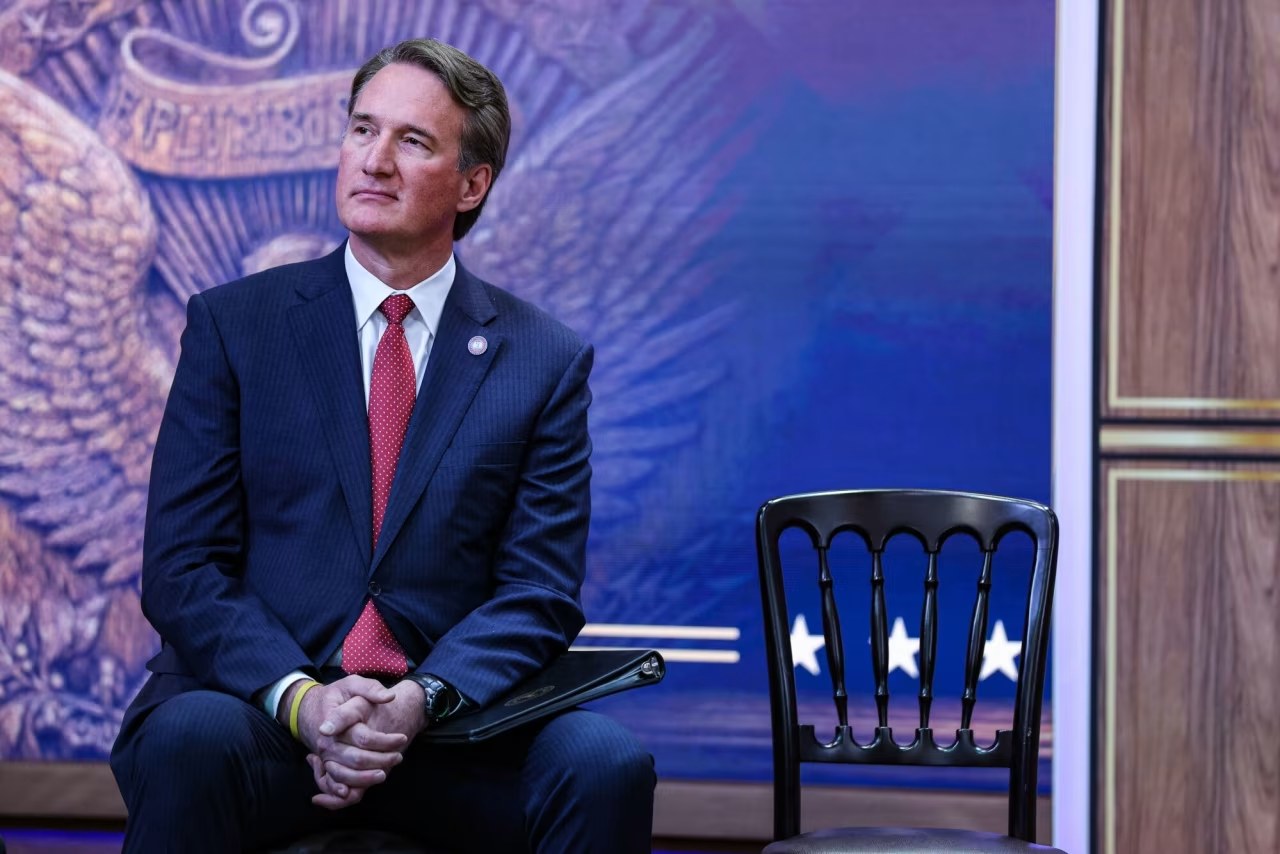
42,000 Early Ballots Cast as Virginia GOP Asks Where Is Glenn Youngkin?
- Virginia Democrats want voters to approve a map that turns the current 6-5 House split into a 10-1 Democratic advantage.
- Republican legislators say former Governor Glenn Youngkin’s popularity with independents could tip the April 21 ballot.
- Youngkin has held zero public events on the measure and declined two party requests to record robocalls, insiders say.
- Early-vote totals released Monday show 42,000 ballots returned, an 18 % jump over the same period in 2022.
Control of the U.S. House may ride on whether Virginia’s most famous Republican decides to engage.
VIRGINIA REDISTRICTING—RICHMOND—When Virginia Democrats launched a $2.3 million ad blitz last week urging voters to “end gerrymandering for good,” Republican legislators scrambled for a counter-messenger who could break through in the state’s expensive media markets. Their first call, according to three party officials, went to Glenn Youngkin—the private-equity magnate who stunned the political world in 2021 by capturing the governorship in a state Joe Biden won by ten points.
Youngkin never responded. With early voting already under way and the April 21 deadline looming, the GOP’s most bankable surrogate has remained silent, leaving local candidates to fend for themselves against a ballot measure that could erase five of the state’s six Republican House districts.
“We are ceding the airwaves at the worst possible moment,” said Delegate Tim Anderson, who represents a swing district in Virginia Beach. “Glenn won 57 % of independents in 2021; if even half that cohort shows up, we win. Instead we’re whispering into the void.”
How the 2021 Youngkin Coalition Became the GOP’s Missing Weapon
Glenn Youngkin’s 2021 victory was built on a coalition that terrifies Democrats: he carried independents by 16 points, improved on Donald Trump’s 2020 margins in every major suburb, and still turned out the party base. Exit polls showed 22 % of Black men and 39 % of Latino voters broke for the Republican, the highest GOP share in Virginia since 2004.
That performance flipped seven State-Delegate seats and delivered the House of Delegates to Republicans. Party strategists believed the same formula—school-board activism plus economic populism—could repel a redistricting amendment that wipes out their congressional foothold.
Youngkin’s 2021 margins by congressional district
Internal analytics shared with the Wall Street Journal show Youngkin carried eight of Virginia’s eleven current districts, including the Democratic-held 2nd, 7th and 10th. In the 2nd—Rep. Elaine Luria’s old seat—he beat Terry McAuliffe by 4.1 points while the Biden-Harris ticket had won it by 2.2 points a year earlier, a 6.3-point rightward swing.
“Those numbers are why our polling shows the amendment underwater when voters learn the details,” said Garren Shipley, communications director for the House GOP caucus. “But learning requires messengers, and Glenn is the only Republican with positive favorables across every region.”
Instead, Youngkin has spent the last month headlining private equity conferences in Palm Beach and raising $1.8 million for his political action committee, which has not reserved a single dollar for the redistricting fight. His only public statement came through a spokesperson who said the governor “trusts voters to study the issue carefully.”
University of Mary Washington political scientist Stephen Farnsworth calls the absence inexplicable. “He has the highest net approval of any Virginia Republican since Senator John Warner—plus-$14 in our March survey. Leaving that capital idle while Democrats spend $3 million is like sitting on a winning lottery ticket.”
Privately, Youngkin advisers say he fears alienating suburban moderates who supported him in 2021 but oppose GOP culture-war rhetoric in 2024. Yet the amendment itself is framed as an anti-gerrymandering measure, language that tests above 70 % approval in Fairfax and Loudoun counties, according to Democratic firm BlueLabs.
By staying out, Youngkin risks the worst of both worlds: a ballot defeat that demoralizes the state party and a national narrative that he blinked in his first post-2021 test.
What the Ballot Measure Actually Changes—and Why It Matters Nationally
The amendment is deceptively simple: it scraps the current map drawn by a bipartisan court-appointed master and replaces it with lines produced by a Democratic-controlled redistricting commission. The new boundaries add four districts that voted for Biden by double digits, turning a 6-5 Democratic edge into a 10-1 advantage.
Because Virginia elects its congressional delegation in odd-numbered years, the new map would take effect immediately for November’s mid-terms, potentially locking in the partisan tilt for a decade. With the U.S. House divided by only five seats, Democrats could secure the majority simply by winning the Virginia referendum.
Redistricting math: four seats at risk for GOP
Under the proposed lines, Republican incumbents Jen Kiggans (VA-02), Dave Brat (VA-07), Ben Cline (VA-06) and Morgan Griffith (VA-09) would see their districts shift left by an average of 7.4 points, according to the non-partisan Virginia Public Access Project. Only the 9th district in coal-country southwest would stay competitive for the GOP.
Democratic donors have poured $9.4 million into the campaign, led by $2 million from Reid Hoffman’s dark-money group and $1.3 million from the National Education Association. Their television ads feature Republican voters who claim the amendment “ends politician-drawn districts”—a message that tests at 68 % approval among independents in internal GOP polling.
Republicans counter that the amendment is a partisan power grab, but their cash-strapped committee has raised only $1.1 million, forcing them to rely on free media and grassroots door-knocks. Youngkin’s absence deprives them of the $50 million donor network he amassed for his 2021 race.
“We are being out-spent eight-to-one in the Norfolk and Richmond markets,” said GOP state chair Rich Anderson. “Glenn could cut a single check from his leadership PAC and erase the gap, but so far crickets.”
National implications are stark: if Democrats flip three of Virginia’s four competitive seats, they could reach the 218-seat threshold even while losing seats in Georgia or Arizona, according to David Wasserman of the Cook Political Report.
House Speaker Mike Johnson has privately urged Youngkin to engage, calling the referendum “the easiest pickup opportunity we have,” according to a leadership aide. Yet Youngkin has not committed to campaign appearances before April 21.
Inside the Youngkin Team’s Risk Calculation—and the Price of Silence
People close to Youngkin describe a governor caught between competing time horizons. In the short term, he wants to preserve moderate credentials for a potential 2024 U.S. Senate run against Democrat Tim Kaine. Long-term, allies say he eyes a 2028 presidential bid and fears alienating suburban voters who recoiled from Trump-style rhetoric.
The redistricting amendment sits at the nexus of that dilemma. While opposition could energize the GOP base, it also forces Youngkin to defend a map that independents view as incumbent protection. One adviser summarized the thinking: “Why spend political capital on a procedural fight when you can wait for a high-profile policy battle?”
Fund-raising momentum slows without marquee race
Youngkin’s Commonwealth Leaders Fund raised $1.8 million in the first quarter, down from $3.4 million during the same period in 2022 when he actively campaigned for legislative candidates. Donors tell staff they want to see a defined mission before writing more checks.
Meanwhile, Democratic groups have saturated the airwaves with ads featuring teachers and nurses who claim the amendment stops “politicians from picking their voters.” The message has moved the needle: a Christopher Newport University poll released last week shows support at 54 %, up from 47 % in February.
Republican operatives fear the window is closing. “Once early vote hits 100,000 ballots, persuasion becomes nearly impossible,” said Tucker Martin, a veteran Virginia GOP strategist. “We’re at 42,000 and adding 5,000 a day. Glenn has maybe ten days to act.”
Youngkin’s team contends he can still be effective through digital micro-targeted appeals, but they have not booked production time or purchased ad slots, according to three Richmond media buyers.
The silence has not gone unnoticed in Washington. “Every House Republican in a marginal district is watching Virginia,” said a senior National Republican Congressional Committee aide. “If we lose four seats because our most popular figure took a pass, good luck recruiting candidates in 2026.”
Could a Late Blitz Still Swing the Outcome?
History says yes. In 2020, a similar Virginia referendum on redistricting trailed by 12 points three weeks before the vote but passed 54-46 after a last-minute advertising surge. Republicans believe Youngkin could create the same inflection point by targeting the 18 % of voters who remain undecided in public polling.
Their internal modeling shows the electorate will be roughly 38 % Democratic, 34 % Republican and 28 % independent—mirroring the 2021 gubernatorial composition. If Youngkin can move independents against the amendment by 10 points, the measure would fail by 1.3 %, according to GOP analytics firm HIT Strategies.
What a last-minute campaign would look like
Ad buyers say $1.2 million would purchase 1,100 gross-rating points in the expensive Washington, D.C., market—enough to reach the average voter 11 times during the final ten days. Youngkin’s PAC currently holds $4.6 million cash-on-hand, more than double the entire opposition campaign.
Youngkin advisers have floated a softer approach: a 60-second digital spot filmed in a classroom that frames the amendment as “taking power away from parents and giving it to political appointees.” The script never mentions partisan seat counts, focusing instead on transparency.
Democrats are preparing counter-messages. Governor Ralph Northam has already cut a radio ad accusing Republicans of “trying to confuse voters at the last minute.” The Democratic National Committee has reserved $800,000 for final-week response ads.
Whether Youngkin pulls the trigger may hinge on this weekend’s absentee numbers. If early vote totals surpass 65,000 by Friday, advisers say the likelihood of intervention drops sharply; below that threshold, expect a flurry of activity next week.
“The irony,” said Quentin Kidd, a political scientist at Christopher Newport University, “is that Glenn Youngkin built his brand on data-driven business solutions. Right now the data says he could move 4 % of the electorate—enough to win. The only question is whether he still believes in the math.”
Frequently Asked Questions
Q: Why is Glenn Youngkin important in Virginia’s redistricting fight?
Youngkin is the only Republican to win statewide since 2009. Party strategists believe his 2021 coalition of independents and suburban voters could sway the April ballot measure that may create a 10-1 Democratic House map.
Q: What exactly are Virginia Democrats proposing?
A constitutional amendment on the ballot would scrap the current 6-5 congressional map and replace it with lines that add four Democratic-leaning districts, producing a 10-1 advantage, according to GOP analysts.
Q: When does early voting end and how many ballots have been cast?
Early voting began Friday and closes April 21. The Virginia Department of Elections reports 42,000 in-person and mail ballots returned in the first three days, exceeding the 2022 pace by 18 percent.
📰 Related Articles
- Schumer’s Funding Standoff Fuels TSA Staffing Crisis, Leaving Travelers in Limbo
- Juliana Stratton’s Primary Triumph Shields Pritzker From Embarrassment
- WSJ’s Paletta Fields Reader Queries on Trump’s Iran Confrontation
- Darren Bailey Clinches GOP Nod, Faces Steeper Climb Against Pritzker in 2026 Illinois Rematch
